TEL:+86 132 6656 7067





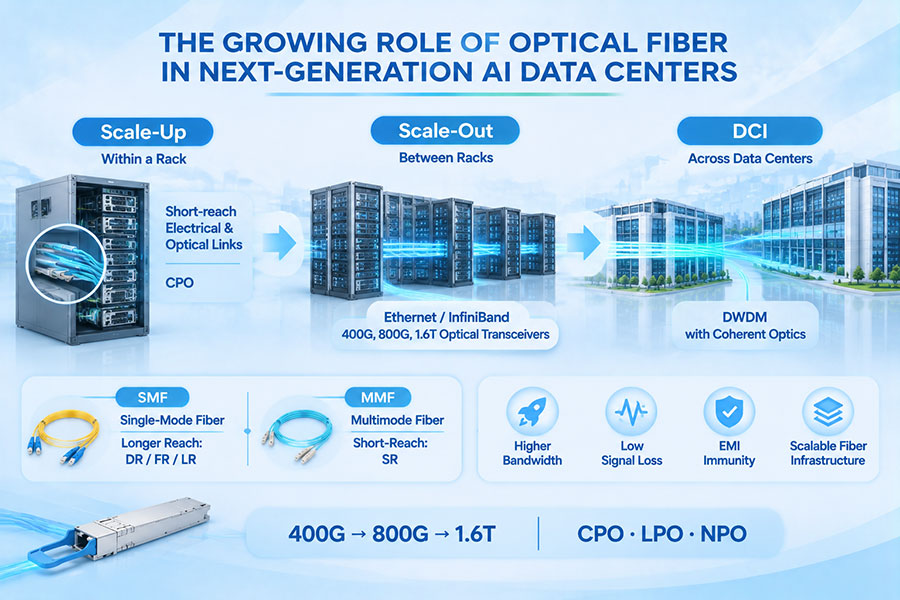
The physical location of optical engines is becoming a major architectural consideration in next-generation computing and data center networks. As processors and switching ASICs handle increasingly large volumes of data, conventional electrical connections between chips and front-panel optical transceivers face growing limitations in signal integrity, power consumption, and bandwidth density.
This is driving an industry transition toward optical engines positioned closer to computing processors. Rather than treating optical transceivers as independent components installed at the edge of a network device, system designers are exploring architectures that integrate optical functions near GPUs, CPUs, accelerators, and high-performance switching silicon.
The transition includes several approaches, from linear pluggable optics and near-packaged optics to co-packaged optics. Each approach represents a different level of integration and creates new requirements for silicon photonics, semiconductor packaging, fiber connectivity, thermal management, and manufacturing.
For AI infrastructure, the objective is to move data between computing resources with higher bandwidth and lower energy consumption. The long-term development of optical interconnects will therefore depend not only on faster transceivers but also on where electrical-to-optical conversion takes place within the complete system.
1. Why Optical Engines Are Moving Closer to Computing Processors
Traditional data center architectures place optical transceivers in front-panel cages on switches and servers. Electrical signals travel from the processor or switch ASIC through package connections, PCB traces, connectors, and module interfaces before reaching the optical conversion circuitry.
This approach has supported several generations of Ethernet and InfiniBand connectivity. It also provides important practical advantages, including replaceable modules, established mechanical interfaces, and flexible fiber deployment.
However, the electrical path becomes more challenging as signaling rates increase. Higher-frequency signals experience greater channel loss and become more sensitive to reflections, crosstalk, and other transmission impairments. Maintaining signal quality may require additional equalization, retiming, and signal-conditioning circuits.
These requirements can increase power consumption and limit the practical distance between computing silicon and optical conversion components.
Moving optical engines closer to processors changes this arrangement. Electrical signals can be converted into optical signals over shorter distances, reducing some of the electrical channel limitations associated with conventional front-panel architectures.
2. The Evolution From Pluggable Optics to Integrated Optical Engines
The movement of optical engines toward computing processors is not a single technology transition. It is a gradual progression involving several architectures with different levels of integration.
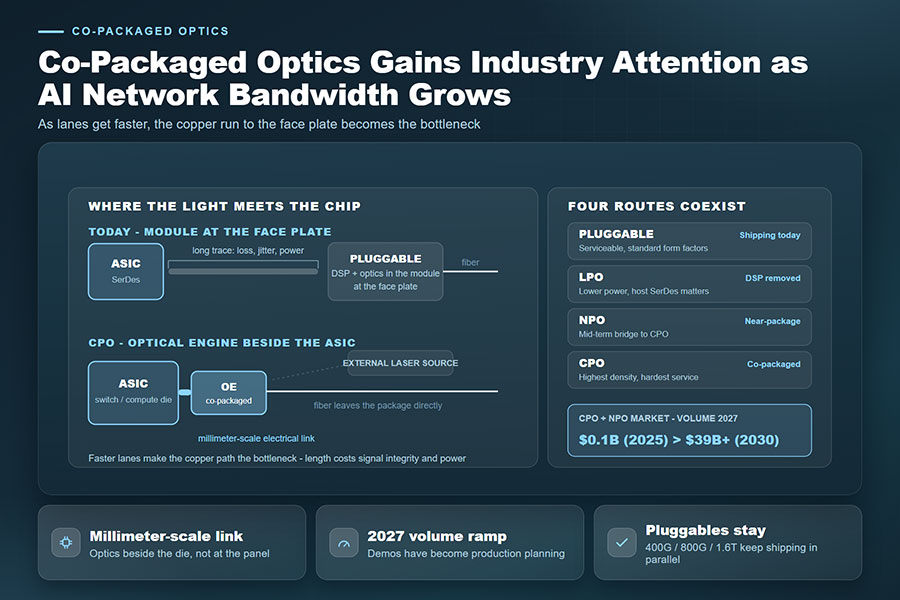
Traditional pluggable optics separate the optical module from the main processing package. LPO modifies the electrical and signal-processing architecture within the pluggable module. NPO moves optical engines closer to the ASIC while retaining some physical separation, whereas CPO integrates optical engines more tightly within the ASIC package.
| Architecture | Optical Engine Location | Integration Level | Main Design Objective |
|---|---|---|---|
| Pluggable Optics | Front-panel optical module | Separate module | Flexible installation and replacement |
| LPO | Front-panel optical module | Conventional pluggable form factor with a simplified signal-processing path | Reduce module power and processing complexity |
| NPO | Near the switch ASIC, generally within the switch platform | Closely positioned but physically separate optical engine | Shorten electrical paths while retaining modularity |
| CPO | Within a closely integrated ASIC package architecture | Highly integrated package | Maximize bandwidth density and reduce electrical interconnect distance |
| Optical I/O Integration | Within or directly connected to computing packages | Processor-level optical integration | Support future high-bandwidth chip-to-chip communication |
These architectures are not necessarily successive replacements. They can coexist in different network layers and computing platforms because each addresses a different balance of power, bandwidth, distance, cost, and serviceability.
3. Electrical Interconnect Limitations Accelerate Optical Integration
Electrical interconnects remain highly effective for short-distance communication between processors, memory, and other components. However, their practical limitations become more significant as lane speeds and aggregate bandwidth increase.
High-speed electrical channels must maintain sufficient signal quality across the complete transmission path. PCB materials, connector transitions, package routing, trace length, and channel topology all influence signal performance.
At higher data rates, system designers may need additional signal-conditioning components to compensate for channel impairments. These components consume power and occupy valuable board and package space.
| Electrical Interconnect Challenge | System Impact | Potential Optical Integration Benefit |
|---|---|---|
| Channel insertion loss | Reduces available signal margin | Shorter electrical paths before optical conversion |
| Signal equalization | Increases processing complexity and power | Can reduce some electrical compensation requirements |
| PCB routing limitations | Restricts high-speed connectivity and layout flexibility | Moves part of the data path into optical fiber |
| High port density | Creates pressure on connectors and board space | Supports denser optical I/O arrangements |
| Electrical reach | Limits practical connection distance at high speeds | Optical transmission supports longer connections with suitable components |
Optical communication does not eliminate every electrical connection. Processors still require electrical interfaces to communicate with nearby electronic and photonic components. The architectural change is that optical conversion takes place closer to the data source, allowing fiber to carry data over distances where high-speed electrical transmission becomes less efficient.
4. NPO Provides a Practical Intermediate Architecture
Near-Packaged Optics is attracting attention because it combines shorter electrical paths with a degree of physical separation between the optical engine and the main ASIC package.
In an NPO architecture, optical engines are positioned close to the switch ASIC, typically within the same switch platform or on a nearby board-level structure. This reduces the electrical distance compared with conventional front-panel optical modules.
Unlike tightly integrated CPO designs, NPO can retain a more modular optical engine arrangement. Depending on the implementation, socketed or otherwise separately assembled optical engines may provide improved serviceability and manufacturing flexibility.
The main advantages of NPO include:
Shorter electrical channels: Optical engines are placed closer to the switching silicon.
Lower electrical interface power: Reduced channel loss may decrease the need for extensive signal compensation.
Higher connectivity density: Optical engines can be arranged around high-bandwidth switching devices.
Modular integration: Some designs preserve replaceable optical engine assemblies.
Supply-chain flexibility: Standardized interfaces may allow multiple suppliers to participate in the ecosystem.
However, NPO is not a universal architecture. Its implementation depends on mechanical interfaces, optical coupling, thermal design, electrical routing, and the service model of the target platform.
TrendForce identified NPO as an important near- to medium-term development direction for some cloud service providers, while CPO is positioned for applications requiring more tightly integrated optical connectivity.
5. CPO Brings Optical Engines Into the Processor Package
Co-Packaged Optics takes integration further by placing optical engines within a closely integrated package architecture alongside a switch ASIC or other high-performance computing silicon.
In conventional pluggable systems, electrical signals travel from the ASIC to the front-panel module. In CPO systems, optical engines are positioned much closer to the switching silicon, significantly reducing the electrical distance before optical conversion.
This approach can provide several benefits:
Reduced electrical channel length.
Higher optical I/O density around the ASIC.
Potentially lower energy consumption per transmitted bit.
Improved support for high-bandwidth switching architectures.
More flexible optical connectivity within advanced package designs.
However, CPO also creates more demanding system-level requirements. The ASIC, optical engines, laser sources, fiber connections, package substrate, and cooling architecture must be designed together.
Repairability is another important consideration. A failed front-panel transceiver can generally be replaced independently, whereas a failed integrated optical engine may require more complex platform-level servicing.
CPO is therefore most attractive when the benefits of higher integration justify the additional packaging, manufacturing, and maintenance complexity.
6. Optical Engines Are Expanding Beyond Network Switches
The industry transition is not limited to Ethernet and InfiniBand switches. As AI computing systems become more interconnected, optical engines are also being investigated for direct communication between processors, accelerators, and other computing components.
Traditional computing systems rely heavily on electrical interfaces for communication between CPUs, GPUs, memory, and accelerator devices. These connections are effective over short distances, but the growing scale of AI systems is increasing the demand for high-bandwidth communication across multiple packages and boards.
Optical I/O provides a potential way to extend high-speed communication beyond the physical limits of conventional electrical links.
| Computing Application | Connectivity Requirement | Potential Role of Optical Engines |
|---|---|---|
| GPU Clusters | High-bandwidth communication between accelerators | Optical links for selected high-capacity interconnect paths |
| AI Accelerators | Fast data exchange between processing devices | Optical I/O for future package-to-package communication |
| CPU and Accelerator Systems | High-throughput communication between compute domains | Short-reach optical interconnects where electrical channels become restrictive |
| Memory Expansion | Increasing bandwidth between processors and memory resources | Potential optical connectivity for future disaggregated architectures |
| AI Switching Fabrics | High-radix, high-capacity network connections | NPO and CPO optical engines close to switching ASICs |
Processor-level optical integration remains an evolving area. Optical engines connected to a switch ASIC should not automatically be treated as equivalent to optical I/O integrated directly with a GPU or CPU package. These applications have different electrical interfaces, packaging constraints, and software requirements.
7. Silicon Photonics Enables Compact Optical Engine Designs
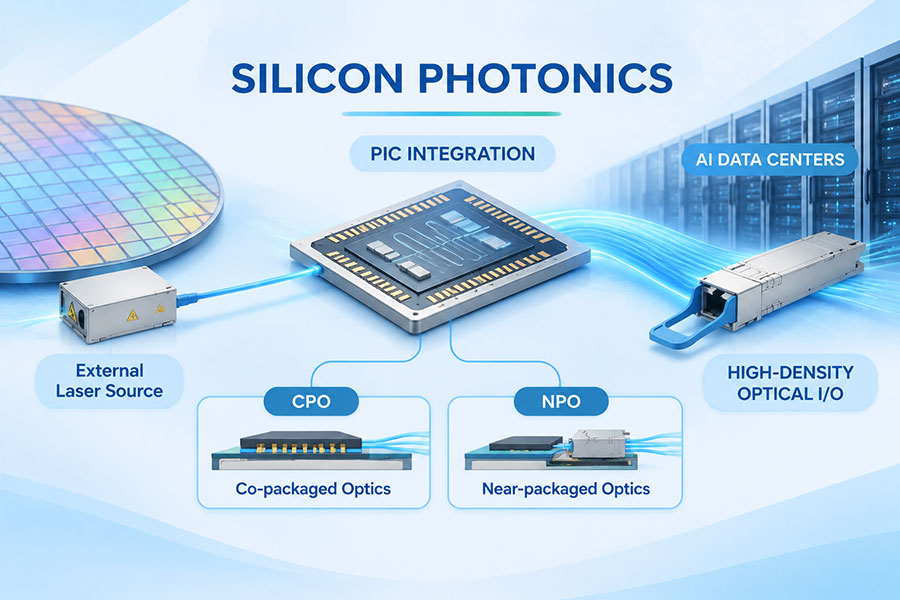
Silicon photonics is an important technology for moving optical functionality closer to computing processors. It allows optical components to be fabricated and integrated on photonic chips using semiconductor manufacturing processes.
A photonic integrated circuit can contain multiple optical functions, including waveguides, modulators, photodetectors, and wavelength-management components. Integrating these functions helps reduce the size of optical engines and supports higher channel density.
Important components include:
Photonic Integrated Circuit (PIC): Performs optical signal routing, modulation, and detection.
Electronic Integrated Circuit (EIC): Provides electrical driver and receiver functions for the optical interface.
Optical Modulator: Converts electrical data into optical signal variations.
Photodetector: Converts incoming optical signals into electrical signals.
Laser Source: Provides the optical carrier required for transmission.
Optical Coupler: Connects the photonic circuit to external fiber interfaces.
Silicon itself is not an efficient light source at common optical communication wavelengths, so silicon photonics platforms generally require laser integration using other materials or external light sources.
The combination of PICs, EICs, and suitable laser architectures allows optical engines to become more compact and better suited to advanced packaging.
8. Advanced Packaging Connects Computing and Photonic Components
Moving optical engines closer to processors requires more sophisticated packaging technologies. Electronic chips and photonic components may use different materials, fabrication processes, and operating conditions. Their integration must preserve electrical performance while maintaining optical alignment and mechanical reliability.
Advanced packaging provides the physical and electrical structures needed to connect these components.
| Packaging Technology | Integration Function | Key Considerations |
|---|---|---|
| 2.5D Packaging | Connects multiple dies through an interposer or advanced substrate | Routing density, power delivery, and thermal behavior |
| Chiplet Integration | Combines specialized processing and photonic dies | Die-to-die interfaces and component compatibility |
| Hybrid Integration | Combines different semiconductor materials and optical devices | Material compatibility and manufacturing yield |
| Silicon Photonics Packaging | Integrates photonic circuits with electronic components | Optical coupling, alignment, and packaging reliability |
| Optics-on-Interposer | Places optical engines on an interposer carrying computing chips | Fine-pitch electrical routing and photonic integration |
At SEMICON West 2026, NVIDIA presented research-stage Optics-on-Interposer technology. The concept places optical engines directly on the interposer carrying computing chips rather than on the conventional organic package substrate. This approach aims to shorten electrical connections further, but the demonstrated technology remains under development rather than representing a universal production architecture.
Such research illustrates how optical integration may continue moving closer to computing silicon as packaging capabilities advance.
9. External Laser Sources and Fiber Connectivity Become More Important
When optical engines move closer to high-power processors, laser placement becomes an important part of the system architecture. Lasers require stable operating conditions, and the thermal environment around a high-performance ASIC can create additional design challenges.
Some CPO and NPO architectures therefore use external laser sources. In these systems, laser light is delivered to the optical engines through dedicated optical connections.
External laser architectures can separate the light source from the hottest parts of the computing package and may simplify certain maintenance and redundancy arrangements.
However, they introduce additional requirements:
Optical power distribution to multiple engines.
Low-loss optical coupling and fiber routing.
Stable laser output and wavelength control.
Connector reliability and fiber management.
Laser monitoring and failure isolation.
Suitable redundancy and maintenance procedures.
Fiber connectivity is also changing. High-density fiber arrays, specialized optical connectors, and removable optical interfaces are important for connecting compact optical engines to external network infrastructure.
As integration increases, optical coupling and connector design become part of the semiconductor packaging challenge rather than simply downstream cabling decisions.
10. Thermal Management and Reliability Shape Integration Choices
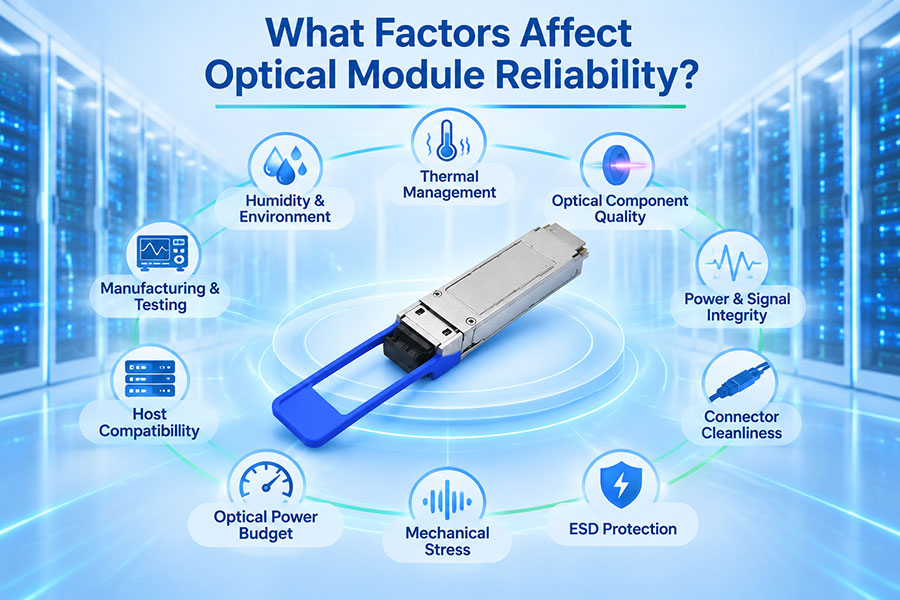
Optical engines positioned close to computing processors operate within a thermal environment influenced by high-power ASICs, memory devices, and other electronic components. Temperature variations can affect laser behavior, optical wavelength characteristics, and the long-term reliability of photonic devices.
Thermal management must therefore be considered during the early stages of package and system design.
Key considerations include:
ASIC heat dissipation: High-performance processors require effective cooling within compact package structures.
Optical component temperature: Photonic devices may have different thermal operating requirements from electronic chips.
Thermal gradients: Uneven heating can influence optical alignment and wavelength stability.
Package reliability: Thermal expansion differences can create mechanical stress.
Cooling architecture: Air cooling and liquid cooling must be evaluated against the complete package design.
Serviceability: Cooling and optical connections must remain accessible under the selected maintenance model.
Reliability also depends on the ability to isolate failures. A modular NPO design may allow an optical engine to be replaced independently, depending on its socket and system implementation. A tightly integrated CPO package can require more extensive repair or replacement procedures.
These differences are important when evaluating total system cost, availability, and long-term maintenance.
11. Higher Data Rates Accelerate the Move Toward Optical I/O
The transition toward optical engines closer to computing processors is closely related to the development of higher-speed electrical and optical interfaces.
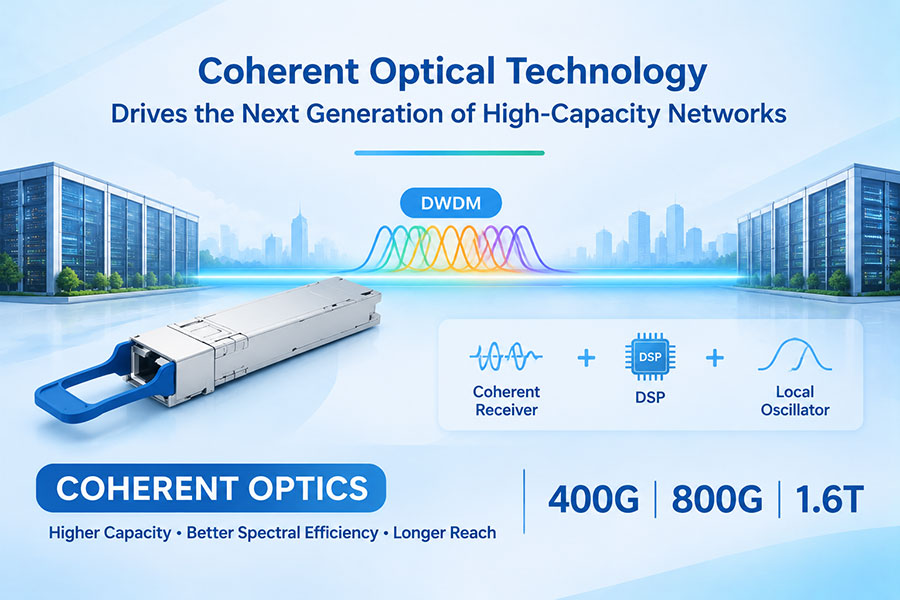
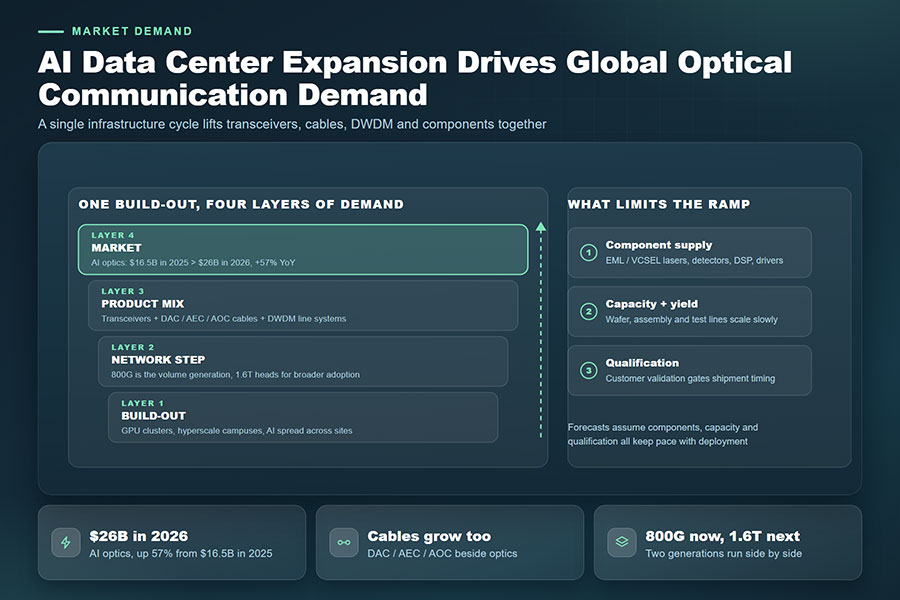
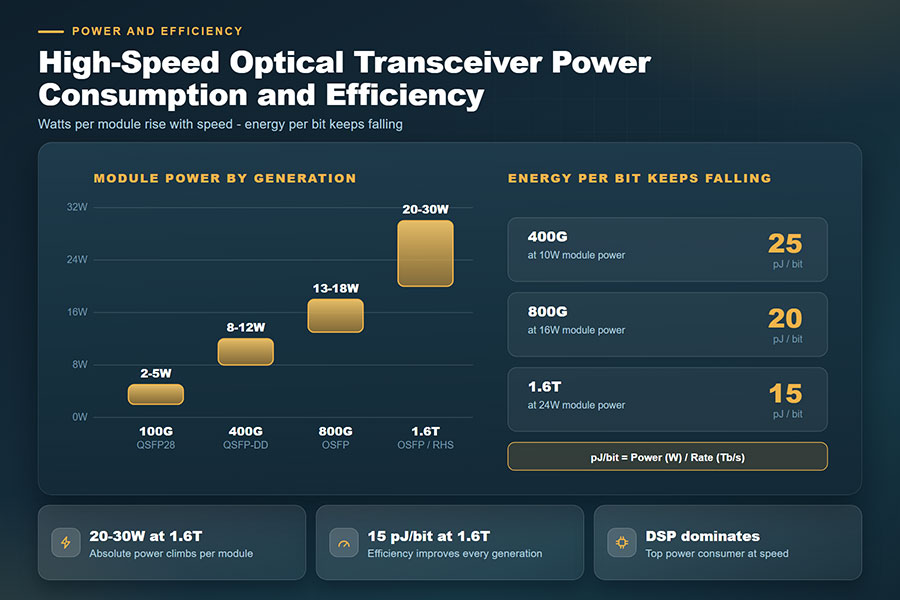
800G and 1.6T connectivity are expanding the bandwidth available to AI data center networks. Future platforms are expected to require even higher aggregate optical I/O capacity, making lane speed, package routing, and optical integration increasingly important.
| Network Generation | Aggregate Interface Rate | Representative Electrical Lane Architecture | Integration Consideration |
|---|---|---|---|
| 400G | 400 Gb/s | Multiple 50G-class or other supported lane configurations | Established pluggable optical interfaces |
| 800G | 800 Gb/s | 8 × 100G or 4 × 200G architectures | Higher-density switch and optical interfaces |
| 1.6T | 1.6 Tb/s | 8 × 200G in common architectures | Advanced electrical channels and optical engine integration |
| 3.2T | 3.2 Tb/s | Future higher-speed lane architectures | Further integration and potential 400G-per-lane development |
These data rates describe aggregate interface capacity, not a guaranteed deployment schedule for NPO or CPO. The adoption of each optical architecture depends on the host platform, electrical lane technology, packaging maturity, thermal limits, and system economics.
As a result, higher-speed pluggable transceivers and integrated optical engines will likely develop in parallel rather than through an immediate transition from one technology to another.
12. The Industry Is Developing a Broader Optical Integration Ecosystem
Moving optical engines closer to processors requires coordination across several parts of the semiconductor and optical communication supply chain.
Traditional optical transceiver manufacturing focuses on lasers, modulators, photodetectors, drivers, receivers, and module assembly. Advanced optical integration adds semiconductor foundries, interposer manufacturing, advanced packaging, fiber-array attachment, thermal solutions, and system-level testing.
| Supply Chain Segment | Role in Optical Integration | Development Priority |
|---|---|---|
| Semiconductor Foundries | Fabricate electronic and photonic integrated circuits | Process maturity and production capacity |
| Photonic Component Suppliers | Provide lasers, modulators, detectors, and optical devices | Performance, reliability, and supply availability |
| Advanced Packaging Providers | Integrate ASICs, PICs, EICs, and interposers | Packaging yield and thermal performance |
| Fiber and Connector Suppliers | Provide high-density optical interfaces | Precision alignment and connector standardization |
| Testing Equipment Providers | Validate optical and electrical performance | Automated testing and production throughput |
| System Manufacturers | Integrate optical engines into network and computing platforms | Platform reliability and serviceability |
TrendForce's June 2026 research projected substantial growth in the combined CPO and NPO market through 2030. The forecast reflects increasing interest in optical integration, although actual adoption will depend on manufacturing yield, supply availability, qualification, and deployment economics.
The market opportunity therefore extends beyond optical modules. Photonic chips, laser sources, packaging technologies, optical connectors, and test systems are all becoming important parts of the developing ecosystem.
13. Pluggable Optical Transceivers Will Continue to Serve Important Applications
The movement toward integrated optical engines does not mean that conventional pluggable transceivers will disappear. Pluggable modules provide flexibility, straightforward replacement, and established interfaces across a wide range of data center and telecommunications applications.
They remain useful when optical reach, maintenance flexibility, or system compatibility is more important than achieving the highest possible integration density.
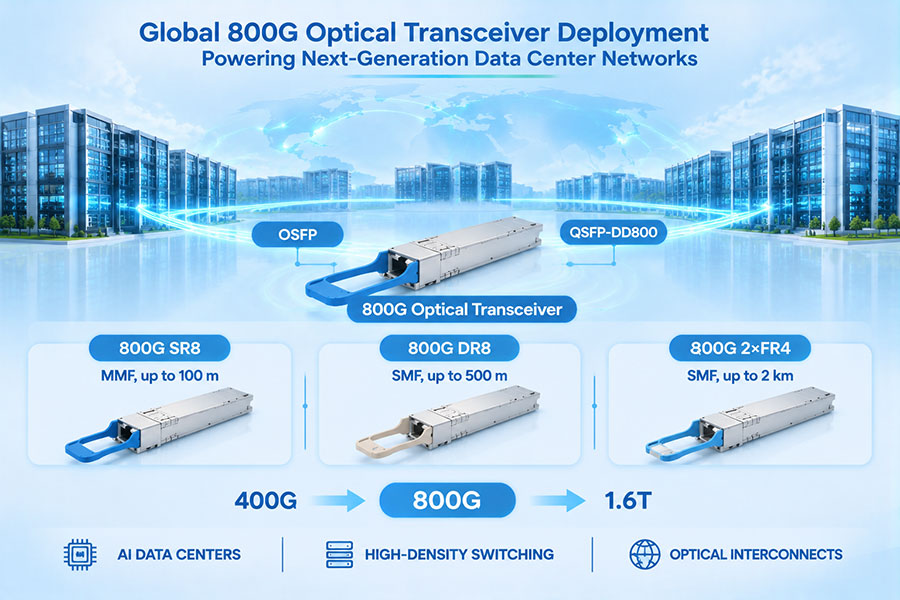
For example, conventional 800G OSFP modules can support different transmission configurations, including short-reach multimode and single-mode links. These products continue to provide practical connectivity for switch-to-switch and other data center network connections.
High-speed active cables also remain useful for short electrical connections where copper-based transmission is appropriate.
14. C-LIGHT High-Speed Connectivity for Next-Generation Networks
While optical engines are moving closer to computing processors, conventional optical transceivers and high-speed cable assemblies remain essential for current AI data centers and high-performance networking systems.
C-LIGHT provides high-speed optical and electrical connectivity products for data centers, cloud infrastructure, and AI networking applications.
C-LIGHT 800G OSFP Optical Transceiver – Supports multiple configurations, including VR8 up to 50 m, SR8 up to 100 m, DR8 up to 500 m, and 2×FR4 up to 2 km. The product family supports specified Ethernet and InfiniBand NDR applications.
C-LIGHT 1.6T OSFP-RHS Optical Transceiver – Uses an 8×200G PAM4 architecture with integrated DSP and FEC. Listed configurations include 2DR4 at 500 m with dual MPO-12 connectors and 2FR4 at 2 km with dual LC/APC connectors.
C-LIGHT 800G AEC Cable – Uses integrated retimer technology for compatible high-speed electrical connections, with listed configurations supporting lengths up to 5 m.
C-LIGHT 800G AOC Cable – Provides integrated optical connectivity for compatible short- and medium-distance data center links.
C-LIGHT 400G QSFP-DD Optical Transceiver – Provides multiple optical configurations for existing high-capacity Ethernet and data center networks.
C-LIGHT DAC, AEC, ACC, and AOC Solutions – Covers different electrical and optical cabling requirements for high-speed network equipment.
These products address established pluggable and cable-based connectivity architectures. They should not be described as CPO or NPO optical engines. Their role is to provide practical connectivity for network platforms that continue to use conventional transceivers and high-speed cables.
For customers planning a network upgrade, product selection should consider data rate, optical reach, fiber type, connector configuration, host compatibility, electrical interface, power consumption, and cooling requirements.
15. Future Development of Processor-Level Optical Connectivity
The next stage of optical integration is likely to extend beyond network switches toward closer connections with computing processors and accelerator packages.
Research into optics-on-interposer and optical I/O demonstrates how photonic components may become more closely integrated with computing silicon. These approaches aim to reduce electrical path length further while increasing the bandwidth available around processor packages.
Several development areas will influence this transition:
Higher optical bandwidth density: More optical channels within compact package structures.
Advanced photonic integration: Greater integration of PICs, EICs, modulators, and detectors.
Improved packaging processes: More reliable interposer, chiplet, and hybrid integration technologies.
External laser development: Better optical power delivery and laser management.
Fiber interface standardization: More consistent mechanical and optical interfaces.
Advanced thermal solutions: Cooling systems designed around high-power computing and photonic components.
Manufacturing automation: Improved optical alignment, testing, and production yield.
One of the biggest challenges will be balancing integration with serviceability. Tighter integration can improve signal paths and bandwidth density, but it can also make components more difficult to replace and systems more complex to manufacture.
For this reason, the industry is unlikely to adopt one universal architecture across all applications. Different combinations of pluggable optics, NPO, CPO, and processor-level optical I/O will serve different computing and networking requirements.
16. Conclusion
The industry transition toward optical engines closer to computing processors reflects a fundamental change in how high-speed data movement is designed. As AI workloads increase communication demand and electrical interfaces face greater signal-integrity and power constraints, optical conversion is moving closer to switch ASICs, GPUs, and other computing components.
Pluggable optics remain important for flexible and serviceable network connections, while LPO, NPO, and CPO offer different approaches to reducing electrical path length and increasing optical integration. Silicon photonics, advanced packaging, external laser sources, fiber coupling, and thermal management are becoming essential technologies supporting this evolution.
The next generation of computing infrastructure will depend on close coordination between electronic processing and optical communication. Rather than replacing every existing connectivity solution, the industry is developing a broader range of architectures that place optical engines where they provide the greatest system-level benefit.
For 400G, 800G, and 1.6T optical transceivers, high-speed active cables, and data center connectivity solutions, Contact C-LIGHT for product information, technical support, and customized connectivity requirements.
 >

 >
 >
 >
 >
 >
 >
 >