TEL:+86 132 6656 7067





Industrial digitalization is changing how factories, energy facilities, transportation systems, and infrastructure operators collect, process, and exchange operational data. Smart manufacturing increasingly depends on connected machines, industrial sensors, machine vision systems, programmable logic controllers (PLCs), and centralized monitoring platforms. As these systems become more interconnected, communication networks must provide reliable data transmission across larger and more complex industrial environments.
Fiber optic communication is gaining importance in this transition. Compared with conventional copper connections, optical fiber supports longer transmission distances, high bandwidth, electrical isolation, and strong resistance to electromagnetic interference. These characteristics make it suitable for factory floors, substations, transportation infrastructure, outdoor installations, and geographically distributed industrial facilities.
The development of Industrial Internet of Things (IIoT), industrial Ethernet, edge computing, and AI-assisted manufacturing is further increasing the importance of scalable communication infrastructure. Fiber is no longer limited to backbone connections; it is becoming an essential part of the communication architecture connecting industrial equipment, control systems, and enterprise networks.
1. Industrial Digitalization Is Reshaping Communication Infrastructure
Traditional industrial networks were often designed around isolated production systems, proprietary communication protocols, and dedicated control networks. Modern industrial digitalization requires a more integrated architecture in which production equipment, monitoring systems, enterprise applications, and cloud platforms can exchange information.
Smart factories generate data from multiple sources, including temperature sensors, vibration monitoring devices, industrial cameras, robotic systems, automated guided vehicles, and production equipment. This information supports equipment monitoring, process optimization, predictive maintenance, and production management.
As the number of connected devices increases, industrial networks face several requirements:
Higher bandwidth: Machine vision, high-resolution inspection, and large-scale sensor deployments increase network traffic.
Reliable connectivity: Communication interruptions can affect production visibility and the coordination of industrial systems.
Long-distance transmission: Fiber links connect equipment distributed across factories, industrial parks, substations, and remote facilities.
Electromagnetic immunity: Optical transmission avoids electrical signal interference associated with motors, drives, welding equipment, and high-voltage installations.
Network scalability: Infrastructure must accommodate additional devices, production lines, and higher-capacity uplinks.
Environmental adaptability: Industrial equipment may need to operate under temperature variations, vibration, dust, and other demanding conditions.
These requirements are driving manufacturers and infrastructure operators to reconsider the role of fiber in both industrial backbone networks and equipment-level connectivity.
2. Fiber Optic Communication Supports Smart Manufacturing
Smart manufacturing relies on continuous communication between production equipment, control systems, monitoring platforms, and management applications. Fiber optic networks provide a high-capacity transmission medium for connecting these systems across production facilities.
Industrial Automation
Automated production lines use PLCs, industrial controllers, sensors, and robotic equipment to coordinate manufacturing processes. Fiber connections can link control cabinets, production zones, and central monitoring systems, particularly where electrical interference or long cable routes make copper connections less suitable.
Machine Vision and Quality Inspection
Industrial cameras capture images for defect detection, dimensional inspection, positioning, and automated quality control. Multiple high-resolution cameras can generate substantial data traffic, especially when inspection systems operate continuously across production lines.
Fiber uplinks provide additional bandwidth for transmitting image data to industrial computers, edge servers, or centralized processing platforms. The required interface speed depends on camera resolution, frame rate, compression, and the number of connected devices.
Industrial Robotics
Robotic systems require communication between controllers, sensors, safety systems, and supervisory platforms. Fiber can support connections between distributed control areas and industrial network aggregation points. Where deterministic communication is required, the complete network architecture must also account for switching behavior, traffic scheduling, redundancy, and control-system requirements.
Predictive Maintenance
Vibration, temperature, pressure, and electrical monitoring systems continuously collect equipment operating data. Fiber networks help transport this information from remote monitoring points to local processing systems or centralized industrial management platforms.
3. Industrial Ethernet and Fiber Networks Are Converging
Industrial Ethernet is becoming a common foundation for connecting operational technology (OT) with information technology (IT). Ethernet-based networks can support communication between industrial controllers, monitoring devices, servers, and enterprise applications while reducing dependence on multiple isolated network infrastructures.
Fiber optic links are frequently used for backbone connections, inter-building communication, long-distance uplinks, and connections between electrically noisy industrial areas.
| Network Technology | Primary Function | Typical Industrial Application |
|---|---|---|
| Industrial Ethernet | Ethernet-based industrial device communication | PLC networks, controllers, production equipment |
| Industrial Fiber Ethernet | Optical transmission between network devices | Factory backbones, remote equipment, industrial campuses |
| Time-Sensitive Networking (TSN) | Time-aware traffic scheduling and deterministic Ethernet capabilities | Motion control, coordinated automation, synchronized systems |
| Industrial Wireless | Wireless connectivity for mobile or difficult-to-wire devices | AGVs, mobile sensors, handheld terminals |
| Private 5G | Wide-area wireless connectivity and mobility | Industrial campuses, logistics, connected equipment |
| Industrial Edge Networking | Connects local processing systems with operational devices | Machine vision, AI inference, real-time data analysis |
These technologies are complementary rather than mutually exclusive. Industrial networks may use fiber for backbone transport, copper Ethernet for short equipment connections, and wireless technologies for mobile devices.
TSN is particularly relevant to industrial Ethernet because it introduces mechanisms for managing time-sensitive traffic. However, using optical fiber does not automatically make a network deterministic. End-to-end latency, synchronization, traffic scheduling, switch capabilities, and application requirements must all be considered.
4. Why Fiber Optic Networks Are Important in Industrial Environments
Industrial facilities present communication challenges that differ from those found in conventional office networks. Large motors, variable-frequency drives, electrical substations, welding equipment, and high-voltage systems can create electromagnetic conditions that affect copper-based communication links.
Fiber optic transmission offers several advantages for these environments.
Resistance to Electromagnetic Interference
Optical fiber transmits information through light rather than electrical signals. It is therefore immune to electromagnetic interference affecting the optical transmission medium itself. This makes fiber particularly useful in industrial facilities with electrically noisy equipment.
Long-Distance Connectivity
Copper Ethernet has distance limitations that depend on the interface and cable category. Fiber links can connect equipment over much longer distances, with the supported reach determined by the optical module, fiber type, wavelength, link budget, and network design.
High Bandwidth and Upgrade Flexibility
Fiber infrastructure can support different Ethernet speeds through compatible optical transceivers and network equipment. An existing fiber route may be upgraded by changing the active equipment, provided that the installed fiber, connectors, optical budget, and network architecture support the new interface.
Electrical Isolation
Optical links do not conduct electrical current between connected network devices. This helps isolate equipment located in different electrical environments and can reduce certain grounding and electrical potential difference concerns.
Support for Distributed Infrastructure
Industrial parks, power facilities, rail networks, and water treatment systems often contain equipment distributed across large areas. Fiber provides a practical transmission medium for connecting remote locations to central monitoring and control infrastructure.
5. Industrial Applications Driving Fiber Optic Network Demand
The demand for industrial optical communication is expanding across several sectors. Each application has different requirements for bandwidth, distance, environmental tolerance, network availability, and equipment compatibility.
| Industry | Application Scenario | Fiber Network Role |
|---|---|---|
| Smart Manufacturing | Robotics, machine vision, automated production lines | High-capacity links between production zones and control systems |
| Electric Power | Substations, grid monitoring, distributed automation | Electrical isolation and communication between remote equipment |
| Transportation | Railway systems, traffic monitoring, tunnel communication | Long-distance connectivity and distributed network aggregation |
| Oil and Gas | Remote monitoring, processing facilities, pipeline infrastructure | Fiber backbones for geographically distributed sites |
| Water Treatment | Pumping stations, treatment equipment, remote sensors | Communication between field devices and central control rooms |
| Warehousing and Logistics | Automated storage, sorting systems, AGV infrastructure | Network connections for automation and monitoring systems |
| Mining | Remote equipment monitoring and industrial communications | Backbone connectivity across large industrial sites |
In many of these environments, fiber is used alongside industrial Ethernet switches, media converters, wireless access points, and specialized control equipment. The combination allows operators to build networks that accommodate both fixed equipment and mobile industrial devices.
6. Industrial Optical Transceivers and Media Converters Enable Fiber Connectivity
Optical transceivers and industrial media converters provide the interfaces required to integrate fiber into Ethernet-based industrial networks. Their selection depends on the network topology, transmission speed, fiber type, optical distance, operating temperature, and host equipment compatibility.
Industrial optical transceivers are available in different form factors and data rates, including SFP, SFP+, CSFP, and other interfaces. Depending on the application, they can support 100 Mbps, Gigabit Ethernet, 2.5G, 10G, and higher-speed connections.
Industrial media converters perform a different function. They convert Ethernet signals between copper and optical interfaces, allowing existing RJ45 equipment to connect to a fiber backbone without requiring every endpoint to have a native optical port.
| Product Type | Primary Function | Typical Application |
|---|---|---|
| Industrial SFP Transceiver | Provides optical connectivity for compatible switches and network devices | Industrial Ethernet uplinks and remote connections |
| Industrial CSFP Transceiver | Supports compact optical connectivity and selected dual-channel configurations | Access aggregation and industrial network equipment |
| Industrial SFP+ Transceiver | Provides higher-speed optical connectivity | 10G industrial backbone and aggregation links |
| Industrial Fiber Media Converter | Converts copper Ethernet to optical fiber and vice versa | Connecting RJ45 equipment to fiber networks |
| Industrial PoE Media Converter | Combines fiber uplink connectivity with PoE delivery | IP cameras, access points, and powered network devices |
| Industrial CWDM/BiDi Transceiver | Supports wavelength-based or single-fiber bidirectional transmission | Fiber resource optimization and distributed links |
For example, C-LIGHT's industrial optical product range includes CSFP transceivers with 1.25G, 2.5G, and 10G options. Selected industrial-grade configurations support an operating temperature range of -40°C to +85°C. These products are relevant to industrial Ethernet, transportation infrastructure, outdoor communication equipment, and other demanding network environments.
7. Industrial Fiber Network Design Requires More Than Bandwidth Selection
Industrial communication networks must be designed around the actual operating conditions of the facility. Choosing an optical module based only on its nominal data rate or transmission distance can lead to compatibility and reliability problems.
Optical Link Budget
The optical power budget must account for fiber attenuation, connector losses, splice losses, splitter losses where applicable, and other passive components. The received optical power must remain within the transmitter and receiver operating limits with an appropriate engineering margin.
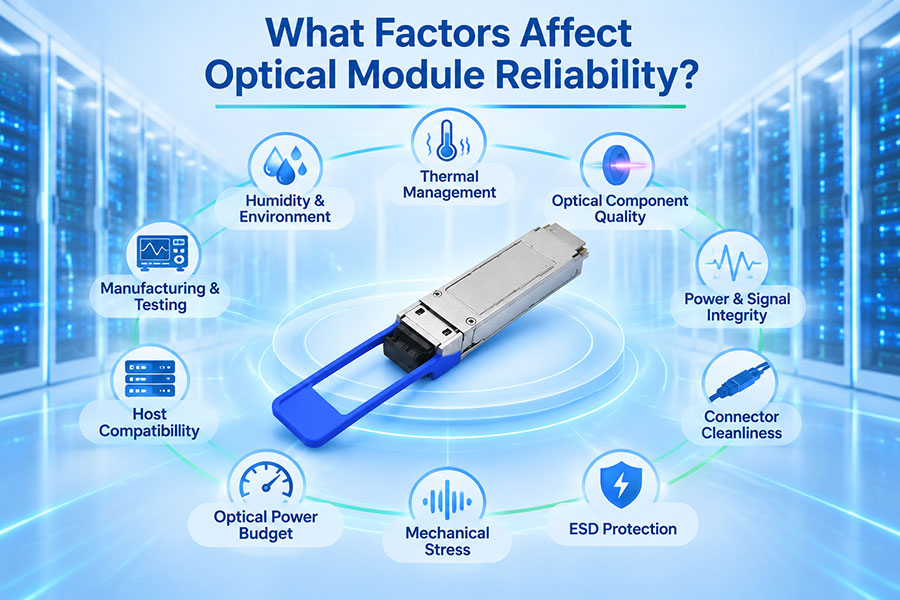
Operating Temperature
Industrial equipment may be installed in outdoor cabinets, substations, production areas, or remote facilities without controlled environmental conditions. The temperature grade of the optical transceiver and host equipment should match the actual installation environment.
Fiber Type and Connector Compatibility
Single-mode and multimode fiber have different transmission characteristics and application ranges. Connector type, wavelength, polarity, and fiber specifications must match the optical interfaces at both ends of the link.
Redundancy and Network Availability
Industrial applications may require redundant fiber paths, ring topologies, or equipment-level failover mechanisms. The appropriate protection method depends on the application and supported network protocols. Redundant cabling alone does not guarantee seamless recovery; switching behavior and convergence time must also be evaluated.
Host Equipment Compatibility
Optical modules must be compatible with the host switch, media converter, or industrial networking device. Supported data rates, electrical interfaces, module coding, diagnostic functions, and vendor compatibility policies should be verified before deployment.
Network topology → Required bandwidth → Fiber type → Optical wavelength → Transmission distance → Optical power budget → Temperature grade → Host compatibility → Redundancy and validation
8. Industrial Digitalization Increases Demand for Rugged Network Equipment
As industrial networks expand beyond temperature-controlled equipment rooms, optical communication devices must operate in a wider range of physical environments. Outdoor cabinets, factory floors, transportation facilities, and energy infrastructure may expose network equipment to temperature variations, vibration, electrical interference, and limited ventilation.
This creates demand for industrial-grade optical transceivers, fiber media converters, and network switches designed for demanding operating conditions.
Important equipment characteristics include:
Extended operating temperature ranges appropriate to the installation.
Stable optical performance across the specified temperature range.
Industrial power input options and, where required, redundant power.
Rugged mechanical construction and suitable mounting methods.
Compatibility with single-mode or multimode fiber infrastructure.
Support for appropriate Ethernet speeds and optical interfaces.
Diagnostic and monitoring functions where required by the network operator.
For critical industrial applications, environmental specifications should be evaluated together with reliability testing, electromagnetic compatibility, equipment certification, and the requirements of the complete network system.
9. C-LIGHT Industrial Fiber Optic Products for Network Applications
C-LIGHT provides optical communication products for industrial Ethernet, enterprise networks, telecommunications infrastructure, and other fiber connectivity applications. Its product portfolio includes industrial optical transceivers, fiber media converters, PoE media converters, and multi-rate optical modules.
CSFP 1.25G/2.5G/10G Industrial-Grade Optical Transceivers – Industrial-grade CSFP optical transceiver options for network equipment interconnection, industrial Ethernet, enterprise networks, and outdoor communication applications. Selected industrial versions support -40°C to +85°C operation.
Industrial Fiber Media Converter – Copper-to-fiber Ethernet conversion with SC, SFP, and selected SFP+ interfaces. Applicable models support 100 Mbps, Gigabit, and 10G optical connectivity, with industrial operating temperature specifications and redundant power options on selected models.
Industrial PoE Media Converter – Combines optical uplink connectivity with PoE power delivery for industrial cameras, wireless access points, and other powered Ethernet devices. Selected configurations support high-power PoE and redundant DC inputs.
CWDM and BiDi Optical Transceivers – Multi-rate optical connectivity options for fiber resource optimization, industrial network links, and distributed communication infrastructure. Selected industrial-grade versions support extended temperature operation.
Industrial and Ethernet Optical Transceiver Portfolio – A wider range of optical transceiver options covering different speeds, wavelengths, form factors, and transmission distances.
Product selection should be based on the specific industrial application, including host equipment, link distance, fiber type, operating environment, and required network performance. C-LIGHT can support product selection and compatibility evaluation for different optical connectivity requirements.
10. Future Trends in Industrial Fiber Optic Communication
Industrial digitalization will continue to increase the importance of reliable communication infrastructure. Several technology developments are likely to influence the next stage of industrial fiber network investment.
Industrial AI and edge computing: AI-based quality inspection, equipment monitoring, and production optimization will increase the volume of data exchanged between industrial devices and local processing systems. Fiber connections will support high-capacity links between production areas, edge servers, and network aggregation points.
Industrial Ethernet and TSN adoption: Greater use of Ethernet-based automation will increase interest in network architectures that combine standard connectivity with predictable traffic handling. TSN capabilities and appropriate network engineering will be important for time-sensitive industrial applications.
Private 5G and fiber convergence: Private 5G can support mobile equipment and wireless industrial devices, while fiber provides backhaul and fixed high-capacity connections. Their combination can support flexible industrial campuses and distributed production environments.
Higher-speed industrial uplinks: As machine vision, video monitoring, and centralized data processing expand, some industrial networks will require higher-capacity aggregation links. Gigabit and 10G optical connectivity will remain important, while faster interfaces may become relevant in selected industrial backbone applications.
Greater emphasis on reliability and cybersecurity: More connected production systems increase the importance of network segmentation, access control, monitoring, redundancy, and secure communication architecture. Fiber provides a transmission medium, but cybersecurity and operational resilience must be addressed across the entire network.
11. Conclusion
Industrial digitalization is creating new requirements for communication networks across smart manufacturing, energy, transportation, logistics, and infrastructure systems. As industrial equipment becomes increasingly connected, networks must support higher bandwidth, longer transmission distances, environmental adaptability, and reliable communication between operational and enterprise systems.
Fiber optic communication provides an important foundation for this transformation. Its resistance to electromagnetic interference, electrical isolation, long-distance transmission capabilities, and upgrade flexibility make it suitable for industrial backbone networks and distributed infrastructure.
Industrial optical transceivers, fiber media converters, PoE media converters, and industrial Ethernet equipment will continue to play important roles in connecting machines, sensors, controllers, cameras, and monitoring platforms. Successful deployment requires careful consideration of optical budgets, fiber compatibility, temperature grades, network redundancy, and host equipment requirements.
As Industry 4.0, IIoT, and industrial AI continue to develop, scalable fiber optic infrastructure will remain a key component of modern industrial communication networks.
For industrial optical transceivers, fiber media converters, and customized industrial fiber connectivity requirements, Contact C-LIGHT for product information and technical support.
 >

 >
 >
 >
 >
 >
 >
 >