TEL:+86 132 6656 7067





Outdoor telecommunications infrastructure, remote network aggregation sites, and industrial Ethernet environments increasingly require high-capacity optical connections that operate beyond the temperature and distance limitations of conventional transceivers. As 100G Ethernet expands into distributed network architectures, coherent optical technology is becoming an important option for extending high-speed connectivity over existing single-mode fiber infrastructure.
Industrial 100G ZR QSFP28 Digital Coherent Optics (DCO) transceivers combine coherent optical transmission, digital signal processing, and extended-temperature operation within a compact pluggable form factor. Designed for demanding deployment environments, these modules can support long-distance 100Gbps connections across dark fiber and amplified DWDM networks while maintaining compatibility with suitable QSFP28 host interfaces.
Unlike conventional 100GBASE-LR4 modules, which use four optical wavelengths for transmission over relatively short distances, 100G ZR DCO modules employ coherent modulation and sophisticated signal processing to transport high-capacity optical signals over significantly longer distances. Their industrial-temperature versions also extend the range of environments in which coherent 100G connectivity can be deployed.
1. What Is an Industrial 100G ZR QSFP28 DCO Transceiver?
An industrial 100G ZR QSFP28 DCO transceiver is a pluggable coherent optical module designed to transmit 100Gbps Ethernet or supported OTN client traffic over long-distance single-mode fiber links. It integrates a coherent optical transmitter and receiver, a tunable laser, an optical front-end, and a digital signal processor (DSP).
The QSFP28 form factor allows the module to be installed in compatible 100G network equipment, including routers, optical transport platforms, and certain high-capacity switches. Its industrial-temperature version is designed for equipment operating in environments where conventional commercial-temperature optical modules may not meet environmental requirements.
| Specification | Industrial 100G ZR QSFP28 DCO |
|---|---|
| Form factor | QSFP28 |
| Client data rate | 100Gbps |
| Optical technology | Digital Coherent Optics |
| Modulation | DP-QPSK in representative implementations |
| Optical wavelength | Tunable C-band |
| Fiber type | Single-mode fiber |
| Optical connector | Duplex LC |
| FEC | Staircase FEC / SC-FEC in supported implementations |
| Transmission distance | Up to 80km on certain dark-fiber implementations; longer distances with suitable amplified DWDM systems |
| Operating case temperature | -40°C to +85°C for industrial-temperature variants |
| Power consumption | Typically around 5–6W for some implementations; varies by design and operating mode |
| Management interface | SFF-8636 or CMIS, depending on module design |
| Application | Long-haul Ethernet, metro networks, DWDM, and industrial optical infrastructure |
The defining characteristics of this module are its coherent transmission capability and extended environmental operating range. These features make it particularly relevant to network architectures where high-speed optical connectivity must be maintained outside conventional temperature-controlled data centers.
2. How 100G ZR Digital Coherent Optics Works
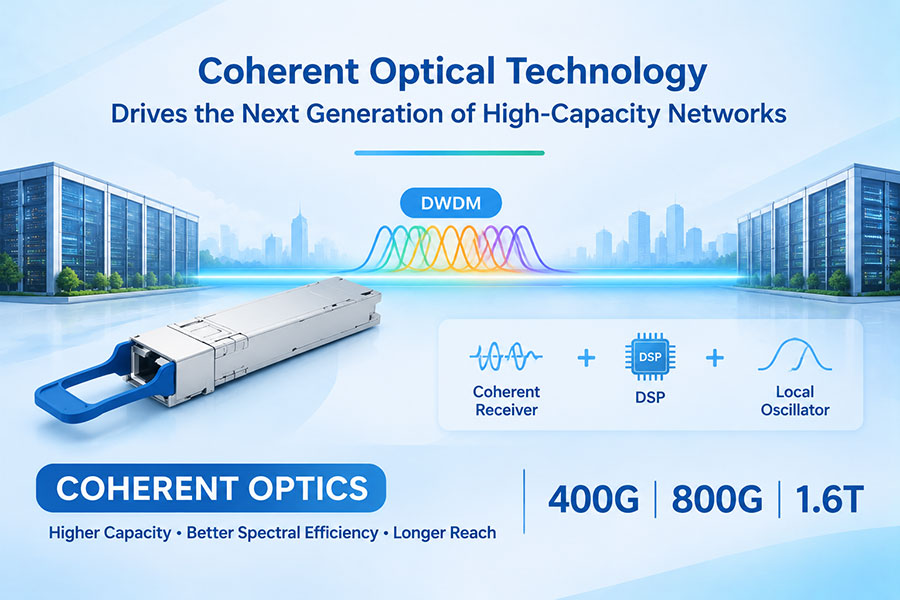
Conventional direct-detection optical transceivers generally recover data by detecting the intensity of incoming optical signals. Coherent optical systems use a different approach by detecting both the amplitude and phase information of optical signals through a coherent receiver.
In a typical 100G ZR QSFP28 DCO implementation, the transmitter uses dual-polarization quadrature phase-shift keying (DP-QPSK). The optical signal carries information across two polarizations, improving spectral efficiency and supporting long-distance transmission.
The coherent receiver combines the incoming optical signal with a local oscillator laser. Optical mixing and balanced detection allow the receiver to recover the signal's amplitude and phase information. The DSP then performs advanced digital processing to reconstruct the transmitted data.
The main functional components include:
Tunable laser: Generates an optical carrier within the supported C-band frequency range.
Optical modulator: Encodes data onto the optical carrier using the selected coherent modulation format.
Dual-polarization transmission: Uses two optical polarization states to increase spectral efficiency.
Coherent receiver: Recovers optical signal information using a local oscillator and coherent detection.
Digital signal processor: Performs signal equalization, dispersion compensation, carrier recovery, and other digital processing functions.
Forward error correction: Detects and corrects transmission errors within the supported FEC architecture.
Integrating these functions within the QSFP28 module reduces the need for separate external coherent optical equipment at each endpoint. This is particularly valuable for distributed network nodes where rack space, equipment complexity, and power availability are important design considerations.
3. Industrial Temperature Range: -40°C to +85°C
Temperature is a major consideration when deploying optical transceivers outside conventional data centers. Telecommunications cabinets, roadside equipment enclosures, industrial facilities, and remote network sites may experience significant temperature fluctuations throughout the year.
Standard commercial optical modules generally use a 0°C to +70°C case-temperature range. Industrial-temperature variants extend this range to -40°C to +85°C, providing additional operating flexibility for equipment exposed to more demanding environmental conditions.
| Temperature Category | Typical Operating Case Temperature | Representative Deployment |
|---|---|---|
| Commercial Temperature | 0°C to +70°C | Temperature-controlled data centers and network rooms |
| Extended Temperature | -5°C to +85°C, where specified | Selected industrial and telecommunications equipment |
| Industrial Temperature | -40°C to +85°C | Outdoor cabinets, roadside infrastructure, and industrial sites |
Industrial-temperature 100G ZR DCO modules are particularly useful in the following environments:
Outdoor telecommunications cabinets: Network equipment may experience substantial temperature changes without centralized cooling.
Industrial Ethernet networks: Optical connections may operate near manufacturing facilities and industrial control infrastructure.
Utility networks: Power substations and distributed infrastructure can require reliable high-speed communication under challenging environmental conditions.
Roadside communication systems: Traffic management and intelligent transportation networks may use outdoor equipment enclosures.
Remote aggregation sites: Distributed network nodes can require long-distance 100G connectivity without conventional data center facilities.
Extended-temperature operation requires careful thermal engineering. The DSP, tunable laser, optical receiver, and power regulation circuitry must maintain their specified operating characteristics across the supported temperature range. Thermal performance should therefore be evaluated at both low- and high-temperature conditions.
4. 100G ZR Transmission Distance and DWDM Applications
One of the main advantages of coherent 100G ZR technology is its ability to support long-distance transmission using a single optical carrier. Instead of relying on multiple independent 25Gbps optical channels, the module transports 100Gbps traffic using a coherent signal architecture.
Transmission distance depends on optical launch power, receiver performance, fiber attenuation, dispersion, OSNR, FEC capability, and whether optical amplification is available.
| Transmission Environment | Representative Distance | Network Configuration |
|---|---|---|
| Dark fiber, unamplified | Up to 80km in certain 100G ZR implementations | Direct point-to-point single-mode fiber |
| Amplified DWDM network | Up to 300km in certain implementations | Optical amplification and DWDM equipment |
| Extended metro transport | Potentially beyond 300km with suitable systems | Engineered optical line systems and intermediate amplification |
These distances are representative product capabilities rather than universal guarantees. Different vendors and module variants may specify different unamplified and amplified transmission limits. A complete optical link budget and system-level interoperability assessment are necessary before deployment.
In DWDM applications, the tunable laser allows the module to operate on selected C-band channels. This makes it possible to integrate 100G ZR DCO modules into wavelength-based transport systems and use existing optical infrastructure where the channel plan and optical line system are compatible.
For network operators, this architecture can support migration from multiple lower-rate optical wavelengths toward higher-capacity 100G connections without requiring a completely new fiber route.
5. Optical Specifications and Key Performance Parameters
Evaluating an industrial 100G ZR QSFP28 DCO transceiver requires more than checking its data rate and temperature rating. Optical output power, receiver sensitivity, wavelength tuning, FEC performance, and power consumption all influence the suitability of the module for a specific transmission system.
| Parameter | Representative Specification | Engineering Significance |
|---|---|---|
| Client data rate | 100Gbps | Supports 100G Ethernet client connectivity. |
| Modulation | DP-QPSK | Provides coherent optical transmission with two polarization states. |
| Wavelength | C-band tunable | Supports channel selection within the specified tuning range. |
| Transmit power | Approximately -8dBm for standard-output variants; other versions may provide higher output | Influences link budget and optical line-system design. |
| Receiver sensitivity | Approximately -30dBm in certain implementations | Indicates the minimum supported received signal level under specified test conditions. |
| Optical connector | Duplex LC | Provides the physical interface to single-mode fiber. |
| FEC | Staircase FEC / SC-FEC | Improves transmission error tolerance. |
| Power consumption | Approximately 5–6W in selected products | Determines host-system power and cooling requirements. |
| Temperature range | -40°C to +85°C | Supports industrial operating environments. |
Actual specifications must be taken from the individual product datasheet. In particular, receiver sensitivity, transmit power, and distance cannot be evaluated independently. The usable link depends on the complete optical system and the selected coherent transmission mode.
6. DSP, FEC, and Coherent Signal Processing
The DSP is one of the most important components in a 100G ZR DCO transceiver. Long-distance coherent transmission introduces signal impairments that cannot be adequately handled by a simple direct-detection receiver architecture.
The DSP processes the received coherent signal and compensates for transmission effects that accumulate along the optical fiber. Its capabilities influence the module's achievable distance, signal quality, interoperability, and overall power consumption.
Important DSP functions include:
Chromatic dispersion compensation: Corrects the timing distortion caused by different optical frequency components traveling at different speeds through fiber.
Polarization demultiplexing: Separates the two transmitted polarization channels.
Adaptive equalization: Compensates for channel impairments and signal distortion.
Carrier recovery: Tracks and compensates for phase and frequency differences between the transmitter and receiver lasers.
FEC processing: Applies error correction coding to improve the reliability of received data.
Signal quality monitoring: Provides diagnostic information for evaluating optical link performance.
Forward Error Correction is especially important for coherent long-distance transmission. The receiver can recover data even when the optical signal contains errors, provided the error level remains within the correction capability of the selected FEC scheme.
100G ZR implementations using IEEE 802.3ct and ITU-T G.709.2-related coherent specifications may employ Staircase FEC or SC-FEC. The exact line-side protocol and host-side FEC configuration should be verified for the selected module and network platform.
7. Industrial 100G ZR DCO vs Conventional 100G Optical Modules
Conventional 100G SR4 and LR4 modules are widely used in data center and enterprise networking. However, their optical architectures and distance capabilities differ considerably from coherent 100G ZR DCO technology.
| Specification | 100G SR4 | 100G LR4 | Industrial 100G ZR DCO |
|---|---|---|---|
| Optical technology | Direct detection | Direct detection | Digital coherent optics |
| Modulation | NRZ | NRZ | DP-QPSK in representative implementations |
| Wavelength | 850nm | LAN-WDM | Tunable C-band |
| Fiber type | Multimode | Single-mode | Single-mode |
| Connector | MPO-12 | Duplex LC | Duplex LC |
| Typical reach | 70–100m | 10km | 80km or longer, depending on system configuration |
| Temperature options | Product-dependent | Product-dependent | Industrial variants available at -40°C to +85°C |
| Typical application | Short-reach data center links | Data center and campus links | Long-distance coherent transport |
The most significant difference is the transmission architecture. SR4 and LR4 are designed for conventional Ethernet optical connections, while ZR DCO incorporates coherent optical processing to support longer distances and wavelength-based transport applications.
Industrial ZR DCO modules are therefore not simply higher-distance replacements for LR4. They introduce different optical line interfaces, DSP requirements, FEC mechanisms, and host-system compatibility considerations.
8. Host Compatibility and Network Integration
QSFP28 mechanical compatibility does not automatically guarantee that an industrial 100G ZR DCO transceiver will operate correctly in every 100G QSFP28 port.
Coherent modules have specific electrical interface, power, thermal, management, and software requirements. These requirements can be more demanding than those of conventional 100G SR4 or LR4 transceivers.
Before installing a 100G ZR DCO module, network engineers should verify the following:
Port support: Confirm that the router, switch, or optical transport platform supports the specific coherent QSFP28 module.
Host electrical interface: Verify support for the required 100GBASE-R CAUI-4 or other specified client interface.
Power budget: Confirm that the host port supports the module's maximum power consumption.
Thermal management: Ensure that the equipment provides sufficient airflow and cooling for the module's operating conditions.
Management interface: Check SFF-8636 or CMIS support and the required diagnostic functions.
Firmware compatibility: Verify that the installed software recognizes and supports the specific coherent transceiver.
Optical line configuration: Confirm wavelength tuning, channel spacing, FEC mode, and optical line-system compatibility.
Host compatibility is particularly important for industrial deployments. An optical module may meet the required -40°C to +85°C case-temperature specification while the host switch or router has a narrower operating temperature range. The complete equipment assembly must satisfy the intended environmental requirements.
9. Industrial 100G ZR DCO Compatibility and Reliability Testing
Industrial coherent optical modules require a broader validation process than conventional short-reach optical transceivers. Their operation depends on the interaction between the coherent optical engine, DSP, host electrical interface, and optical transport system.
For C-LIGHT, industrial 100G ZR QSFP28 DCO product validation should cover electrical compatibility, optical performance, temperature behavior, and coherent link interoperability.
Verify QSFP28 hardware recognition.
Check module identification and management information.
Confirm host electrical interface compatibility.
Validate power consumption under different operating conditions.
Measure transmitter optical output power.
Verify receiver sensitivity and overload limits.
Check tunable wavelength accuracy and channel stability.
Evaluate optical performance using the specified FEC mode.
Verify coherent signal quality and link stability.
Evaluate operation at the specified low-temperature limit.
Evaluate operation at the specified high-temperature limit.
Monitor DSP, laser, and module temperature behavior.
Check wavelength stability across temperature variations.
Verify power and diagnostic behavior during thermal transitions.
Establish 100G Ethernet connectivity with supported host platforms.
Validate FEC and line-side configuration.
Check interoperability with compatible coherent optical equipment.
Monitor bit error rate and post-FEC error performance.
Evaluate sustained traffic operation and link recovery.
For coherent transmission, pre-FEC BER, post-FEC BER, and optical signal quality provide important information about the condition of the link. A module that establishes a connection does not necessarily demonstrate that the optical system has sufficient performance margin for continuous operation.
Testing should therefore cover the intended fiber route, optical amplification equipment, DWDM channel configuration, and receiving platform rather than evaluating the transceiver as an isolated component.
10. Power Consumption and Thermal Management
Power consumption is an important design consideration for QSFP28 coherent modules, especially when they are installed in compact industrial routers, outdoor network cabinets, or high-density optical equipment.
Compared with conventional 100G SR4 and LR4 modules, coherent DCO transceivers integrate additional processing and optical functions. Their DSP, coherent receiver, tunable laser, and optical front-end contribute to overall power consumption.
| Parameter | Design Consideration |
|---|---|
| Module power | Some industrial 100G ZR DCO implementations operate around 5–6W, while other designs may differ. |
| Host power delivery | The QSFP28 port must support the module's specified maximum power requirement. |
| Airflow | Host equipment must provide sufficient airflow around the transceiver. |
| Thermal dissipation | DSP and optical components require appropriate thermal management. |
| Outdoor enclosure | Cabinet ventilation, passive cooling, and ambient temperature affect the total thermal environment. |
| Temperature monitoring | Module diagnostics can help identify abnormal thermal conditions. |
In outdoor installations, thermal design should account for both the module and the equipment enclosure. Solar loading, restricted ventilation, adjacent high-power components, and seasonal temperature changes can influence the actual operating conditions.
Low-temperature operation also requires attention. Laser tuning, wavelength stability, power regulation, and DSP initialization should be evaluated across the entire specified temperature range.
11. Typical Applications of Industrial 100G ZR QSFP28 DCO
The combination of 100Gbps coherent transmission, long-distance single-mode fiber connectivity, and industrial-temperature operation makes these modules suitable for several distributed network architectures.
| Application | Network Requirement | Role of Industrial 100G ZR DCO |
|---|---|---|
| Outdoor telecommunications cabinets | High-capacity optical links in uncontrolled environments | Supports long-reach 100G connections with extended-temperature operation. |
| 5G transport networks | High-bandwidth connections between distributed aggregation sites | Provides coherent optical transport over single-mode fiber. |
| Industrial Ethernet | Reliable connections between geographically separated industrial facilities | Extends 100G connectivity beyond conventional short-reach optical links. |
| Electric utility networks | Communication between substations and central network facilities | Supports high-capacity optical connectivity in suitable industrial platforms. |
| Metro optical networks | 100G wavelength transport over existing fiber infrastructure | Enables tunable coherent wavelength-based connectivity. |
| Remote network aggregation | Long-distance optical links without large transport chassis | Integrates coherent functionality into a compact pluggable module. |
| Transportation infrastructure | Optical communication for distributed roadside equipment | Supports high-speed connectivity in appropriately rated equipment. |
These applications share a common requirement: high-capacity optical transmission outside traditional data center environments. Industrial 100G ZR DCO technology offers an alternative to deploying larger optical transport equipment at every remote network location, provided that the host platform supports the coherent module.
12. Industrial 100G ZR DCO vs 400G and 800G Coherent Optics
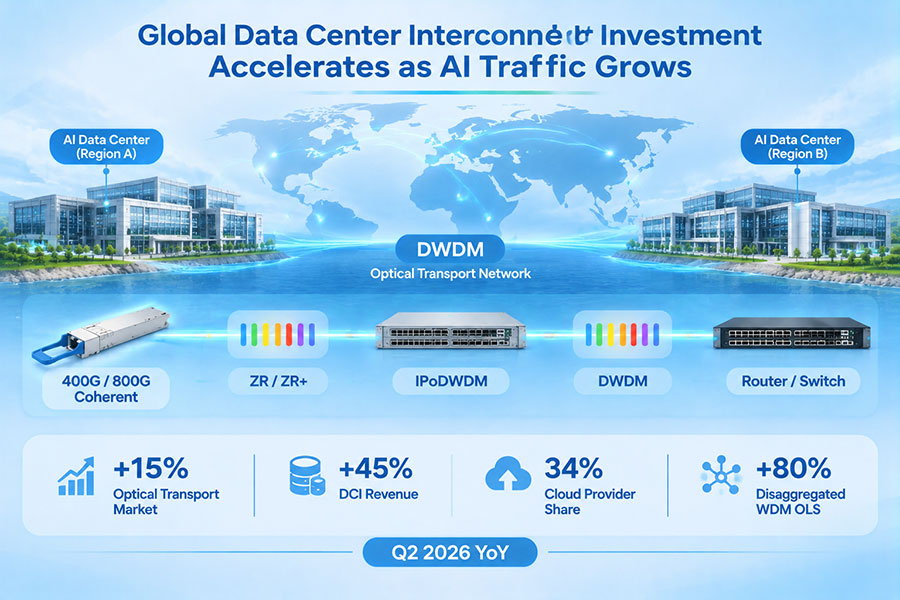
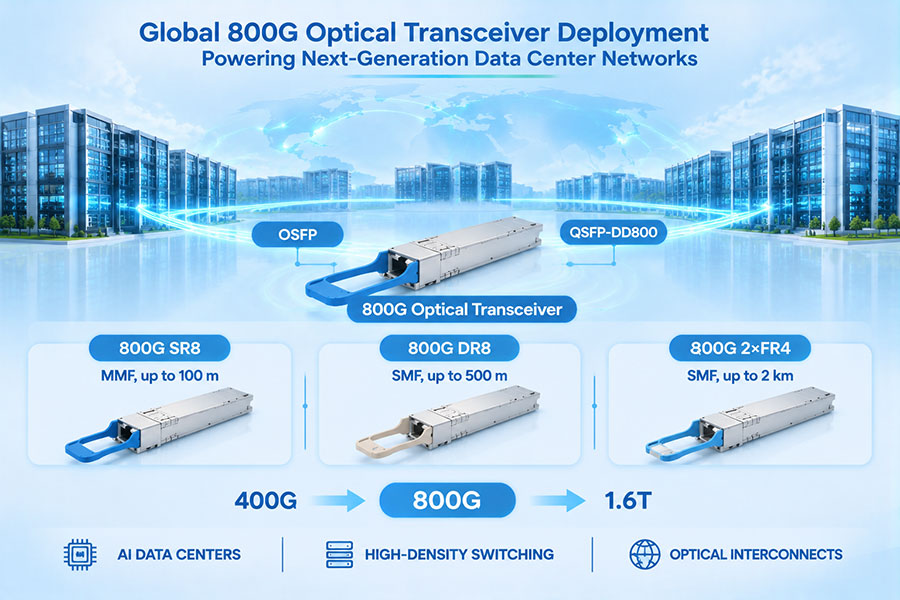
As optical network capacity increases, coherent pluggable technology is evolving across multiple form factors and data rates. QSFP28 100G ZR DCO remains relevant for existing 100G infrastructure, while higher-capacity coherent modules address growing requirements in metro, regional, and data center interconnection networks.
| Technology | Form Factor | Typical Network Role | Main Consideration |
|---|---|---|---|
| 100G ZR DCO | QSFP28 | 100G long-distance optical transport | Suitable for existing 100G host infrastructure. |
| 400G ZR / ZR+ | QSFP-DD or OSFP, depending on implementation | High-capacity metro and DCI links | Higher bandwidth and more demanding host power and thermal requirements. |
| 800G coherent optics | OSFP or QSFP-DD, depending on implementation | High-capacity optical transport and advanced DCI | Supports increasing bandwidth requirements in modern network architectures. |
For operators maintaining established 100G networks, industrial 100G ZR DCO modules can provide a practical way to extend existing infrastructure without immediately migrating all network equipment to higher-speed platforms.
For new network construction, the selection between 100G, 400G, and 800G coherent solutions should consider total traffic demand, fiber availability, optical line-system capacity, equipment compatibility, and long-term network expansion.
13. Selecting an Industrial 100G ZR QSFP28 DCO Transceiver
Choosing an appropriate industrial coherent transceiver requires a system-level evaluation. Temperature rating alone does not establish suitability for an industrial network, and the longest advertised transmission distance may not represent the achievable reach on an existing fiber route.
The following factors should be considered during product selection:
Temperature range: Confirm the required -40°C to +85°C case-temperature rating and environmental conditions.
Transmission distance: Determine whether the link uses dark fiber or an amplified DWDM system.
Optical tuning: Verify the supported C-band tuning range and channel spacing.
FEC interoperability: Confirm that the transmitting and receiving equipment support compatible FEC modes.
Host platform: Check the router or switch model, QSFP28 port capabilities, firmware, and power budget.
Optical output power: Select the appropriate standard-output or high-output variant for the optical system.
Management interface: Confirm SFF-8636 or CMIS support and the required diagnostic information.
Thermal performance: Evaluate module operation under the expected enclosure and airflow conditions.
Interoperability: Validate compatibility with the existing coherent optical line system and remote endpoint.
For industrial deployments, the module, host equipment, fiber infrastructure, and optical transport system should be evaluated as a complete solution. This approach helps avoid problems caused by mismatched optical channels, insufficient host power, unsupported FEC configurations, or thermal limitations.
14. C-LIGHT Industrial 100G Optical Connectivity Solutions
As industrial networks expand toward higher bandwidth and longer optical transmission distances, optical transceivers must meet increasingly demanding requirements for transmission performance, environmental tolerance, and equipment interoperability.
C-LIGHT's optical connectivity portfolio covers multiple Ethernet and telecommunications applications, including high-speed optical transceivers, industrial-temperature optical modules, and long-distance fiber connectivity solutions.
For industrial 100G ZR QSFP28 DCO applications, important product requirements include:
100Gbps coherent optical transmission.
QSFP28 pluggable form factor.
Industrial case-temperature operation from -40°C to +85°C.
Tunable C-band optical transmission.
DP-QPSK coherent modulation in supported configurations.
Compatible FEC and optical line interfaces.
Duplex LC single-mode fiber connectivity.
Host platform and management interface compatibility.
For projects involving outdoor telecommunications equipment, industrial Ethernet networks, or long-distance 100G optical links, selecting the correct DCO configuration requires careful consideration of both the transceiver specifications and the network architecture.
For industrial 100G optical module requirements, product specifications, and compatibility support, contact the C-LIGHT team.
15. Conclusion
Industrial 100G ZR QSFP28 DCO transceivers combine coherent optical technology, advanced DSP processing, and extended-temperature operation to support long-distance 100Gbps connectivity. Their tunable C-band transmission, single-mode fiber interface, and supported FEC architecture make them suitable for selected dark-fiber and amplified DWDM applications.
The industrial -40°C to +85°C case-temperature range expands deployment possibilities across outdoor telecommunications cabinets, industrial facilities, remote aggregation sites, and distributed optical networks. However, successful implementation depends on host platform support, power delivery, thermal management, optical line configuration, and coherent interoperability.
As 100G coherent connectivity continues to serve established transport networks, industrial QSFP28 DCO modules provide an important option for extending high-capacity optical infrastructure into environments where conventional commercial-temperature transceivers may not be suitable.
For industrial 100G ZR QSFP28 DCO optical transceivers and other high-speed fiber connectivity solutions, C-LIGHT provides technical support for product selection and application requirements.
 >

 >
 >
 >
 >
 >
 >
 >