TEL:+86 132 6656 7067





100G Ethernet connectivity across HPE networking environments relies on more than matching port speeds and transceiver form factors. Fiber type, optical wavelength, connector design, module coding, and switch platform support all influence whether a 100G QSFP28 link operates reliably. Two widely deployed options, 100GBASE-SR4 and 100GBASE-LR4, address different network requirements despite sharing the same QSFP28 interface and nominal 100Gbps data rate.
HPE 100G QSFP28 SR4 modules are designed primarily for short-reach multimode fiber connections within data centers, while LR4 modules support longer-distance transmission over single-mode fiber. For network operators considering original HPE optics or third-party compatible alternatives, understanding these differences is essential for selecting the correct transceiver and validating end-to-end interoperability.
1. HPE 100G QSFP28 SR4 and LR4 Overview
HPE offers multiple 100G QSFP28 optical transceiver options for its networking platforms, including SR4 and LR4 variants. Both provide 100Gbps Ethernet connectivity through four optical channels, but their transmission technologies and physical interfaces differ.
| Specification | 100G QSFP28 SR4 | 100G QSFP28 LR4 |
|---|---|---|
| Ethernet standard | 100GBASE-SR4 | 100GBASE-LR4 |
| Form factor | QSFP28 | QSFP28 |
| Data rate | 100Gbps | 100Gbps |
| Optical channels | 4 × 25Gbps | 4 × 25Gbps |
| Modulation | NRZ | NRZ |
| Wavelength | 850nm | LAN-WDM, approximately 1295–1310nm |
| Fiber type | Multimode fiber (MMF) | Single-mode fiber (SMF) |
| Connector | MPO-12 | Duplex LC |
| Typical transmission distance | 70m on OM3 / 100m on OM4 | Up to 10km |
| Optical transmission | Parallel optics | Wavelength-division multiplexing |
| Typical application | Data center interconnections | Campus and data center interconnections |
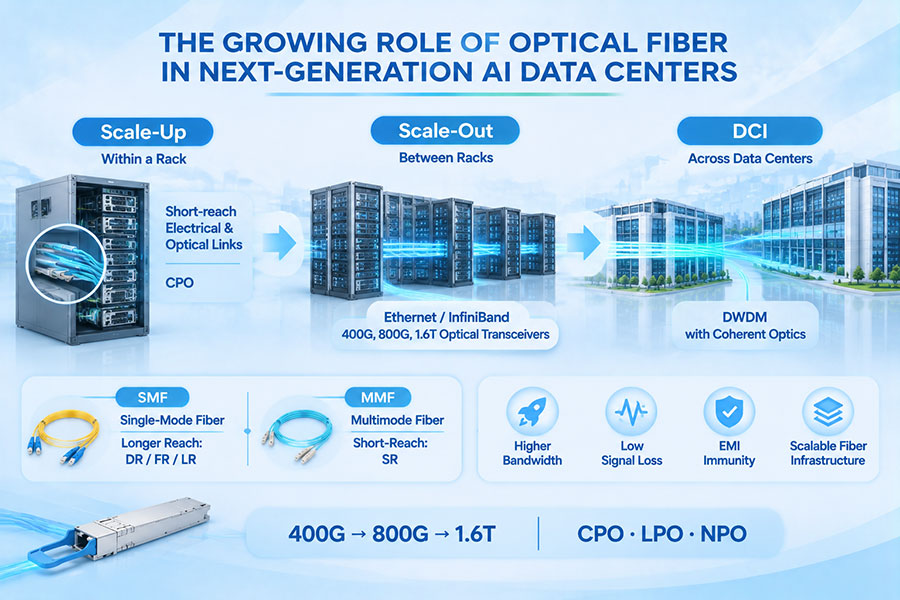
The most important distinction is the optical architecture. SR4 uses four separate transmit and receive fiber channels, requiring an MPO connection. LR4 combines four wavelengths over a duplex single-mode fiber connection, allowing all 100Gbps of traffic to travel through a conventional two-fiber link.
2. HPE 100G QSFP28 SR4 Module Compatibility
HPE 100G QSFP28 SR4 transceivers are intended for short-distance, high-bandwidth connections using multimode optical fiber. Each of the four optical lanes carries approximately 25Gbps, resulting in an aggregate transmission rate of 100Gbps.
SR4 modules typically operate at 850nm and use an MPO-12 connector. Eight fiber positions are used for the four transmit and four receive channels, while the remaining positions are not used for the standard SR4 optical link.
Representative HPE SR4 product references include:
| HPE Product Number | Product Description | Optical Interface |
|---|---|---|
| JL274A | HPE X150 100G QSFP28 MPO SR4 100m MM Transceiver | 850nm / MPO / MMF |
| JL309A | Aruba 100G QSFP28 MPO SR4 100m Transceiver | 850nm / MPO / MMF |
| 845966-B21 | HPE 100Gb QSFP28 MPO SR4 100m Transceiver | 850nm / MPO / MMF |
| Q2F19A | HPE 100GbE QSFP28 SR4 100m XCVR | 850nm / MPO / MMF |
Although these products share the SR4 specification, their supported switch families and firmware requirements should not be assumed to be identical. The exact hardware platform and its transceiver compatibility documentation must be checked before deployment.
Fiber compatibility: OM3 and OM4 multimode fiber are commonly used with 100GBASE-SR4. The typical maximum link distances are 70 meters on OM3 and 100 meters on OM4. OM1 and OM2 should not be treated as supported SR4 cabling media.
For applications requiring connections to four individual 25G ports, SR4 can also support an optical breakout arrangement using an appropriate MPO-to-4×LC fan-out cable. This requires compatible switch port breakout functionality and corresponding 25G SR transceivers at the other end.
3. HPE 100G QSFP28 LR4 Module Compatibility
HPE 100G QSFP28 LR4 modules are designed for longer-reach Ethernet connections over single-mode fiber. Unlike SR4, which transmits across four separate fiber channels, LR4 uses four LAN-WDM wavelengths multiplexed onto one transmit fiber and one receive fiber.
The four nominal optical wavelengths are approximately 1295.56nm, 1300.05nm, 1304.58nm, and 1309.14nm. Each wavelength carries a 25Gbps data channel, and the optical signals are combined through wavelength-division multiplexing to provide an aggregate 100Gbps connection.
A typical 100GBASE-LR4 module provides up to 10km transmission over single-mode fiber, using a duplex LC connector.
| HPE Product Number | Product Description | Optical Interface |
|---|---|---|
| JL275A | HPE X150 100G QSFP28 LC LR4 10km SM Transceiver | LAN-WDM / LC / SMF |
| JL310A | HPE Aruba Networking 100G QSFP28 LC LR4 10km SMF Transceiver | LAN-WDM / LC / SMF |
LR4 is particularly useful when two network devices are located in different equipment rooms, buildings, or data center areas where multimode fiber infrastructure is unsuitable or the required distance exceeds the reach of SR4.
4. Optical Interface Differences and Interoperability
Although SR4 and LR4 share the QSFP28 form factor, their optical interfaces are fundamentally different. This means that matching the physical module size and data rate is not sufficient to establish a working connection.
| Compatibility Factor | SR4 | LR4 |
|---|---|---|
| Optical medium | Multimode fiber | Single-mode fiber |
| Optical transmission | Four parallel channels | Four multiplexed wavelengths |
| Fiber count | 8 active fibers | 2 active fibers |
| Connector interface | MPO-12 | Duplex LC |
| Optical wavelength | 850nm | Four LAN-WDM wavelengths |
| Typical reach | Up to 100m on OM4 | Up to 10km on SMF |
| Direct SR4-to-LR4 connection | Not supported as a standard optical link | |
A common deployment mistake is assuming that two 100G QSFP28 modules can communicate simply because both support 100Gbps Ethernet. In reality, the optical signaling method, fiber type, wavelength arrangement, and connector configuration must all be compatible.
For example, an HPE SR4 module connected to an LR4 module through a passive fiber adapter will not establish a standard 100G Ethernet link. The two modules use different optical media and transmission architectures.
When a network requires an SR4-to-LR4 transition, an appropriate active conversion solution or a network device with separate compatible optical interfaces is necessary.
5. HPE Switch Platform and Firmware Compatibility
HPE transceiver compatibility is determined by more than the optical standard. Switch hardware, port capabilities, firmware versions, transceiver identification, and platform-specific support policies can all affect module operation.
HPE networking products cover multiple hardware families, including Aruba CX switches, Comware-based switches, and HPE Synergy environments. A transceiver listed for one platform should not automatically be considered supported on every HPE device.
When evaluating an SR4 or LR4 module, engineers should verify the following information:
Switch model: Confirm the exact HPE or Aruba switch model and hardware revision.
Port specifications: Verify that the physical port supports 100G QSFP28 operation.
Transceiver support: Check the official compatibility guide for the relevant module type and product family.
Software version: Confirm that the installed operating system and firmware support the selected transceiver.
Module identification: Check whether the switch recognizes the module and correctly identifies its manufacturer, model, and optical characteristics.
DOM/DDM support: Verify whether digital optical monitoring information is available and correctly reported.
For example, JL274A and JL275A are listed in HPE Comware-based device compatibility documentation as SR4 and LR4 options, respectively. Aruba networking documentation also identifies specific SR4 and LR4 products for its supported platforms. These product references are useful starting points, but the individual switch compatibility list remains the final reference.
6. Third-Party HPE 100G QSFP28 SR4 and LR4 Compatibility Testing
Third-party optical transceivers provide another option for network operators looking to manage optical connectivity costs while maintaining compatibility with existing HPE infrastructure. However, compatibility should be established through platform-specific testing rather than relying exclusively on generic QSFP28 specifications.
For C-LIGHT, HPE-compatible 100G optical module validation should cover both hardware recognition and actual Ethernet link performance.
EEPROM identification: Verify that the switch correctly reads the module identification and supported operating parameters.
Port recognition: Confirm that the switch recognizes the transceiver without unsupported-module or identification errors.
Link establishment: Test 100G link initialization with compatible transceivers at both ends.
DOM/DDM monitoring: Check real-time TX power, RX power, temperature, voltage, and laser bias information where supported.
Optical power validation: Measure transmit and receive optical power against the module's specifications and link budget.
Traffic performance: Verify sustained 100G Ethernet traffic and monitor packet errors, CRC errors, and link stability.
Thermal operation: Evaluate module behavior under the expected operating temperature and switch airflow conditions.
Link recovery: Check whether the connection recovers correctly following a port reset or switch reboot.
SR4 and LR4 require different test setups. SR4 validation should use appropriate multimode fiber and MPO connectivity, while LR4 validation requires single-mode fiber and duplex LC connections. Testing should also include the actual HPE switch model and software version intended for deployment.
For cross-vendor connectivity, testing both endpoints is especially important. A third-party transceiver that is recognized by an HPE switch may still encounter interoperability problems when connected to a different vendor's equipment.
7. Common Compatibility Problems and Troubleshooting
Several issues can prevent an HPE 100G QSFP28 connection from operating correctly. Identifying whether the problem originates from module recognition, optical infrastructure, or link configuration helps reduce troubleshooting time.
| Problem | Possible Cause | Recommended Check |
|---|---|---|
| Transceiver not recognized | Unsupported module coding or platform restrictions | Check switch compatibility documentation and module identification information. |
| Link remains down | Incorrect optical type, incompatible endpoints, or configuration | Verify that both ends use compatible 100G optical standards and port settings. |
| Low RX optical power | Fiber loss, dirty connectors, or incorrect polarity | Inspect and clean connectors, verify fiber routing, and measure optical power. |
| SR4 connection failure | Incorrect MPO polarity or fiber mapping | Verify the MPO cable type, polarity, and transmit/receive lane mapping. |
| LR4 connection failure | Incorrect single-mode fiber connection or optical loss | Check duplex LC connections, fiber continuity, and the optical power budget. |
| Intermittent link instability | Optical power fluctuations, thermal issues, or signal integrity problems | Monitor DOM/DDM values, port error counters, and module temperature. |
| DOM/DDM information unavailable | Monitoring support or software compatibility differences | Check module monitoring capabilities and switch software support. |
When diagnosing a link failure, engineers should first confirm that the optical standards match at both ends. They can then inspect the fiber connections, verify polarity, review transceiver diagnostic information, and examine switch interface statistics.
8. Selecting the Right HPE-Compatible 100G QSFP28 Module
The choice between SR4 and LR4 should be based on the physical network environment, existing fiber infrastructure, transmission distance, and supported switch interfaces.
| Deployment Requirement | Recommended Module | Reason |
|---|---|---|
| Short-distance data center links | 100G QSFP28 SR4 | Suitable for high-density multimode fiber connectivity. |
| Connections using OM3 fiber | 100G QSFP28 SR4 | Supports typical distances up to 70m. |
| Connections using OM4 fiber | 100G QSFP28 SR4 | Supports typical distances up to 100m. |
| Longer links between network rooms | 100G QSFP28 LR4 | Provides transmission distances up to 10km. |
| Existing single-mode fiber infrastructure | 100G QSFP28 LR4 | Uses duplex LC single-mode fiber connectivity. |
| Four independent 25G optical connections | 100G QSFP28 SR4 with breakout | Supports 4×25G SR breakout when the switch and cabling are compatible. |
For network equipment manufacturers, system integrators, and enterprise IT teams, the most practical approach is to confirm the switch model, identify the required optical interface, and validate the complete link before large-scale deployment.
C-LIGHT provides optical connectivity solutions covering 100G QSFP28 SR4, LR4, and other high-speed Ethernet applications. These product categories support different fiber infrastructures and transmission requirements, allowing network operators to select suitable optical interfaces for their deployment environments.
For HPE networking projects, compatibility requirements should be specified with the exact switch model, operating system version, target distance, fiber type, and required diagnostic functions. This provides a clearer basis for selecting and validating compatible optical modules.
9. Conclusion
HPE 100G QSFP28 SR4 and LR4 optical modules share the same 100Gbps QSFP28 interface but serve different connectivity requirements. SR4 operates over 850nm multimode fiber with an MPO connector and supports short-distance links up to 100m on OM4. LR4 uses four LAN-WDM wavelengths over duplex LC single-mode fiber and supports transmission distances up to 10km.
Successful deployment depends on matching the optical standards, fiber infrastructure, switch platform, firmware, and module compatibility requirements. For third-party alternatives, comprehensive hardware recognition, optical performance, and interoperability testing are important steps in establishing reliable HPE 100G connectivity.
For HPE-compatible 100G QSFP28 SR4 and LR4 optical transceiver requirements, contact the C-LIGHT team for product selection and compatibility support.
 >

 >
 >
 >
 >
 >
 >
 >