TEL:+86 132 6656 7067





Distributed computing is changing how digital services are built and operated. Instead of relying on a single data center or centralized computing platform, modern infrastructure distributes processing, storage, and application workloads across multiple locations. Cloud service providers, artificial intelligence platforms, enterprise networks, and edge computing operators increasingly depend on interconnected computing resources to deliver scalable performance and maintain service availability.
This architectural shift creates new requirements for optical communication networks. Computing resources located in different racks, buildings, campuses, and geographic regions must exchange large volumes of data with predictable latency and high reliability. As distributed AI training and real-time data processing expand, network infrastructure must provide sufficient bandwidth not only within individual data centers but also between geographically separated facilities.
High-capacity optical networks provide the transmission foundation for this development. Fiber-optic links, 400G and 800G transceivers, emerging 1.6T interfaces, DWDM systems, and coherent optical technology enable operators to scale connectivity across different network layers. The challenge is no longer simply connecting more devices; it is coordinating distributed computing resources through a network capable of handling increasingly dynamic traffic patterns.
1. Distributed Computing Is Reshaping Network Infrastructure
Distributed computing divides processing tasks among multiple interconnected computing resources. These resources may operate within the same data center, across several facilities in one metropolitan area, or between data centers in different regions.
This architecture offers several advantages. Workloads can be distributed according to available computing capacity, applications can access resources closer to users, and organizations can improve infrastructure flexibility. Large AI models can also use distributed accelerators to process training and inference workloads across multiple servers or locations.
However, distributing computing resources increases dependence on network connectivity. Data must move between processors, storage systems, application platforms, and remote facilities. Network performance can therefore influence overall computing efficiency.
| Distributed Computing Model | Infrastructure Characteristics | Network Requirement |
|---|---|---|
| Distributed cloud computing | Computing and storage resources operate across multiple data centers | High-capacity inter-data-center connectivity |
| Distributed AI training | Accelerators exchange model parameters, gradients, and training data | High bandwidth, low latency, and predictable performance |
| Edge computing | Processing resources are positioned closer to users and devices | Reliable regional and access-network connectivity |
| Enterprise distributed systems | Applications and databases operate across different business locations | Secure, reliable, and scalable wide-area connectivity |
| High-performance computing | Multiple compute nodes cooperate on complex workloads | High-throughput, low-latency interconnects |
These computing models have different traffic characteristics, but they share a common requirement: reliable communication between distributed resources. Optical networks provide the capacity and physical transmission infrastructure needed to support these connections.
2. AI Workloads Increase Traffic Between Distributed Data Centers
Artificial intelligence is one of the major drivers of distributed computing infrastructure. Training large models requires extensive processing resources, high-speed memory access, and continuous communication between GPUs and other accelerators.
When a training workload is distributed across multiple servers, the computing nodes must exchange intermediate results and synchronization information. Depending on the training architecture, communication may involve frequent transfers of gradients, model parameters, activations, and other data structures.
As the number of accelerators increases, the aggregate network traffic can become substantial. A cluster with thousands of GPUs may require a high-capacity fabric to maintain efficient communication between nodes. When computing resources are distributed across multiple facilities, the network must also connect separate data center environments.
Several factors influence the required optical capacity:
GPU cluster size: Larger accelerator deployments increase the number of potential communication paths.
Training architecture: Data parallelism, tensor parallelism, and pipeline parallelism create different communication patterns.
Model size: Larger models can increase the volume of information exchanged during training and synchronization.
Workload distribution: Moving tasks between facilities introduces additional inter-site traffic.
Storage architecture: Distributed datasets and shared storage systems require high-throughput connections.
Network topology: The arrangement of switches, routers, and optical links affects aggregate bandwidth and congestion.
The ITU-T GSTR-ION-2030 technical report identifies high-capacity interconnection as an important requirement for distributed AI training. It discusses 400G, 800G and higher per-wavelength transmission capabilities, together with low-latency transport and flexible bandwidth provisioning for future computing infrastructure.
3. Three Network Layers Connect Distributed Computing Infrastructure
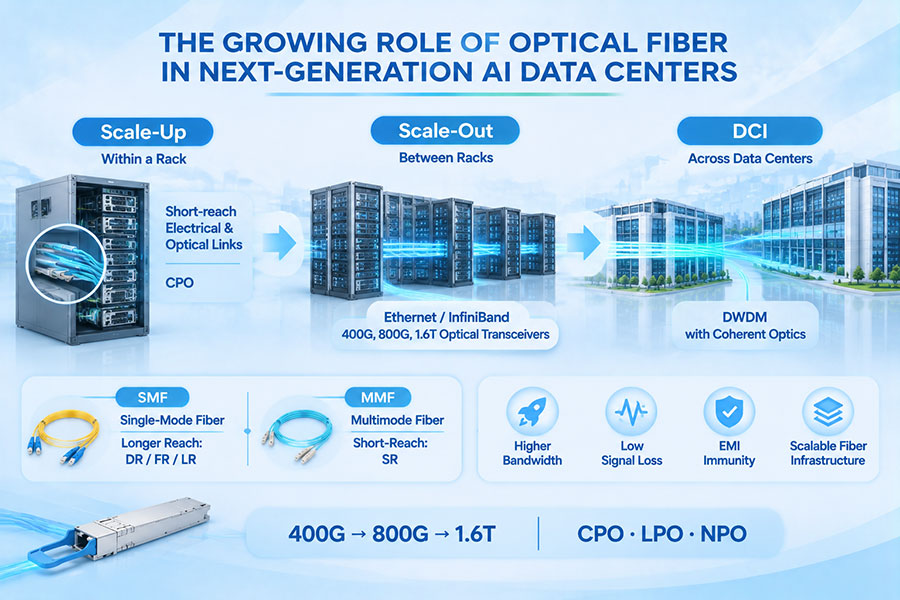
Distributed computing environments require optical connectivity at several levels. A useful way to understand the architecture is to separate the network into data center networks, data center interconnection, and data center access.
| Network Layer | Primary Function | Typical Connectivity |
|---|---|---|
| Data Center Network (DCN) | Connects servers, storage, accelerators, and switches inside a facility | DAC, AEC, AOC, and high-speed optical transceivers |
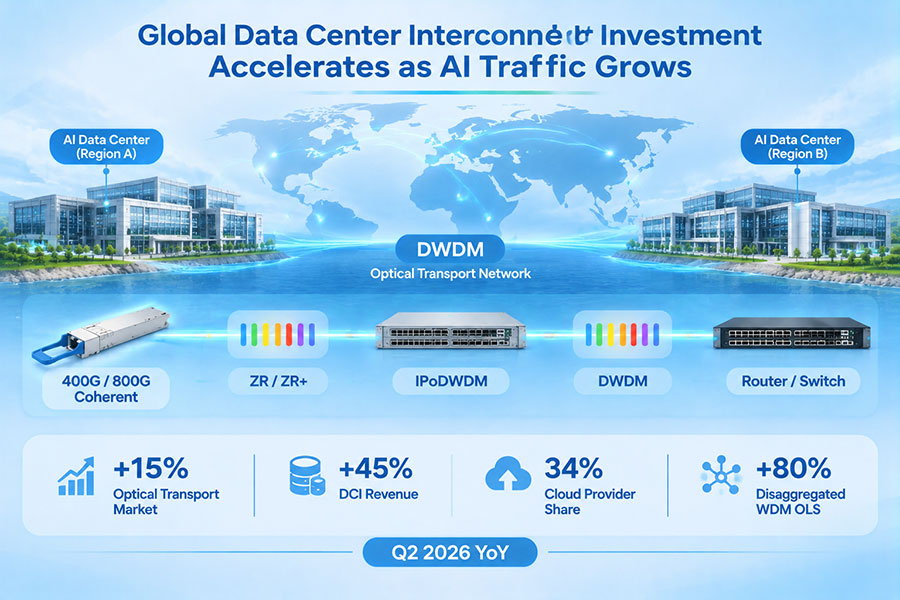
| Data Center Interconnection (DCI) | Connects separate data centers and computing facilities | Single-mode optical transceivers, DWDM, and coherent optics |
| Data Center Access (DCA) | Connects users, enterprise locations, edge facilities, and external networks | Optical access networks, Ethernet, and transport infrastructure |
Within a data center, short electrical and optical connections support communication between servers and switching equipment. Across facilities, single-mode fiber and high-capacity optical transport become more important. At the access layer, networks connect enterprise users, remote locations, and edge computing resources to centralized or distributed cloud platforms.
These layers must work together. Increasing bandwidth inside a data center without providing sufficient inter-site capacity can create bottlenecks when workloads or datasets need to move between facilities.
4. Data Center Interconnection Becomes a Critical Infrastructure Layer
Data Center Interconnection is the optical and networking infrastructure that links separate data centers. It allows computing resources, storage systems, and applications to communicate across facilities without requiring all workloads to operate in one physical location.
DCI is increasingly important for distributed cloud infrastructure, AI computing, disaster recovery, content delivery, and enterprise applications. Its requirements vary according to distance and application characteristics.
| DCI Deployment | Typical Distance Range | Connectivity Considerations |
|---|---|---|
| Same-campus interconnection | Hundreds of meters to several kilometers | High port density, fiber availability, and low-cost optical interfaces |
| Metro DCI | Several to tens of kilometers | Single-mode optics, optical amplification where needed, and route diversity |
| Regional DCI | Tens to hundreds of kilometers | DWDM transport, coherent optics, and optical link engineering |
| Long-haul DCI | Hundreds of kilometers and beyond | Coherent transmission, optical amplification, and advanced transport systems |
These distance categories are illustrative rather than fixed industry boundaries. The appropriate optical architecture depends on the actual fiber route, optical budget, channel capacity, latency requirements, and available line-system infrastructure.
For shorter DCI links, direct-detection optical transceivers may provide a suitable solution. As distance and aggregate capacity increase, coherent DWDM systems can offer greater spectral efficiency and transmission flexibility.
5. 400G, 800G, and 1.6T Increase Network Capacity
Distributed computing infrastructure requires more bandwidth as the number of connected servers, accelerators, and data centers grows. High-speed optical transceivers provide the physical interfaces needed to increase capacity between network devices.
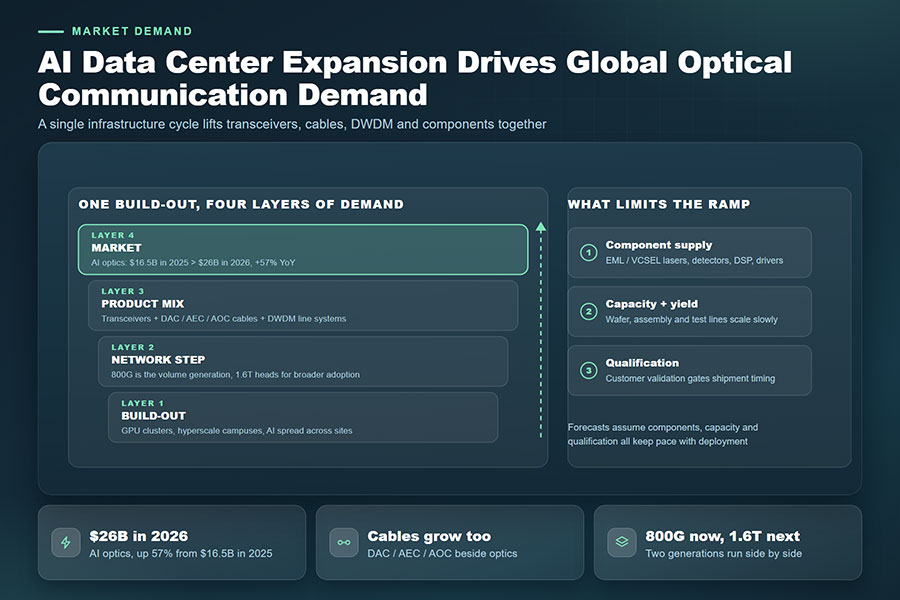
400G connectivity has become an important foundation for modern high-performance networks. 800G interfaces provide a further increase in port bandwidth, while 1.6T optical modules are emerging for next-generation switching platforms and high-density AI infrastructure.
| Optical Connectivity Generation | Aggregate Data Rate | Potential Network Role |
|---|---|---|
| 100G | 100 Gb/s | Enterprise links, access aggregation, and established transport systems |
| 400G | 400 Gb/s | High-capacity data center and regional network connections |
| 800G | 800 Gb/s | AI cluster fabrics, hyperscale switching, and high-capacity DCI |
| 1.6T | 1.6 Tb/s | Next-generation high-density switching and accelerator networks |
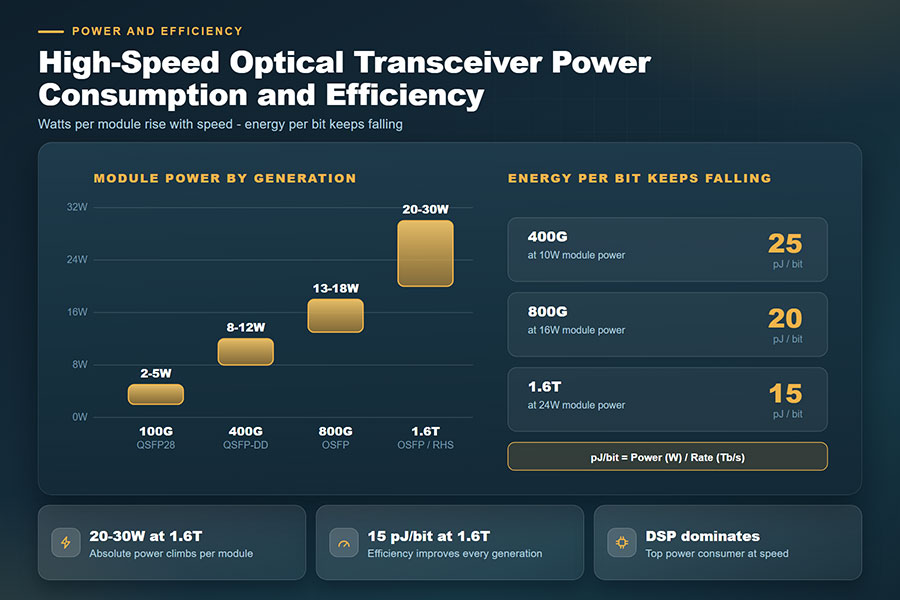
Higher-speed interfaces can increase the bandwidth available per port and help reduce the number of physical connections required for a given capacity target. However, the transition also increases requirements for electrical signaling, optical performance, power delivery, cooling, and fiber management.
In distributed environments, the best interface is determined by the role of each network connection. A short server-to-switch link may use a different technology from a metro DCI connection, even when both are part of the same computing platform.
6. DWDM Supports High-Capacity Connections Across Multiple Locations
Dense Wavelength Division Multiplexing allows multiple optical wavelengths to share the same fiber. Each wavelength carries an independent data channel, increasing the aggregate capacity of the fiber infrastructure.
This technology is particularly valuable for DCI and regional transport networks where operators need to connect multiple facilities over limited fiber resources.
A DWDM system typically includes several components:
Optical transponders: Convert client data into optical signals suitable for the transport system.
DWDM multiplexers: Combine multiple wavelengths onto a common fiber.
DWDM demultiplexers: Separate the wavelengths at the receiving end.
Optical amplifiers: Compensate for signal attenuation over longer fiber spans.
ROADMs: Allow selected wavelengths to be added, dropped, or routed through network nodes.
Network monitoring systems: Track optical power, channel conditions, and transmission performance.
For distributed computing infrastructure, DWDM can connect several data centers through a shared optical transport network. It also provides a flexible foundation for adding capacity as new facilities and computing clusters are deployed.
7. Coherent Optics Extends the Reach of Distributed Computing Networks
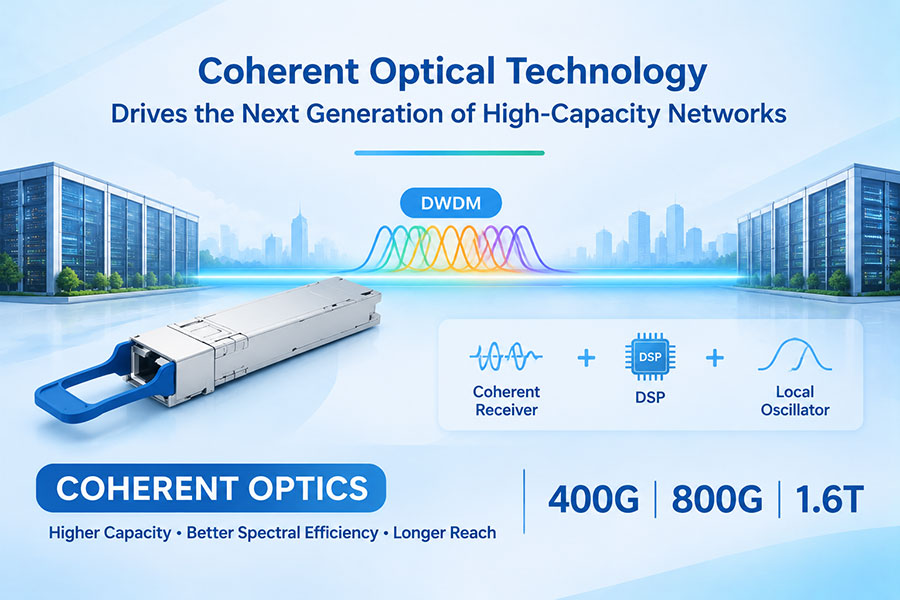
When distributed computing facilities are separated by long fiber routes, conventional short-reach optical modules may not provide the required transmission performance. Coherent optical technology addresses this challenge through advanced modulation, coherent detection, and digital signal processing.
Coherent transceivers can encode information in both the amplitude and phase of optical signals. Their receivers use a local oscillator and DSP to recover the transmitted information and compensate for important transmission impairments.
This makes coherent optics suitable for high-capacity metro, regional, and long-haul networks. It is also increasingly relevant to DCI, where operators need to connect geographically separated computing facilities.
Coherent technology offers several advantages:
Higher spectral efficiency through advanced modulation formats.
Digital compensation for chromatic dispersion and other signal impairments.
Support for high-capacity optical channels.
Compatibility with DWDM transport architectures when the module and line system are designed to work together.
Flexible bandwidth options for different DCI and backbone applications.
ZR, ZR+, and higher-capacity coherent solutions serve different reach and performance requirements. A compact coherent pluggable may be suitable for a particular metro or DCI route, while longer or more demanding connections may require dedicated transport equipment and a carefully engineered optical line system.
8. Edge Computing Expands the Need for Regional Optical Networks
Edge computing moves processing and storage closer to users, devices, and data sources. This approach can reduce the distance that certain applications need to travel to reach computing resources and can support applications requiring localized processing.
Examples include industrial automation, smart transportation, connected infrastructure, video analytics, and real-time data processing. These applications may rely on distributed edge facilities connected to regional cloud platforms and centralized data centers.
Optical fiber provides the high-capacity transport infrastructure required to connect these locations. Regional aggregation networks can collect traffic from multiple edge sites and forward it to larger computing facilities.
| Edge Computing Application | Traffic Characteristics | Optical Network Requirement |
|---|---|---|
| Industrial automation | Continuous equipment and sensor communication | Reliable fiber links and predictable network performance |
| Video analytics | Large volumes of video data | High-throughput regional aggregation |
| Smart transportation | Distributed real-time data exchange | Low-latency and resilient connectivity |
| Edge AI inference | Model requests, results, and data synchronization | Scalable connections between edge and cloud platforms |
| Enterprise edge services | Application and database access across locations | Secure, reliable, and flexible optical transport |
Not every edge application requires the same bandwidth or latency. Network planning must account for the type of workload, number of connected devices, data generation rate, geographic distribution, and service availability requirements.
9. Network Latency and Reliability Influence Distributed Computing Performance
Bandwidth is only one part of network performance. Distributed computing also depends on latency, packet loss, jitter, route stability, and the ability to recover from network failures.
For workloads distributed across multiple computing nodes, communication delays can affect synchronization and overall task completion time. This is particularly relevant to distributed AI training, where frequent exchanges between computing nodes may introduce synchronization overhead.
Optical fiber provides a predictable physical transmission medium, but the end-to-end latency of a network also depends on route length, switching, routing, queueing, and transport architecture.
| Performance Factor | Impact on Distributed Computing | Network Design Consideration |
|---|---|---|
| Bandwidth | Determines how much data can be transferred over a link | Capacity planning and link aggregation |
| Latency | Influences communication and synchronization time | Fiber route length and network topology |
| Packet loss | Can trigger retransmissions and reduce effective throughput | Congestion management and reliable transport |
| Jitter | Creates variation in packet delivery timing | Traffic management and queue design |
| Availability | Affects access to remote computing resources | Route diversity and protection mechanisms |
| Scalability | Determines how easily capacity can grow | Modular optical transport and flexible wavelength allocation |
For geographically distributed systems, physical distance places a fundamental limit on propagation latency. Higher optical data rates can increase available bandwidth, but they cannot remove the time required for signals to travel through fiber. Network architecture must therefore balance computing placement, route length, and capacity.
10. Optical Network Flexibility Supports Dynamic Workload Distribution
Distributed computing workloads are not always static. Cloud platforms may move applications between facilities, AI systems may allocate computing resources according to availability, and enterprise traffic can change significantly throughout the day.
Optical transport networks can support this flexibility through configurable wavelengths, ROADMs, software-defined control, and automated bandwidth management.
These capabilities allow network operators to provision or reconfigure capacity as demand changes. Rather than building every connection as a fixed point-to-point circuit, operators can use programmable optical infrastructure to manage resources across multiple locations.
Important capabilities include:
Wavelength provisioning: Assigns optical channels to specific network connections.
ROADM-based routing: Allows wavelengths to be added, dropped, or redirected at supported network nodes.
Network telemetry: Provides information about link performance and resource utilization.
Automated capacity management: Helps allocate available network resources according to traffic demand.
Failure recovery: Supports restoration through alternative paths where network design permits.
Flexible optical networking can make distributed infrastructure easier to scale, but automation must operate within physical limits such as available fiber capacity, optical signal quality, and equipment compatibility.
11. Energy Efficiency Becomes a Network Design Priority
Distributed computing infrastructure requires substantial electrical power for processors, memory, storage, cooling, and network equipment. As more computing facilities are connected, the energy consumption of the network becomes an increasingly important consideration.
Optical communication can provide high bandwidth over long distances with lower transmission loss than many alternative physical media. However, optical networks still consume power in transceivers, DSPs, switches, amplifiers, and cooling systems.
Network operators therefore need to evaluate energy efficiency across the complete transmission system rather than considering the optical module alone.
Several factors influence network energy consumption:
Optical transceiver power consumption and data rate.
Number of active optical links and network devices.
DSP complexity and electrical signal processing requirements.
Optical amplification and transport-system architecture.
Cooling efficiency and operating temperature.
Network utilization and traffic distribution.
Higher-capacity interfaces can reduce the number of ports needed for a given bandwidth target, but their individual power requirements may also be higher. The most efficient architecture depends on traffic volume, link distance, equipment utilization, and system design.
12. C-LIGHT Optical Connectivity for Distributed Computing Infrastructure
Distributed computing networks require a combination of short-reach connectivity, high-capacity data center links, and optical transport solutions for connections between facilities. Selecting the right product depends on network distance, data rate, fiber type, protocol, and host-platform compatibility.
C-LIGHT provides optical transceivers and high-speed connectivity products for data centers, cloud computing, AI clusters, high-performance computing, and telecommunications infrastructure.
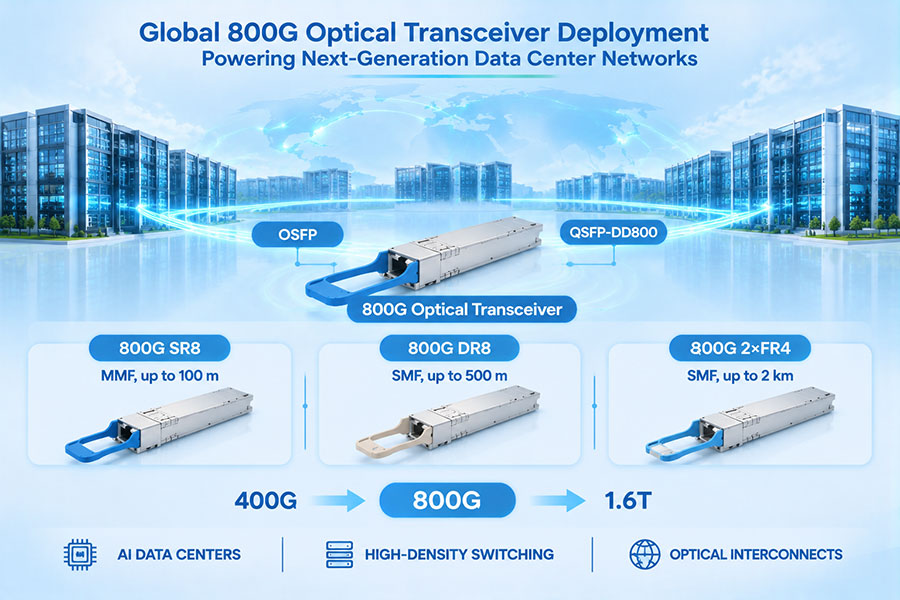
C-LIGHT 800G OSFP Optical Transceiver – Supports multiple configurations, including VR8 up to 50 m, SR8 up to 100 m, DR8 up to 500 m, and 2×FR4 up to 2 km. The product family also includes selected coherent 800ZR and 800ZR+ configurations for longer-reach applications.
C-LIGHT 1.6T OSFP-RHS Optical Transceiver – Provides 1.6 Tb/s aggregate connectivity using an 8×200G PAM4 architecture. The product family includes 2DR4 and 2FR4 configurations for high-density data center networks.
C-LIGHT DWDM DCO Coherent Transceivers – Offers 100G, 200G, 400G, and 800G coherent options for DWDM transport and DCI applications. Specific reach and performance depend on the selected model and optical line system.
C-LIGHT 800G AOC Cable – Provides integrated optical cable connectivity for compatible short- and medium-distance high-speed links in data center environments.
C-LIGHT 800G AEC Cable – Provides an active electrical connectivity option for compatible short-distance equipment connections.
C-LIGHT DAC, AEC, ACC, and AOC Solutions – Covers different high-speed cable requirements for server, switch, and rack-level connectivity.
C-LIGHT Optical Transceiver Portfolio – Includes multiple data rates and optical technologies, covering data center connectivity, DCI, DWDM, and other fiber-optic communication applications.
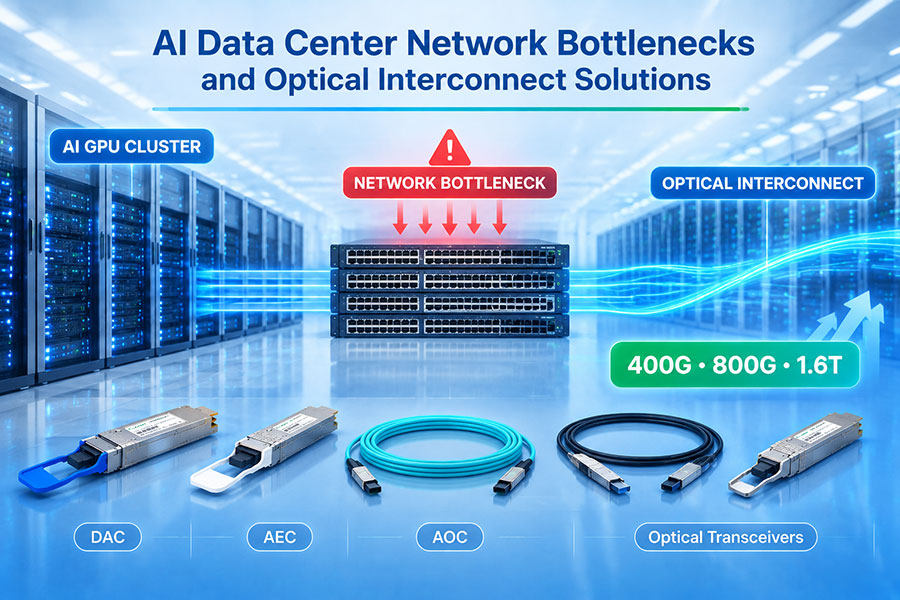
For intra-data-center connections, 800G and 1.6T optical transceivers can support high-bandwidth switching architectures. DAC, AEC, and AOC products address shorter links where their electrical or optical characteristics match the host platform.
For connections between geographically separated computing facilities, single-mode optical transceivers and coherent DWDM solutions may be more appropriate. The final selection should be based on the actual route distance, optical budget, required capacity, line-system compatibility, and host equipment specifications.
13. Future Optical Networks Will Become More Intelligent and Scalable
The development of distributed computing is encouraging a shift from fixed-capacity transport networks toward more flexible optical infrastructure. Future networks will need to support higher transmission rates, more distributed computing locations, and increasingly dynamic workload requirements.
Several technology directions are expected to influence this evolution:
Higher-capacity optical interfaces: 800G and 1.6T technologies will support higher bandwidth density in data center and transport networks.
Expanded DWDM capacity: Wider optical bandwidth and improved spectral efficiency will help increase the capacity of existing fiber infrastructure.
Coherent pluggable optics: Compact coherent modules will provide more flexible options for metro and DCI applications.
Optical circuit switching: Optical switching technologies may help manage large traffic flows in selected data center architectures.
AI-assisted network operations: Intelligent monitoring and automated resource management can improve network planning and operational efficiency.
Edge-to-cloud integration: Optical access, metro, and backbone networks will increasingly operate as interconnected parts of distributed computing infrastructure.
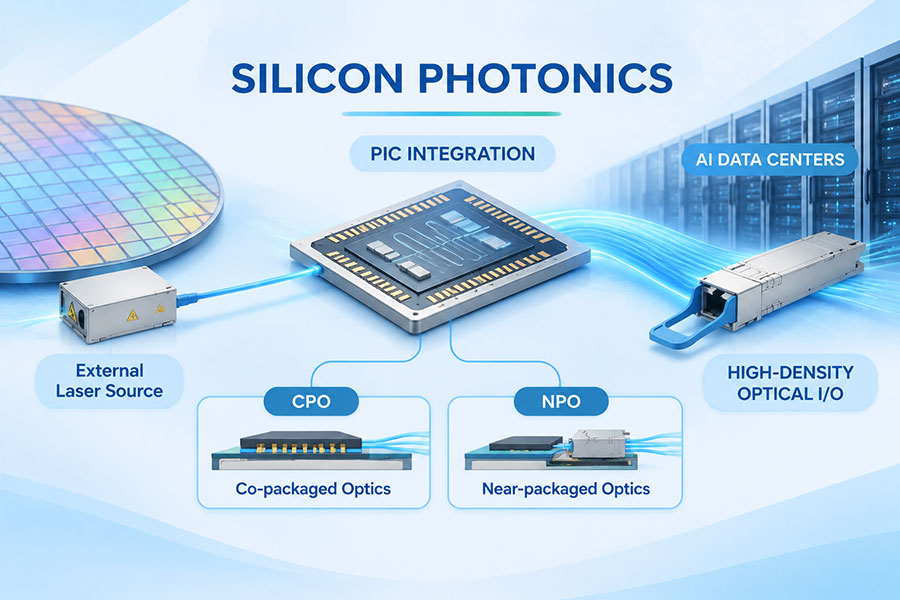
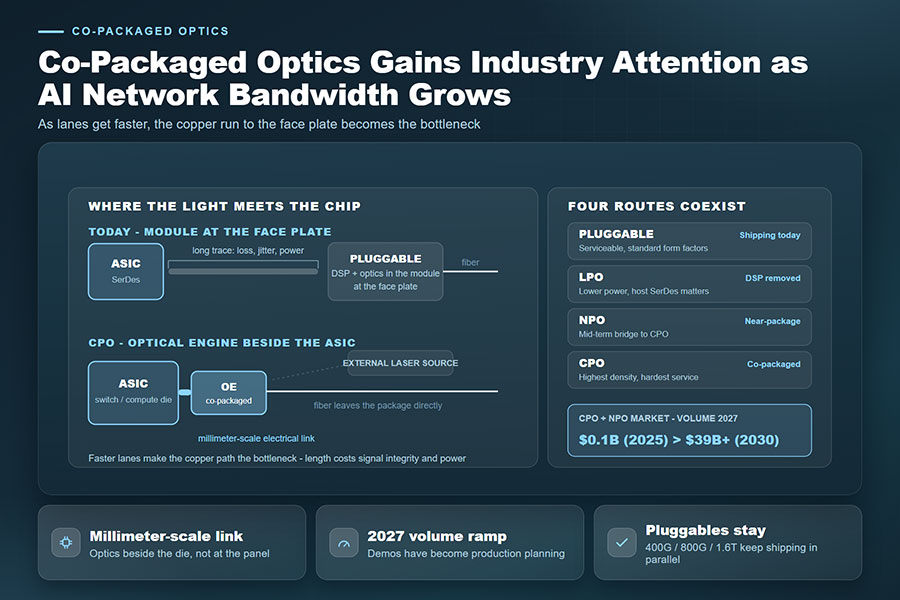
Advanced photonic integration: Silicon photonics, NPO, and CPO may support higher optical integration and improved system-level power efficiency.
The ITU-T ION-2030 framework describes an optical network architecture spanning data center interconnection, intra-data-center networks, and data center access. This reflects the growing need to coordinate optical infrastructure across the complete computing environment rather than treating individual data center links as isolated connections.
Future progress will depend on the coordination of optical components, switching systems, fiber infrastructure, network control, and computing resource management.
14. Conclusion
Distributed computing is increasing the importance of high-capacity optical networks. As AI training, cloud services, edge computing, and enterprise applications spread across multiple facilities, reliable high-bandwidth connections become essential for coordinating computing resources and moving data efficiently.
Within data centers, 400G, 800G, and emerging 1.6T optical interfaces support higher port bandwidth and more scalable switching architectures. Between facilities, DWDM and coherent optical technologies provide the capacity and transmission reach required for metro, regional, and long-haul interconnection.
Network performance also depends on latency, reliability, energy efficiency, fiber availability, and flexible bandwidth management. No single optical technology addresses every requirement. A successful distributed computing network combines short-reach electrical and optical connections with high-capacity fiber transport and appropriately engineered DCI infrastructure.
As computing resources become more geographically distributed, optical networks will remain a fundamental part of the infrastructure connecting data centers, cloud platforms, edge facilities, and next-generation AI systems.
For high-speed optical transceivers, DWDM DCO solutions, and data center connectivity requirements, Contact C-LIGHT for product information, technical support, and customized optical networking solutions.
 >

 >
 >
 >
 >
 >
 >
 >