TEL:+86 132 6656 7067





Global data traffic continues to increase as cloud computing, artificial intelligence, video services, enterprise applications, and international digital infrastructure expand. Long-haul optical networks carry enormous volumes of information between cities, regions, countries, and continents. As these networks approach higher capacity limits, operators need transmission technologies that can increase the amount of data carried by existing fiber infrastructure while maintaining signal quality over hundreds or thousands of kilometers.
Coherent optical technology has become a central part of this transition. Unlike conventional intensity-modulated direct-detection systems, coherent transmission uses advanced modulation, optical detection, and digital signal processing (DSP) to recover both the amplitude and phase information of optical signals. This enables higher spectral efficiency, improved tolerance to fiber impairments, and greater transmission capacity over long distances.
Developments in 400G and 800G coherent transceivers, tunable DWDM wavelengths, high-performance DSP, and optical amplification are extending the capabilities of backbone networks. At the same time, compact coherent pluggable modules are bringing technologies traditionally associated with large transport systems into routers, switches, and data center interconnection platforms.
1. Why Long-Haul Optical Networks Need Coherent Technology
Long-haul optical communication networks connect geographically separated infrastructure over extended fiber routes. These systems support telecommunications backbones, cloud platforms, international internet traffic, enterprise networks, and connections between major data centers.
As traffic volumes grow, operators face several interconnected challenges. Fiber availability is limited along some routes, installing new fiber infrastructure can be expensive, and existing transmission systems must accommodate higher data rates without compromising service reliability.
Increasing the number of wavelengths on a fiber is one way to raise total capacity. However, each wavelength must operate within the available optical spectrum and maintain sufficient signal quality after transmission through fiber, amplifiers, and other optical components.
Coherent transmission addresses these requirements through advanced signal processing and modulation techniques. It allows network operators to transmit more information within a given optical bandwidth and compensate for important transmission impairments.
| Long-Haul Network Challenge | Impact on Transmission | Coherent Technology Contribution |
|---|---|---|
| Limited fiber availability | Restricts opportunities to expand physical infrastructure | Improves spectral efficiency and capacity per fiber |
| Long transmission distance | Accumulates attenuation, dispersion, and noise | Uses coherent detection and DSP to recover degraded signals |
| Higher channel rates | Increases requirements for modulation and signal processing | Supports advanced modulation formats and high-speed optical interfaces |
| Growing network traffic | Requires more aggregate capacity across existing routes | Supports high-capacity DWDM transmission systems |
| Network upgrade costs | New fiber deployment and equipment replacement can be expensive | Can increase capacity on suitable existing fiber infrastructure |
Coherent optics does not eliminate the need for fiber expansion or new optical line systems. Its value is in improving the capacity and flexibility of transmission infrastructure when the fiber route and supporting equipment are suitable.
2. How Coherent Optical Transmission Works
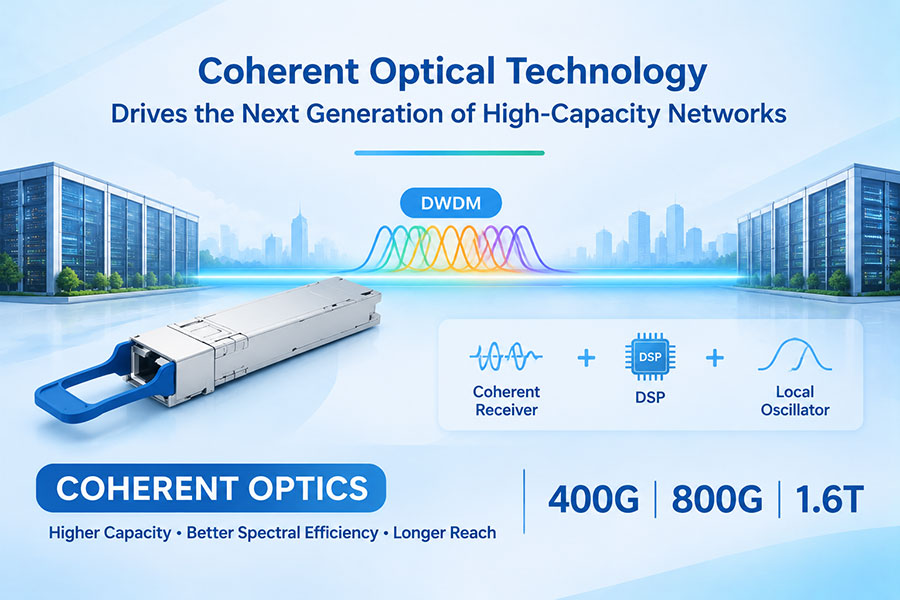
Conventional direct-detection receivers primarily measure the optical intensity of an incoming signal. Coherent receivers combine the received optical signal with a local oscillator laser and use optical mixing and balanced detection to recover information encoded in the signal's amplitude and phase.
This additional information enables coherent systems to use advanced modulation formats and sophisticated digital signal processing. The DSP performs functions such as chromatic dispersion compensation, polarization demultiplexing, carrier recovery, and forward error correction, depending on the system architecture.
A typical coherent transmission chain contains several major functional stages:
Coherent transmitter: Generates an optical signal using a laser source and optical modulator.
Advanced modulation: Encodes information in the optical signal's amplitude and phase.
Optical fiber link: Carries the signal through the transmission route.
Optical amplifiers: Compensate for accumulated optical attenuation where required.
Coherent receiver: Combines the incoming signal with a local oscillator and detects the resulting electrical signals.
Coherent DSP: Recovers the transmitted data and compensates for relevant transmission impairments.
FEC: Provides error-correction capability to improve the reliability of recovered information.
The combination of optical detection and digital processing makes coherent systems suitable for demanding transmission environments where conventional direct-detection approaches may not provide the required capacity or reach.
3. Advanced Modulation Improves Spectral Efficiency
Spectral efficiency describes how much information can be transmitted within a given optical bandwidth. It is an important consideration in long-haul networks because the usable optical spectrum is limited.
Coherent systems use modulation formats that encode information in the phase and amplitude of an optical carrier. QPSK and higher-order QAM formats are commonly associated with coherent transmission, although the appropriate format depends on the required reach, signal quality, and system design.
| Modulation Format | Bits per Symbol | General Characteristics | Typical Consideration |
|---|---|---|---|
| QPSK | 2 | Relatively robust against noise and transmission impairments | Suitable for demanding long-distance transmission designs |
| 8QAM | 3 | Higher spectral efficiency than QPSK | Requires a suitable signal-to-noise ratio |
| 16QAM | 4 | Higher information density per symbol | Requires better optical signal quality |
| 64QAM | 6 | Higher spectral efficiency | More demanding signal quality and operating conditions |
Higher-order modulation can increase the amount of information transmitted per symbol, but it generally requires a higher signal-to-noise ratio. This creates a trade-off between spectral efficiency and achievable transmission distance.
For example, QPSK is commonly used in long-reach coherent transmission because of its relatively strong tolerance to noise. Higher-order modulation formats such as 16QAM can support greater capacity per optical channel when the link budget and optical signal quality are sufficient.
Modern coherent DSP platforms may also use probabilistic constellation shaping and other advanced techniques to optimize transmission performance. These methods allow operators to balance capacity, reach, and optical spectrum utilization according to network requirements.
4. 400G and 800G Coherent Transmission Expand Backbone Capacity
The evolution of coherent technology is increasing the capacity available from individual optical channels. Earlier generations of long-haul networks relied heavily on 10G and 100G transmission systems. The introduction of 200G and 400G coherent technology significantly increased channel capacity, while 800G solutions are extending the capabilities of modern transport networks.
However, the data rate of a coherent transceiver does not determine its transmission distance by itself. Reach depends on modulation format, symbol rate, optical power, receiver sensitivity, DSP capability, fiber characteristics, amplifier configuration, and the required system margin.
| Coherent Data Rate | Network Application | Typical Deployment Considerations |
|---|---|---|
| 100G | Legacy transport upgrades and selected regional networks | Established coherent platforms and existing optical line systems |
| 200G | Regional and long-haul optical transport | Reach and spectral efficiency depend on the selected modulation and platform |
| 400G | High-capacity backbone, metro, and long-distance transmission | Widely relevant to modern coherent transport architectures |
| 800G | High-capacity transport and selected long-reach applications | Requires careful assessment of optical performance and line-system compatibility |
A 400G or 800G coherent channel can provide substantial capacity, but operators must evaluate the complete optical link rather than selecting equipment based only on its nominal data rate.
Research published in Nature Reviews Electrical Engineering in April 2026 examined the technologies required for large-capacity 400G long-haul optical networks. It highlighted the importance of high symbol rates, wide optical bandwidth, suitable fiber infrastructure, and coherent transmission performance for routes exceeding 1,500 km.
5. DWDM Maximizes the Capacity of Existing Fiber Infrastructure
Dense Wavelength Division Multiplexing (DWDM) is a fundamental technology in high-capacity optical transport. It allows multiple optical channels operating at different wavelengths to share a single fiber, increasing total transmission capacity without requiring a separate fiber for every channel.
When coherent transceivers are combined with DWDM systems, each wavelength can carry a high-capacity data stream using advanced modulation and digital signal processing.
A coherent DWDM network typically includes:
Coherent transponders or transceivers: Generate and receive high-capacity optical channels.
DWDM multiplexers: Combine multiple wavelengths onto a shared fiber.
DWDM demultiplexers: Separate wavelengths at the receiving end.
Optical amplifiers: Compensate for signal attenuation along the transmission route.
ROADM equipment: Enables wavelength routing and optical channel management at selected network nodes.
Optical monitoring systems: Monitor channel power, wavelength, and transmission conditions.
The aggregate capacity of a DWDM fiber depends on the number of active channels, the data rate of each channel, spectral spacing, usable optical bandwidth, and the performance of the optical line system.
For operators with limited fiber resources, combining coherent transmission with DWDM can provide an effective way to increase capacity per fiber pair. However, spectrum planning and optical engineering remain essential to achieving the expected performance.
6. Optical Amplification and OSNR Are Critical for Long-Distance Links
Optical signals lose power as they travel through fiber. Over long routes, optical amplifiers are used to restore signal power and support transmission across multiple fiber spans.
Erbium-Doped Fiber Amplifiers (EDFAs) are widely used in long-haul DWDM networks, particularly in the C-band. Raman amplification can also be used in suitable system designs to improve transmission performance and manage the optical signal-to-noise characteristics of the link.
Amplification does not restore a signal to its original quality without limitation. Optical amplifiers introduce noise, and noise accumulates as the signal passes through multiple spans. This makes the Optical Signal-to-Noise Ratio (OSNR) a key parameter in coherent network engineering.
OSNR describes the relationship between optical signal power and noise power within a specified measurement bandwidth. Coherent receivers require sufficient OSNR to recover transmitted information with acceptable error performance.
Important factors affecting long-haul OSNR include:
Fiber attenuation and span length.
Amplifier noise figure and gain configuration.
Number of amplifier stages.
Optical channel power and loading conditions.
Modulation format and symbol rate.
Fiber nonlinear effects.
Filtering and other optical component losses.
Network engineers must evaluate OSNR alongside other transmission parameters. Increasing launch power does not always improve performance because excessive optical power can increase nonlinear interference in the fiber.
7. Fiber Impairments and Coherent DSP Compensation
Long-distance optical transmission is affected by several physical phenomena that can degrade signal quality. Coherent systems use DSP to compensate for important impairments and recover information from signals that have traveled through complex fiber routes.
| Fiber Impairment | Effect on Transmission | Coherent System Response |
|---|---|---|
| Chromatic dispersion | Different wavelength components travel at different speeds | Digital dispersion compensation |
| Polarization mode dispersion | Different polarization components experience different delays | Adaptive polarization processing and equalization |
| Phase noise | Laser phase variations affect signal recovery | Carrier phase estimation and recovery |
| Fiber nonlinearities | Signal propagation becomes power-dependent and distorted | DSP-based compensation where supported, together with optical link optimization |
| Optical noise | Reduces the quality of the received signal | FEC and appropriate modulation and coding strategies |
DSP capability is one of the major factors distinguishing coherent optical transmission from simpler direct-detection systems. It allows the receiver to process complex signal information and compensate for transmission effects that would otherwise limit capacity or reach.
Nevertheless, digital processing cannot completely eliminate all physical impairments. The optical link must still operate within its designed power, OSNR, nonlinear, and dispersion limits.
8. Coherent Pluggable Transceivers Simplify Network Architecture
Traditional long-haul coherent transmission often relies on dedicated transponder equipment that connects client interfaces to DWDM line systems. These platforms provide substantial processing and optical performance but can require additional equipment, rack space, and operational complexity.
Coherent pluggable transceivers integrate coherent optical functions into compact module form factors. This allows compatible routers and switches to connect directly to optical transport networks, reducing the need for some external transponder functions.
400ZR and OpenZR+ are important developments in this area. They extend coherent transmission into more compact pluggable interfaces, although their specifications and intended applications differ.
| Technology | General Positioning | Key Characteristics |
|---|---|---|
| 400ZR | Standardized coherent pluggable interface | Designed primarily for high-capacity data center interconnection and compatible DWDM applications |
| OpenZR+ | Extended coherent pluggable ecosystem | Supports additional operating modes and applications beyond the basic 400ZR profile, depending on implementation |
| 800ZR | Next-generation high-capacity coherent interface | Extends coherent pluggable capacity toward 800G for compatible optical systems |
| Performance-optimized transponders | Long-haul and demanding transport networks | Can prioritize spectral efficiency, reach, and advanced signal processing without the same pluggable power constraints |
Coherent pluggables are not universal replacements for dedicated transport transponders. Some long-haul and submarine routes require performance levels, optical power, or operational features that are better addressed by specialized transport equipment.
The choice between a pluggable coherent module and a dedicated transponder depends on route length, required capacity, optical line-system compatibility, power budget, and network operating model.
9. Coherent Optics Extends from Long-Haul Networks to DCI
Coherent technology was initially associated with long-haul, backbone, and submarine optical networks. Its combination of high spectral efficiency and advanced signal processing made it suitable for transmission over demanding fiber routes.
As coherent DSP technology became more compact and power-efficient, coherent pluggable modules began expanding into metropolitan networks and data center interconnection applications.
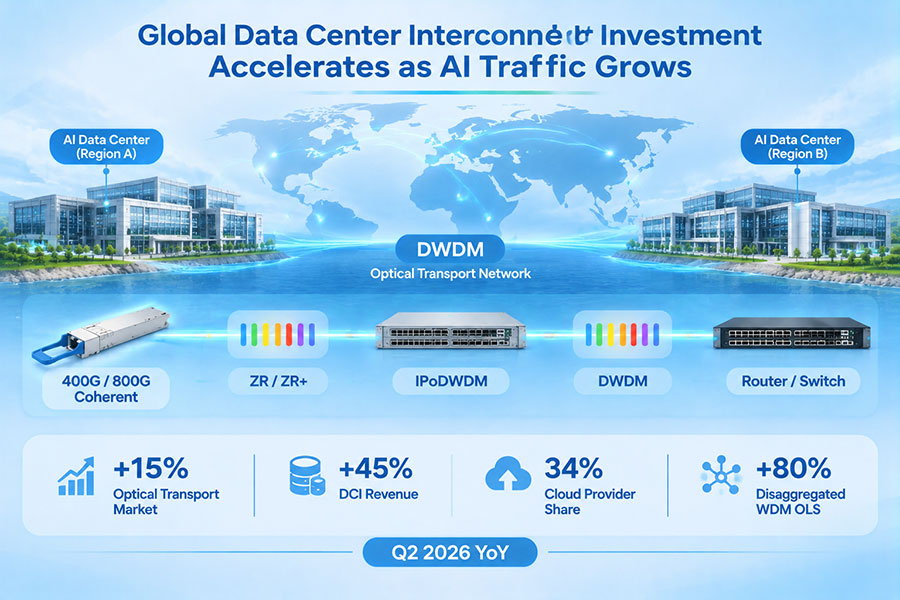
AI infrastructure is accelerating this trend. Large data center campuses and geographically distributed computing facilities need high-capacity connections for data replication, storage, distributed processing, and AI workload coordination.
ZR and ZR+ coherent modules provide different options for these applications, while higher-capacity coherent platforms are being developed for increasingly demanding interconnection requirements.
The distinction between long-haul transport and DCI remains important. A coherent module designed for a particular metro or DCI reach is not automatically suitable for a much longer backbone route. Long-haul deployments require detailed evaluation of fiber attenuation, amplifier spacing, OSNR, dispersion, nonlinear effects, and system margin.
10. Submarine Cable Networks Depend on Advanced Coherent Transmission
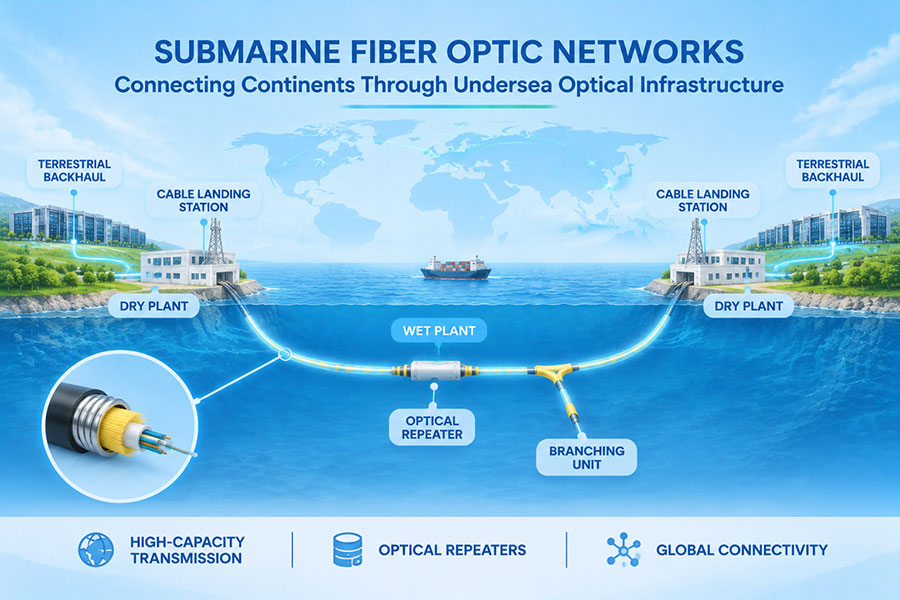
Submarine fiber-optic cables carry a substantial share of international data traffic. These systems connect continents and major telecommunications markets through undersea fiber routes that may extend thousands of kilometers.
Because submarine cable capacity is expensive to deploy and difficult to expand physically, operators place strong emphasis on maximizing the capacity of installed fiber pairs.
Coherent transmission supports this objective through high spectral efficiency, advanced modulation, and sophisticated DSP. Modern submarine systems are engineered around the characteristics of the wet plant, including cable attenuation, repeater design, available optical bandwidth, and power-feeding constraints.
Important technology considerations include:
High-capacity coherent transponders.
Optimized modulation and coding strategies.
Submarine repeaters and optical amplification.
Fiber characteristics and nonlinear transmission limits.
Available C-band and L-band optical spectrum.
System-level capacity and reliability planning.
Submarine cable systems should not be treated as ordinary terrestrial DWDM links. Their repeaters, power-feeding equipment, optical amplifiers, and wet-plant engineering are specialized. Terrestrial coherent transceivers may serve compatible terminal or backhaul applications, but they are not substitutes for submarine wet-plant equipment.
11. Coherent Optical Network Design and Performance Evaluation
Deploying coherent optics over long distances requires more than choosing a transceiver with the desired data rate. Operators must evaluate the complete transmission path and ensure that the optical equipment, fiber infrastructure, and line system work together.
| Parameter | Engineering Purpose | Why It Matters |
|---|---|---|
| Transmission distance | Defines the optical route length | Influences attenuation, amplification, and achievable reach |
| OSNR | Measures optical signal quality relative to noise | Determines whether the receiver can recover the signal reliably |
| Optical launch power | Defines transmitted channel power | Influences received power and nonlinear effects |
| Channel spacing | Defines the frequency separation between DWDM channels | Affects spectral packing and system compatibility |
| Modulation format | Determines how information is encoded | Influences spectral efficiency and signal-quality requirements |
| FEC performance | Provides error correction | Helps maintain data integrity under supported operating conditions |
| Fiber type | Defines the physical transmission medium | Affects attenuation, dispersion, and nonlinear behavior |
| Optical line compatibility | Checks interoperability with amplifiers, filters, and ROADMs | Prevents mismatches between transceivers and transport infrastructure |
For multi-span networks, engineers should use the actual fiber-route data and optical equipment specifications to calculate the link budget and evaluate OSNR. Theoretical reach figures from a transceiver datasheet should not be treated as guaranteed performance across every fiber route.
12. C-LIGHT Coherent DWDM Solutions for High-Capacity Optical Networks
As long-haul and regional optical networks move toward higher channel capacities, coherent transceivers provide an important option for backbone transmission, DWDM transport, and data center interconnection.
C-LIGHT offers a range of DWDM Digital Coherent Optics (DCO) transceivers designed for different data rates, form factors, and transmission requirements.
C-LIGHT 800G/400G/200G/100G DWDM DCO Coherent Transceivers – A coherent product portfolio covering multiple data rates and form factors, including QSFP28, CFP2, QSFP-DD, and OSFP. Selected configurations support C-band tunable DWDM operation.
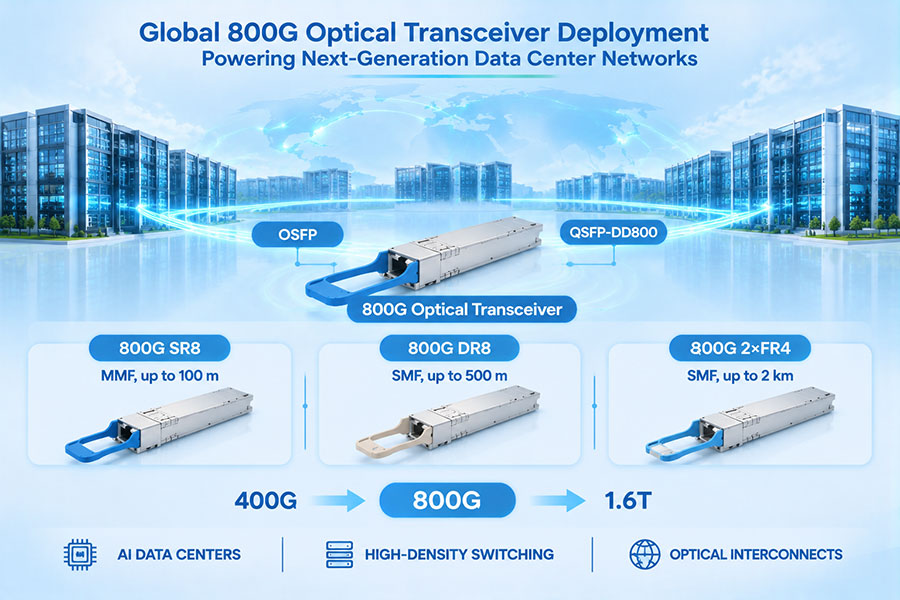
800G QSFP-DD and OSFP DCO – Selected 800ZR configurations are specified for 120 km, while 800ZR+ variants include configurations listed for 340 km and 500 km. Actual reach depends on the selected model and optical system conditions.
400G QSFP-DD DCO – Available in different reach configurations, including 120 km and 300 km variants, with selected high-performance configurations specified for longer transmission applications.
400G CFP2 DCO – A coherent transceiver option for DWDM transport systems, with selected product configurations specified for transmission distances up to 500 km.
200G and 100G CFP2 DCO – Coherent transmission options for regional and long-distance optical transport, with selected configurations listed for distances up to 2,000 km.
These product distances are model-specific reference specifications, not universal reach guarantees. Actual deployment requires confirmation of modulation mode, optical power, OSNR, fiber route, amplification, channel loading, and host-platform compatibility.
For broader optical network requirements, C-LIGHT also provides optical transceiver solutions covering multiple data rates and application environments.
13. Future Developments in Coherent Optical Communication
Coherent technology continues to evolve as operators seek higher transmission capacity, lower cost per bit, improved energy efficiency, and greater network flexibility. Several developments are expected to influence the next generation of optical transport systems.
Higher-capacity coherent channels: Progress in DSP, modulators, photonic integration, and high-speed electronic components will support the development of 800G and future higher-capacity transmission interfaces.
Expanded optical bandwidth: Wider use of C-band and L-band transmission can increase the available spectrum for DWDM networks, although amplifier performance and fiber characteristics must be considered.
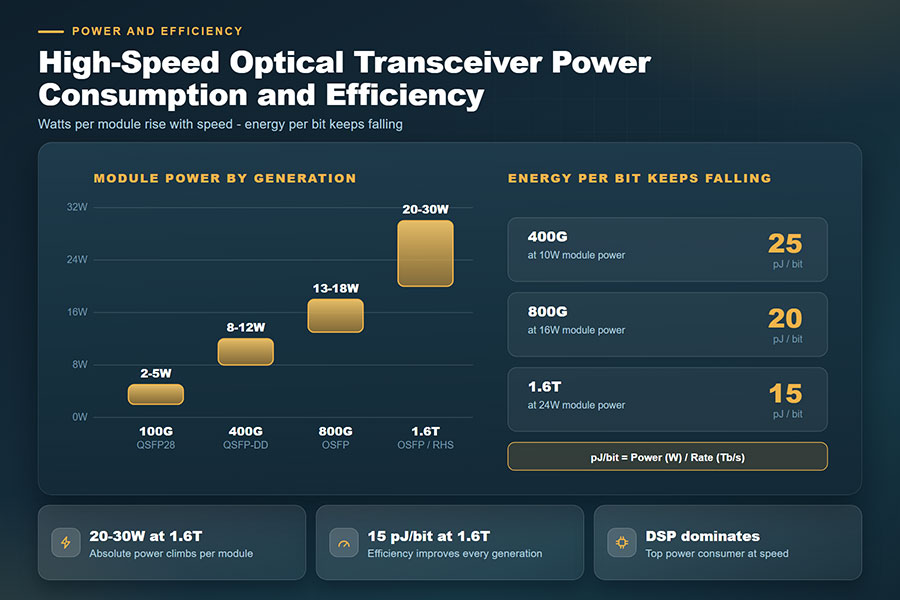
More efficient coherent DSP: Improvements in signal processing can help balance modulation performance, power consumption, latency, and transmission reach.
Compact coherent pluggables: QSFP-DD and OSFP coherent modules will continue to support more direct integration with routers and switches in compatible network architectures.
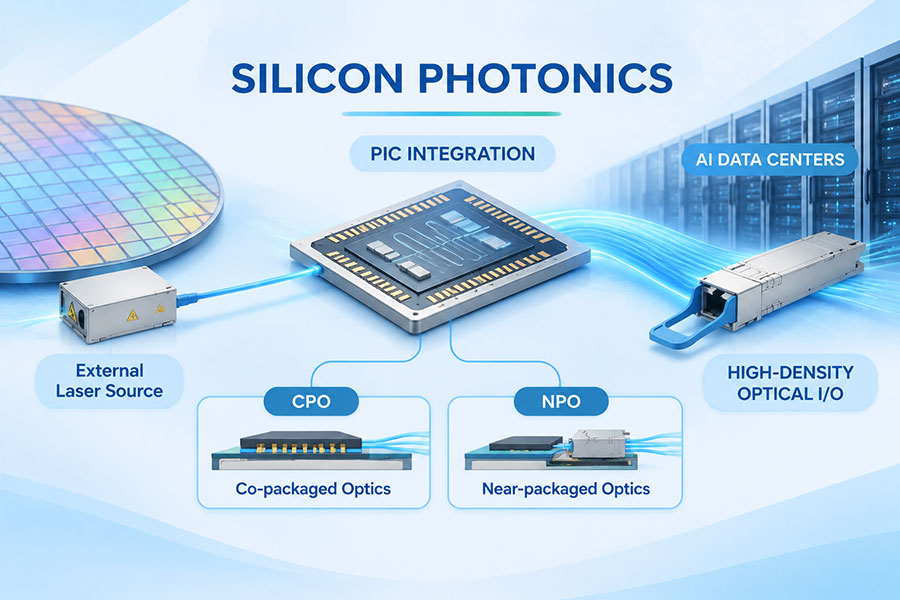
Advanced optical integration: Silicon photonics and other photonic integration platforms may support more compact optical engines and improve manufacturing scalability.
Flexible optical transport: Software-controlled wavelength configuration, ROADMs, and disaggregated optical systems will give operators more flexibility in managing network capacity.
AI-assisted network optimization: Intelligent monitoring and automated network planning can help operators identify performance changes, optimize channel allocation, and manage increasingly complex optical infrastructure.
These developments will not eliminate the need for traditional transport engineering. Instead, they will provide more tools for designing networks around specific route lengths, capacity targets, optical spectrum constraints, and operational requirements.
14. Conclusion
Coherent optics is playing an increasingly important role in long-haul optical communication as global data traffic drives demand for higher-capacity and more efficient fiber networks. Through advanced modulation, coherent detection, and digital signal processing, the technology enables high-capacity transmission over demanding optical routes.
The combination of 400G and 800G coherent transceivers with DWDM, optical amplification, and advanced fiber infrastructure is helping operators increase the capacity of backbone networks and improve the utilization of existing fiber resources.
Coherent pluggable modules are also extending this technology into metropolitan networks and data center interconnection, creating more flexible options for high-capacity connectivity. However, long-haul deployment still requires careful engineering of OSNR, optical power, fiber impairments, channel spacing, and line-system compatibility.
As coherent DSP, photonic integration, and optical transport technologies continue to advance, coherent transmission will remain a fundamental technology for future backbone, regional, submarine, and high-capacity interconnection networks.
For 100G to 800G coherent DWDM transceivers and high-capacity optical connectivity requirements, Contact C-LIGHT for product information, technical support, and customized optical networking solutions.
 >

 >
 >
 >
 >
 >
 >
 >