TEL:+86 132 6656 7067





International data traffic continues to increase as cloud computing, artificial intelligence, video streaming, financial services, and global digital platforms expand across regions. Behind this growth is a physical infrastructure network that connects continents and enables large volumes of information to move between countries: submarine fiber-optic cables.
These undersea systems form the backbone of international telecommunications. They carry the vast majority of intercontinental data traffic and provide the high-capacity connections required by cloud providers, telecommunications operators, enterprises, and content platforms. As AI workloads and hyperscale data centers generate additional demand, investment in new submarine cable routes and capacity upgrades is gaining momentum.
The investment landscape is also changing. Traditional telecommunications consortia remain important, but major cloud and technology companies are increasingly financing, owning, or participating in submarine cable systems. New projects are introducing higher fiber-pair counts, space-division multiplexing, advanced coherent transmission, and innovative fiber designs to increase capacity while improving route diversity.
1. Why Global Submarine Cable Investment Is Accelerating
International connectivity requirements are changing as digital services become more distributed. Data is no longer concentrated within a small number of national networks. Cloud platforms operate across multiple regions, enterprises use geographically distributed infrastructure, and AI applications increasingly depend on communication between large computing facilities.
Submarine cable investment is being driven by several interconnected factors:
International bandwidth growth: Video, cloud applications, enterprise services, and AI workloads require increasing amounts of cross-border transmission capacity.
Hyperscale data center expansion: New data center clusters create demand for direct, high-capacity connections between major digital infrastructure hubs.
AI infrastructure development: Distributed AI computing and large-scale data movement are increasing the strategic importance of reliable international connectivity.
Network resilience: Operators are investing in alternative routes to reduce dependence on individual cable corridors and landing locations.
Aging infrastructure: Existing cable systems eventually require replacement, modernization, or additional capacity.
Emerging digital markets: New international routes improve connectivity for regions with limited access to major submarine cable networks.
Submarine cables are long-term infrastructure investments. Planning, marine surveys, permitting, manufacturing, installation, and commissioning can take several years. Consequently, investment decisions made today are intended to support traffic requirements well into the future.
2. Global Investment Reaches a New Level
Recent industry research indicates that submarine cable investment is entering one of its most active periods in decades. According to TeleGeography's 2026 industry update, the value of new submarine cable construction planned to enter service between 2026 and 2029 exceeds US$16 billion.
The International Telecommunication Union (ITU) also reported substantial growth in the sector. Its Global Connectivity Report 2025 indicated that submarine cable investment increased from approximately US$0.8 billion in 2015 to US$9.7 billion in 2025, with cumulative investment exceeding US$45 billion over that period.
| Market Indicator | Reported Figure | Industry Significance |
|---|---|---|
| Planned cable construction investment | More than US$16 billion | Projects planned to enter service during 2026–2029 |
| Annual submarine cable investment | Approximately US$9.7 billion | Reported investment level in 2025 by ITU |
| Cumulative investment | More than US$45 billion | Reported cumulative investment from 2015 to 2025 |
| Operational global cable network | More than 500 systems | ITU's reported global network scale in 2025 |
| Global submarine cable length | More than 1.4 million km | Approximate network length reported by ITU |
These figures use different reporting periods and definitions. Planned construction costs are not the same as annual investment expenditure, while cumulative investment includes projects completed over multiple years.
Nevertheless, the scale of announced projects demonstrates the strategic importance of submarine infrastructure. Investment is increasingly directed toward both major intercontinental routes and regional connections that support growing data center and telecommunications markets.
3. Hyperscale Technology Companies Reshape Cable Ownership
Historically, international submarine cable systems were commonly developed through consortia of telecommunications operators. Multiple carriers shared construction costs, capacity, and operational responsibilities.
The expansion of cloud computing has introduced another major group of investors. Large technology companies increasingly participate directly in submarine cable development because international bandwidth is essential to their cloud platforms, content delivery networks, and global data center operations.
This change creates several advantages for large infrastructure users:
Greater capacity control: Direct investment provides more influence over the capacity available for internal network requirements.
Route planning flexibility: Cable routes can be designed around major data center locations and strategic connectivity hubs.
Long-term capacity planning: Dedicated infrastructure supports future traffic requirements and reduces dependence on leased capacity alone.
Network resilience: Additional independently routed systems provide alternative paths during outages or maintenance events.
Integration with cloud infrastructure: Submarine systems can connect directly with terrestrial fiber networks and regional data center facilities.
Telecommunications carriers remain essential participants. They provide landing stations, terrestrial backhaul, international network services, and operational expertise. The evolving ownership model is therefore creating a broader ecosystem involving carriers, hyperscalers, cable manufacturers, system integrators, and infrastructure investors.
4. New Submarine Cable Projects Expand International Connectivity
Several projects announced or advancing in 2026 illustrate how investment is being distributed across major international routes. These developments also show that cable expansion is not limited to traditional transatlantic and transpacific corridors.
| Project | Route or Region | Published Capacity or Scale | Expected Development |
|---|---|---|---|
| Petal | France–United States | 1 Pbps target capacity | Expected service in 2029 |
| Intra-Asia Marine Cable | Japan–Malaysia–Singapore, with additional regional connectivity | Approximately 320 Tbps initial design capacity | Planned service in 2029 |
| Fastnet | United States–Ireland | More than 320 Tbps planned capacity | Expected service in 2028 |
| APX East | Australia–United States | New direct transpacific route | Targeted for 2028 |
| Synapse | Brazil–United States | Approximately 9,700 km route and 16 fiber pairs | Expected completion around 2029–2030 |
Project specifications and schedules reflect publicly announced plans and may change during engineering, permitting, manufacturing, and installation.
These developments highlight several important trends:
New transatlantic systems are pursuing substantially higher total capacity.
Asia-Pacific investment is expanding connections between major regional data hubs.
New routes are being developed to connect emerging data center markets.
Hyperscale companies are playing a larger role in financing and planning international infrastructure.
New cable designs are targeting greater capacity without proportional increases in physical infrastructure.
5. AI and Cloud Computing Increase the Importance of Submarine Networks
AI infrastructure is becoming a significant driver of international connectivity investment. Large AI systems require access to data, computing resources, storage, and cloud platforms that may be distributed across multiple locations.
Although most AI training traffic remains within data center networks or between nearby facilities, international submarine cables provide the connectivity required to link geographically separated cloud regions, content platforms, and digital infrastructure.
Several applications are contributing to this demand:
Distributed cloud infrastructure: Cloud providers connect regional data centers to support applications and services across countries.
AI model development: Data and computing resources may be distributed across different facilities and regions.
Global inference services: AI applications require reliable access to cloud platforms and regional computing resources.
Content delivery: Video, software, and digital services generate substantial international traffic.
Enterprise connectivity: Financial institutions and multinational companies depend on reliable international communication.
Data replication: Distributed storage systems and disaster-recovery infrastructure require high-capacity links between regions.
The connection between AI and submarine cable investment is therefore broader than simply transmitting AI training data across oceans. AI infrastructure increases the need for reliable, scalable connectivity throughout the international network ecosystem.
As cloud providers establish additional data center regions, submarine routes become important components of their long-term infrastructure planning. New cable landing stations and terrestrial backhaul networks are also being developed to connect these systems with local data center clusters.
6. Space-Division Multiplexing Increases Submarine Cable Capacity
One of the most important technical developments in modern submarine cable systems is space-division multiplexing (SDM). Traditional capacity expansion relies heavily on improving the transmission performance of each fiber pair. However, physical, optical, and power constraints limit how far this approach can scale.
SDM increases total system capacity by providing additional spatial transmission paths within a cable system. In practical submarine cable designs, this can involve increasing the number of fiber pairs and optimizing the amplification architecture.
Its major advantages include:
Higher aggregate transmission capacity within a single cable system.
More efficient allocation of optical power across multiple fiber pairs.
Improved capacity scaling as international traffic grows.
Greater flexibility for designing high-capacity submarine routes.
Potential improvements in capacity per unit of infrastructure investment.
Multi-core fiber is another developing approach. Instead of using separate conventional cores within each fiber strand, multiple light-guiding cores can be integrated into a single fiber structure. This creates opportunities to increase spatial transmission density, although crosstalk, fiber manufacturing, amplification, and system reliability require careful engineering.
7. Coherent Optical Transmission Enables Higher Capacity Over Long Distances
Submarine cable systems operate over distances that can extend thousands of kilometers. Optical signals experience attenuation and other transmission impairments as they travel through the fiber, making advanced optical transmission technology essential.
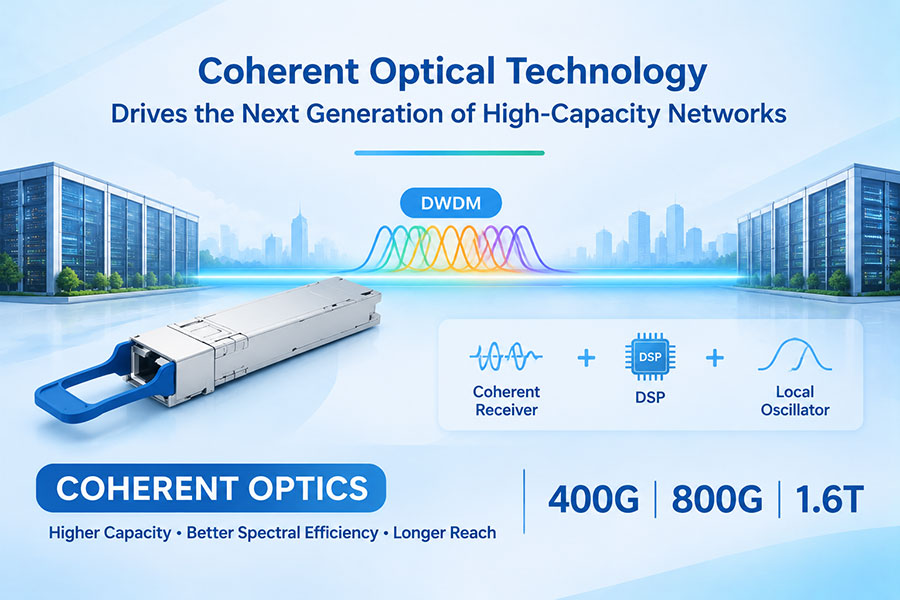
Coherent optical communication has become a central technology in modern long-distance submarine networks. It uses information encoded in the amplitude and phase of an optical signal and employs digital signal processing to compensate for transmission impairments.
Important technologies include:
Coherent detection: Enables recovery of complex optical modulation formats and supports high spectral efficiency.
Digital signal processing: Compensates for chromatic dispersion, polarization effects, and other signal impairments.
Advanced modulation formats: Allow operators to adjust transmission performance according to route conditions and optical link budgets.
Wavelength-division multiplexing: Transmits multiple optical channels through the same fiber infrastructure.
Optical amplification: Compensates for signal attenuation along long-distance cable routes.
Coherent technology also supports flexible capacity planning. Operators can select modulation formats and transmission parameters according to the distance, fiber characteristics, available optical power, and required capacity.
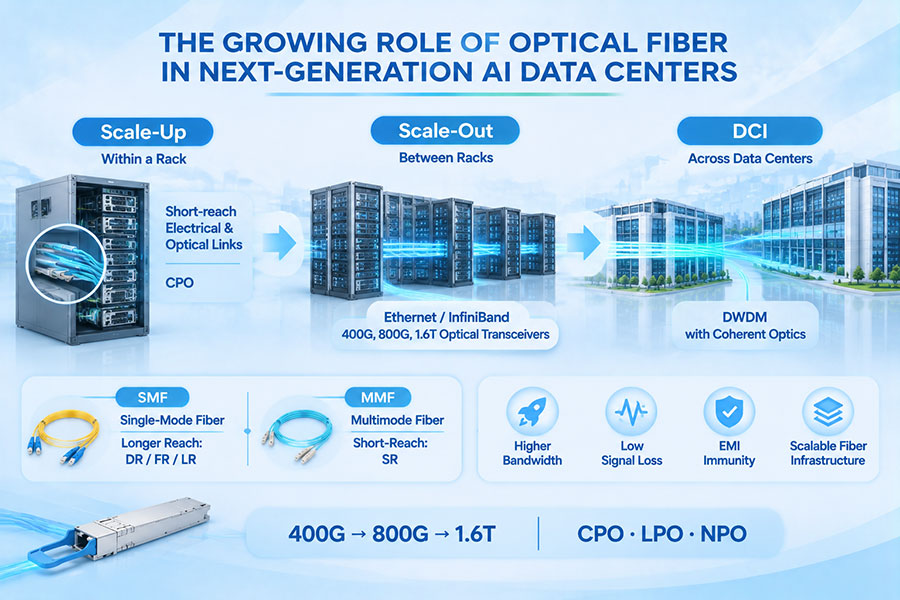
For terrestrial metro and regional networks connected to submarine cable landing stations, coherent pluggable modules can provide compact, high-capacity interfaces. C-LIGHT's DWDM coherent optical transceiver solutions address applications involving high-capacity optical transport. Specific module configurations must be matched to the transmission distance, line system, wavelength plan, and host platform.
8. DWDM and Optical Line Systems Support International Capacity Expansion
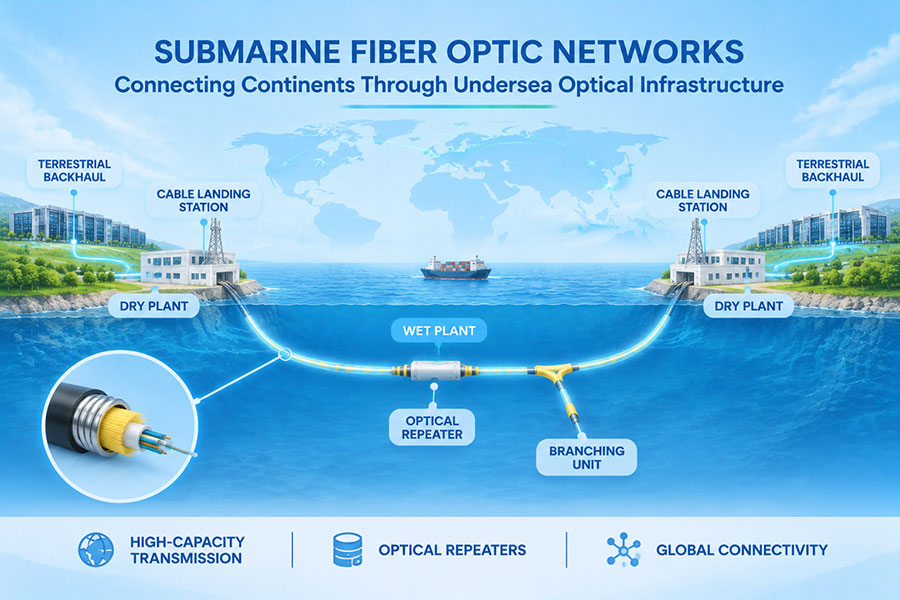
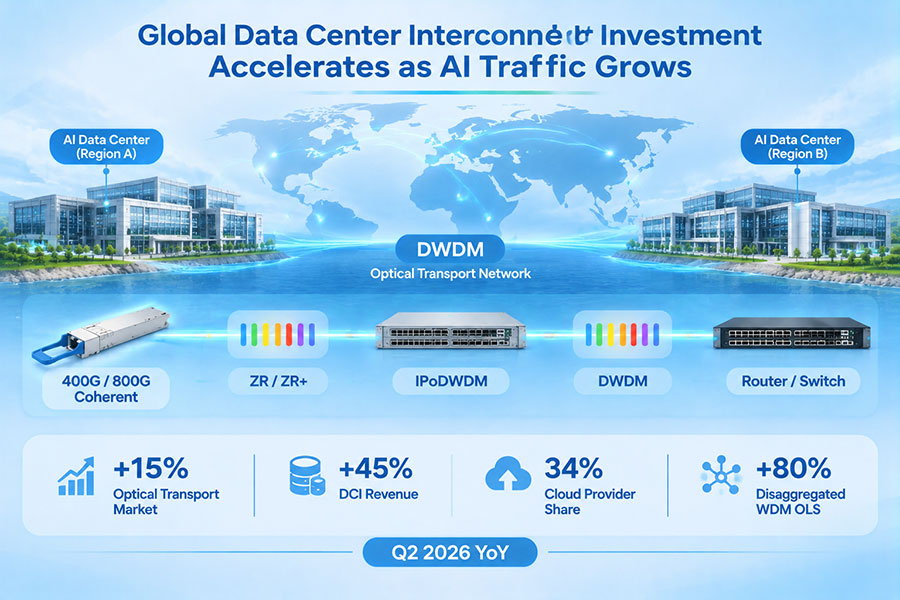
Submarine cable systems do not operate independently of terrestrial networks. At each landing location, international traffic must be transferred to regional and national fiber infrastructure. DWDM and optical line systems play an important role in extending capacity from cable landing stations to data centers, carrier networks, and major metropolitan hubs.
Dense wavelength-division multiplexing allows multiple optical wavelengths to share the same fiber. Each wavelength can carry an independent data channel, increasing the aggregate capacity of the fiber infrastructure.
Key components of a DWDM transmission system include:
Transponders and muxponders: Convert client signals into optical channels suitable for transmission across the optical line system.
Multiplexers and demultiplexers: Combine and separate individual wavelengths.
Optical amplifiers: Compensate for attenuation and maintain signal levels across the transmission path.
Wavelength-selective switches: Support flexible wavelength routing and optical channel management.
Dispersion and signal management: Support transmission performance according to the system architecture.
Monitoring equipment: Provides visibility into optical power, channel performance, and network conditions.
As international traffic grows, operators can use DWDM upgrades to increase the capacity of existing terrestrial fiber routes. This is particularly important around major landing stations, where multiple submarine cable systems connect to regional networks.
The relationship between submarine cables and terrestrial optical transport creates demand for coherent transceivers, DWDM equipment, optical amplifiers, and high-capacity fiber connectivity.
9. Submarine Cable Routes and Network Resilience
International cable capacity is only one part of network planning. Reliability and route diversity are equally important because submarine systems can be affected by accidental damage, geological events, anchoring activity, fishing operations, and other external conditions.
A cable failure can affect international connectivity when traffic depends heavily on a limited number of routes. Network operators therefore design systems with alternative paths and traffic-restoration mechanisms.
Important resilience strategies include:
Geographic route diversity: Establishing alternative cable paths between major network regions.
Multiple landing stations: Reducing dependence on a single coastal landing location.
Terrestrial backhaul diversity: Connecting landing stations through independent inland fiber routes.
Traffic restoration: Redirecting traffic through available alternative paths when a cable system becomes unavailable.
Network monitoring: Identifying faults and abnormal transmission conditions as quickly as possible.
Capacity reservation: Maintaining access to alternative transmission capacity for critical services.
New cable investment is increasingly influenced by these considerations. A route that provides additional geographic diversity can have strategic value even when it does not offer the lowest cost per transmitted bit.
10. Regional Submarine Cable Investment Trends
Investment is expanding across several major international regions. Each market has different traffic patterns, infrastructure requirements, and opportunities for new cable development.
Transatlantic Routes
The transatlantic corridor connects major digital infrastructure markets in North America and Europe. Cloud computing, financial services, enterprise networks, and content delivery generate substantial demand for capacity across this region.
New projects are targeting higher aggregate bandwidth and improved route diversity. The development of petabit-class cable systems also demonstrates how advanced fiber technologies may increase the capacity of future transoceanic networks.
Transpacific Routes
The transpacific region connects North America with major Asia-Pacific markets. Cloud infrastructure, international business services, and regional data center development are contributing to additional demand.
New systems and planned routes are intended to increase capacity between the United States, Japan, Southeast Asia, Australia, and other regional connectivity hubs.
Asia-Pacific Regional Networks
Regional cable systems are expanding connections between Japan, South Korea, Singapore, Malaysia, the Philippines, and other markets. These systems support cloud services, telecommunications, regional data centers, and cross-border enterprise networks.
Additional routes can also improve connectivity resilience by reducing dependence on a limited number of international gateways.
Middle East and Africa
Investment in the Middle East and Africa is supporting new international gateways and regional connectivity. Submarine routes linking Europe, Asia, and Africa are important for cloud infrastructure, telecommunications, and digital services.
New landing stations and terrestrial backhaul networks can improve access to international capacity in markets that previously relied on a smaller number of routes.
Latin America
Latin America is developing additional submarine connectivity to improve international bandwidth and support regional data center growth. New links between Brazil, the United States, and other markets are intended to strengthen digital infrastructure and provide alternative international routes.
11. New Cable Technology Creates Opportunities for Optical Component Suppliers
Submarine cable investment creates demand across a broad supply chain. While cable manufacturers and marine installation companies are responsible for the physical undersea systems, optical communication components are essential to the wider network infrastructure connecting submarine cables with terrestrial networks and data centers.
Important product categories include:
| Product Category | Network Application | Market Opportunity |
|---|---|---|
| Coherent optical transceivers | High-capacity metro, regional, and DCI links | Increasing demand for high-bandwidth transport interfaces |
| DWDM optical modules | Wavelength-based transmission systems | Expansion of multi-channel fiber networks |
| 400G optical transceivers | Data center and terrestrial backbone connections | Capacity upgrades across existing infrastructure |
| 800G optical transceivers | High-capacity data center and network interconnections | Higher port bandwidth and cloud infrastructure expansion |
| Optical amplifiers | Long-distance optical transmission | Signal compensation across extended fiber links |
| MPO/MTP and fiber connectivity | High-density data center cabling | More fiber connections within network facilities |
| Optical monitoring components | Network performance and fault monitoring | Improved visibility across complex optical networks |
Submarine wet-plant equipment, including repeaters, branching units, and specialized undersea cable assemblies, is a highly specialized segment with its own engineering and qualification requirements. Standard data center optical transceivers should not be confused with these purpose-built submarine components.
However, the terrestrial infrastructure surrounding cable landing stations creates a wider market for optical modules and transmission equipment. These products connect submarine cable systems to carrier networks, cloud facilities, metropolitan fiber routes, and enterprise infrastructure.
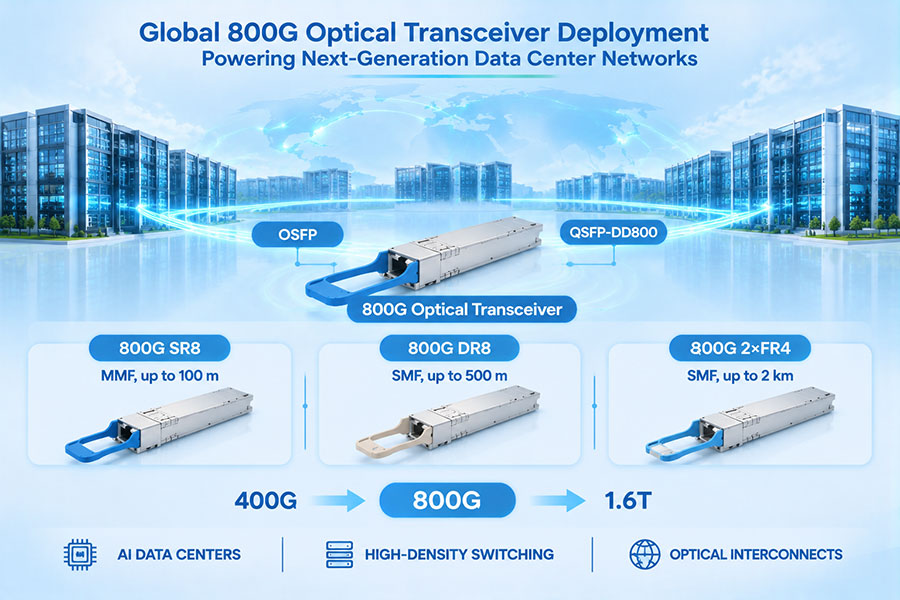
C-LIGHT's 400G QSFP-DD, 800G QSFP-DD, and 800G OSFP product families address high-speed network connectivity requirements. For next-generation data center infrastructure, the 1.6T OSFP-RHS series provides another option for emerging high-bandwidth applications.
12. Challenges Facing the Global Submarine Cable Industry
Despite strong investment interest, submarine cable projects involve complex technical, financial, and regulatory challenges. A cable system may require years of planning before it becomes operational.
Major challenges include:
High capital expenditure: Cable manufacturing, marine installation, landing stations, and terrestrial connections require substantial investment.
Long project timelines: Route surveys, environmental approvals, permitting, procurement, and installation can delay completion.
Marine installation complexity: Deep-sea conditions, seabed geography, and coastal environments affect engineering and deployment.
Geopolitical considerations: International routes may cross multiple jurisdictions and require complex regulatory coordination.
Infrastructure concentration: Dependence on a small number of cable corridors or landing stations can create network risks.
Maintenance requirements: Cable faults require specialized repair vessels, equipment, and coordination among relevant authorities.
Technology qualification: New fiber designs, repeaters, and transmission technologies must demonstrate long-term performance and reliability.
These factors influence route selection, investment structure, project schedules, and the commercial viability of new systems. As cable capacity increases, operators must also ensure that landing stations and terrestrial backhaul networks can handle the additional traffic.
13. Future Outlook: Higher Capacity and More Diverse International Networks
The next phase of submarine cable development will likely focus on increasing transmission capacity while improving the flexibility and resilience of international networks.
Several technology and infrastructure trends are expected to influence future projects:
Petabit-class transmission: New cable designs are targeting aggregate capacities approaching or reaching petabit-per-second levels on selected routes.
Multi-core fiber: Spatially integrated fiber designs may increase transmission density within a cable system.
Advanced SDM architectures: Additional fiber pairs and optimized amplification systems will support higher aggregate capacity.
Expanded optical bandwidth: C-band and L-band transmission can provide additional wavelength capacity where supported by the system design.
More regional landing points: New routes can improve access to international networks for emerging digital markets.
Cloud-led infrastructure investment: Hyperscale operators are expected to remain important participants in new cable projects.
Integrated terrestrial and submarine networks: Cable landing stations, metro networks, and data centers will become increasingly interconnected.
Meta's announced Petal project provides an example of the industry's technical direction. The planned France–United States system is designed to deliver 1 Pbps of capacity over approximately 7,000 km using multi-core fiber technology at scale. It is expected to enter service in 2029. The project illustrates how future submarine systems may increase capacity through changes in fiber architecture rather than relying exclusively on conventional fiber-pair expansion.
Meanwhile, the Intra-Asia Marine Cable project led by NTT DATA, Sumitomo Corporation, and JA Mitsui Leasing is designed to connect Japan, Malaysia, and Singapore, with additional regional connectivity. Its announced initial design capacity is approximately 320 Tbps, with service planned for 2029.
These projects demonstrate that the next generation of international connectivity will combine higher optical capacity, new fiber technologies, expanded landing infrastructure, and more diverse network routes.
14. Conclusion: Submarine Cable Investment Strengthens the Global Digital Backbone
Global submarine cable investment is expanding as international data traffic, cloud computing, AI infrastructure, and digital services increase demand for reliable cross-border connectivity. New projects are being developed across transatlantic, transpacific, Asia-Pacific, and emerging regional routes, while hyperscale technology companies are playing a larger role in financing and infrastructure planning.
At the technology level, coherent optical transmission, DWDM, space-division multiplexing, multi-core fiber, and advanced optical amplification are helping the industry increase capacity and improve network efficiency. At the infrastructure level, new landing stations and terrestrial backhaul networks are extending international connectivity to more data center and telecommunications markets.
For the optical communication industry, this investment creates opportunities across coherent modules, high-speed transceivers, DWDM equipment, fiber connectivity, and network monitoring solutions. As submarine and terrestrial networks become more closely integrated, reliable optical components and scalable transmission technologies will remain essential to the development of the global digital economy.
Looking for optical transceiver solutions for high-capacity network infrastructure?
C-LIGHT provides optical connectivity solutions covering 400G, 800G, and 1.6T applications, together with coherent optical transceivers for supported DWDM and data center interconnect deployments. Contact our team to discuss product specifications, transmission requirements, and platform compatibility.
 >

 >
 >
 >
 >
 >
 >
 >