TEL:+86 132 6656 7067





Artificial intelligence is changing the economics and technical requirements of optical communication. Large-scale GPU clusters, hyperscale data centers, cloud platforms, and distributed computing environments require significantly more high-speed connectivity than many traditional network architectures. This demand is influencing not only optical transceiver shipments but also the upstream supply of lasers, photonic chips, optical DSPs, fiber materials, connectors, and advanced packaging services.
The global optical communication industry is therefore entering a period of supply-chain adjustment. Manufacturers are expanding production capacity, qualifying additional component sources, investing in new manufacturing locations, and developing technologies that can support higher bandwidth with improved power efficiency. At the same time, supply constraints in selected high-performance components are making production planning and long-term procurement increasingly important.
The transition from 400G to 800G and 1.6T optical connectivity is accelerating these changes. Emerging architectures such as silicon photonics, near-packaged optics (NPO), and co-packaged optics (CPO) are also broadening the range of suppliers involved in next-generation optical networking.
1. AI Infrastructure Is Reshaping Optical Communication Demand
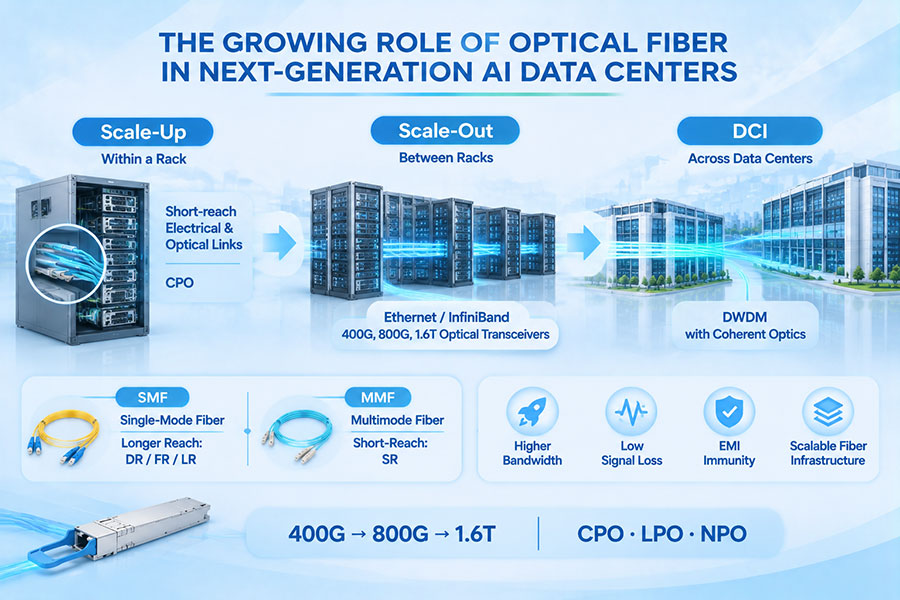
AI data centers require large numbers of high-speed connections to link GPUs, switches, storage systems, and computing racks. As cluster sizes increase, network bandwidth becomes an important factor in overall system performance. Optical interconnects support these connections by providing high data rates, suitable transmission distances, and the ability to scale network capacity.
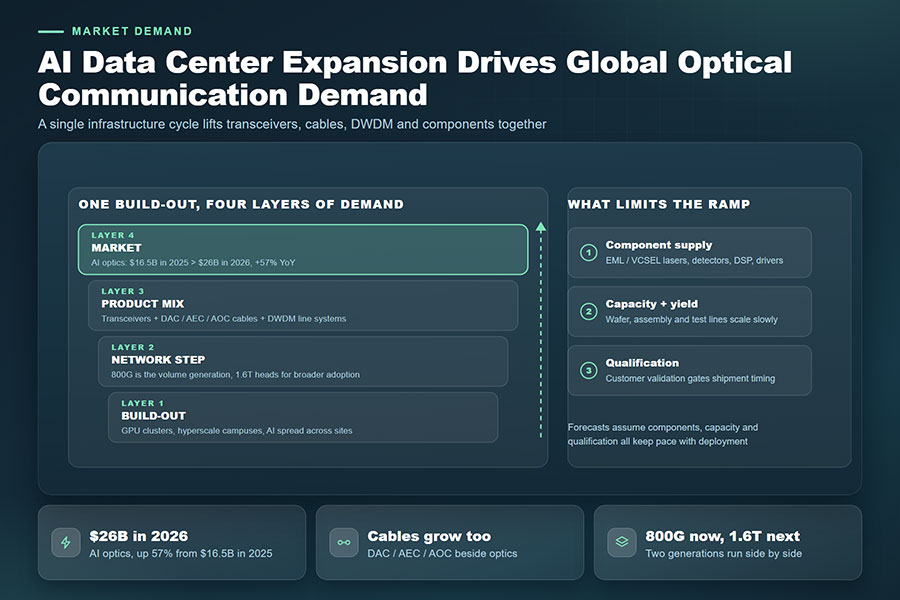
TrendForce estimated that the global AI-focused optical transceiver market would increase from approximately US$16.5 billion in 2025 to US$26 billion in 2026. The research also highlighted strong demand for 800G and faster products, alongside supply constraints in several critical components.
This growth affects multiple stages of the optical communications industry. More transceiver demand creates additional requirements for laser chips, photodetectors, DSPs, optical subassemblies, precision alignment, module assembly, and production testing.
| AI Infrastructure Development | Optical Supply-Chain Impact |
|---|---|
| Larger GPU clusters | Higher demand for 800G and 1.6T transceivers and optical engines |
| Higher switch bandwidth | Greater requirements for high-speed lasers, DSPs, and photonic integration |
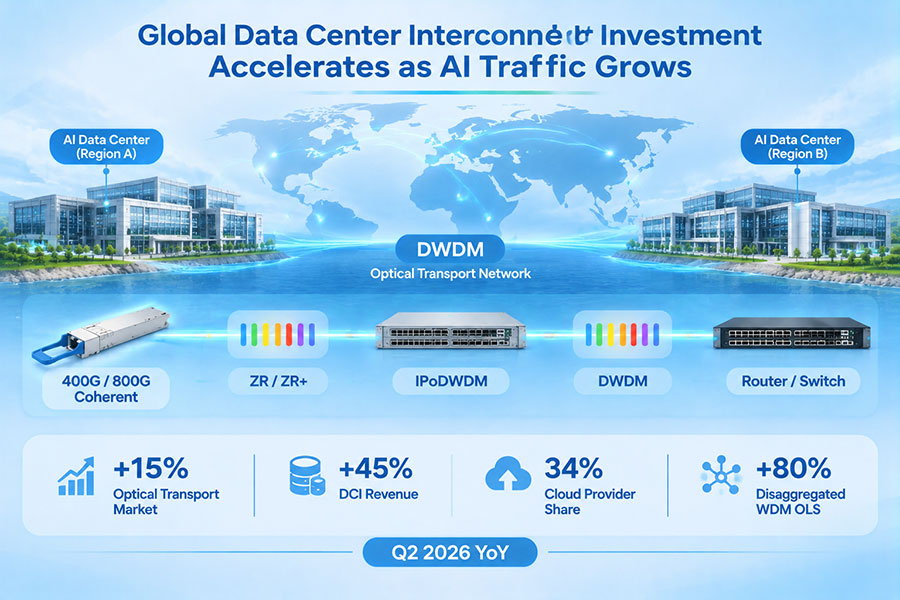
| More data center interconnection | Additional demand for coherent optics, DWDM equipment, and fiber infrastructure |
| Higher rack density | More attention to power consumption, thermal design, and packaging density |
| Faster network deployment | Greater need for predictable component availability and manufacturing capacity |
Unlike a conventional product upgrade cycle, AI-related demand is affecting both the volume and technical complexity of optical products. Suppliers must increase output while qualifying components and manufacturing processes for more demanding data rates.
2. The Optical Communication Supply Chain Includes Multiple Specialized Layers
Optical communication products depend on a broad ecosystem of materials, semiconductor devices, precision components, manufacturing equipment, and system-level integration. A shortage at one stage can affect the production schedule of downstream modules, even when other components remain available.
The supply chain can be divided into three broad layers.
Upstream: Materials and Core Optoelectronic Components
Upstream suppliers provide the materials and semiconductor devices required to generate, modulate, transmit, and detect optical signals. Important inputs include indium phosphide (InP) substrates, EML laser chips, continuous-wave lasers, photodiodes, optical amplifiers, and specialized optical materials.
Midstream: Optical Components and Transceiver Manufacturing
Midstream manufacturers integrate optical and electronic components into functional subassemblies and transceiver modules. This stage involves optical alignment, active and passive assembly, electrical integration, firmware or management-interface implementation, calibration, and testing.
Downstream: Network Equipment and Infrastructure Deployment
Downstream customers include data center operators, cloud service providers, telecommunications carriers, network equipment manufacturers, and system integrators. Their requirements determine product specifications, qualification schedules, compatibility testing, and procurement volumes.
| Supply-Chain Stage | Representative Products or Processes | Role in Optical Networking |
|---|---|---|
| Materials | InP substrates, optical fiber, specialty glass, packaging materials | Provide the foundation for optical devices and transmission infrastructure |
| Optoelectronic chips | EML, CW lasers, VCSELs, photodiodes | Generate, modulate, and detect optical signals |
| Electronic components | DSPs, drivers, TIAs, retimers, control ICs | Process and condition high-speed electrical signals |
| Optical subassemblies | TOSA, ROSA, optical engines, lenses, isolators | Integrate optical transmission and reception functions |
| Module manufacturing | 400G, 800G, 1.6T transceivers | Deliver standardized optical interfaces for network equipment |
| System integration | Switches, routers, DWDM systems, data center networks | Deploy optical products in operational network architectures |
The different stages have different investment requirements and technical barriers. Semiconductor fabrication requires specialized facilities and process expertise, while transceiver assembly depends heavily on precision manufacturing, automation, component sourcing, and consistent production yields.
3. Laser Chips and InP Materials Become Critical Supply-Chain Priorities
Laser technology is one of the most important upstream elements in high-speed optical communication. EML devices, continuous-wave lasers, and other optical sources are used in different transceiver architectures, with selection depending on wavelength, modulation format, output power, transmission distance, and system design.
Indium phosphide is a key semiconductor material for several high-performance optical devices. InP-based technologies support laser and photodetector products used in data communication and telecommunications applications.
As demand shifts toward 800G and 1.6T products, the industry requires more advanced optical sources and higher-performance components. Manufacturing capacity cannot always expand immediately because semiconductor production involves specialized equipment, process qualification, yield improvement, and customer validation.
TrendForce identified constrained supplies of EML and continuous-wave laser components as important factors affecting the expansion of AI optical transceiver production in 2026. LightCounting also highlighted InP EML and laser-chip production capacity as a limiting factor in the optical connectivity market.
These constraints have several consequences:
Longer procurement cycles: Module manufacturers may need to place orders earlier to secure critical optical sources.
Capacity reservation: Long-term supply agreements can help manufacturers obtain more predictable access to key components.
Alternative-source qualification: Additional suppliers can reduce dependence on a limited number of component manufacturers, although technical qualification takes time.
Design flexibility: Different laser technologies and optical architectures may provide alternative paths when supported by the system requirements.
Yield and quality requirements: Higher-speed products require consistent optical performance across large production volumes.
4. DSPs and High-Speed Electronic Components Add Another Layer of Complexity
Optical transceivers depend on electronic components as well as optical devices. Digital signal processors, laser drivers, transimpedance amplifiers, clock and data recovery circuits, and control electronics all contribute to the performance of high-speed modules.
In DSP-based PAM4 transceivers, the DSP performs functions such as signal processing, equalization, and error correction support. As data rates increase, the requirements placed on signal-processing performance, power consumption, and semiconductor integration become more demanding.
The move toward 1.6T modules also increases the importance of high-speed electrical interfaces and advanced electronic packaging. A shortage or delayed qualification of a key DSP or driver can affect the production schedule even when the optical components are available.
| Component | Primary Function | Supply-Chain Consideration |
|---|---|---|
| Optical DSP | Signal processing, equalization, and related digital functions | Advanced semiconductor process availability and product qualification |
| Laser driver | Controls the electrical drive signal for laser devices | High-speed performance and compatibility with optical sources |
| TIA | Converts weak photodetector current into a usable voltage signal | Noise performance, bandwidth, and integration |
| Retimer or CDR | Supports signal conditioning and clock recovery in applicable architectures | Electrical interface compatibility and power requirements |
| Controller and memory | Supports module management and monitoring functions | Firmware compatibility and component lifecycle management |
For manufacturers, component planning must therefore cover both the optical and electrical sides of the module. A complete bill of materials, qualified alternatives, and coordinated production forecasts are important for maintaining output consistency.
5. Optical Fiber and Passive Components Face Expanding AI-Driven Requirements
AI infrastructure growth is not limited to active optical transceivers. Data centers also require large quantities of optical fiber, connectors, adapters, patch cords, splitters, and high-density cabling systems.
As computing clusters become larger, the number of optical connections increases across server rows, network switches, storage systems, and inter-building links. Fiber management and connector density consequently become important considerations in data center design.
Different network architectures require different fiber and passive-component solutions:
Multimode fiber: Used in suitable short-reach data center connections, depending on the transceiver and link design.
Single-mode fiber: Supports a broad range of data center, metropolitan, and long-distance applications.
MPO/MTP connectivity: Supports high-density parallel optical connections and structured cabling.
LC connectivity: Commonly used in duplex optical interfaces and many single-mode transceiver applications.
DWDM filters and passive components: Support wavelength multiplexing and optical transport systems.
Fiber management systems: Help organize, protect, and maintain high-density optical connections.
Demand for fiber infrastructure can also be influenced by the physical layout of AI data centers. More distributed facilities, larger clusters, and additional interconnection routes can increase requirements for fiber capacity and passive optical infrastructure.
The Fiber Broadband Association's 2026 materials outlook identifies AI data center construction as a source of pressure on fiber-network materials and related infrastructure inputs. This illustrates how data center investment can affect supply availability beyond the transceiver market itself.
6. 800G and 1.6T Production Drives Manufacturing Upgrades
Higher-speed optical modules require more demanding manufacturing and testing processes. As the industry moves from 400G to 800G and 1.6T, manufacturers must improve precision, automation, thermal management, electrical performance, and production quality control.
For example, a high-speed transceiver may integrate multiple optical channels, advanced modulation, DSP functions, and complex thermal structures. Small variations in optical alignment, component characteristics, or assembly quality can affect the performance of the finished module.
Manufacturing upgrades commonly involve:
Automated optical alignment and active coupling equipment.
Precision placement of optical and electronic components.
Improved high-speed electrical testing and signal-integrity validation.
Optical power, wavelength, sensitivity, and transmit-quality measurements.
Thermal testing under defined operating conditions.
Automated production records and traceability systems.
Reliability and compatibility testing for target host platforms.
Testing capacity is especially important during a rapid product transition. A manufacturer may have sufficient component inventory and assembly equipment but still face production limitations if calibration, validation, or reliability-testing capacity cannot scale at the same rate.
7. Global Manufacturing Strategies Are Becoming More Diversified
Optical communication manufacturers are reassessing where components are sourced, where modules are assembled, and how finished products are delivered to global customers. AI infrastructure investment, regional industrial policies, logistics considerations, and geopolitical uncertainty are all influencing these decisions.
TrendForce reported in May 2026 that optical interconnect demand and geopolitical considerations were encouraging some U.S. vendors to expand outsourcing activities in Southeast Asia. This reflects a broader effort to diversify manufacturing footprints and reduce exposure to concentrated production locations.
Supply-chain diversification does not necessarily mean moving every manufacturing process to a new country. Different stages may remain concentrated in regions with established semiconductor, photonics, packaging, or precision-manufacturing capabilities.
| Manufacturing Strategy | Potential Benefit | Implementation Consideration |
|---|---|---|
| Regional assembly capacity | Improves geographic flexibility and delivery options | Requires trained personnel, equipment, and process transfer |
| Multiple component suppliers | Reduces dependence on a single source | Alternative components require engineering validation |
| Long-term procurement agreements | Improves visibility into future component availability | Requires reliable demand forecasts and commercial commitments |
| Localized testing and logistics | Can shorten selected delivery and support processes | Requires consistent quality standards across facilities |
| Manufacturing automation | Improves repeatability and production scalability | Requires capital investment and process optimization |
A diversified supply chain can improve resilience, but it also increases coordination requirements. Manufacturers must maintain consistent engineering specifications, quality systems, traceability, and production controls across different locations.
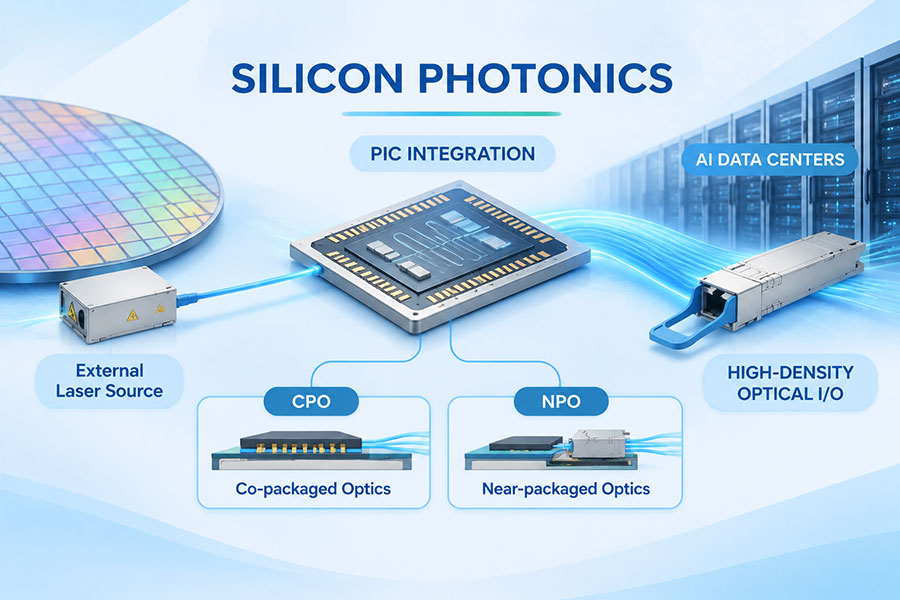
8. Silicon Photonics, NPO, and CPO Expand the Technology Ecosystem
The development of high-speed optical networking is also changing the structure of the supply chain. Traditional pluggable transceivers remain important, but silicon photonics, near-packaged optics, and co-packaged optics are creating new opportunities for optical integration.
Silicon Photonics
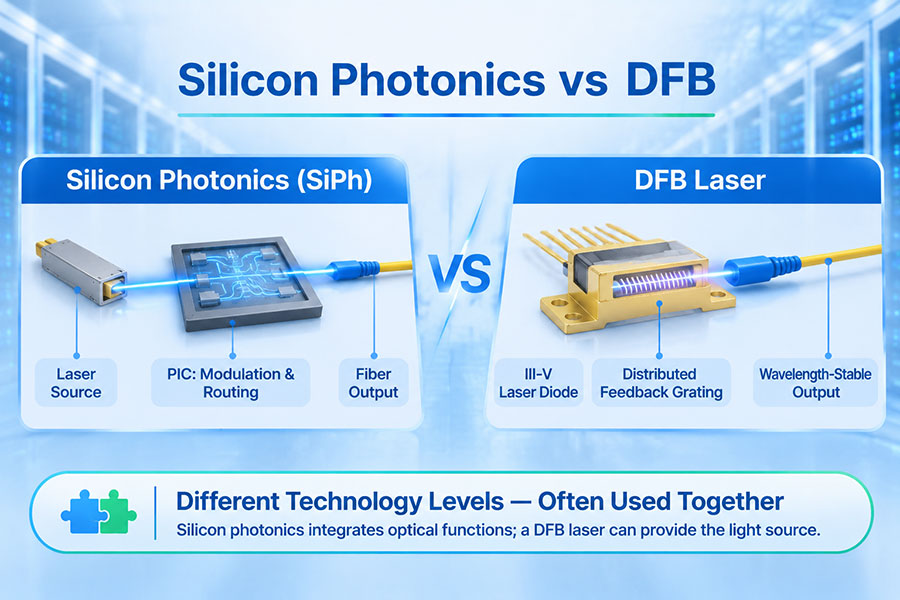
Silicon photonics integrates optical functions using semiconductor manufacturing techniques. It can combine optical waveguides and other photonic structures with electronic integration approaches, depending on the device architecture.
Its potential advantages include integration density, manufacturing scalability, and opportunities to support higher-bandwidth optical engines. However, laser integration, coupling efficiency, packaging, thermal behavior, and production yield remain important engineering considerations.
Near-Packaged Optics
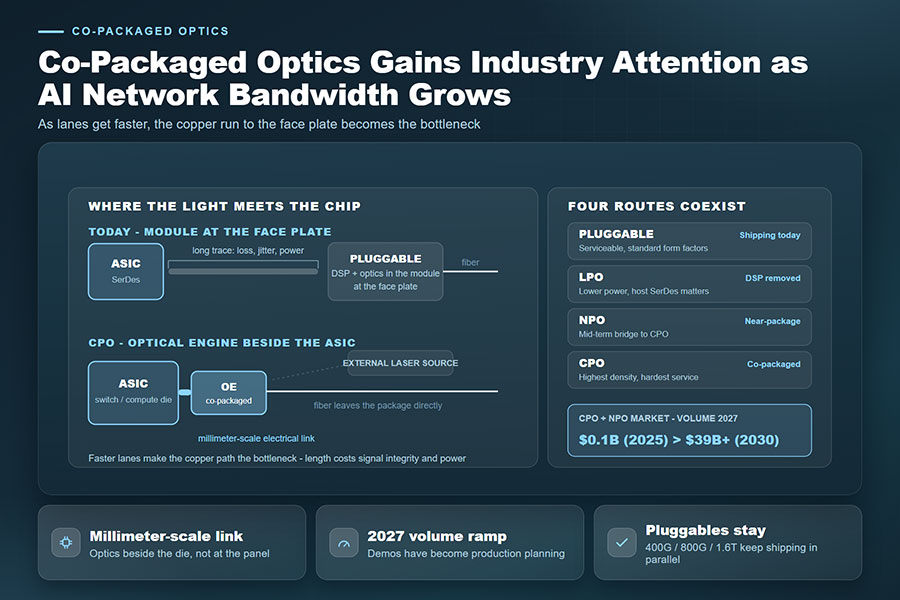
NPO places optical engines closer to switching or computing ASICs than conventional front-panel pluggable modules. The objective is to reduce electrical interconnect distance and address signal-integrity and power challenges as data rates increase.
This architecture creates additional requirements for optical engines, fiber-array units, connectors, precision packaging, and thermal design.
Co-Packaged Optics
CPO integrates optical engines within the same package or closely integrated assembly as a high-performance switch or computing ASIC. It is intended to address the limitations of long, high-speed electrical connections in selected system architectures.
TrendForce projected significant growth in the combined NPO and CPO market through 2030, reflecting increasing interest in optical integration for AI infrastructure. However, commercialization depends on system architecture, reliability, serviceability, manufacturing yield, and ecosystem maturity.
| Technology | Integration Approach | Supply-Chain Requirements |
|---|---|---|
| Pluggable optics | Optical transceiver installed in a host port | Optical chips, DSPs, module assembly, connectors, and testing |
| Silicon photonics | Photonic functions integrated on silicon-based platforms | Photonic fabrication, laser sources, coupling, and packaging |
| NPO | Optical engine positioned near the host ASIC | Optical engines, fiber arrays, advanced packaging, and thermal solutions |
| CPO | Optical engines integrated closely with the ASIC package | Co-design, photonic integration, advanced substrates, and system-level testing |
These technologies do not eliminate the need for a broad optical supply chain. Instead, they redistribute value across photonic chips, electronic components, packaging, fiber connectivity, and system integration.
9. Supply-Chain Resilience Becomes a Competitive Requirement
Rapid AI infrastructure deployment has increased the importance of supply-chain reliability. Customers need products that meet performance requirements and can be delivered consistently over the lifecycle of a network project.
For optical module manufacturers and suppliers, resilience involves several connected capabilities.
Component traceability: Manufacturers need visibility into component origins, production batches, and quality records. This supports failure analysis and helps manage product consistency.
Supplier qualification: Alternative sources can improve sourcing flexibility, but each component must meet the required optical, electrical, mechanical, and reliability specifications.
Production planning: Forecasting demand for 800G and 1.6T products helps manufacturers coordinate component procurement, assembly capacity, and testing resources.
Quality management: Consistent testing and process control are necessary when production is distributed across multiple facilities.
Product lifecycle management: Rapid technology transitions make it important to manage component obsolescence, engineering changes, and compatibility across product generations.
Customer qualification: Optical modules must be validated against the intended host platforms and network configurations. A component that is available in the market is not automatically interchangeable with another part.
10. C-LIGHT Optical Connectivity for Evolving AI Networks
As AI infrastructure expands, optical networking suppliers need to support a wider range of transmission speeds, distances, form factors, and deployment environments. C-LIGHT provides optical transceivers and connectivity products for data centers, high-performance computing, telecommunications, and optical transport applications.
400G QSFP-DD Optical Transceivers – A range of short-reach, parallel, single-mode, and extended-reach configurations for data center and network applications. Specific reach and interface details depend on the selected model.
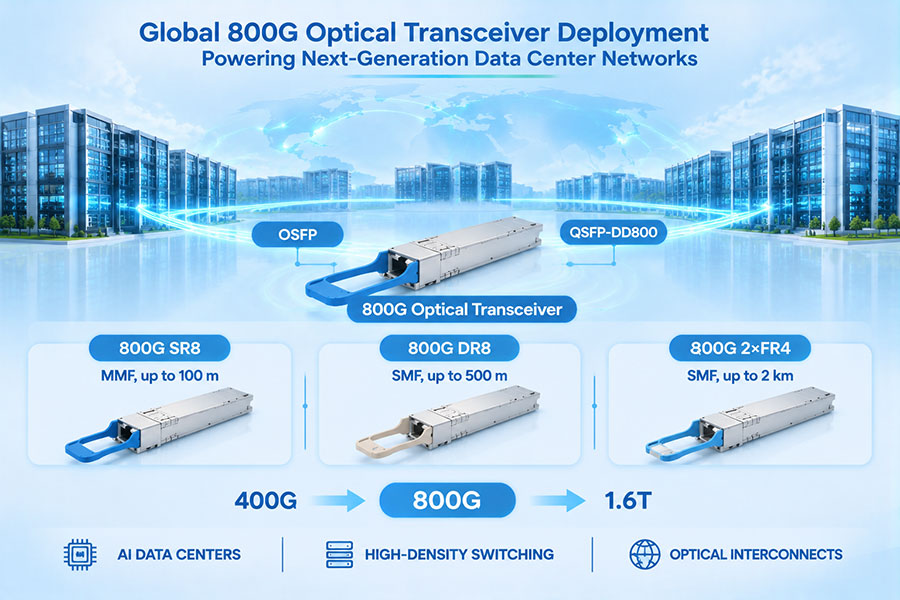
800G OSFP Optical Transceivers – Includes VR8, SR8, DR8, and 2×FR4 configurations for high-density AI and data center networks.
800G QSFP-DD Optical Transceivers – Supports selected 800G applications with different reach options for high-bandwidth switching and interconnection.
1.6T OSFP-RHS Optical Transceivers – Uses an 8×200G PAM4 architecture with integrated DSP and FEC. Selected configurations address 500m DR4 and 2km 2×FR4 applications.
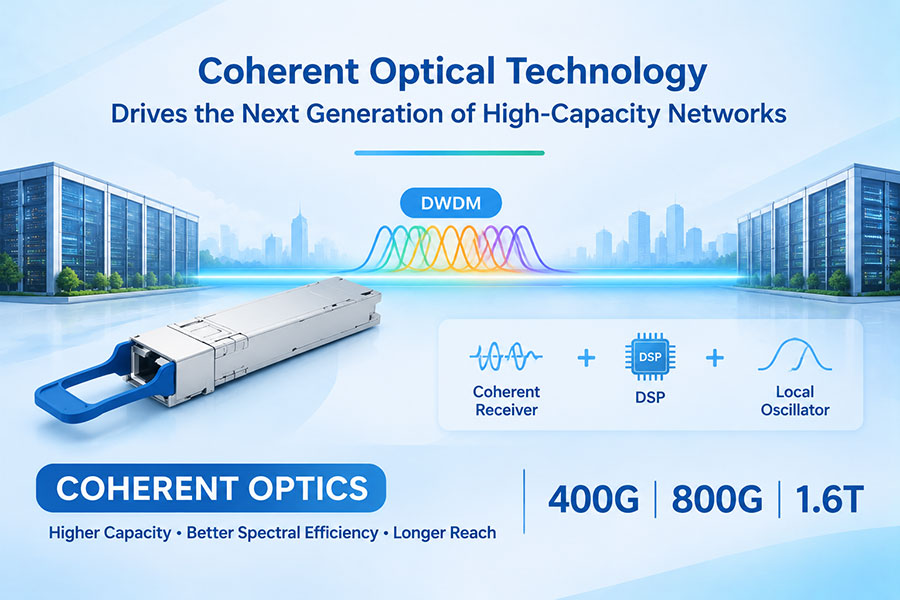
DWDM DCO Coherent Transceivers – Coherent optical solutions for high-capacity DWDM transmission and data center interconnection, with supported rates and distances depending on the specific configuration.
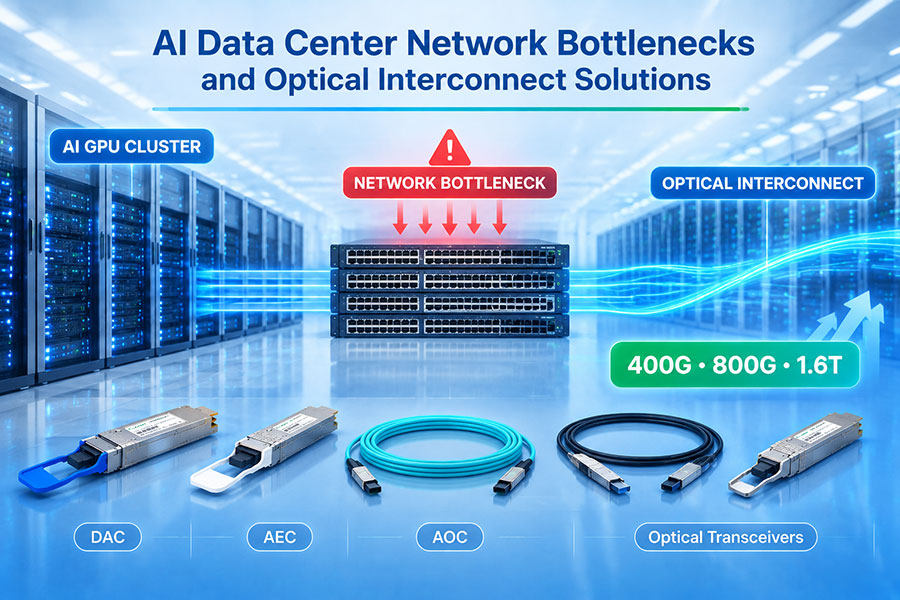
AOC and DAC Connectivity – Direct-attach and active optical cable options for short-distance connections within data centers and high-performance computing environments.
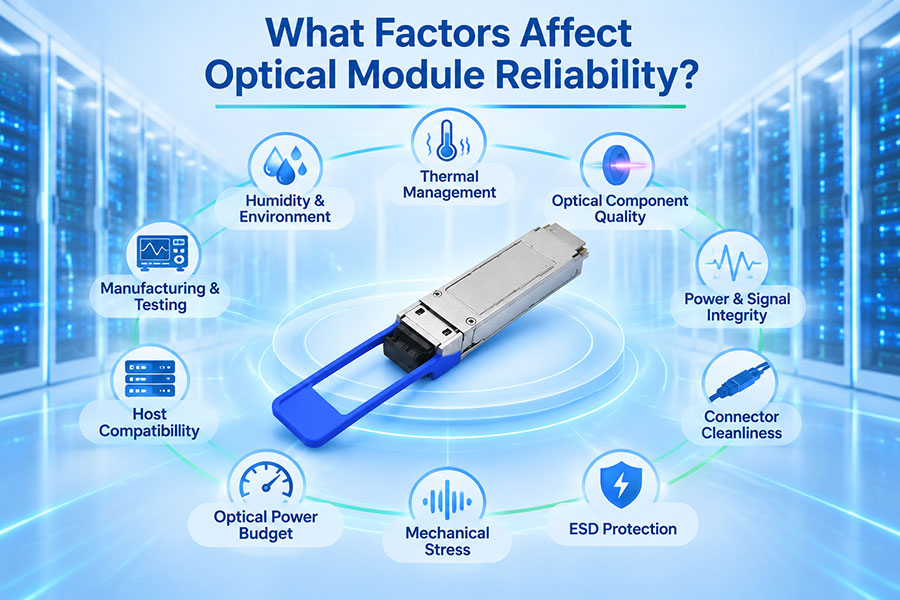
Product selection should consider more than headline data rate. Optical reach, fiber type, wavelength, connector interface, host compatibility, power consumption, thermal conditions, and management support all influence deployment suitability.
For large-scale network projects, customers should also confirm product qualification requirements, delivery schedules, component availability, and consistency across production batches.
11. The Next Stage of Optical Supply-Chain Development
The optical communication supply chain is likely to continue evolving as AI data center investment expands and network architectures become more demanding. Several developments will influence the industry's direction.
Higher-speed product transitions: 800G adoption and the introduction of 1.6T products will increase demand for advanced optical and electronic components.
More integrated photonics: Silicon photonics, NPO, and CPO will expand the role of photonic integration, precision packaging, and system-level co-design.
Broader manufacturing capacity: Suppliers will continue evaluating production expansion, automation, and regional manufacturing strategies to improve supply flexibility.
Greater component qualification: Long-term availability and second-source qualification will become increasingly important for high-volume network deployments.
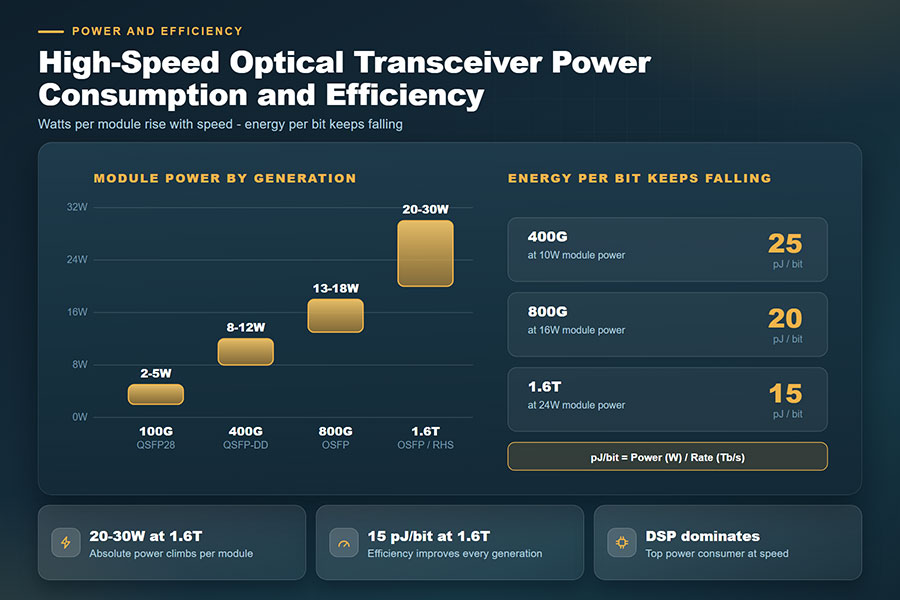
More attention to energy efficiency: Power consumption and thermal performance will influence component selection and system architecture as optical port density increases.
Closer supply-chain coordination: Optical component suppliers, transceiver manufacturers, semiconductor companies, and network system vendors will need stronger coordination to align product roadmaps and production capacity.
12. Conclusion
Rising AI infrastructure demand is reshaping the global optical communication supply chain from upstream materials and semiconductor devices to transceiver manufacturing and network deployment. EML lasers, InP-based components, DSPs, optical fiber, passive connectivity, and precision packaging are all becoming increasingly important to the expansion of high-speed optical networks.
The transition to 800G and 1.6T connectivity is raising manufacturing and qualification requirements, while silicon photonics, NPO, and CPO are creating new opportunities across the photonics ecosystem. At the same time, component availability, regional manufacturing strategies, production yields, and long-term supplier relationships will influence how quickly the industry can respond to demand.
For optical communication manufacturers and network operators, sustainable growth will depend on more than expanding production volume. It will require reliable sourcing, consistent product quality, engineering collaboration, and the ability to support rapidly evolving network architectures.
For high-speed optical transceivers, DWDM solutions, and data center connectivity requirements, Contact C-LIGHT for product information, technical support, and customized optical networking solutions.
 >

 >
 >
 >
 >
 >
 >
 >