TEL:+86 132 6656 7067





Artificial intelligence infrastructure is changing the economics and technical priorities of the global optical communication industry. Large-scale AI training clusters require continuous data exchange among GPUs, switches, storage systems, and geographically distributed data centers. As computing capacity expands, network bandwidth, latency, power consumption, and connectivity density are becoming increasingly important factors in infrastructure investment.
This shift is creating demand across the optical communications value chain. High-speed optical transceivers connect servers and switches, fiber-optic cabling supports dense data center networks, coherent optics extend connectivity between facilities, and wavelength-division multiplexing systems increase the capacity of existing fiber infrastructure. Meanwhile, emerging architectures such as co-packaged optics (CPO) and near-packaged optics (NPO) are attracting attention as network designers seek more efficient ways to connect increasingly powerful computing systems.
The result is a broader growth opportunity for optical communication manufacturers. Demand is no longer driven only by traditional telecommunications upgrades or broadband expansion. AI infrastructure investment is creating an additional market cycle centered on high-speed data transmission, optical integration, and scalable network architecture.
1. AI Infrastructure Becomes a Major Growth Driver for Optical Communication
AI workloads generate substantial traffic between computing devices. During distributed training, GPUs exchange model parameters, gradients, and intermediate data through high-performance network fabrics. Inference infrastructure also requires fast communication among computing resources, storage platforms, and application systems.
As AI clusters expand, the number of high-speed network connections increases. More servers and accelerators require additional switch ports, while larger network fabrics need higher-capacity links to prevent communication bottlenecks.
Several infrastructure trends are contributing to this demand:
Large-scale GPU deployment: AI training clusters require high-bandwidth connections between accelerators and network switches.
Higher rack-level computing density: Increasing computing capacity within individual racks creates greater demand for efficient internal connectivity.
Distributed data center architectures: AI infrastructure is expanding across multiple facilities, increasing demand for data center interconnect (DCI).
Higher network traffic volumes: Training, inference, storage synchronization, and distributed computing generate growing east-west traffic.
Power and thermal constraints: Operators are evaluating connectivity technologies according to bandwidth, energy efficiency, and cooling requirements.
Infrastructure expansion: New data center construction creates demand for fiber, optical modules, switches, and optical transport equipment.
These factors are changing the position of optical communication within the data center. Optical connectivity is becoming a fundamental part of computing infrastructure planning rather than simply a component selected after the server and switching architecture has been established.
2. Market Forecasts Highlight the Scale of AI-Driven Optical Demand
Recent industry research indicates that AI-related optical demand is entering a period of accelerated growth. Different research organizations use different market definitions, including AI-focused optical transceivers, data center connectivity, optical transport equipment, and the broader optical communication industry. Their forecasts should therefore be interpreted according to the segment being measured.
| Research Organization | Market Indicator | Published Estimate | Time Frame |
|---|---|---|---|
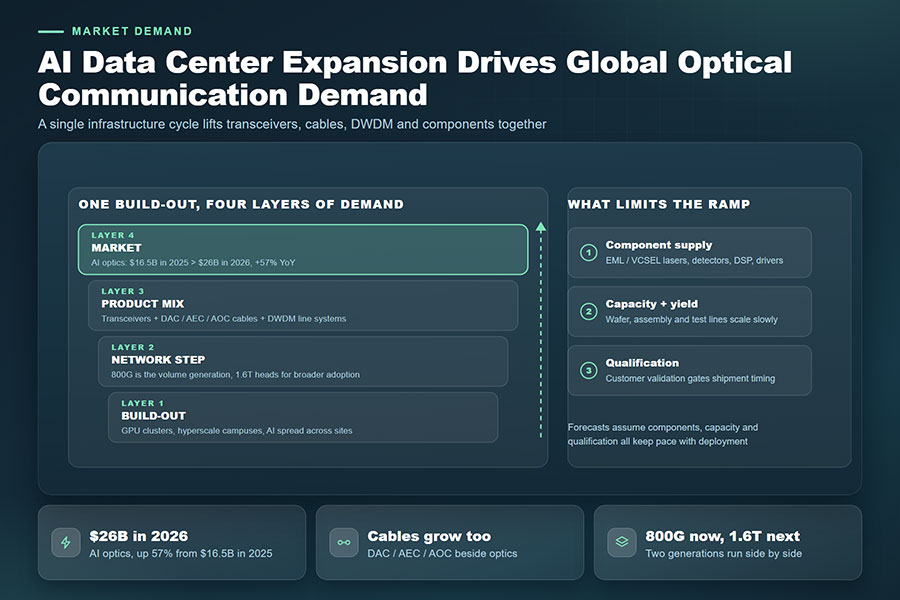
| TrendForce | Global AI-focused optical transceiver market | US$26 billion, compared with US$16.5 billion in 2025 | 2026 forecast |
| Yole Group | Global optical transceiver market | US$112 billion, compared with US$23 billion in 2025 | Five-year outlook published July 2026 |
| Dell'Oro Group, reported by Lightwave | Global optical transport equipment market | More than US$18 billion, with 16% projected annual growth | 2026 forecast |
| Goldman Sachs Research | Optical networking total addressable market opportunity | US$154 billion potential market opportunity | AI networking research published in 2026 |
These figures describe different market segments and measurement approaches. They should not be added together or treated as interchangeable estimates of the entire optical communications industry.
Nevertheless, the direction is consistent: AI infrastructure is increasing the commercial importance of optical connectivity. The fastest changes are occurring in high-speed data center interconnects, optical transceivers, and technologies designed to support higher bandwidth within increasingly dense computing environments.
For manufacturers, this creates opportunities across both established product categories and emerging optical architectures. It also raises expectations for production capacity, product qualification, power efficiency, and supply-chain reliability.
3. 400G, 800G, and 1.6T Transceivers Drive the Next Upgrade Cycle
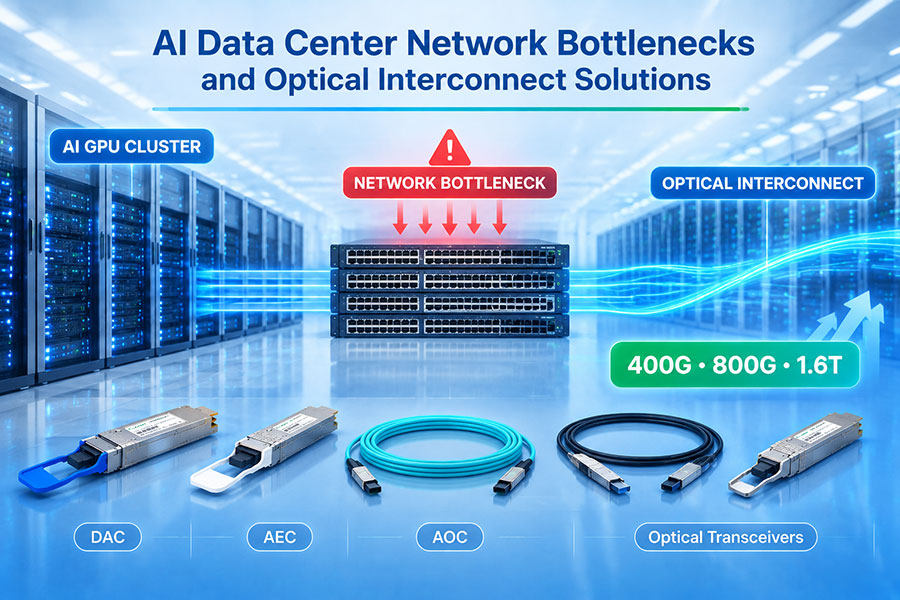
Higher network bandwidth is one of the most visible effects of AI infrastructure investment. As switch capacity and server connectivity requirements increase, data center operators are moving toward higher-speed optical interfaces.
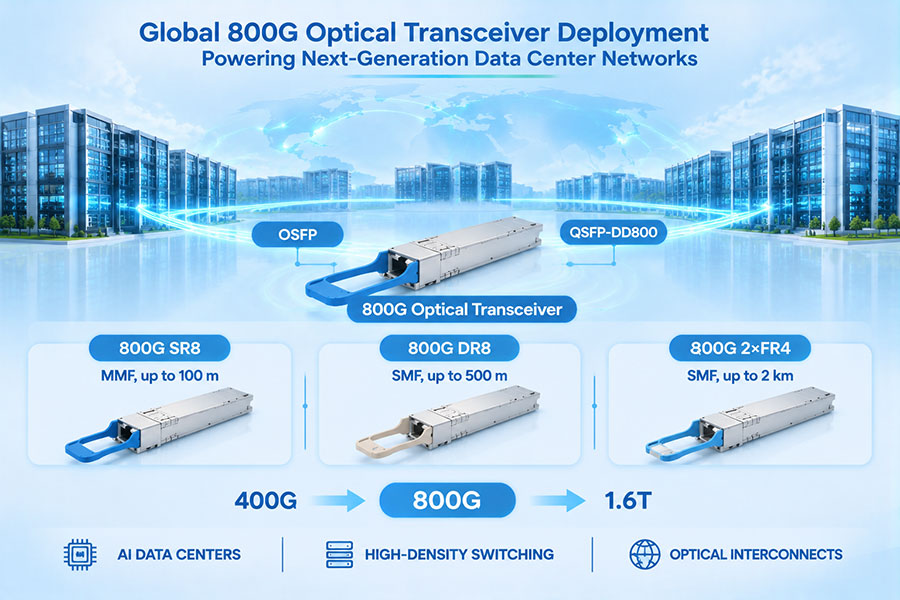
400G remains important in existing data center deployments, while 800G is becoming a major generation for high-performance AI and cloud networking. The industry is also advancing toward 1.6T interfaces to support next-generation switching platforms and larger AI clusters.
| Optical Interface | Representative Applications | Market Development |
|---|---|---|
| 400G | Data center spine-leaf networks, high-speed server connections, DCI | Established deployment generation with multiple optical reach options |
| 800G | AI cluster networking, hyperscale switching, high-density data center links | Expanding adoption as operators upgrade network capacity |
| 1.6T | Next-generation AI fabrics, high-capacity switching platforms | Emerging generation with increasing development and qualification activity |
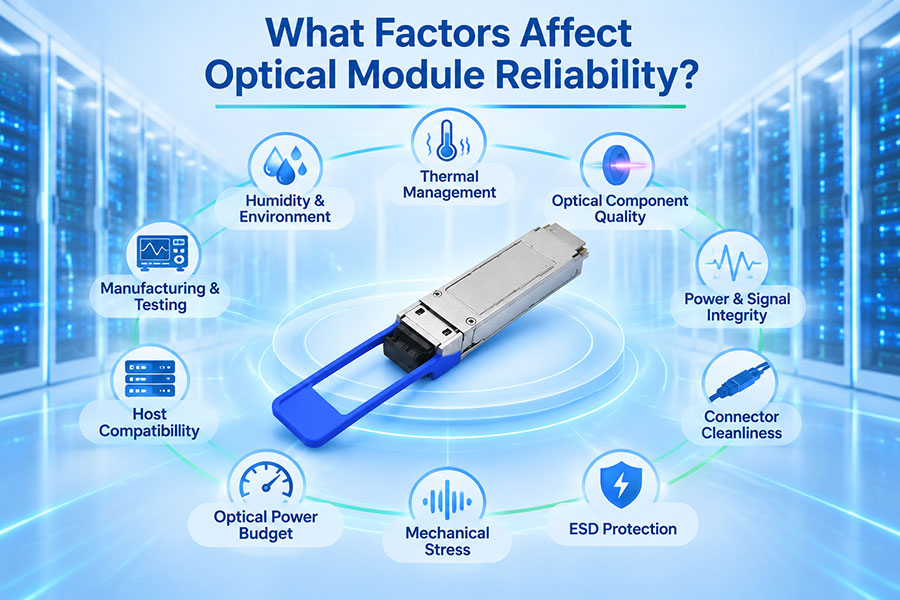
The transition is not simply a matter of doubling the nominal data rate. Higher-speed modules must also address electrical signal integrity, optical performance, thermal management, power consumption, and host-platform compatibility.
Different form factors support different system requirements. QSFP-DD remains relevant for high-density switching platforms, while OSFP provides another important path for high-bandwidth applications. The selection depends on the switch architecture, thermal design, electrical interface, and supported optical application.
C-LIGHT's 400G QSFP-DD optical transceiver series supports a range of data center and optical transport applications. Its 800G QSFP-DD and 800G OSFP product families address higher-capacity network deployments, while the 1.6T OSFP-RHS series targets emerging AI and hyperscale data center architectures.
4. Optical Connectivity Expands Across AI Data Center Architectures
AI data center networks are commonly designed around multiple connectivity layers. Each layer has different bandwidth, distance, latency, and physical-density requirements. Optical communication technologies are therefore being adopted across several parts of the network rather than being limited to connections between data centers.
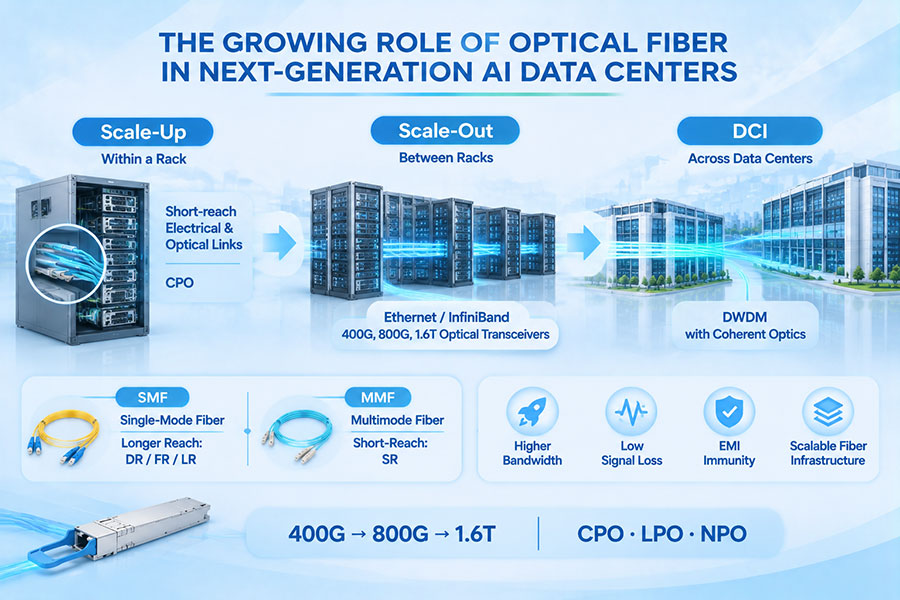
Scale-Out Networking
Scale-out architecture connects servers and accelerator systems through network switches. It allows operators to expand computing capacity by adding more servers, racks, and network resources.
As the number of connected systems increases, the network must support higher aggregate throughput. Optical transceivers and high-speed optical cables are widely used for connections between server network interfaces and switches, as well as between switching layers.
Scale-Up Connectivity
Scale-up architectures focus on connecting processors and accelerators within a tightly integrated computing system. These connections place strong emphasis on bandwidth density, latency, power efficiency, and physical distance.
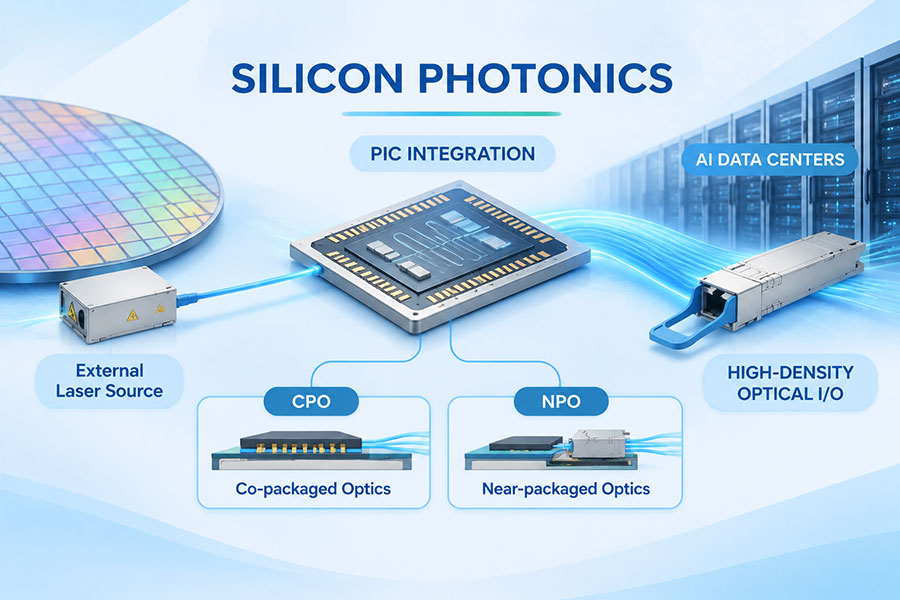
Copper remains useful for certain short-reach connections, but increasing bandwidth and rack-level complexity are encouraging the development of advanced optical interconnect solutions. CPO and NPO are among the technologies being evaluated for future high-density systems.
Scale-Across and Distributed AI Infrastructure
Large AI deployments may extend beyond a single data center. Scale-across architectures connect computing resources across separate facilities or geographic locations.
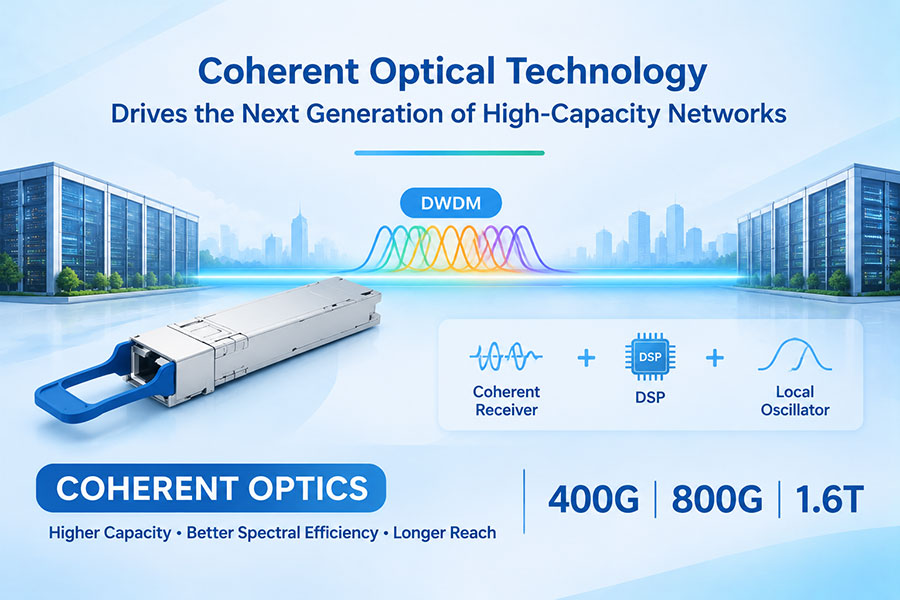
These deployments require optical transport systems capable of supporting high-capacity links over longer distances. Coherent optical transceivers, DWDM systems, and optical line systems become increasingly important as operators connect geographically distributed computing infrastructure.
5. CPO, NPO, and Silicon Photonics Reshape Optical Integration
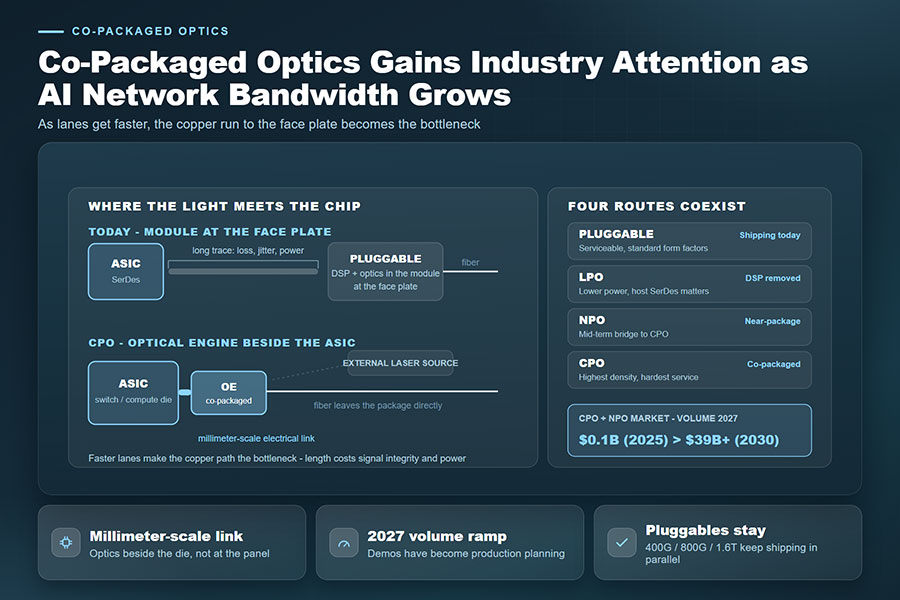
Traditional pluggable optical transceivers provide a flexible way to connect switches, routers, and servers. However, as port speeds and switch capacity increase, the electrical path between the switching ASIC and the optical module can create challenges involving signal loss, power consumption, and packaging density.
New optical integration approaches are being developed to address these constraints.
Pluggable optics: Remain widely used because they offer modularity, serviceability, and flexibility across network platforms.
Near-packaged optics (NPO): Place optical engines closer to the host ASIC to shorten high-speed electrical connections while retaining a degree of physical separation.
Co-packaged optics (CPO): Integrate optical engines more closely with switching or computing ASIC packages to reduce electrical interconnect distance.
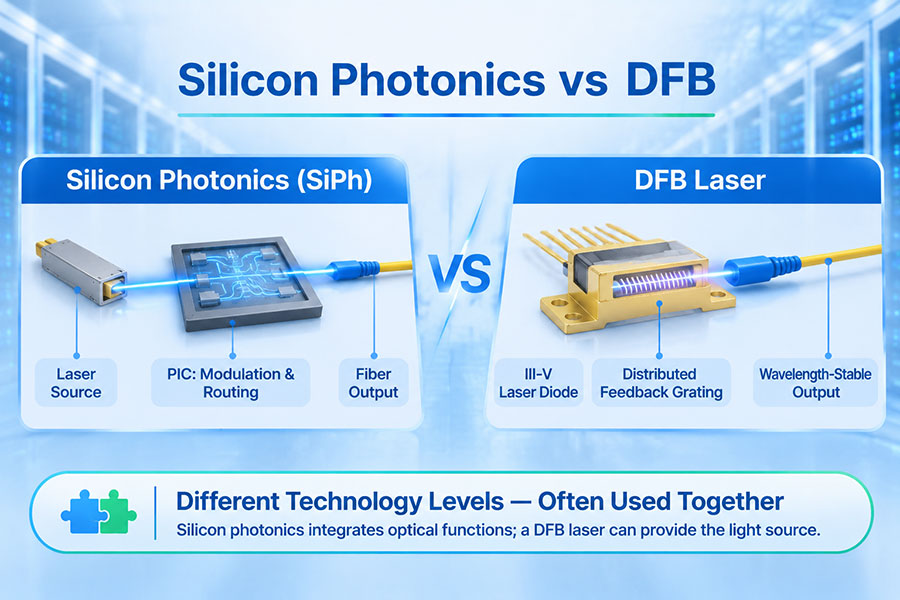
Silicon photonics: Uses silicon-based photonic integration to combine optical functions and support compact, scalable optical devices.
Linear-drive optics: Reduce or simplify some module-side signal-processing functions to target lower power and latency in supported system architectures.
These technologies are not direct replacements for one another in every application. Their adoption depends on system architecture, manufacturing maturity, optical coupling, serviceability, thermal design, and the ability to maintain reliable operation at scale.
Pluggable optics are expected to remain important across a wide range of data center applications. Meanwhile, CPO and NPO are attracting investment as system designers investigate more integrated approaches for future high-bandwidth platforms.
6. Data Center Interconnect Creates Demand Beyond Individual Facilities
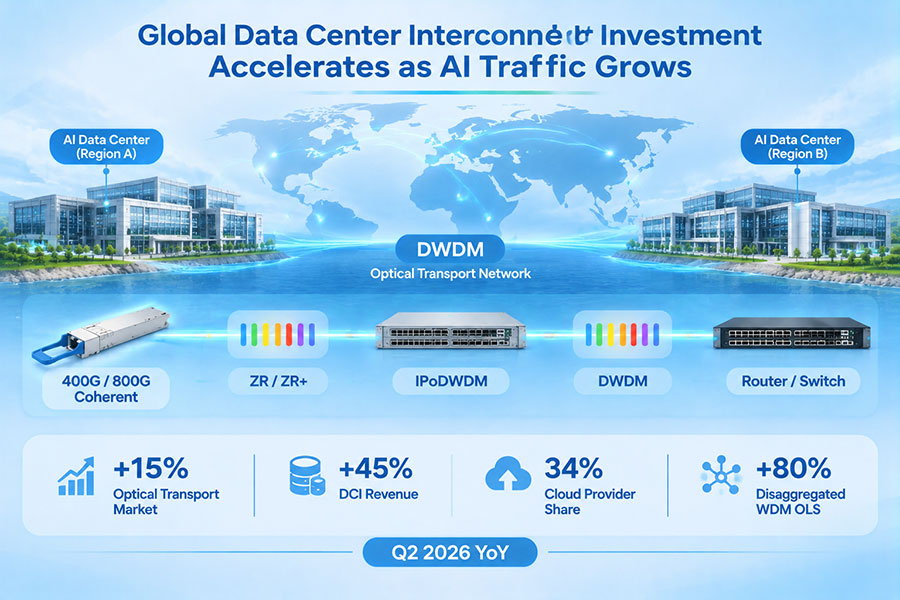
AI infrastructure investment is also expanding the market for connectivity between geographically distributed data centers. Large computing projects may use multiple facilities to address power availability, land constraints, cooling requirements, network resilience, and regional capacity planning.
Data center interconnect links support traffic between these facilities, including distributed computing workloads, storage replication, data synchronization, and cloud service operations.
Several optical technologies are central to DCI deployment:
400G and 800G coherent transceivers: Support high-capacity connections between data center locations.
ZR and ZR+ optical modules: Provide coherent pluggable options for supported data center interconnect distances and network architectures.
DWDM systems: Increase the number of independent optical channels carried over fiber infrastructure.
Optical line systems: Provide amplification, wavelength management, and other functions required for longer-distance transmission.
Digital coherent optics (DCO): Integrate coherent signal-processing functions into pluggable optical modules.
For operators with existing fiber infrastructure, DWDM can increase transmission capacity without requiring a completely new fiber route for every additional service. Coherent technology also allows high-capacity optical signals to operate across metro, regional, and other supported network distances.
C-LIGHT's DWDM coherent optical transceiver solutions address applications requiring high-capacity optical transport. The appropriate module depends on the required reach, line rate, wavelength plan, optical link budget, and compatibility with the optical line system.
7. Fiber Infrastructure Remains the Foundation of Optical Communication Growth
Although AI networking receives significant attention, the expansion of optical communication still depends on physical fiber infrastructure. High-speed transceivers and coherent modules cannot deliver their intended capacity without suitable fiber links, connectors, patch panels, and optical distribution systems.
AI data centers require dense internal fiber connections to support links between servers, switches, and network distribution points. At the same time, DCI and cloud expansion require additional metro and regional fiber capacity.
Important infrastructure components include:
Single-mode fiber: Supports high-capacity transmission across a broad range of data center, metro, and long-distance applications.
Multimode fiber: Remains relevant for selected short-reach data center connections.
MPO/MTP connectivity: Supports high-density multi-fiber connections used in parallel optical architectures.
LC connectors: Commonly used in duplex optical interfaces and many single-mode transceiver applications.
Optical distribution frames: Help organize, manage, and maintain fiber connections in large facilities.
Fiber patch cords and trunk cables: Provide structured connectivity between equipment and distribution points.
As port density increases, cable management and connector cleanliness become more important. Poor fiber routing, excessive bending, contamination, or incorrect polarity can affect link performance and complicate troubleshooting.
The growth of 400G, 800G, and 1.6T optical networks therefore creates opportunities not only for active optical modules but also for passive fiber connectivity products and structured cabling systems.
8. Power Efficiency and Thermal Management Influence Product Selection
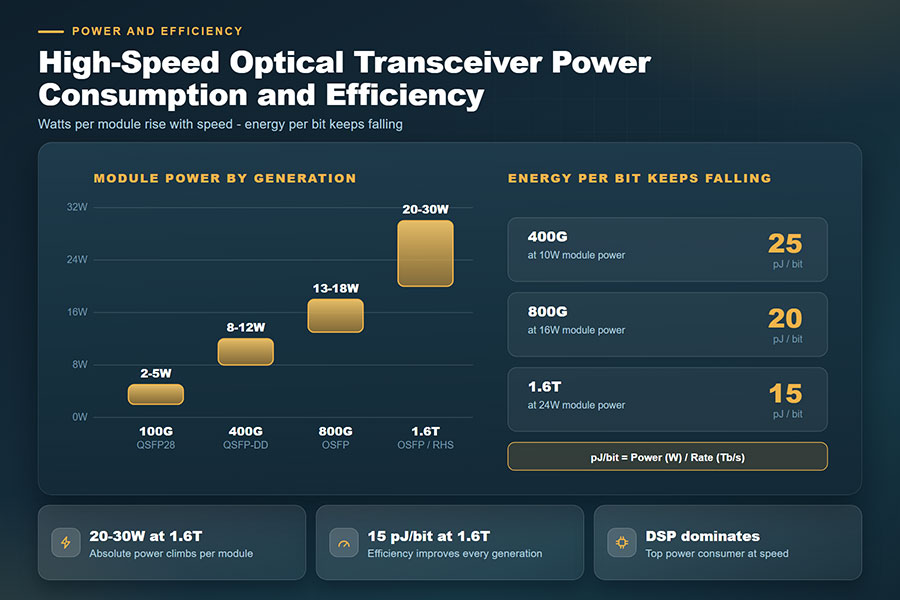
AI data centers consume substantial electrical power, and the network infrastructure contributes to the overall energy requirements. As optical modules operate at higher data rates, power consumption per module and the total power density across a switch become important design considerations.
Operators increasingly evaluate optical connectivity according to several factors:
Power consumption per port and per transmitted bit.
Thermal behavior under sustained high-bandwidth traffic.
Airflow requirements and heat dissipation.
Signal-processing efficiency.
Optical link budget and transmission distance.
Reliability under continuous operation.
Higher-speed modules may integrate more complex DSP and optical components, increasing the importance of thermal design. The module, host cage, heatsink, airflow path, and surrounding components must be considered together.
Liquid cooling and cold-plate designs are also receiving attention in high-density AI systems. However, optical module compatibility with a particular cooling architecture must be verified against the mechanical and thermal requirements of the host platform.
For example, C-LIGHT's 1.6T OSFP-RHS product family is designed around a reduced-height heatsink form factor for supported high-density system configurations. Actual thermal performance remains dependent on the switch design and cooling implementation.
9. Supply Chain Capacity Becomes a Strategic Industry Issue
Rapid demand growth creates pressure across the optical communication supply chain. High-speed transceivers depend on a range of specialized components, including laser chips, photodetectors, optical engines, DSPs, drivers, connectors, and precision packaging materials.
Some components require specialized manufacturing processes and qualification cycles. Expanding module assembly capacity alone may therefore be insufficient if upstream component availability remains constrained.
Important supply-chain considerations include:
Laser availability: EML and other high-performance laser components are important for multiple high-speed optical applications.
Photonic integration capacity: Silicon photonics and other optical integration technologies require specialized fabrication and packaging capabilities.
DSP and semiconductor supply: High-speed modules depend on advanced electronic components with specific performance and power requirements.
Manufacturing yield: Increasing lane rates and tighter performance margins place greater demands on production consistency.
Qualification time: New optical products must complete engineering validation and customer qualification before large-scale deployment.
Long-term supply planning: Network operators need reliable component availability throughout deployment and maintenance cycles.
As AI infrastructure projects become larger, buyers are paying closer attention to supplier manufacturing capacity, component sourcing, quality control, product lifecycle planning, and delivery consistency.
10. Regional Investment Patterns and Global Market Opportunities
Optical communication investment is distributed across multiple regions, with different demand drivers shaping local market development.
North America
North America is a major center for hyperscale cloud infrastructure and AI data center investment. Large computing projects are creating demand for high-speed optical transceivers, dense fiber connectivity, and high-capacity DCI networks.
Infrastructure investment is also encouraging upgrades to existing metro and long-distance optical transport systems. Network operators need to connect new data center facilities while maintaining the capacity and resilience of established networks.
Asia-Pacific
Asia-Pacific benefits from large-scale digital infrastructure development, cloud expansion, telecommunications investment, and growing AI computing demand. China, Japan, South Korea, Singapore, and other regional markets have different infrastructure priorities, but all contribute to demand for optical communication technologies.
The region also has an important role in the optical component and transceiver manufacturing supply chain. Manufacturing capacity, photonic integration, and module assembly capabilities are significant factors in its industry position.
Europe
European optical communication investment is supported by data center development, cloud services, enterprise connectivity, telecommunications upgrades, and cross-border network infrastructure. Metro and regional optical transport remain important as operators expand capacity between major business and data center locations.
Other Emerging Markets
Latin America, the Middle East, and Africa are developing opportunities in broadband access, mobile backhaul, cloud connectivity, and data center infrastructure. Their growth patterns vary according to investment conditions, fiber availability, regulatory frameworks, and the maturity of local digital markets.
Across these regions, optical communication demand is supported by a combination of AI infrastructure, cloud computing, mobile networks, enterprise connectivity, and broadband expansion. AI investment is an important accelerator, but it is not the only source of long-term market growth.
11. Opportunities for Optical Communication Manufacturers
The expansion of AI infrastructure is changing product demand and supplier requirements. Customers increasingly need complete connectivity portfolios that can support different network layers, transmission distances, and bandwidth generations.
Several product categories are positioned to benefit from this development:
| Product Category | Key Application | Demand Driver |
|---|---|---|
| 400G optical transceivers | Data center and network infrastructure upgrades | Existing high-speed deployment requirements |
| 800G optical transceivers | AI clusters and hyperscale switching | Higher aggregate bandwidth and port capacity |
| 1.6T optical transceivers | Next-generation AI and cloud networks | Increasing switch capacity and lane rates |
| Coherent DCO modules | Metro, regional, and DCI links | High-capacity transmission over fiber infrastructure |
| DAC and AEC cables | Short-reach rack and equipment connections | High-density connectivity and system design requirements |
| AOC cables | Short-reach optical connections | Flexible cabling for high-speed equipment interconnection |
| MPO/MTP connectivity | Parallel optical links and structured fiber systems | Increasing fiber density inside data centers |
Manufacturers that can support multiple data rates, form factors, optical reaches, and host platforms may be better positioned to address different customer deployment requirements.
At the same time, product development must be supported by reliable testing, accurate technical documentation, interoperability validation, and stable production capacity. High-speed optical products are increasingly part of critical infrastructure, making supplier quality and long-term support important purchasing considerations.
12. Future Development: Higher Bandwidth and More Integrated Optical Networks
The optical communication market is expected to continue evolving as AI computing systems become larger and more interconnected. Several technology directions are likely to influence product development and network architecture over the coming years.
200G-per-lane signaling: Higher lane rates are supporting the development of next-generation 1.6T and future optical interfaces.
Advanced optical integration: CPO, NPO, and silicon photonics are being developed to improve bandwidth density and reduce electrical interconnect constraints.
Coherent pluggable optics: Higher-capacity coherent modules are expanding the range of applications that can use compact pluggable form factors.
Optical circuit switching: Optical switching technologies are being investigated for flexible connectivity in large computing environments.
Improved power efficiency: Lower power consumption per bit will remain an important design objective.
Higher-density fiber infrastructure: Data center cabling and optical distribution systems will continue adapting to increasing port and fiber counts.
More intelligent network monitoring: Management telemetry and automated diagnostics will help operators monitor increasingly complex optical networks.
These developments will not necessarily advance at the same speed. Pluggable optics will remain important for many existing deployments, while more integrated optical technologies may gain adoption in specific high-density system architectures. The commercial outcome will depend on performance, reliability, manufacturing maturity, serviceability, and total system cost.
13. Conclusion: AI Investment Is Expanding the Role of Optical Communication
AI infrastructure investment is creating a new growth cycle for the global optical communication industry. Larger GPU clusters, higher network traffic, distributed computing, and expanding data center capacity are increasing demand for optical transceivers, fiber connectivity, coherent optics, and optical transport systems.
The transition from 400G to 800G and 1.6T is accelerating product development, while CPO, NPO, silicon photonics, and advanced coherent technologies are expanding the industry's technical possibilities. At the same time, power efficiency, thermal management, component availability, and manufacturing quality are becoming increasingly important to successful deployment.
For optical communication manufacturers, the opportunity extends across the entire connectivity ecosystem. Suppliers that combine high-speed product development with reliable manufacturing, technical support, interoperability, and stable supply capabilities will be better positioned to serve the changing requirements of global data center and telecommunications infrastructure.
Looking for optical connectivity solutions for AI data centers and high-speed networks?
C-LIGHT provides optical transceiver and connectivity solutions covering 400G, 800G, and 1.6T applications, as well as coherent optics and high-speed interconnect products. Contact our team to discuss product specifications, application requirements, and network compatibility.
 >

 >
 >
 >
 >
 >
 >
 >