TEL:+86 132 6656 7067





Cloud computing has transformed the way organizations deploy applications, store information, and deliver digital services. As workloads expand across multiple data centers and geographic regions, network infrastructure must provide reliable, high-capacity connections between facilities. Data Center Interconnect (DCI) has consequently evolved from relatively simple point-to-point fiber links into sophisticated optical transport architectures.
Early DCI deployments primarily relied on dedicated fiber connections and conventional optical interfaces. Modern architectures increasingly combine dense wavelength division multiplexing (DWDM), coherent optical transceivers, optical transport systems, software-defined networking, and intelligent traffic management. These technologies allow cloud providers to increase transmission capacity, improve fiber utilization, and connect distributed computing resources more efficiently.
The growing deployment of AI infrastructure is adding another dimension to this evolution. Large-scale training, distributed inference, storage replication, and cloud service delivery create different bandwidth and latency requirements between facilities. Next-generation DCI networks must therefore balance transmission capacity, reach, reliability, scalability, and operational flexibility.
1. Why Data Center Interconnect Architecture Is Changing
Data centers were traditionally designed as relatively independent facilities serving local computing and storage requirements. As cloud platforms expanded, applications and data became distributed across multiple locations. Communication between facilities became essential for service availability, workload distribution, disaster recovery, and data synchronization.
Several industry developments are accelerating the evolution of DCI architecture:
Cloud service expansion: Applications increasingly operate across multiple availability zones and geographic regions.
AI infrastructure growth: Distributed computing clusters require high-capacity connections between facilities.
Data replication: Backup, storage synchronization, and disaster recovery generate continuous inter-site traffic.
Content delivery: Cloud platforms distribute application content and services across geographically separated locations.
Higher network availability requirements: Service providers need redundant paths and resilient transport infrastructure.
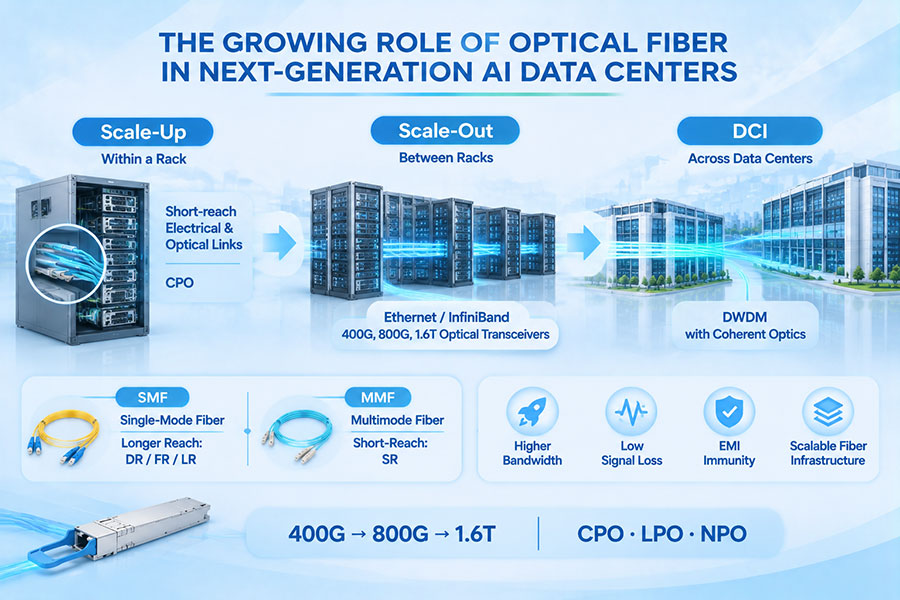
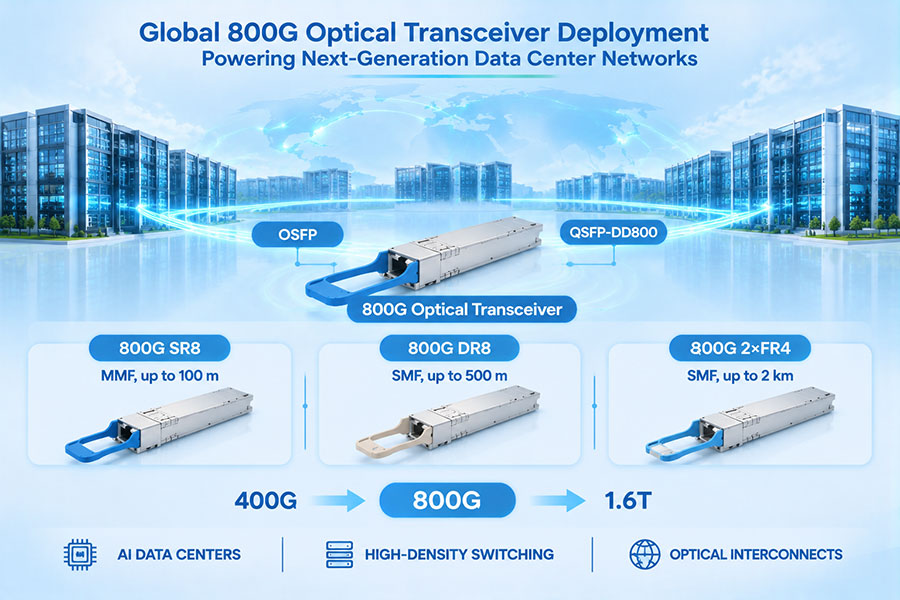
Bandwidth growth: 400G and 800G optical interfaces are increasing the capacity available on individual network connections.
These requirements have changed DCI from a basic connectivity function into an important component of cloud infrastructure architecture.
2. From Dedicated Fiber Links to Wavelength-Division Multiplexing
Early DCI systems commonly used dedicated fiber pairs to connect routers, switches, and optical transport equipment between facilities. This approach is relatively straightforward and can provide predictable performance when sufficient fiber resources are available.
However, dedicated fiber connections become less efficient as traffic demand increases. Each additional connection may require more fiber capacity, optical interfaces, and physical infrastructure. In metropolitan areas and established data center corridors, obtaining additional fiber can also be expensive or difficult.
Wavelength Division Multiplexing (WDM) addresses this challenge by transmitting multiple optical wavelengths over a shared fiber infrastructure. Instead of assigning a separate fiber pair to every connection, multiple services can share the same physical optical path through different wavelengths.
DWDM uses closely spaced wavelengths to increase the number of optical channels that can be carried over a fiber. It has become an important technology for high-capacity DCI systems.
| Connection Approach | Operating Principle | Advantages | Considerations |
|---|---|---|---|
| Dedicated Fiber | Separate fiber resources for individual connections | Simple architecture and direct connectivity | Higher fiber consumption as capacity grows |
| CWDM | Multiple wavelengths with relatively wide channel spacing | Cost-effective wavelength multiplexing for suitable applications | Lower channel density than DWDM |
| DWDM | Multiple closely spaced wavelengths on shared fiber | High fiber capacity and scalable wavelength allocation | Requires optical power, OSNR, and channel management |
| Active Optical Transport | Optical equipment manages multiplexing, amplification, and transmission | Flexible capacity and longer-reach transport options | Additional equipment and operational complexity |
DWDM allows operators to expand network capacity without installing a new fiber pair for every additional service. Its effectiveness depends on the available optical spectrum, fiber characteristics, amplifier configuration, channel spacing, and transmission performance.
3. The Evolution of DCI Network Architecture
DCI architecture has developed through several technology generations. These generations are not strict replacements for one another. Different approaches continue to coexist according to network scale, distance, capacity, and operational requirements.
| Architecture Generation | Main Technology | Typical Deployment | Primary Objective |
|---|---|---|---|
| Direct Optical Connection | Dedicated fiber and gray optics | Nearby data centers | Simple point-to-point connectivity |
| Wavelength Multiplexing | CWDM and DWDM | Metro and regional DCI | Increase capacity over existing fiber |
| Optical Transport Network | OTN, transponders, and muxponders | Metro, regional, and long-haul networks | Service aggregation and transport management |
| Coherent Pluggable DCI | 400ZR, 800ZR, and ZR+ optics | Cloud and hyperscale interconnects | Integrate high-capacity optics into routers and switches |
| IPoDWDM | Router-integrated coherent optics | Large cloud and service provider networks | Reduce dedicated transport layers where practical |
| Intelligent Optical Networking | SDN, telemetry, automation, and programmable optical systems | Multi-site cloud infrastructure | Dynamic resource allocation and operational efficiency |
The most important architectural change is the closer integration of packet networking and optical transport. Traditional networks often relied on separate equipment layers for routing, transponder functions, and optical line systems. Modern coherent pluggables allow some optical transmission functions to be integrated directly into supported routers and switches.
This can simplify selected network designs, although dedicated optical transport equipment remains valuable for wavelength aggregation, amplification, switching, monitoring, and longer-distance transmission.
4. Coherent Optical Technology Reshapes DCI Connectivity
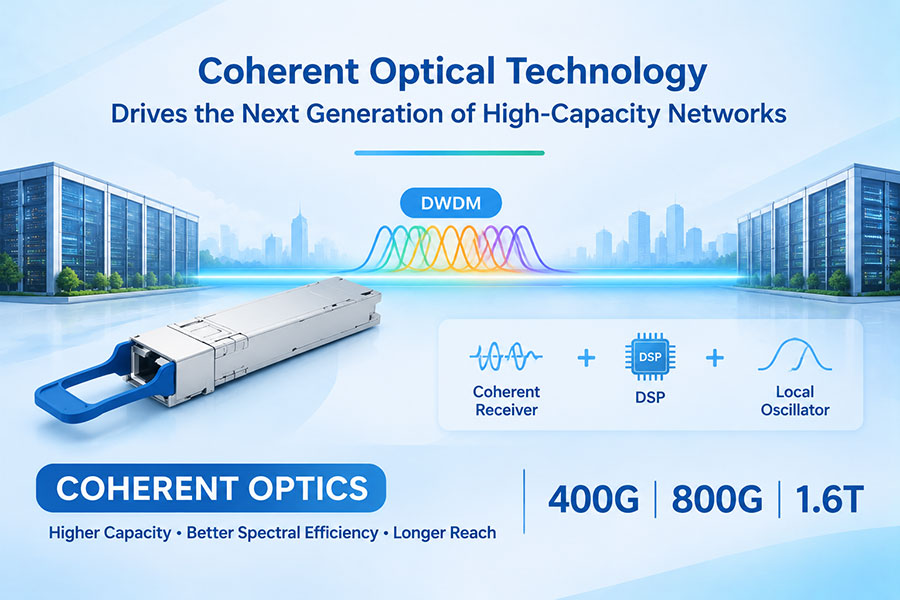
Coherent optical technology has become central to modern high-capacity DCI. Unlike conventional intensity-modulated direct-detection systems, coherent transmission uses advanced modulation and coherent detection to recover information encoded in the amplitude and phase of optical signals.
Coherent receivers use digital signal processing to compensate for supported transmission impairments, including chromatic dispersion and polarization-related effects. This enables high-capacity optical transmission over distances that are difficult to support with conventional short-reach interfaces.
Important technologies in coherent DCI include:
Advanced modulation: QPSK and higher-order modulation formats provide different balances between spectral efficiency and transmission reach.
Coherent detection: Recovers amplitude and phase information from the received optical signal.
Digital signal processing: Compensates for supported channel impairments and manages signal recovery.
Forward error correction: Improves link performance by detecting and correcting transmission errors within the supported operating limits.
Tunable lasers: Allow optical modules to operate on selected wavelengths within a supported DWDM band.
Coherent technology makes it possible to deploy high-capacity optical interfaces directly in compatible routers and switches, reducing the need for separate transponders in some DCI applications.
5. 400ZR, 800ZR, and the Next Generation of Coherent DCI
Standardized coherent pluggable interfaces have played an important role in bringing optical transport capabilities closer to packet networking equipment. 400ZR established a widely recognized foundation for compact coherent DCI, while 800G coherent interfaces extend the available capacity per optical module.
These technologies support different transmission requirements and should not be treated as having identical reach or optical performance.
| Coherent Technology | Nominal Capacity | Typical Application Direction | Important Consideration |
|---|---|---|---|
| 400ZR | 400G | Point-to-point DCI and supported amplified DWDM applications | Reach depends on the specified optical interface and line system |
| 400ZR+ | 400G-class | Extended metro and regional optical transport | Implementation and FEC profiles vary |
| 800ZR | 800G | Higher-capacity DCI links | Requires compatible host and optical line system |
| 800ZR+ | 800G-class | Extended coherent transport applications | Reach depends on modulation, FEC, amplification, and fiber conditions |
| 1600ZR | 1.6T | Emerging next-generation coherent DCI | Standards development and product interoperability continue to shape deployment |
The Optical Internetworking Forum published its 1600ZR Implementation Agreement in September 2026. It defines an interoperable 1.6T coherent line interface and frame format for amplified point-to-point DWDM links in the 120 km application class.
This is an important standards milestone, but publication of an implementation agreement does not mean that all 1.6T coherent modules are already commercially available or universally interoperable. Product qualification, host support, and optical system validation remain essential.
For cloud operators, the progression from 400ZR to 800ZR and emerging 1600ZR creates additional options for increasing DCI capacity while maintaining a pluggable optical architecture.
6. IPoDWDM Integrates Optical Transmission Into IP Networks
Traditional DCI networks often use a layered architecture in which routers connect to transponders, and transponders connect to DWDM line systems. This structure provides flexibility and centralized optical transport management, but it also introduces additional equipment and interfaces.
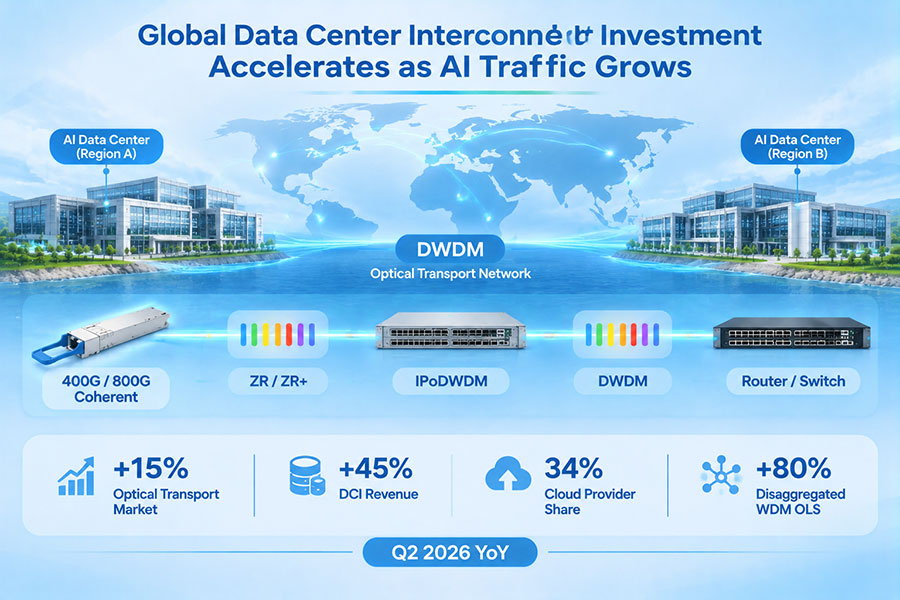
IP over DWDM, commonly referred to as IPoDWDM, integrates coherent optical interfaces directly into compatible routers or switches. The router generates the client traffic and the coherent optical module provides the line-side transmission function.
A simplified architecture can be represented as:
Router / Switch → Transponder or Muxponder → DWDM Line System → Fiber → DWDM Line System → Transponder → Router / Switch
IPoDWDM:
Router / Switch with Coherent Pluggable → DWDM Line System or Compatible Optical Infrastructure → Fiber → DWDM Line System or Compatible Optical Infrastructure → Coherent Pluggable in Router / Switch
IPoDWDM can reduce the number of equipment layers in suitable deployments. It may also simplify network operations by bringing optical link management closer to the IP network.
However, direct router-to-router optical transmission is not automatically the most suitable solution for every DCI route. Longer distances, optical amplification, wavelength aggregation, protection requirements, and multi-vendor interoperability may still require dedicated transport equipment.
| Factor | Traditional Transponder-Based DCI | IPoDWDM |
|---|---|---|
| Equipment Architecture | Separate routing and optical transport layers | Coherent optics integrated into supported IP equipment |
| Operational Model | Separate IP and optical management domains | Closer coordination between IP and optical interfaces |
| Equipment Requirements | May require additional transponders or muxponders | Can reduce dedicated transponder requirements |
| Optical Line Functions | Provided through dedicated transport equipment | May still require external amplifiers, ROADMs, or line systems |
| Best-Fit Applications | Complex transport and multi-service networks | Suitable high-capacity router-to-router connections |
7. ROADM and Flexible Optical Transport Networks
As DCI networks expand across multiple sites, fixed point-to-point optical connections can become difficult to manage. Operators need ways to route wavelengths through different network paths, add capacity, and adapt to changing traffic requirements.
Reconfigurable Optical Add-Drop Multiplexers (ROADMs) provide this flexibility. They allow selected wavelengths to be added, dropped, or passed through optical network nodes without requiring every channel to be converted into an electrical signal at each intermediate location.
ROADM-based architectures are particularly useful in metro and regional optical networks that connect multiple data centers.
Key benefits include:
Flexible wavelength routing: Optical channels can be directed through different network paths.
Capacity expansion: Additional wavelengths can be introduced as traffic demand increases, subject to available spectrum and system limits.
Reduced manual intervention: Remote configuration simplifies wavelength provisioning.
Network resilience: Optical paths can be designed with alternative routes and protection mechanisms.
Multi-site connectivity: Multiple data centers can share a common optical transport infrastructure.
Modern flexible-grid optical systems can allocate spectrum according to channel requirements rather than relying exclusively on a fixed channel grid. This helps improve spectrum utilization in networks carrying different transmission rates and modulation formats.
8. DCI Architecture Across Metro, Regional, and Long-Haul Networks
The physical distance between data centers has a direct influence on optical architecture. A connection between nearby facilities may use direct optics or a relatively simple DWDM system, while regional and long-haul routes may require coherent transmission, optical amplification, and more advanced transport infrastructure.
| Network Scope | Typical Distance Context | Possible Optical Architecture | Primary Requirements |
|---|---|---|---|
| Campus / Nearby DCI | Short links, often within a few kilometers | Direct optical connections or suitable gray optics | Low complexity and cost-effective connectivity |
| Metro DCI | Several to tens of kilometers | Coherent pluggables, DWDM, or optical transport systems | High capacity and fiber efficiency |
| Extended Metro / Regional DCI | Tens to hundreds of kilometers | Coherent optics, amplification, and DWDM | Optical reach, OSNR, and path protection |
| Long-Haul DCI | Hundreds of kilometers and beyond | Coherent transport with engineered optical line systems | Multi-span performance and end-to-end reliability |
These distance categories are architectural guidelines rather than universal product specifications. Actual reach depends on fiber attenuation, optical connectors, amplifier placement, span loss, OSNR, modulation format, FEC, and the capabilities of the selected coherent module.
For longer routes, network engineers must evaluate the complete optical path rather than selecting a transceiver based only on its advertised maximum distance.
9. AI Data Centers Introduce New DCI Requirements
AI infrastructure is expanding the role of DCI beyond conventional cloud service delivery. Large AI platforms may distribute computing resources across multiple facilities to improve capacity planning, energy utilization, and geographic resilience.
These deployments create different traffic patterns between data centers. Front-end traffic connects users and applications to cloud services, while back-end traffic may support storage, distributed computing, and communication between AI clusters.
AI training across geographically distributed facilities can be particularly demanding because synchronization and data exchange may be sensitive to latency, packet loss, and network interruptions.
Several requirements are becoming more important:
High aggregate bandwidth: Distributed workloads require sufficient capacity between computing sites.
Predictable latency: Network delay must be considered when deciding whether a workload is suitable for multi-site execution.
Low packet loss: Reliable transport helps avoid performance degradation during data exchange.
Traffic engineering: Network paths must accommodate changing traffic volumes and service priorities.
Redundant connectivity: Multiple paths reduce dependence on a single fiber route or transport system.
Optical scalability: DWDM and coherent technologies provide additional capacity as AI infrastructure grows.
Not every AI workload should be distributed across geographically distant data centers. Synchronous GPU communication can be highly sensitive to propagation delay. In many architectures, tightly coupled training remains within a facility or campus, while DCI supports selected scale-across, storage, data movement, and service continuity functions.
Therefore, DCI design for AI infrastructure must account for workload characteristics rather than treating all inter-site traffic as equivalent.
10. Reliability, Redundancy, and Network Protection
Cloud platforms depend on continuous connectivity between data centers. A fiber cut, equipment failure, or optical performance issue can affect application availability, data replication, and distributed services.
Modern DCI architectures use multiple layers of protection to reduce the impact of network failures.
| Protection Method | Implementation | Purpose |
|---|---|---|
| Physical Path Diversity | Separate fiber routes and conduit paths | Reduces the risk of a single physical incident affecting all connections |
| Optical Protection | Protection switching and alternative optical paths | Maintains connectivity when an optical path fails |
| IP Layer Redundancy | Routing protocols and multiple network paths | Supports traffic rerouting after network failures |
| Equipment Redundancy | Redundant routers, line systems, and power supplies | Reduces dependence on individual devices |
| Monitoring and Telemetry | Optical power, OSNR, BER, and interface alarms | Helps identify degradation and operational faults |
Physical path diversity is especially important. Two logical connections do not provide meaningful physical redundancy if they share the same fiber route, duct, or intermediate facility.
Network operators should also distinguish between protection at the optical layer and recovery at the IP layer. Each mechanism has different switching behavior, failure coverage, and service impact. A resilient architecture coordinates these layers to avoid unnecessary interruptions or conflicting recovery actions.
11. Intelligent DCI Management and Network Automation
As cloud providers operate larger multi-site networks, manual configuration of optical channels and routing paths becomes increasingly difficult. Intelligent network management helps operators monitor performance, allocate capacity, and respond to changing service requirements.
Software-defined networking and network automation can coordinate IP and optical resources. By collecting telemetry from routers, coherent modules, and optical transport equipment, management platforms can provide a more complete view of network conditions.
Important capabilities include:
Automated provisioning: Reduces the manual steps required to establish new services and optical paths.
Performance monitoring: Tracks optical power, temperature, BER, OSNR, and interface status where supported.
Capacity planning: Identifies links approaching utilization limits.
Fault localization: Combines equipment alarms and network telemetry to narrow down failure locations.
Traffic engineering: Helps distribute traffic across available network paths.
Predictive maintenance: Uses historical performance data to identify potential degradation before it becomes a service-affecting failure.
ITU-T's international optical network report identifies DCI, intra-data-center networking, and data center access as connected elements of future cloud and AI optical infrastructure. It also highlights optical resource scheduling, management-control coordination, and high-reliability transport as important architectural capabilities.
Automation does not remove the need for optical engineering. It makes accurate telemetry, interoperable interfaces, consistent configuration, and coordinated control more important.
12. Security and Operational Considerations in Multi-Site DCI
Connecting geographically distributed data centers introduces security and operational requirements beyond basic optical transmission. DCI links may carry sensitive application data, storage replication traffic, management information, and communication between cloud infrastructure components.
Network architecture should therefore include appropriate controls across physical, optical, and packet layers.
Important considerations include:
Physical security: Protect fiber routes, optical facilities, and equipment locations from unauthorized access.
Traffic encryption: Apply suitable encryption where required by data sensitivity and security policy.
Network segmentation: Separate management, storage, application, and customer traffic according to security requirements.
Access control: Restrict configuration and monitoring permissions to authorized personnel.
Configuration management: Maintain consistent policies across routers, switches, and optical transport equipment.
Continuous monitoring: Detect unexpected changes in traffic, interface status, and network behavior.
Optical transmission alone does not guarantee data confidentiality. Encryption and access-control mechanisms must be implemented at appropriate network layers according to the deployment's security requirements.
13. Selecting Optical Transceivers for Modern DCI Networks
Optical transceiver selection is an important part of DCI engineering. The correct module depends on transmission distance, bandwidth, optical line architecture, host platform, fiber type, and required interoperability.
For short-distance connections, conventional gray optics may be sufficient. For higher-capacity metro and regional DCI, coherent pluggables can provide greater transmission capacity and support DWDM wavelength operation.
| Selection Factor | Technical Questions | Why It Matters |
|---|---|---|
| Data Rate | Is the connection 100G, 400G, 800G, or higher? | Determines interface capacity and host requirements |
| Transmission Distance | What is the actual fiber route length and loss budget? | Determines the required optical reach |
| Optical Technology | Is direct detection or coherent transmission required? | Affects reach, spectral efficiency, and system architecture |
| Wavelength | Does the module support the required DWDM channel or tuning range? | Ensures compatibility with the optical line system |
| Host Compatibility | Does the router or switch support the module and its operating mode? | Prevents host and interface compatibility problems |
| Power and Cooling | Can the host support the module's power and thermal requirements? | Ensures stable operation under the intended conditions |
| Management | Are the management interface and diagnostics supported? | Enables monitoring and maintenance |
For coherent DCI, engineers should also verify modulation format, baud rate, FEC mode, optical output power, receiver performance, and compatibility with the optical line system.
14. C-LIGHT Coherent Optical Solutions for DCI Networks
C-LIGHT provides optical transceiver solutions for cloud data centers, metro networks, regional optical transport, and high-capacity DCI applications. Its coherent DWDM product portfolio includes compact pluggable modules designed for different transmission rates and distances.
C-LIGHT DWDM DCO Coherent Transceiver – A portfolio covering 100G to 800G coherent optical solutions in supported form factors, including QSFP28, CFP2, QSFP-DD, and OSFP. Selected configurations support C-band tunable DWDM operation.
C-LIGHT 800G QSFP-DD ZR / ZR+ DCO – Supports 800G coherent transmission for high-capacity DCI applications. Listed configurations include 800ZR at 120 km and selected 800ZR+ modes at longer distances, subject to their individual specifications and optical system requirements.
C-LIGHT 400G ZR++ DCO – Provides coherent optical connectivity for extended transmission applications. The listed product configuration supports up to 2,400 km under its specified operating conditions.
C-LIGHT 800G OSFP Optical Transceiver – Provides high-speed optical connectivity for data center switching and network infrastructure, with multiple optical configurations for different link distances.
C-LIGHT 400G QSFP-DD Optical Transceiver – Offers multiple 400G optical interface options for data center and networking applications.
For DCI deployment, product selection should be based on the actual route, fiber characteristics, optical line system, required transmission capacity, and host equipment. Coherent module reach figures are configuration-specific and should not be interpreted as guaranteed distances across arbitrary fiber infrastructure.
C-LIGHT supports customers evaluating optical transceiver options for high-capacity cloud connectivity and optical transport applications. Host compatibility, operating modes, and optical performance requirements should be confirmed before deployment.
15. The Future of DCI Architecture in Cloud and AI Networks
The next stage of DCI development will involve closer coordination between IP networking, coherent optics, optical transport, and automated network management. As cloud infrastructure becomes more geographically distributed, operators will need architectures that can scale capacity while maintaining predictable performance and high availability.
Several developments are likely to influence future DCI networks:
Higher-capacity coherent interfaces: 800G and emerging 1.6T technologies will expand the bandwidth available per optical connection.
Greater IP and optical integration: IPoDWDM and coherent pluggables will simplify selected network architectures.
Flexible optical transport: ROADMs and flexible-grid systems will support more adaptable wavelength routing.
AI-aware network planning: Traffic engineering will increasingly account for workload distribution and inter-site data movement.
Improved automation: Integrated telemetry and software-defined control will help manage large multi-site networks.
Higher reliability requirements: Physical route diversity and coordinated protection will remain essential for cloud service continuity.
More efficient optical infrastructure: Better spectral utilization and improved power efficiency will become increasingly important as network capacity grows.
The future DCI architecture will not be based on a single technology. Direct optical connections, DWDM, coherent pluggables, OTN, and ROADM systems will continue to serve different network environments. Their integration will determine how efficiently cloud providers can connect distributed computing resources.
16. Conclusion
Data Center Interconnect architecture has evolved from dedicated fiber links into a flexible optical networking foundation for modern cloud infrastructure. DWDM has improved fiber capacity, coherent optics have increased transmission performance, and IPoDWDM has brought optical transmission closer to routing and switching equipment.
As cloud platforms and AI infrastructure expand across multiple locations, DCI networks must support higher bandwidth, reliable transport, flexible wavelength management, and increasingly automated operations. Technologies such as 400ZR, 800ZR, ROADMs, and emerging 1.6T coherent interfaces will contribute to this evolution.
The most effective architecture depends on the distance between facilities, traffic characteristics, available fiber resources, optical system requirements, and operational objectives. Rather than relying on one universal design, cloud operators will continue combining different optical and packet technologies to build scalable multi-site networks.
For high-capacity coherent optical transceivers, DWDM DCO solutions, and data center connectivity requirements, Contact C-LIGHT for product information, technical support, and customized optical networking solutions.
 >

 >
 >
 >
 >
 >
 >
 >