TEL:+86 132 6656 7067





Optical communication systems use different modulation and detection techniques to transmit data across fiber networks. NRZ (Non-Return-to-Zero) is a binary line-signaling format that represents information through two signal states, while coherent optical transmission uses a local optical reference to recover the amplitude and phase of the incoming optical field. These technologies are often discussed in the context of transmission speed, optical reach and receiver complexity, but they describe different aspects of a communication system. NRZ defines how binary information is represented in a signal, whereas coherent detection defines how the receiver extracts information from light. Understanding their relationship is important when evaluating optical transceivers, high-speed Ethernet interfaces and optical transport networks.
1. What Is the Difference Between Coherent and NRZ?
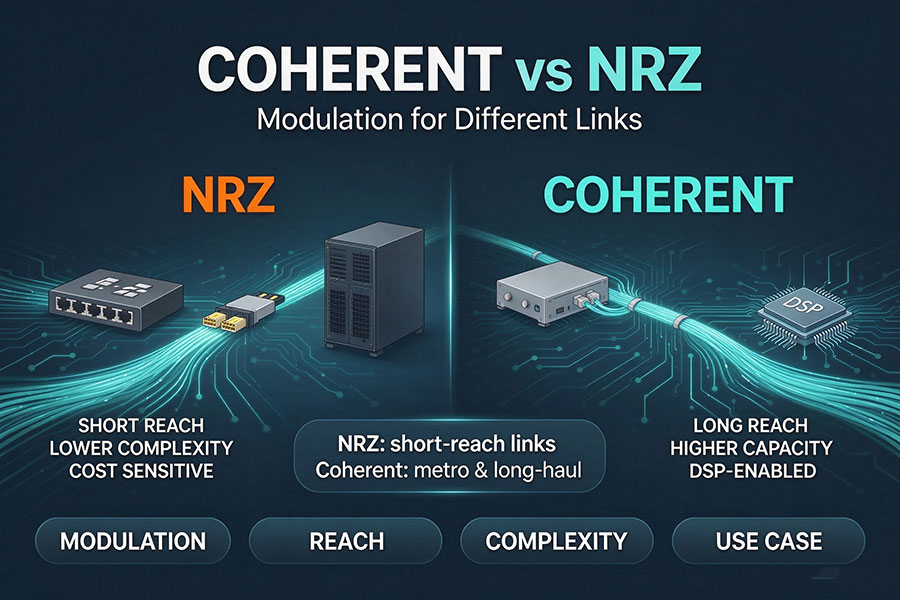
Coherent and NRZ are not strictly equivalent technical categories. NRZ describes a signal encoding format, while coherent describes an optical detection architecture and, in practical systems, a broader transmission approach involving complex optical modulation and digital signal processing.
In a conventional NRZ optical link, binary data is represented by two signal levels. A logical 1 and a logical 0 correspond to different optical intensity states, commonly implemented using On-Off Keying (OOK). The receiver uses a photodiode to detect the optical power and convert it into an electrical signal.
Coherent optical transmission uses a local oscillator (LO) at the receiver to interfere with the incoming optical signal. This enables recovery of the optical field's in-phase and quadrature components. The transmitter can encode information in amplitude and phase, and many systems also use polarization multiplexing.
2. What Is NRZ Modulation?
NRZ stands for Non-Return-to-Zero. It is a binary signaling format in which the signal maintains its assigned level throughout a bit interval rather than returning to a zero reference level between consecutive bits.
In a common electrical or optical NRZ implementation, two amplitude levels represent binary data. The signal changes level when the transmitted bit requires a different state, but it does not automatically return to zero at the end of every bit period.
NRZ is commonly associated with OOK in conventional optical communication. Under this arrangement, one optical power level represents a logical 1 and a lower optical power level represents a logical 0.
Because NRZ carries one bit per symbol, its symbol rate is numerically equal to its gross bit rate before coding and framing overhead. A 10 Gb/s NRZ signal, for example, has a nominal symbol rate of 10 GBd.
NRZ has a relatively simple signal structure and receiver implementation. It has therefore been widely used in Ethernet, telecommunications and optical transmission systems. Its limitations become more apparent as data rates increase, because higher symbol rates require greater electrical and optical bandwidth and place tighter demands on signal integrity.
3. How NRZ Optical Transmission Works
A conventional NRZ optical transmitter converts an electrical binary data stream into an optical signal with two intensity levels. The implementation may use a directly modulated laser or an external optical modulator.
NRZ transmitter
In a directly modulated laser transmitter, the electrical drive current changes the laser's output intensity according to the data pattern. In an externally modulated transmitter, a continuous-wave laser provides the optical carrier while an EAM or MZM controls the transmitted optical power.
The transmitter driver must generate the required electrical signal swing and maintain suitable timing, waveform quality and extinction ratio. The optical output is then transmitted through single-mode or multimode fiber according to the application.
NRZ receiver
A conventional direct-detection NRZ receiver uses a PIN photodiode or APD to convert received optical power into photocurrent. A transimpedance amplifier (TIA) converts the photocurrent into a voltage signal, and subsequent circuits recover the clock and determine the binary data.
Here, i(t) is the photocurrent, R is the photodiode responsivity and P(t) is the received optical power. The receiver distinguishes between the two optical states using an appropriate decision threshold.
This architecture is relatively straightforward because the receiver does not need to recover the optical carrier phase. However, the receiver must still manage noise, dispersion, jitter, inter-symbol interference and other channel impairments.
4. What Is Coherent Optical Transmission?
Coherent optical transmission uses interference between the received optical signal and a local oscillator to recover information from the optical field. Unlike conventional direct detection, which measures optical power, coherent detection provides access to the signal's in-phase and quadrature components.
A typical coherent transmitter uses a narrow-linewidth laser and an IQ modulator. The IQ modulator generates controlled amplitude and phase variations by combining two modulation paths with a defined phase relationship.
At the receiver, the incoming signal is combined with the local oscillator through an optical hybrid. Balanced photodetectors convert the interference signals into electrical I/Q components. High-speed ADCs digitize these signals, and a digital signal processor reconstructs the transmitted symbols.
Common coherent modulation formats include QPSK, 16QAM and 64QAM. Dual-polarization coherent systems can transmit independent data streams on two orthogonal polarization states.
| Coherent component | Function |
|---|---|
| Narrow-linewidth laser | Provides the optical carrier for signal generation or local reference. |
| IQ modulator | Controls the optical signal's in-phase and quadrature components. |
| Local oscillator | Provides the reference optical field for coherent reception. |
| Optical hybrid | Combines the received signal and local oscillator with controlled phase relationships. |
| Balanced photodetectors | Convert optical interference signals into electrical I/Q components. |
| ADC | Digitizes the received electrical waveforms. |
| DSP | Performs equalization, carrier recovery, polarization processing and signal reconstruction. |
5. NRZ vs Coherent: Signal Representation
NRZ and coherent systems differ in the amount and type of optical signal information represented and recovered. Conventional NRZ OOK uses two intensity states, while coherent systems can use multiple amplitude and phase combinations.
| Characteristic | NRZ OOK with direct detection | Coherent optical transmission |
|---|---|---|
| Technical category | Binary line-signaling and intensity modulation format | Optical detection and transmission architecture |
| Signal information | Two intensity states | Amplitude and phase; may also use polarization multiplexing |
| Bits per symbol | 1 | Depends on modulation format |
| Typical modulation | OOK / NRZ | QPSK, 16QAM, 64QAM and other complex formats |
| Receiver reference | No local oscillator required | Local oscillator used in conventional coherent reception |
| Detection method | Direct photodetection | Optical mixing and balanced detection |
| Signal processing | Clock recovery and electrical equalization as required | Complex-field recovery and extensive DSP |
The comparison above describes common NRZ OOK direct-detection links, not every possible NRZ implementation. For example, NRZ-DPSK and NRZ-DQPSK use phase-related signaling and can employ interferometric or coherent detection techniques.
6. NRZ, OOK and RZ: Understanding the Relationship
NRZ is frequently used together with OOK in optical communication, but the terms describe different aspects of the signal.
OOK describes a binary intensity modulation method in which the presence or absence of a signal level represents data. NRZ describes the temporal line coding behavior, in which the signal does not return to the zero level between bit intervals.
RZ (Return-to-Zero) is another temporal signaling format. In RZ, the optical pulse returns toward its zero level within each bit period, even when consecutive bits contain logical 1s.
| Format | Signal behavior | Typical characteristics |
|---|---|---|
| NRZ | Signal remains at its assigned level throughout the bit interval. | Relatively compact bandwidth and straightforward implementation. |
| RZ | Signal returns toward zero within each bit interval. | Often requires broader bandwidth, but can offer different dispersion and timing characteristics. |
| NRZ-DPSK | Information is represented by differential phase changes with an NRZ-type symbol structure. | Requires phase-sensitive or interferometric detection. |
| NRZ-DQPSK | Uses differential quadrature phase changes. | Can carry more information per symbol than binary NRZ OOK. |
NRZ and RZ should not be confused with direct and coherent detection. The former describe signal formats, while the latter describe receiver approaches. ITU-T optical system guidance covers NRZ, RZ, DPSK, DQPSK and dual-polarization QPSK as different signaling and modulation options.
7. Data Rate and Bandwidth Efficiency
One important characteristic of NRZ is that it carries one bit per symbol. As the required data rate increases, the symbol rate must also increase, placing greater demands on the transmitter, receiver and electrical and optical channels.
Coherent systems can use higher-order modulation formats to transmit multiple bits per symbol. QPSK carries two bits per symbol, 16QAM carries four and 64QAM carries six, before coding overhead.
| Modulation format | Bits per symbol | Typical signaling approach |
|---|---|---|
| NRZ OOK | 1 | Two optical intensity states |
| QPSK | 2 | Four phase states |
| 16QAM | 4 | Sixteen I/Q constellation points |
| 64QAM | 6 | Sixty-four I/Q constellation points |
For example, a 100 Gb/s binary NRZ signal requires approximately 100 GBd before overhead, whereas a QPSK signal can carry two bits per symbol. A dual-polarization QPSK system can carry two independent QPSK streams, increasing the gross information rate per symbol interval across both polarizations.
These examples illustrate signaling efficiency rather than a direct product-level comparison. Actual transmission rates depend on baud rate, polarization multiplexing, FEC, framing and implementation details.
8. Optical Receiver Sensitivity and Noise Performance
NRZ direct-detection systems and coherent systems use different receiver mechanisms, which influences their sensitivity and noise performance.
In a conventional NRZ direct-detection receiver, the photodiode converts optical power into electrical current. The receiver must distinguish the two signal levels while managing shot noise, thermal noise, amplifier noise, inter-symbol interference and timing errors.
Coherent detection mixes the received optical signal with a local oscillator. The strong reference field enables the receiver to recover weak optical signals through the resulting interference components. This is an important reason coherent systems can achieve high receiver sensitivity in suitable implementations.
However, coherent receivers introduce their own noise and implementation requirements. Laser linewidth, frequency offset, phase noise, optical hybrid balance, photodetector performance and ADC characteristics all influence the recovered signal quality.
Important performance measurements include:
Receiver sensitivity: Minimum received optical power required to meet a specified error-performance target.
BER: Bit error ratio measured before or after FEC, depending on the test point.
OSNR: Optical signal-to-noise ratio, especially important in amplified coherent transmission systems.
Extinction ratio: Ratio between the high and low optical power states in an intensity-modulated transmitter.
Eye quality: Measures the signal opening and timing margin in a directly detected NRZ waveform.
9. Chromatic Dispersion and Transmission Distance
Chromatic dispersion occurs because different optical frequency components travel through fiber at different group velocities. This causes pulse broadening and inter-symbol interference, particularly as symbol rates and fiber distances increase.
Conventional NRZ OOK direct-detection links have limited access to the optical field information needed for advanced digital dispersion compensation. Their practical reach therefore depends on the optical wavelength, fiber characteristics, transmitter quality, receiver sensitivity and applicable interface specifications.
Coherent systems recover the complex optical field and can digitally compensate for chromatic dispersion. They can also compensate for polarization-mode dispersion and other impairments through adaptive signal processing.
| Performance factor | NRZ OOK direct detection | Coherent transmission |
|---|---|---|
| Chromatic dispersion | Managed through link design, reach limits and suitable equalization. | Can be digitally compensated using recovered optical-field information. |
| Polarization-mode dispersion | Managed through fiber and receiver design. | Adaptive DSP can compensate for polarization-related impairments. |
| Optical noise | Influences the ability to distinguish two intensity levels. | Influences constellation quality and achievable modulation order. |
| Typical reach profile | Common in short-reach and selected medium-reach links. | Common in metro, regional, long-haul and high-capacity DCI systems. |
Coherent transmission does not eliminate all fiber limitations. Amplifier noise, nonlinear effects, filtering, laser characteristics and insufficient OSNR can still constrain the achievable distance and data rate.
10. Power Consumption and Hardware Complexity
Conventional NRZ direct-detection transceivers generally have simpler optical receiver architectures than coherent modules. They do not require a local oscillator, optical hybrid or multiple balanced detection paths.
This simplicity can reduce optical front-end complexity and support cost-effective, high-density connectivity. However, NRZ is not automatically a low-power solution at every data rate. High-speed drivers, receiver amplifiers, equalizers and host electrical interfaces still consume power.
Coherent modules require additional optical and electronic components, including the local oscillator, optical hybrid, balanced photodetectors, ADCs and advanced DSP. These components increase integration requirements and can produce higher power consumption and thermal output.
| Evaluation factor | NRZ direct detection | Coherent transmission |
|---|---|---|
| Optical receiver structure | Relatively simple photodiode-based receiver. | LO, optical hybrid and balanced detection. |
| DSP requirements | Generally simpler clock recovery and equalization. | Complex-field recovery, carrier recovery and adaptive equalization. |
| Module power profile | Often favorable for simpler short-reach interfaces. | Generally higher due to additional optical and DSP functions. |
| Thermal design | Driver, TIA and host signal integrity are important. | DSP, LO and coherent photonic components require careful thermal management. |
| Cost priorities | Port density and economical short-reach connectivity. | High capacity per wavelength and advanced optical transport. |
Actual power and cost depend on data rate, module form factor, integration level, host platform and application. A meaningful evaluation should use the specifications of the complete transceiver and network system.
11. Why NRZ Was Widely Used in Earlier Optical Networks
NRZ became a widely adopted signaling format because of its relatively simple transmitter and receiver requirements. It can be implemented using direct laser modulation or external intensity modulators, with straightforward direct-detection receivers.
For early Ethernet and telecommunications interfaces, this simplicity provided a practical balance between data rate, optical performance, component availability and equipment cost.
NRZ was also attractive because it requires less bandwidth than conventional RZ signaling at the same bit rate under comparable pulse-shaping assumptions. This can help reduce component bandwidth requirements and simplify signal processing.
As optical networks moved toward higher data rates, the limitations of binary NRZ became more significant. Increasing the bit rate also increases the symbol rate, requiring faster electrical drivers, wider-bandwidth modulators, higher-speed photodetectors and more demanding receiver electronics.
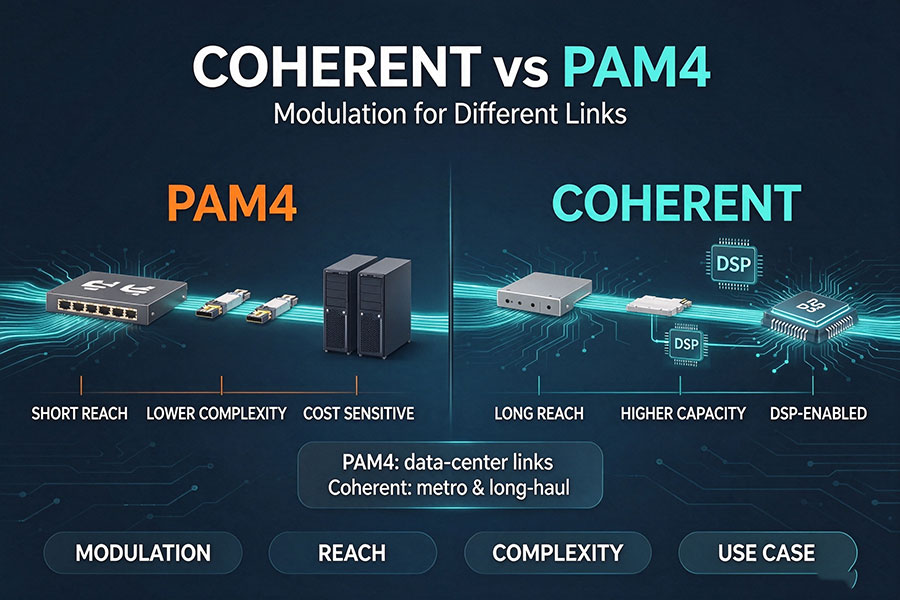
For these reasons, many modern high-speed short-reach interfaces have adopted PAM4, while coherent systems have expanded into high-capacity optical transport and data center interconnect applications.
12. Typical Applications of NRZ Optical Transceivers
NRZ remains relevant in optical communication, particularly in established and lower-rate interfaces where simple signaling and direct detection are suitable.
Traditional Ethernet interfaces: Many 1G, 10G and other established optical interfaces use NRZ or related binary signaling formats.
Enterprise networks: NRZ-based optical modules are used for suitable switch-to-switch and equipment connectivity.
Telecommunications access: Certain access-network interfaces use binary intensity signaling according to their applicable specifications.
Industrial optical links: NRZ-based modules can provide straightforward optical connectivity when the required data rate and reach are within the product specification.
Legacy network infrastructure: Existing equipment may continue to use NRZ-based optical interfaces for compatibility and maintenance.
The specific optical reach depends on the transceiver standard, wavelength, fiber type, optical budget and host compatibility rather than the NRZ label alone.
13. Typical Applications of Coherent Optical Transceivers
Coherent optical transmission is widely used in applications that require high capacity per wavelength, advanced modulation formats and compensation of fiber transmission impairments.
Metro optical networks: High-capacity connections between metropolitan network nodes.
Regional transport: Long-distance links using advanced modulation and optical amplification.
Long-haul networks: High-capacity transmission across multiple fiber spans.
Submarine communication: Systems requiring high spectral efficiency and sophisticated OSNR management.
Data center interconnects: High-capacity optical connections between separate data center facilities.
Coherent pluggable modules such as 400ZR and 800ZR demonstrate how coherent transmission can be integrated into compact optical modules for routers and switches. Their application depends on the supported line interface and optical infrastructure.
14. Coherent Pluggables and the Evolution of Optical Networking
Modern optical networks are increasingly moving toward higher data rates and more flexible optical transport architectures. While NRZ remains useful in established binary interfaces, it is no longer sufficient for every high-capacity application.
Two important developments have shaped modern optical connectivity:
High-speed intensity-modulated interfaces
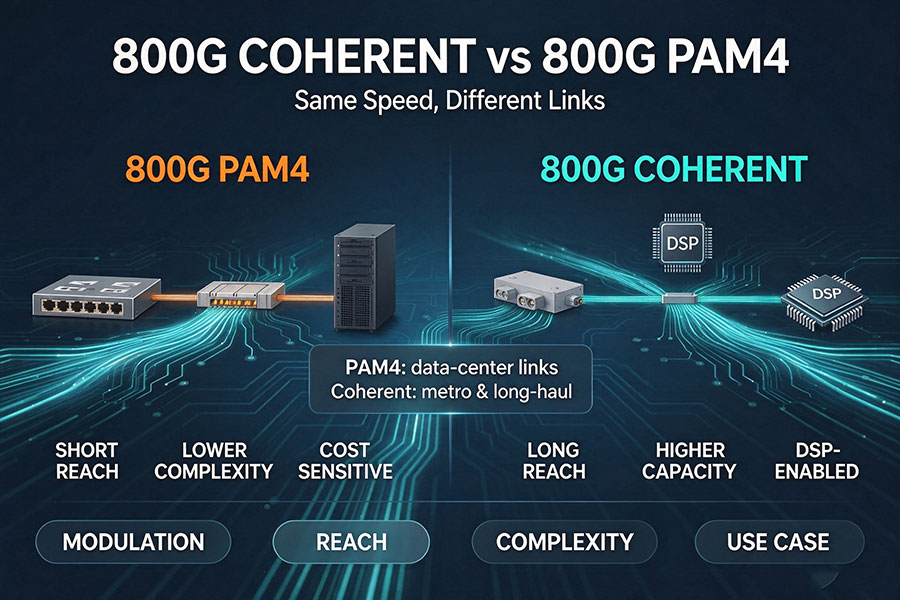
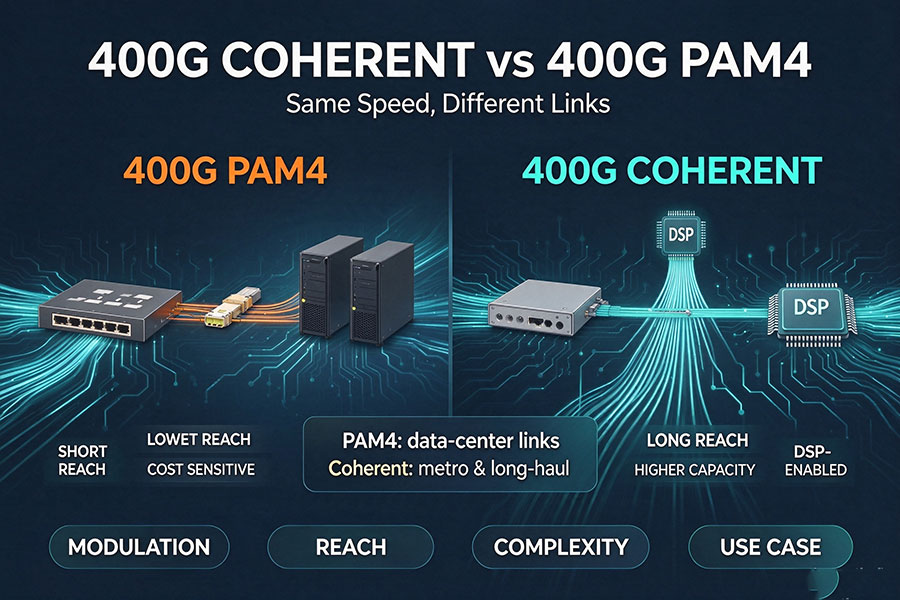
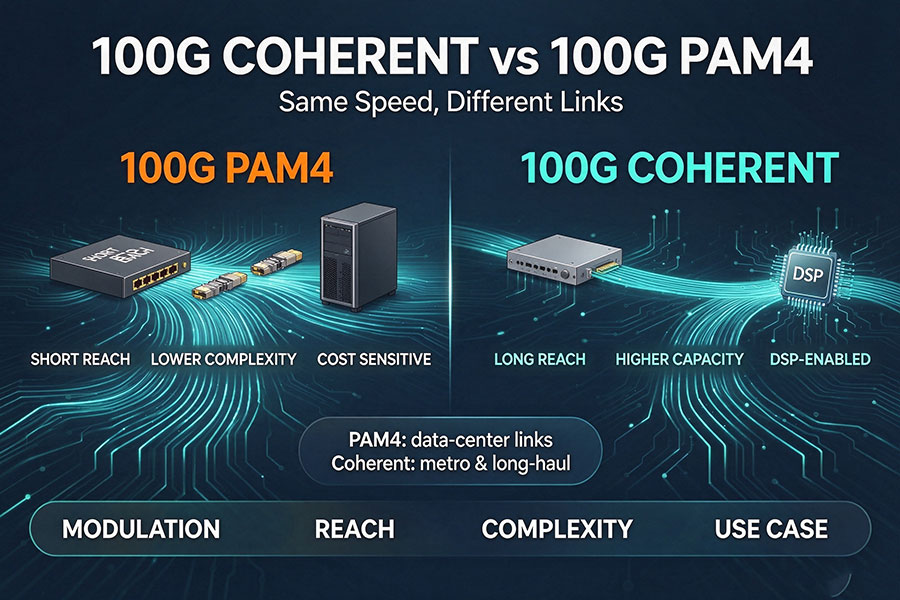
Many 400G and 800G Ethernet optical interfaces use PAM4 rather than NRZ because PAM4 carries two bits per symbol. This allows higher data rates without requiring the same symbol rate as binary NRZ.
Coherent pluggable interfaces
Coherent technology has moved beyond traditional large transport equipment into compact pluggable modules. OIF's 400ZR and 800ZR interfaces provide examples of standardized coherent solutions for amplified DWDM data center interconnect applications.
| Interface family | Technology direction | Application |
|---|---|---|
| Traditional NRZ optical interfaces | Binary intensity signaling in applicable implementations | Established Ethernet and optical connectivity. |
| High-speed PAM4 interfaces | Four-level intensity signaling | Many modern 100G, 400G and 800G optical lane architectures. |
| 400ZR | Coherent DP-16QAM | 400G amplified DWDM data center interconnect. |
| 800ZR | Coherent high-capacity line interface | 800G amplified DWDM data center interconnect. |
| 1600ZR | 1.6T coherent line interface | Next-generation high-capacity amplified DWDM interconnect. |
These technologies address different system requirements. NRZ, PAM4 and coherent interfaces can coexist in the same network, with each selected according to data rate, distance, optical budget, spectrum and operational needs.
15. How to Select Between NRZ and Coherent Optical Solutions
NRZ and coherent should be evaluated according to the intended application rather than treated as direct alternatives. A conventional NRZ direct-detection interface may be appropriate for a simpler binary optical link, while a coherent module may be more suitable for high-capacity transmission over a DWDM line system.
| Selection factor | NRZ direct-detection solution | Coherent solution |
|---|---|---|
| Transmission application | Established Ethernet, access and suitable short-reach links. | Metro, regional, long-haul and high-capacity DCI. |
| Signal format | Two-level binary signaling. | QPSK, QAM and other complex modulation formats. |
| Receiver architecture | Photodiode and electrical signal recovery. | Local oscillator, optical hybrid, balanced detection and DSP. |
| Dispersion management | Link design and appropriate equalization. | Advanced digital compensation of optical-field impairments. |
| Power and complexity | Generally simpler optical front end. | More extensive optical and electronic processing. |
| Optical infrastructure | Suitable point-to-point fiber and supported optical interface. | Compatible coherent wavelength and line-system architecture. |
Before selecting an optical transceiver, engineers should verify the host interface, data rate, wavelength, fiber type, connector, optical power budget, receiver sensitivity, transmission distance and operating temperature.
For coherent applications, additional requirements include the modulation format, OSNR margin, FEC compatibility, laser frequency characteristics, DWDM channel plan and interoperability with the optical line system.
For NRZ interfaces, transmitter extinction ratio, receiver sensitivity, signal bandwidth, jitter, eye quality and dispersion tolerance should be evaluated against the relevant interface specification.
16. Conclusion
NRZ and coherent optical transmission represent different technical aspects of optical communication. NRZ is a binary signaling format that uses two signal states and has been widely adopted because of its relatively simple implementation. Coherent transmission uses a local oscillator and advanced DSP to recover the optical field, enabling amplitude and phase modulation, polarization multiplexing and compensation of important fiber impairments.
The distinction is not simply between older and newer technology. NRZ remains useful in established optical interfaces, while coherent technology supports high-capacity metro, long-haul and data center interconnect applications. Modern optical networks also use PAM4 to extend the capabilities of direct-detection links beyond traditional binary signaling.
For network engineers and optical transceiver buyers, selecting the right technology requires evaluating the complete link architecture. Data rate, transmission distance, fiber characteristics, receiver performance, optical budget, power consumption and host compatibility should all be considered together.
Different optical interfaces serve different transmission requirements across enterprise networks, data centers and optical transport systems. Selecting the right transceiver requires matching data rate, reach, wavelength, fiber type, optical budget and host equipment compatibility. Explore the optical transceiver product range or contact our team for application-specific technical support.
Contact C-LIGHT >

 >
 >
 >
 >
 >
 >
 >