TEL:+86 132 6656 7067





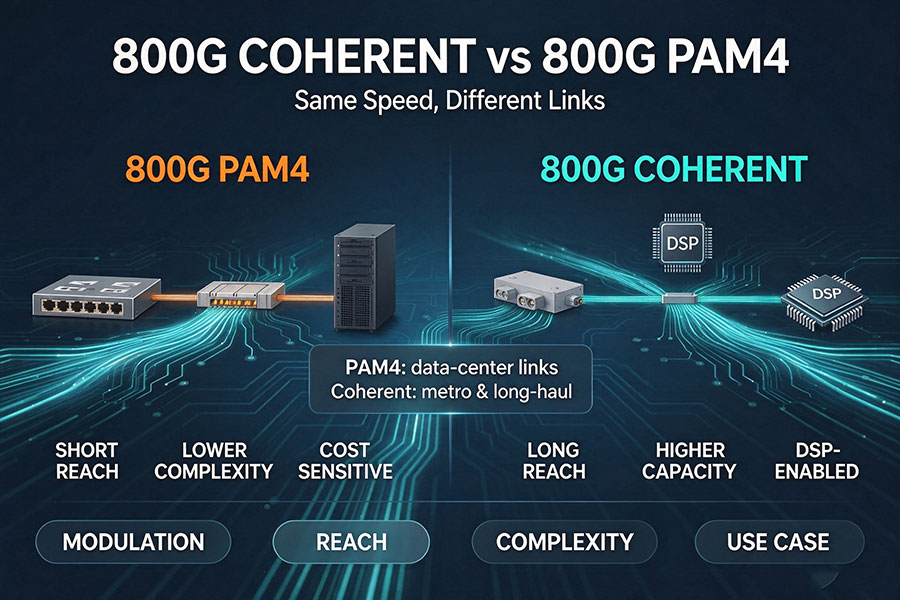
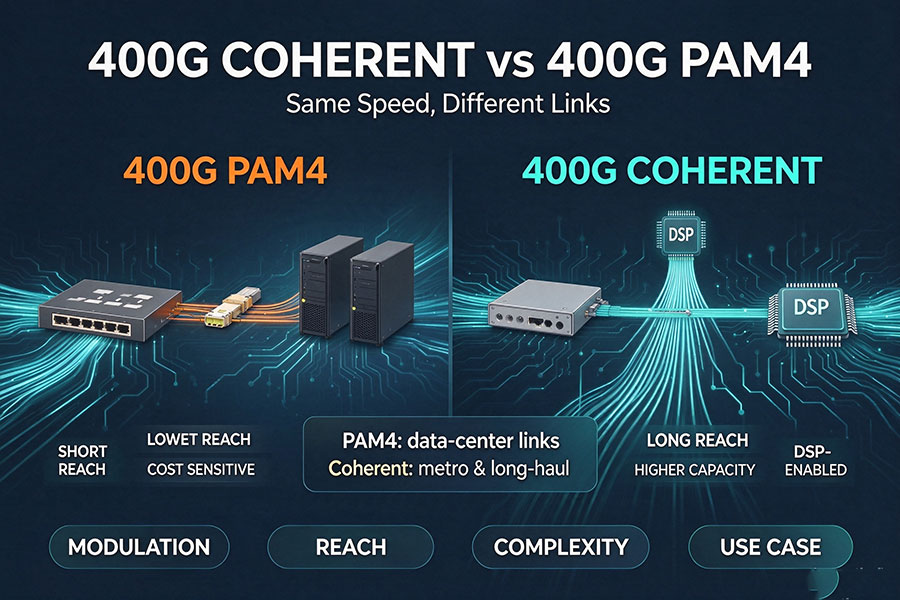
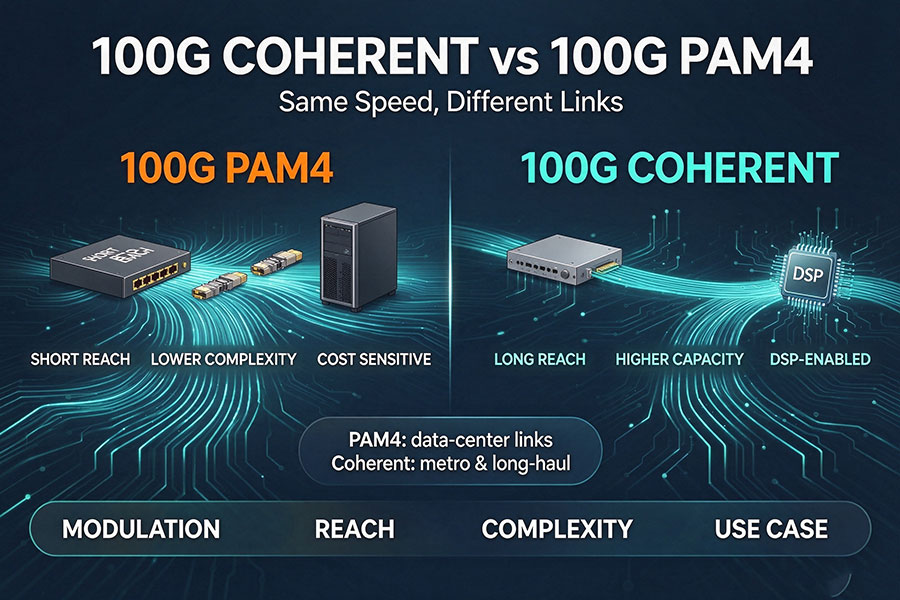
The transition to 800G optical connectivity is increasing the importance of transmission architecture, signal processing and optical infrastructure. Data centers need high-density connections between switches and servers, while distributed AI clusters and large-scale networks also require high-capacity links between facilities. Two major approaches address these requirements: 800G PAM4 direct-detection optics and 800G coherent transceivers.
800G PAM4 is commonly implemented through multiple optical lanes, such as eight 100G-class PAM4 lanes in 800GBASE-DR8. Other implementations combine multiple wavelengths over duplex single-mode fiber. These designs are well suited to data center Ethernet connectivity where the required distance and optical budget are within the interface specification.
800G coherent technology takes a different approach. It uses coherent optical detection and advanced DSP to transmit an aggregate 800G signal over a single optical wavelength. OIF 800LR targets unamplified links up to 10 km, while OIF 800ZR addresses amplified DWDM links in the 80–120 km range. Extended coherent implementations can support longer metro and regional transport.
1. The Fundamental Difference Between 800G Coherent and 800G PAM4
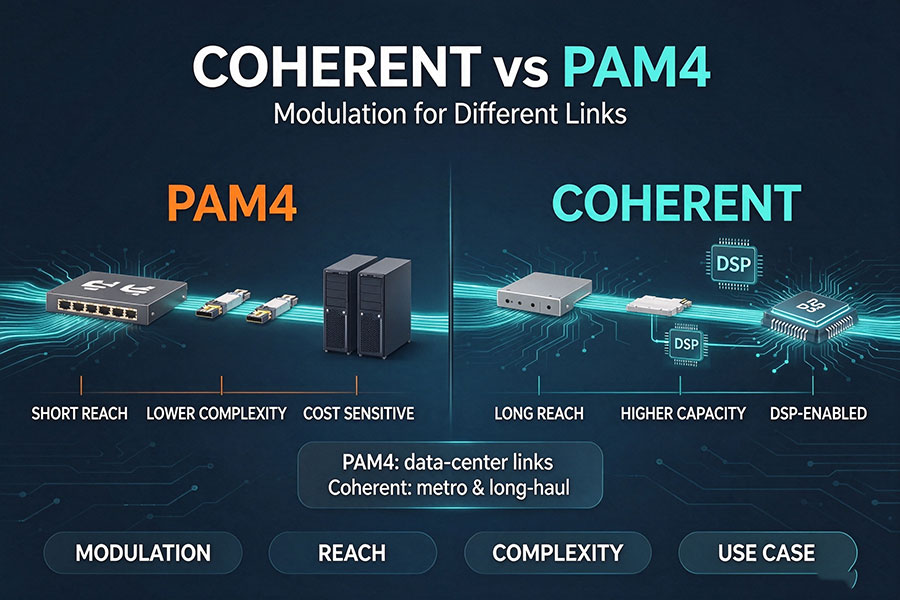
PAM4 describes a modulation format that uses four signal levels to represent two bits per symbol. Coherent describes an optical transmission and detection architecture that recovers amplitude and phase information using a local oscillator, optical hybrid and digital signal processing.
A typical 800G PAM4 direct-detection module uses multiple optical lanes. An 800G coherent module can instead transport the aggregate data rate through one coherent optical carrier, using dual-polarization modulation and coherent DSP.
| Characteristic | 800G PAM4 Direct Detection | 800G Coherent |
|---|---|---|
| Transmission architecture | Typically intensity modulation with direct detection | Coherent optical transmission and detection |
| Representative optical format | PAM4 | DP-16QAM in OIF 800ZR |
| Optical lane arrangement | Commonly 8 × 100G-class lanes; other lane configurations are emerging | One 800G-class coherent optical carrier |
| Receiver | Photodiodes, TIAs and electrical signal processing | Local oscillator, optical hybrid, balanced detectors, ADCs and coherent DSP |
| Typical reach | From tens of meters to several kilometers, depending on interface | Up to 10 km for OIF 800LR; 80–120 km application range for OIF 800ZR |
| Wavelength operation | Fixed wavelengths in common Ethernet interfaces | Fixed wavelength for 800LR; tunable wavelength operation for typical 800ZR products |
| Fiber configuration | Parallel SMF, duplex SMF or multimode fiber, depending on interface | Typically duplex single-mode fiber |
| Signal processing | Equalization, clock recovery and symbol decisions | Carrier recovery, polarization processing, dispersion compensation and FEC |
| Typical deployment | Data center switching and high-density Ethernet | DCI, campus interconnect, metro and DWDM transport |
These are typical deployment patterns rather than absolute limitations. The reach, power consumption and interoperability of any transceiver depend on its specific implementation and supported optical interface.
2. How 800G PAM4 Optical Transmission Works
800G PAM4 uses four signal levels to represent two bits per symbol. Compared with NRZ, which carries one bit per symbol, PAM4 doubles the number of bits represented by each symbol at the same baud rate.
A widely deployed 800G architecture uses eight optical lanes, each operating at approximately 106.25 GBd. Each PAM4 symbol carries two bits, providing approximately 212.5 Gb/s of gross signaling per lane before accounting for coding and other overhead. Eight lanes together provide an 800G-class interface.
Eight-lane PAM4 transmission
In an 800GBASE-DR8 implementation, eight optical transmit lanes operate around the 1310 nm region. The corresponding eight receive lanes provide full-duplex transmission over a parallel single-mode fiber connection. The interface uses 16 optical fibers in total and typically an MPO/MTP connector.
Other 800G PAM4 products use wavelength multiplexing. For example, an 800G 2×FR4 architecture combines two four-wavelength optical groups over duplex single-mode fiber. This reduces the number of physical fibers required compared with parallel-lane transmission.
Direct-detection receiver
Each optical receiver lane converts incoming optical power into an electrical current using a photodiode. A transimpedance amplifier converts the current into a voltage signal, while equalization, clock recovery and symbol-decision circuitry recover the transmitted data.
Depending on the module design, some signal processing is performed inside the transceiver and some is handled by the host ASIC or associated electrical components. A direct-detection PAM4 receiver does not require a local optical oscillator.
3. Common 800G PAM4 Optical Interfaces
800G PAM4 is available in several optical configurations. The main differences involve lane count, fiber type, wavelength arrangement and transmission distance.
| Interface or product family | Optical arrangement | Fiber configuration | Representative reach | Application |
|---|---|---|---|---|
| 800GBASE-DR8 | 8 × 100G-class PAM4 lanes at approximately 1310 nm | 16-fiber parallel SMF | 500 m | High-density data center connections |
| 800GBASE-DR8-2 | 8 × 100G-class PAM4 lanes | 16-fiber parallel SMF | 2 km | Extended-reach parallel-fiber links |
| 800G 2×FR4 | Two groups of four PAM4 WDM wavelengths | Duplex SMF | Typically 2 km | Data center interconnection |
| 800G 2×LR4 | Two groups of four PAM4 WDM wavelengths | Duplex SMF | Typically 10 km | Longer campus and data center links |
| 800GBASE-SR8 | 8 × 100G-class PAM4 lanes at 850 nm | 16-fiber parallel MMF | 100 m | Short-reach multimode links |
The DR8 and DR8-2 entries are IEEE-defined Ethernet application types. The 2×FR4 and 2×LR4 labels are commonly used for product architectures; their detailed specifications should be verified against the applicable vendor or MSA documentation rather than assumed to be identical across manufacturers.
These interfaces also differ in cabling and installation requirements. Parallel-fiber modules require more fiber strands and suitable multi-fiber connectors, while WDM modules can use duplex LC connections but introduce wavelength multiplexing and demultiplexing requirements.
4. How 800G Coherent Optical Transmission Works
Coherent transmission uses the optical field's amplitude and phase to carry information. At the receiver, the incoming signal is combined with a local oscillator laser. An optical hybrid separates the signal into in-phase and quadrature components, and balanced photodetectors convert the resulting optical signals into electrical waveforms.
High-speed analog-to-digital converters and coherent DSP then recover the transmitted information. This architecture provides access to information that a conventional intensity-only receiver does not directly recover.
DP-16QAM in OIF 800ZR
OIF 800ZR uses dual-polarization 16-QAM. Each polarization carries 16 constellation points, with four bits represented per symbol. Combining two polarization states provides eight bits per dual-polarization symbol.
The 800ZR specification uses a nominal symbol rate of approximately 118 GBd. Its higher baud rate and constellation density allow a single coherent optical carrier to transport an 800G-class payload. The implementation also defines optical framing and Open FEC (OFEC) to support interoperability and transmission performance.
Coherent DSP functions
Coherent DSP performs several functions that are particularly valuable in optical transport networks:
Chromatic-dispersion compensation: Corrects accumulated dispersion across the fiber link.
Polarization demultiplexing: Separates the two transmitted polarization channels.
Carrier recovery: Estimates and compensates for frequency offset and phase variations.
Adaptive equalization: Reduces the impact of channel distortion and polarization-related effects.
FEC processing: Detects and corrects errors within the supported correction capability.
These functions make coherent optics suitable for single-wavelength high-capacity transmission over optical line systems. They do not eliminate the need for adequate optical power, OSNR or correct line-system engineering.
5. OIF 800LR and 800ZR: Two Coherent Application Classes
An important development in 800G coherent technology is the availability of separate implementation agreements for shorter unamplified links and longer amplified DWDM links. OIF 800LR and 800ZR address different optical environments.
| Characteristic | OIF 800LR | OIF 800ZR |
|---|---|---|
| Application | Short-reach coherent connectivity | Amplified DWDM transport |
| Transmission distance | Up to 10 km | 80–120 km application range |
| Amplification | Unamplified | Amplified single-span link |
| Wavelength | Fixed wavelength | DWDM channel operation |
| Network environment | DCI, campus and metro edge | Metro DCI and optical transport |
| Primary objective | Low-power, interoperable coherent connectivity | Single-wavelength 800G transport over DWDM |
OIF published the 800LR implementation agreement in April 2025. It defines a single-wavelength, unamplified point-to-point coherent link up to 10 km, supporting either one 800GE client or two 400GE clients. OIF 800LR announcement.
OIF 800ZR defines an amplified, single-span DWDM interface for DCI applications. Its specified application range is 80–120 km, depending on the optical conditions and link configuration. OIF-800ZR-01.0 specification.
This distinction matters because 800G coherent should no longer be described as a technology intended only for long-distance amplified networks. The 800LR profile brings coherent connectivity into shorter campus and data center environments.
6. Modulation and Signal Processing Differences
| Parameter | 800G PAM4 | 800G Coherent DP-16QAM |
|---|---|---|
| Information representation | Four intensity levels | Sixteen constellation points per polarization |
| Bits per symbol | 2 bits per PAM4 symbol | 4 bits per polarization symbol; 8 across two polarizations |
| Optical lane structure | Multiple independent optical lanes in common architectures | Single coherent optical carrier |
| Detection method | Direct detection of optical intensity | Coherent detection of amplitude and phase |
| Local oscillator | Not required | Required |
| Polarization processing | Not normally required for intensity-level decisions | Required for dual-polarization recovery |
| Signal processing | Equalization, clock recovery and symbol decisions | Carrier recovery, polarization processing, dispersion compensation and FEC |
| Key signal-quality metric | Eye quality, receiver sensitivity and BER | OSNR, constellation quality, pre-FEC BER and post-FEC BER |
The two approaches should not be treated as equivalent modulation formats. PAM4 describes the way information is encoded in four intensity levels, while coherent describes the optical detection architecture. A coherent module can accept PAM4 electrical signaling from its host and convert it into a coherent optical line signal.
7. Transmission Distance and Optical Reach
Transmission distance is one of the most visible differences between common 800G PAM4 Ethernet optics and coherent modules. PAM4 interfaces are generally designed around defined direct-fiber reach classes. Coherent interfaces are designed for specific unamplified or amplified optical applications.
| Optical solution | Representative reach | Optical environment |
|---|---|---|
| 800GBASE-SR8 | 100 m | Multimode fiber |
| 800GBASE-DR8 | 500 m | Parallel single-mode fiber |
| 800GBASE-DR8-2 | 2 km | Parallel single-mode fiber |
| 800G 2×FR4 | Typically 2 km | Duplex single-mode fiber with WDM |
| 800G 2×LR4 | Typically 10 km | Duplex single-mode fiber with WDM |
| OIF 800LR | Up to 10 km | Unamplified coherent link |
| OIF 800ZR | 80–120 km application range | Amplified DWDM link |
| Extended 800G coherent | Hundreds of kilometers or more, depending on implementation | Amplified metro and regional optical networks |
These distances are representative interface targets, not universal guarantees. For example, 800ZR+ and other extended coherent modes can support longer transmission distances, but the result depends on modulation, FEC, optical power, OSNR, amplifier spacing and line-system design.
Likewise, a PAM4 module's specified reach depends on its exact optical interface, fiber type, connector loss and receiver performance. A 10 km PAM4 product should not automatically be treated as a substitute for a coherent module designed for an amplified DWDM network.
8. Chromatic Dispersion and OSNR Performance
Chromatic dispersion causes different wavelength components of an optical signal to propagate at different group velocities. Over longer fiber distances, this can broaden and distort the received waveform. Polarization-mode dispersion and other channel impairments can further affect signal quality.
In a direct-detection PAM4 link, the receiver must distinguish four intensity levels after the signal has passed through the fiber channel. Noise, dispersion, optical filtering and waveform distortion can reduce the separation between levels and close the eye openings.
Coherent receivers recover phase and amplitude information and use DSP to compensate for substantial chromatic dispersion and polarization-related impairments. This provides an advantage in amplified DWDM networks where the optical signal accumulates impairments over longer fiber paths.
OSNR is a central performance parameter for coherent transmission. Optical amplifiers introduce noise, and the accumulated noise can reduce the receiver's ability to distinguish the transmitted constellation points. The available margin depends on the modulation format, baud rate, FEC, channel spacing and optical line design.
Coherent DSP cannot compensate for unlimited noise or insufficient optical power. The link must still meet the specified OSNR and optical power requirements, with adequate engineering margin.
9. FEC and Error-Performance Requirements
Forward Error Correction is important in both 800G PAM4 and coherent optical transmission. However, the FEC implementation and the location of the encoding and decoding functions differ between architectures.
For PAM4 Ethernet interfaces, FEC requirements depend on the selected PHY and host electrical interface. The host ASIC, retimer or another part of the system may implement the required coding functions. Both endpoints must support compatible FEC behavior.
OIF 800ZR defines an optical framing and OFEC architecture for its coherent line interface. The FEC is designed to improve error-correction performance under the specified optical conditions and support interoperability between compliant implementations.
Pre-FEC BER measures errors before correction, while post-FEC BER measures residual errors after correction. A low post-FEC BER does not necessarily mean the link has substantial margin. If pre-FEC BER approaches the correction threshold, changes in OSNR or optical power may cause the link to become unstable.
For PAM4, engineers should monitor optical power, receiver performance, lane status, signal quality and host FEC counters. For coherent links, OSNR estimates, pre-FEC BER, post-FEC BER and coherent alarms are important indicators of transmission health.
10. Power Consumption and Transceiver Complexity
800G PAM4 direct-detection modules generally have a simpler optical receiver architecture than coherent modules. They do not require a local oscillator, optical hybrid or the full coherent DSP processing chain. This can support compact designs and lower receiver complexity.
Coherent modules integrate additional optical and electronic functions, including a local oscillator, balanced photodetection, high-speed conversion and coherent DSP. These components increase integration and thermal-design requirements. However, the introduction of 800LR and improvements in coherent DSP are driving more power-efficient coherent implementations.
| Design factor | 800G PAM4 | 800G Coherent |
|---|---|---|
| Optical receiver | Photodiode and TIA-based direct detection | Local oscillator, optical hybrid and balanced detection |
| DSP complexity | Generally lower, depending on implementation | Higher due to carrier and polarization processing |
| Module power | Varies with reach, lane count and DSP architecture | Varies with coherent mode, DSP generation and optical design |
| Thermal management | Depends on module power and host airflow | Requires careful management of DSP and optical component heat |
| Diagnostics | Optical power, temperature and interface-specific monitoring | May include OSNR estimates, constellation metrics and BER monitoring |
| System complexity | Typically simpler for standard Ethernet links | More complex optical and line-system integration |
Actual power consumption must be taken from the manufacturer's data sheet. Comparing only the modulation format is insufficient because reach, form factor, host interface, optical engine design and thermal conditions all influence module power.
11. DWDM Compatibility and Network Integration
800G coherent optics are designed to work with wavelength-based optical transport infrastructure. A tunable 800ZR module can place an 800G signal on a defined DWDM channel, allowing multiple high-capacity services to share a fiber pair through wavelength multiplexing.
OIF 800ZR defines a single-channel coherent line interface for amplified DWDM applications. The specification establishes the optical conditions and framing needed for compliant implementations to interoperate over a qualifying optical path.
800LR serves a different purpose. It is a fixed-wavelength coherent interface designed for unamplified point-to-point connections up to 10 km. It brings coherent transmission into shorter campus and DCI applications without requiring the same amplified DWDM environment as 800ZR.
Conventional 800G PAM4 Ethernet interfaces such as DR8 and DR8-2 are designed for direct Ethernet fiber connections. WDM-based PAM4 modules can combine multiple wavelengths over duplex fiber, but this does not automatically make them tunable DWDM transceivers.
Some vendor-specific PAM4 transport solutions may support particular wavelength plans or optical line systems. Their interoperability must be verified against the module specification and network equipment requirements.
12. Form Factors and Host Interface Compatibility
800G PAM4 and coherent modules may both be available in pluggable packages such as QSFP-DD and OSFP. However, the same mechanical form factor does not guarantee identical electrical interfaces, optical signaling or management functions.
A typical 800G PAM4 module may receive eight 100G-class electrical lanes from the host and convert them into multiple optical lanes. An 800G coherent module may accept a supported 800G client electrical interface, process the client data through its DSP and generate one coherent optical carrier.
| Compatibility item | What to verify |
|---|---|
| Form factor | QSFP-DD, OSFP or another supported package |
| Host electrical interface | Lane count, signaling rate, electrical compliance and gearbox requirements |
| Optical interface | DR8, DR8-2, 2×FR4, 2×LR4, 800LR or 800ZR |
| FEC | Host-side FEC, module line-side FEC and endpoint compatibility |
| Wavelength | Fixed Ethernet wavelength plan or tunable coherent channel |
| Optical line system | Channel spacing, filters, amplifiers, launch power and OSNR requirements |
| Management | CMIS support, module coding, alarms and digital diagnostics |
| Platform support | Switch, router, transport equipment and firmware compatibility |
Before deployment, confirm the exact transceiver part number and host platform compatibility documentation. Two 800G modules with the same package and nominal data rate may still have incompatible electrical or optical interfaces.
13. Typical Applications of 800G PAM4
800G PAM4 direct-detection optics are particularly relevant to high-density Ethernet networks where the required reach falls within the supported optical interface. Their multi-lane architecture fits the port structures of modern data center switches and AI cluster networks.
AI data center leaf-spine networks: DR8 and WDM-based PAM4 interfaces connect high-capacity switches within and between data center rows.
GPU cluster scale-out networks: 800G PAM4 links provide high-bandwidth Ethernet or InfiniBand connectivity between network devices, subject to platform support.
High-density switching: Multiple 100G-class lanes provide an established architecture for 800G Ethernet ports.
Data center interconnection: FR4- and LR4-class product architectures can support duplex-fiber connections at their specified distances.
Short-reach multimode connectivity: SR8 supports short links using multimode fiber in suitable environments.
For these applications, important selection factors include fiber count, connector configuration, optical lane mapping, reach, FEC support and host compatibility.
14. Typical Applications of 800G Coherent
800G coherent optics are suited to applications where a high-capacity optical carrier must operate over a single-mode fiber link with defined transmission impairments and wavelength requirements.
Data center interconnect: 800ZR supports 800G single-wavelength transmission over amplified DWDM links in its specified application range.
Campus connectivity: 800LR provides an unamplified coherent option for links up to 10 km.
Metro DWDM networks: Tunable coherent modules support high-capacity wavelength channels over shared fiber infrastructure.
Regional optical transport: Extended coherent modes can operate over longer routes with suitable amplification and line-system engineering.
AI scale-across networks: Coherent optics can connect geographically separated data center facilities where high aggregate capacity and optical transport efficiency are important.
The exact reach and interoperability depend on the coherent implementation, supported modulation modes, FEC, optical line system and host platform.
15. How to Select Between 800G Coherent and 800G PAM4
The right selection depends on network topology, fiber infrastructure, reach and host equipment. A 500 m connection inside a data center and a 100 km amplified DCI link require different optical architectures even when both carry 800G traffic.
| Deployment requirement | Likely starting point | Reason |
|---|---|---|
| Short multimode connection | 800GBASE-SR8 | Designed for short-reach multimode fiber |
| 500 m parallel single-mode link | 800GBASE-DR8 | Standardized eight-lane Ethernet interface |
| 2 km parallel single-mode link | 800GBASE-DR8-2 | Extended parallel-fiber Ethernet reach |
| 2 km duplex single-mode link | Qualified 800G 2×FR4 solution | WDM architecture reduces fiber count |
| 10 km unamplified coherent link | OIF 800LR | Single-wavelength coherent interface for short-reach transport |
| Amplified 80–120 km DWDM link | OIF 800ZR | Designed for single-span amplified coherent DCI |
| Longer metro or regional route | Qualified extended coherent solution | Supports longer optical paths with suitable line-system engineering |
A practical selection process should include the following checks:
Determine the actual fiber distance, fiber type and whether the connection is point-to-point or part of a DWDM network.
Identify the required optical interface and confirm that the switch or router supports the module's electrical lane configuration.
Calculate the optical power budget, including fiber attenuation, connector loss, splice loss and passive components.
For PAM4 links, verify lane mapping, receiver performance, fiber count, connector type and FEC requirements.
For coherent links, validate OSNR, wavelength compatibility, channel spacing, amplification and line-system support.
Confirm module power, cooling, CMIS management support, firmware compatibility and platform qualification.
Compare total deployment cost, including transceivers, fiber cabling, optical line equipment and ongoing maintenance.
16. Common Misunderstandings
800G PAM4 does not always mean eight optical lanes
Eight 100G-class optical lanes are common in 800G PAM4 architectures such as DR8. Other implementations use wavelength multiplexing or different lane arrangements. The electrical lane count, optical lane count and number of fiber pairs should be checked separately.
800G coherent is not limited to 80–120 km
OIF 800ZR addresses amplified DWDM links in the 80–120 km application range, while OIF 800LR supports unamplified links up to 10 km. Extended coherent implementations can support longer distances, depending on modulation, FEC and optical line-system design.
800G PAM4 and 800G coherent are not directly interchangeable
They can have different optical wavelengths, modulation formats, lane arrangements and receiver architectures. Two modules labeled 800G cannot be assumed to communicate directly unless their optical interfaces and specifications are compatible.
Coherent modules can use PAM4 electrical signaling
A coherent transceiver may accept multiple electrical PAM4 lanes from a host ASIC and convert them into a single coherent optical carrier. The electrical client interface and optical line format are separate parts of the system.
Higher DSP complexity does not always mean a better solution
Coherent processing is valuable when the optical channel requires advanced impairment compensation or DWDM integration. For a short Ethernet connection, a qualified PAM4 module may provide the required performance with a simpler and more economical architecture.
17. Conclusion
800G PAM4 and 800G coherent are complementary technologies for high-capacity optical networks. PAM4 direct-detection optics provide a practical solution for high-density Ethernet connectivity through parallel-fiber and WDM interfaces. Coherent transceivers provide single-wavelength 800G transmission with advanced DSP, supporting both short unamplified links and longer amplified DWDM applications.
For 800G optical connectivity requirements, transceiver compatibility evaluation or customized optical solutions, Contact C-LIGHT.
 >

 >
 >
 >
 >
 >
 >
 >