TEL:+86 132 6656 7067





Large-scale AI training is transforming data center network requirements. Modern training systems distribute workloads across hundreds or thousands of GPUs, requiring continuous communication between accelerators, servers, and network switches. During model training, computing nodes exchange gradients, parameters, intermediate results, and synchronization information. As the number of accelerators increases, the network must handle substantially more traffic while maintaining predictable latency and reliable data delivery.
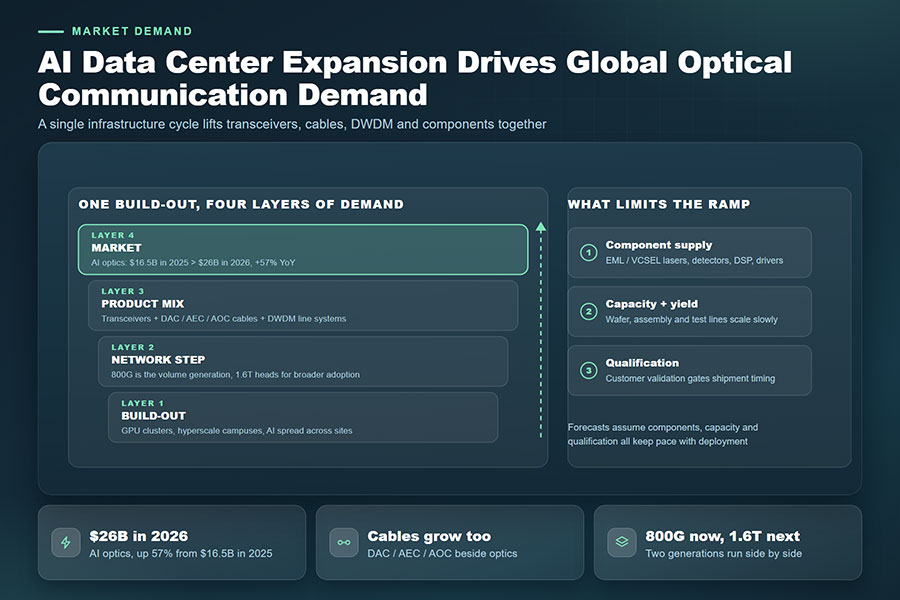
This makes high-bandwidth optical connectivity an essential part of AI infrastructure. Electrical connections remain important for short-distance communication within servers and racks, but optical links provide the reach and bandwidth density required for larger GPU clusters. The transition from 400G to 800G and emerging 1.6T interfaces is therefore closely connected to the expansion of distributed AI training.
Network design is becoming a system-level challenge involving GPU communication patterns, Scale-up and Scale-out architectures, Ethernet and InfiniBand fabrics, optical transceivers, active cables, switching capacity, and thermal management. The ability to move data efficiently between computing resources can directly influence how effectively an AI training cluster uses its available processing capacity.
1. Why AI Training Clusters Require More Network Bandwidth
AI training clusters combine multiple computing servers to process large datasets and train increasingly complex models. Each server may contain several GPUs or specialized accelerators, while high-speed network interfaces connect the servers to a larger switching fabric.
In distributed training, a model is divided across computing resources or replicated among multiple workers. These workers must exchange information to maintain consistent training progress. Communication can involve gradient synchronization, parameter updates, tensor exchanges, and collective operations such as All-Reduce.
As models and accelerator clusters grow, communication demand can increase significantly. If the network cannot transfer data quickly enough, GPUs may spend more time waiting for communication operations to complete rather than performing computation.
Several factors contribute to higher bandwidth requirements:
Increasing GPU counts: Larger clusters create more potential communication paths between computing nodes.
Larger AI models: More complex models can increase the amount of information exchanged during distributed training.
Frequent synchronization: Distributed workers need to coordinate model updates and intermediate results.
Higher GPU performance: Faster accelerators can generate and consume data at higher rates.
Distributed storage: Training datasets and checkpoints may be accessed across multiple storage systems.
Multi-rack deployment: Expanding clusters across racks increases dependence on high-capacity network links.
2. GPU Communication Patterns Drive Network Architecture
AI training workloads generate different types of communication depending on the model structure and parallelization strategy. Understanding these patterns is important when designing the network topology and selecting optical connectivity.
| Communication Pattern | Function | Network Requirement |
|---|---|---|
| Data Parallelism | Multiple workers process different data batches and synchronize model gradients | High aggregate bandwidth and efficient collective communication |
| Tensor Parallelism | Splits model operations across multiple accelerators | High bandwidth and low latency between closely connected GPUs |
| Pipeline Parallelism | Distributes different model stages across computing resources | Reliable communication between pipeline stages |
| Expert Parallelism | Routes tokens between different experts in Mixture-of-Experts models | Flexible high-throughput communication with efficient traffic handling |
| Model Synchronization | Coordinates parameters and training state across workers | Predictable latency and reliable data exchange |
These communication patterns create different traffic demands. Tensor parallelism may require frequent communication between tightly coupled accelerators, while data parallelism can generate large collective transfers across multiple servers. Mixture-of-Experts models can introduce dynamic traffic patterns because tokens may be routed to different expert groups.
A network designed for AI training must therefore consider more than peak bandwidth. It must also support the communication patterns of the workload, avoid congestion, and provide sufficient capacity across the entire cluster.
3. Scale-Up and Scale-Out Networks Serve Different Roles
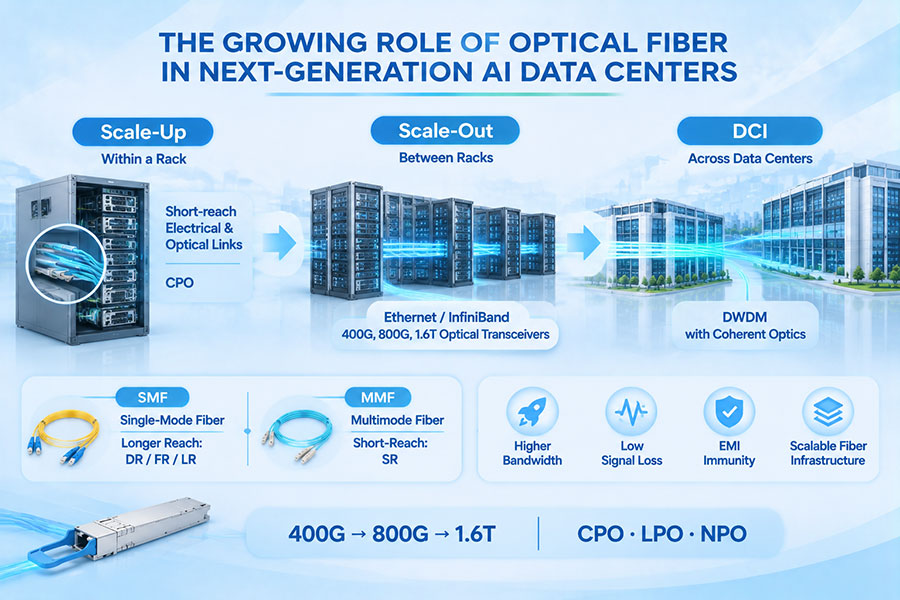
AI infrastructure commonly separates accelerator communication into Scale-up and Scale-out networking. These two architectures address different levels of computing integration and have different connectivity requirements.
Scale-up networking connects accelerators within a tightly integrated computing domain. It aims to provide high bandwidth and low latency so that multiple GPUs can cooperate as a larger computing system.
Scale-out networking connects servers and racks across a larger data center fabric. It enables an AI cluster to expand beyond the physical limits of an individual server or rack.
| Network Architecture | Primary Function | Typical Connectivity | Key Requirement |
|---|---|---|---|
| Scale-up | Connects GPUs and accelerators within a tightly integrated domain | High-speed electrical interconnects and platform-specific optical technologies | Very high bandwidth and low latency |
| Scale-out | Connects servers and racks across the AI cluster | Ethernet, InfiniBand, optical transceivers, AOC, and active copper cables | Scalable aggregate bandwidth and efficient traffic management |
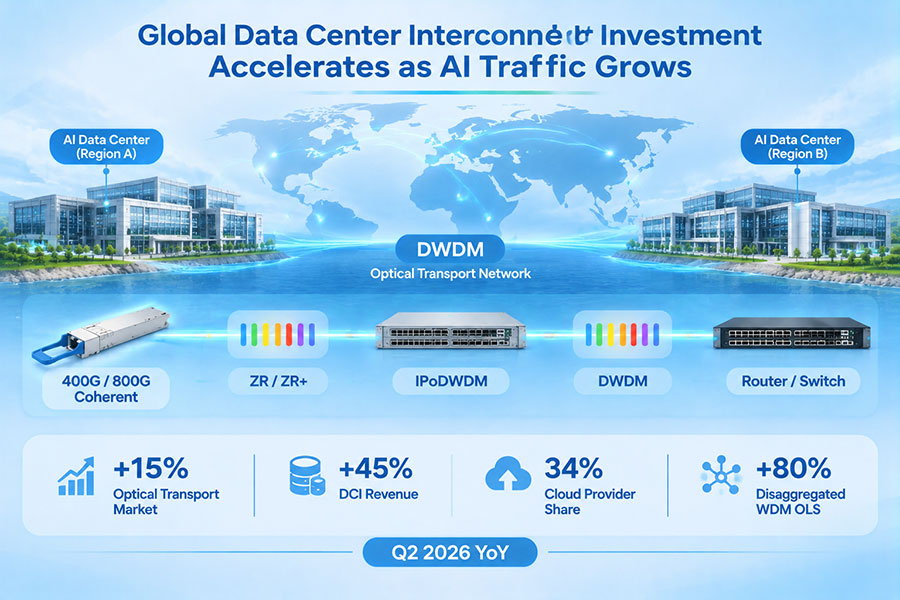
| Scale-across | Connects separate AI factories or geographically distributed computing facilities | High-capacity fiber networks, DCI, DWDM, and coherent optics | Long-distance capacity and network resilience |
The distinction is important when selecting optical products. Not every GPU connection requires a pluggable optical transceiver. Some Scale-up links use specialized electrical or platform-integrated interconnects, while optical connectivity becomes increasingly important for Scale-out and Scale-across connections.
NVIDIA's July 2026 technical discussion of NVLink similarly distinguishes Scale-up fabrics from Scale-out networks such as InfiniBand and Ethernet. Both are necessary for large AI factories, but they solve different communication problems.
4. Ethernet and InfiniBand Support High-Performance AI Fabrics
Ethernet and InfiniBand are two important networking technologies used in high-performance computing and AI infrastructure. Both can support high-speed communication between servers, but their architectures, management models, and deployment ecosystems differ.
InfiniBand has a long history in high-performance computing and provides specialized capabilities for low-latency communication and RDMA-based data movement. Ethernet is widely deployed across enterprise and cloud infrastructure and has developed specialized capabilities for large-scale AI fabrics, including RoCEv2 and advanced congestion-management mechanisms.
| Technology | Network Characteristics | AI Cluster Application |
|---|---|---|
| InfiniBand | High-performance fabric with RDMA and specialized congestion management | Large-scale GPU clusters and HPC environments |
| Ethernet | Broad ecosystem with high-speed switching and standardized interfaces | Cloud AI networks and large distributed computing environments |
| RoCEv2 | RDMA over Converged Ethernet using UDP/IP | Low-latency data movement over appropriately engineered Ethernet fabrics |
Optical transceivers and high-speed cables provide the physical connectivity for these networks. However, an optical module's data rate alone does not establish protocol compatibility. The module, switch, network interface card, firmware, and host electrical interface must support the intended deployment.
For example, C-LIGHT's 800G OSFP portfolio specifies support for IEEE Ethernet standards and InfiniBand NDR applications. The exact module variant and host platform should still be verified before deployment.
5. 800G Optical Connectivity Supports Large GPU Clusters
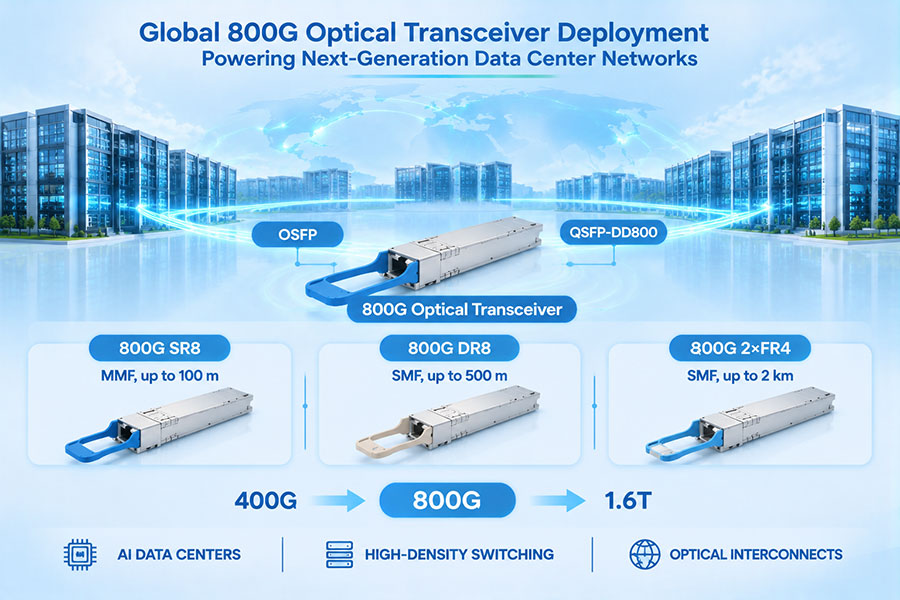
As AI training clusters expand, 800G optical connectivity is becoming an important option for high-capacity links between switches and computing systems. It provides twice the aggregate bandwidth of a 400G interface and can support higher-capacity network fabrics without requiring the same proportional increase in port count.
Different 800G optical configurations address different fiber types and transmission distances.
| 800G Optical Configuration | Fiber Type | Representative Reach | Typical Application |
|---|---|---|---|
| 800G SR8 | Multimode fiber | Up to 100 m | Short-reach data center connections |
| 800G DR8 | Single-mode fiber | Up to 500 m | Switch-to-switch and rack-level connectivity |
| 800G 2×FR4 | Single-mode fiber | Up to 2 km | Longer data center and campus connections |
| 800G VR8 | Multimode fiber | Up to 50 m | Very short-reach high-density links |
These are representative product-class distances, not universal reach guarantees. Actual performance depends on the specific transceiver, fiber grade, connector loss, optical budget, FEC implementation, and host system.
For large AI clusters, optical connectivity is particularly important when network connections extend beyond the practical reach of passive copper. It also provides a flexible approach to connecting high-radix switches across multiple racks and equipment rows.
6. The Transition Toward 1.6T Optical Interfaces
As switch ASIC bandwidth and accelerator performance increase, 800G interfaces will not be sufficient for every future network architecture. The industry is therefore developing 1.6T optical connectivity to increase bandwidth per port and support higher-density AI fabrics.
A common 1.6T architecture uses eight 200G electrical lanes with PAM4 signaling. This increases the aggregate interface rate while requiring improvements in SerDes, optical engines, DSP, packaging, and thermal management.
| Generation | Aggregate Data Rate | Representative Lane Architecture | Network Development Focus |
|---|---|---|---|
| 400G | 400 Gb/s | 8 × 50G or other supported implementations | High-speed data center connectivity |
| 800G | 800 Gb/s | 8 × 100G or 4 × 200G | Large AI cluster fabrics and high-capacity switching |
| 1.6T | 1.6 Tb/s | 8 × 200G in common architectures | Next-generation high-density network interfaces |
| 3.2T | 3.2 Tb/s | Future higher-speed lane architectures | Further increases in switch and optical port capacity |
Higher data rates create additional engineering challenges. Electrical signal integrity becomes more difficult, optical components must support higher lane speeds, and modules require more advanced thermal designs.
The transition is not simply a replacement of every 800G port with 1.6T. Both generations are expected to coexist because network operators upgrade different parts of their infrastructure at different times.
7. DAC, AEC, and AOC Connect Servers and Switches
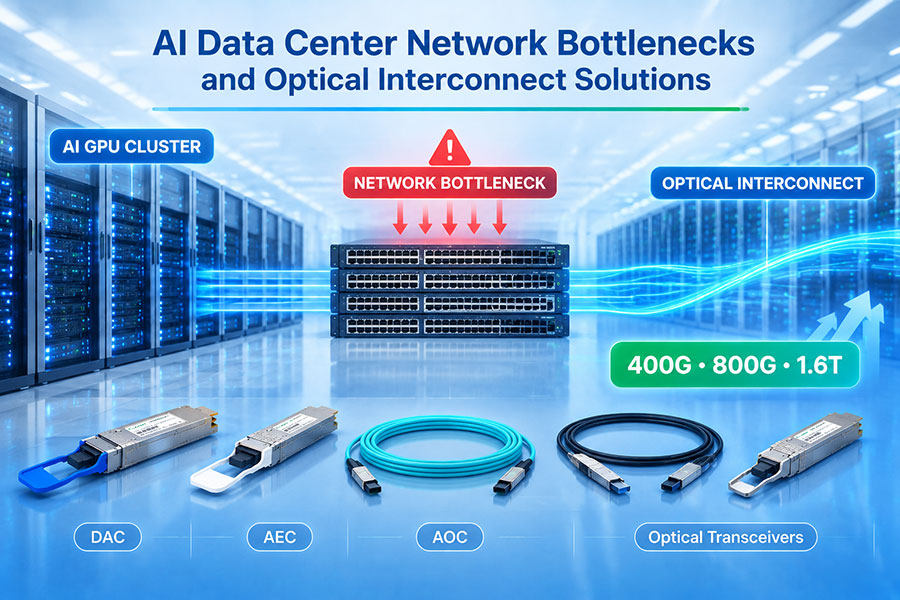
Optical transceivers are not the only connectivity option in AI data centers. DAC, AEC, and AOC cables are also important for short-distance connections between servers, network interface cards, and switches.
Choosing the appropriate technology depends on the physical distance, host interface, signal integrity, power consumption, and installation requirements.
| Connectivity Type | Transmission Medium | Key Characteristics | Typical Use |
|---|---|---|---|
| DAC | Passive copper | No optical conversion; simple and low-power construction | Very short rack-level connections |
| AEC | Active copper | Uses active signal conditioning or retiming, depending on design | Short-distance high-speed connections |
| AOC | Integrated optical fiber cable | Optical transmission with fixed cable assemblies | Short- and medium-distance rack and switch connections |
| Optical transceiver | Optical fiber with pluggable modules | Flexible fiber selection and different reach options | Rack-to-rack and longer network links |
Passive DAC cables can be suitable for very short connections where the host electrical channel supports the required signaling rate. AEC products use active electronics to improve electrical signal transmission over their specified lengths. AOC cables integrate optical conversion into the cable assembly, while pluggable transceivers provide more flexibility for structured fiber networks.
For 800G AI infrastructure, cable selection must account for connector configuration, supported protocol, lane mapping, cable length, power consumption, and host compatibility.
8. PAM4, DSP, and FEC Maintain High-Speed Signal Integrity
High-speed AI networks rely on reliable transmission across increasingly demanding electrical and optical interfaces. PAM4 signaling increases information density by encoding two bits per symbol using four signal levels. This helps achieve higher data rates without proportionally increasing the symbol rate.
However, PAM4 has smaller signal-level separation than NRZ, making it more sensitive to noise, distortion, and channel impairments. Digital signal processing and forward error correction are therefore important parts of modern high-speed connectivity.
| Technology | Function | Importance in AI Networking |
|---|---|---|
| PAM4 | Encodes two bits per symbol using four amplitude levels | Supports higher lane data rates |
| DSP | Processes and equalizes high-speed signals | Improves signal recovery and channel performance |
| FEC | Detects and corrects transmission errors | Improves link reliability within supported operating limits |
| SerDes | Converts parallel and serial electrical data streams | Connects switch ASICs and high-speed optical interfaces |
These technologies must work together across the complete host-to-module channel. Optical module performance alone cannot compensate for every limitation caused by poor electrical design, incompatible interfaces, excessive connector loss, or unsuitable cabling.
9. Congestion Management and Network Topology Affect Training Efficiency
High bandwidth does not automatically guarantee efficient AI training. Network congestion can occur when multiple computing nodes send data through shared links or switching resources at the same time.
Collective communication operations can create synchronized traffic bursts. If the network cannot handle these flows efficiently, queues may grow, packets may be delayed, and available bandwidth may not be fully utilized.
AI network design therefore considers topology, routing, congestion control, traffic scheduling, and link capacity together.
Important design considerations include:
Oversubscription ratio: Determines the relationship between aggregate downstream bandwidth and available uplink capacity.
Network topology: Leaf-spine and other fabric architectures influence the number of communication paths and switching stages.
Congestion control: Helps manage traffic bursts and reduce performance degradation.
Load balancing: Distributes traffic across available paths where supported.
Link redundancy: Provides alternative paths when network components or connections fail.
Port utilization: Helps operators identify bottlenecks and plan additional capacity.
A well-designed optical network must provide sufficient bandwidth at each switching layer. Upgrading server-facing links without increasing uplink and spine capacity can simply move congestion to another part of the network.
10. Optical Fiber Density and Cable Management Become More Important
Large AI training clusters can contain thousands of high-speed connections. As 800G and 1.6T interfaces increase port capacity, the physical fiber infrastructure must support higher bandwidth density while remaining manageable and serviceable.
Parallel optical interfaces often use MPO/MTP multi-fiber connectors, while other optical architectures use LC duplex or specialized connector configurations. The correct connector depends on the module specification and optical lane arrangement.
Fiber infrastructure planning should address several factors:
Correct transmit and receive polarity.
Connector cleanliness and inspection.
Insertion loss across connectors and patch panels.
Fiber bend radius and cable routing.
Port identification and labeling.
High-density patch panel and trunk cable organization.
Maintenance access and future expansion capacity.
At high data rates, contamination and excessive optical loss can lead to link instability or degraded performance. Structured fiber management and consistent cleaning procedures are therefore important for reliable AI cluster operation.
11. Thermal Management and Power Efficiency in AI Optical Networks
AI training facilities operate large numbers of accelerators, switches, and optical connections within high-density equipment racks. Each optical module contains components such as lasers, drivers, photodetectors, and signal-processing electronics, all of which contribute to the thermal load.
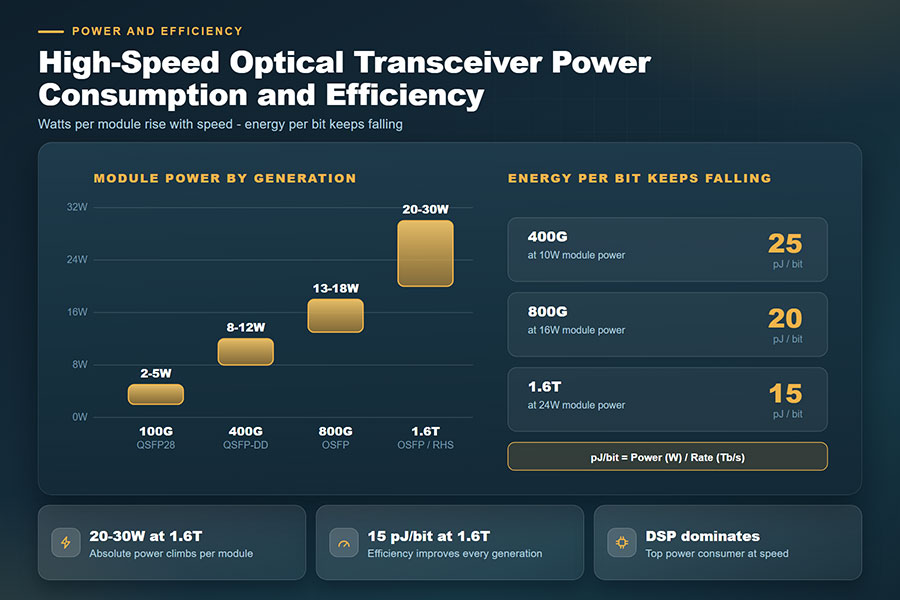
As data rates increase, module power consumption and cooling requirements become more important. The combined power demand of thousands of optical ports can affect rack-level energy budgets and facility cooling design.
Several factors influence optical network power efficiency:
Transceiver power consumption per port.
DSP architecture and processing requirements.
Optical engine integration and electrical channel length.
Switch ASIC power consumption and port density.
Airflow direction and heat-sink design.
Cold-plate and liquid-cooling compatibility where supported.
Energy consumption per transmitted bit.
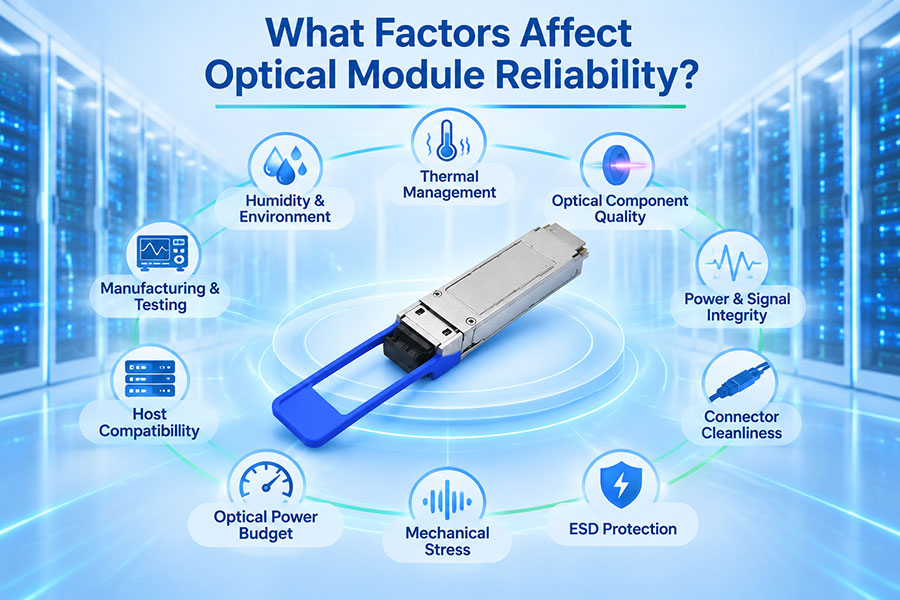
OSFP-RHS is one packaging approach designed for specific high-density thermal environments. Its reduced-height heat-sink structure can support host systems designed around particular airflow or cold-plate arrangements. It should not be assumed that every OSFP-RHS module is interchangeable with every OSFP host cage or liquid-cooling platform.
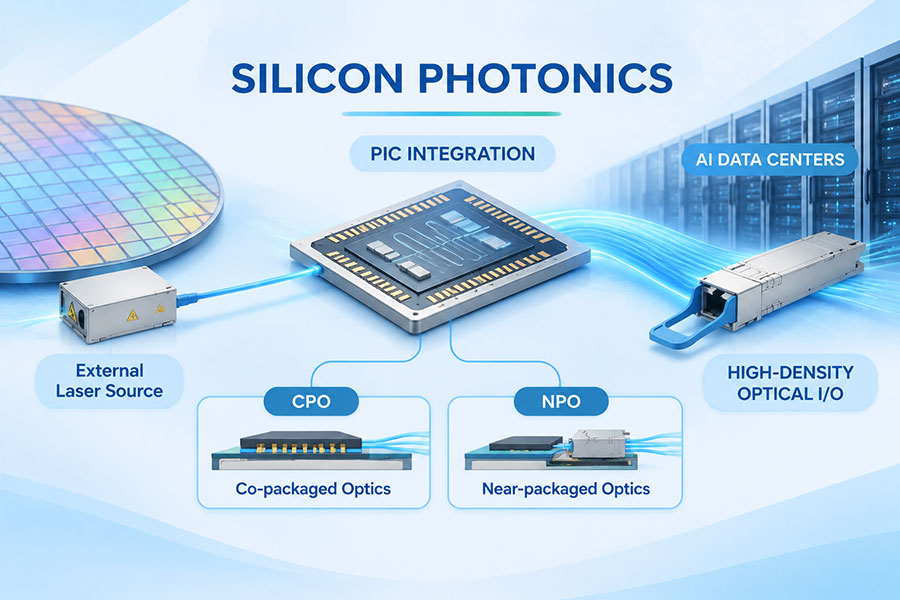
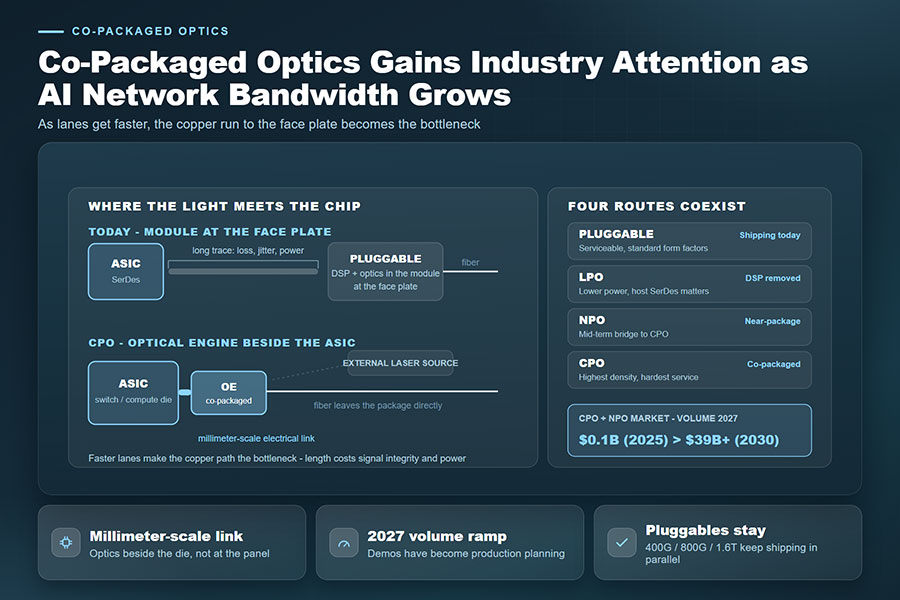
Co-Packaged Optics and Near-Packaged Optics are also attracting attention because shorter electrical paths can reduce some signal-integrity and power challenges. However, these architectures involve system-level packaging and serviceability considerations beyond those of conventional pluggable transceivers.
12. Reliability and Interoperability Are Essential for Large GPU Fabrics
AI training clusters depend on the coordinated operation of many network components. A single unstable connection can affect communication between multiple computing nodes, particularly when workloads require frequent synchronization.
For this reason, optical connectivity must be evaluated under realistic host and network conditions rather than relying only on standalone module specifications.
| Validation Area | Test Focus | Purpose |
|---|---|---|
| Optical performance | Transmit power, receiver sensitivity, wavelength, and optical budget | Confirms optical link performance |
| Electrical performance | Lane rate, signal integrity, and host interface characteristics | Verifies host-to-module compatibility |
| BER and FEC | Pre-FEC and post-FEC error performance where applicable | Evaluates transmission reliability |
| Thermal testing | Operating temperature and power consumption | Confirms operation under host cooling conditions |
| Management interface | CMIS, diagnostics, alarms, and module identification | Supports monitoring and maintenance |
| Interoperability | Testing with actual switches, NICs, and supported platforms | Confirms system-level compatibility |
Compatibility verification should include form factor, electrical lane mapping, protocol, firmware, optical interface, and thermal requirements. A module that fits physically is not necessarily compatible with every switch or network adapter.
13. C-LIGHT High-Speed Connectivity for AI Training Clusters
AI training networks require different connectivity solutions depending on the distance between GPUs, servers, racks, and switching equipment. Short-distance links may use active copper cables, while optical transceivers are important for higher-bandwidth connections across larger data center spaces.
C-LIGHT provides optical transceivers and high-speed cable products for AI data centers, GPU clusters, high-performance computing, and hyperscale cloud networks.
C-LIGHT 800G OSFP Optical Transceiver – Supports 800G optical connectivity with multiple configurations, including VR8 up to 50 m, SR8 up to 100 m, DR8 up to 500 m, and 2×FR4 up to 2 km. The product family includes selected Ethernet and InfiniBand NDR applications.
C-LIGHT 1.6T OSFP-RHS Optical Transceiver – Uses an 8×200G PAM4 architecture with integrated DSP and FEC. The listed product configurations include 2DR4 at 500 m with dual MPO-12 connectors and 2FR4 at 2 km with dual LC/APC connectors.
C-LIGHT 800G AEC Cable – Uses integrated retimer technology for high-speed electrical connectivity, with selected configurations supporting lengths up to 5 m. It is designed for compatible GPU cluster and rack-level connections.
C-LIGHT 800G AOC Cable – Provides integrated optical connectivity for high-bandwidth connections between compatible servers and switches.
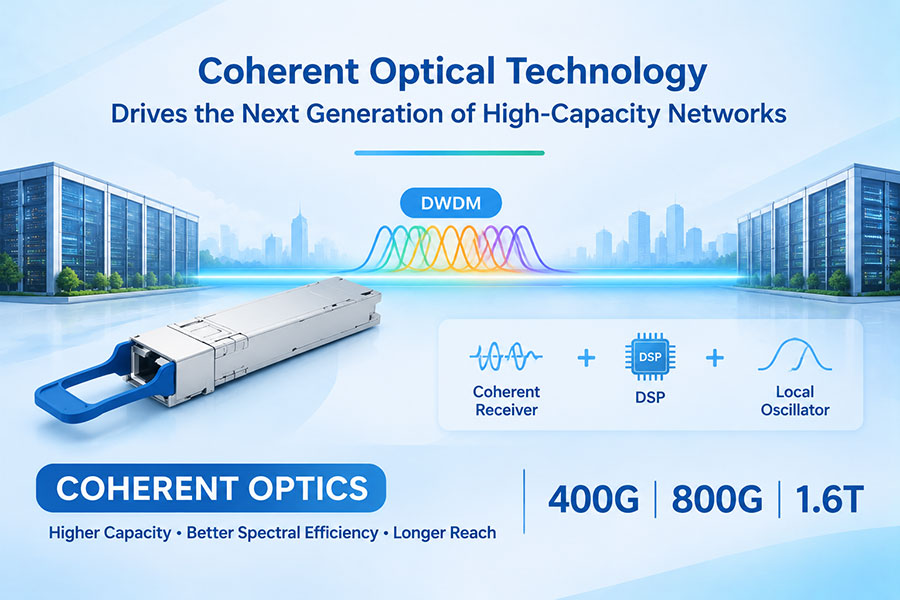
C-LIGHT DWDM DCO Coherent Transceivers – Offers coherent optical options for high-capacity DCI and transport links connecting geographically separated AI facilities.
C-LIGHT DAC, AEC, ACC, and AOC Solutions – Covers different short-distance electrical and optical cabling requirements for data center infrastructure.
C-LIGHT Optical Transceiver Portfolio – Includes multiple data rates, form factors, and transmission technologies for data center and optical communication applications.
For AI cluster deployments, product selection should start with the network architecture and required link distance. AEC may be suitable for compatible short electrical connections, while AOC and pluggable optical transceivers address different optical link requirements.
For 800G and 1.6T Ethernet or InfiniBand applications, the selected module must match the host interface, optical configuration, management requirements, and platform thermal design. Specific product reach and compatibility should be confirmed against the applicable datasheet and host equipment.
14. The Future of Optical Networking for AI Training
AI training infrastructure is evolving toward larger accelerator domains, higher network bandwidth, and increasingly integrated computing and communication architectures. Optical networking will continue to develop alongside switch ASICs, GPU platforms, and advanced photonic components.
Several technology directions are shaping this evolution:
Higher-speed optical interfaces: 800G deployment and 1.6T adoption will support greater bandwidth density in AI fabrics.
Higher per-lane data rates: Advances in SerDes and optical engines will enable future 200G and 400G-per-lane architectures.
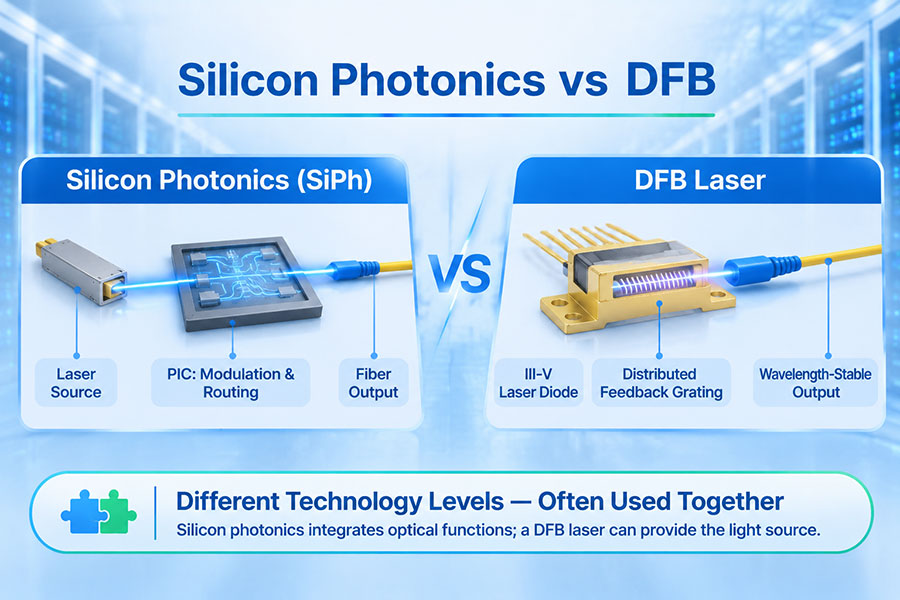
Silicon photonics: Photonic integration can support compact optical engines and multi-channel connectivity.
NPO and CPO: Optical engines positioned closer to switching silicon may help reduce electrical I/O power and signal loss.
High-density fiber infrastructure: Improved connectors, cabling systems, and fiber management will support larger clusters.
Network automation: Telemetry and intelligent traffic management will help optimize utilization and identify bottlenecks.
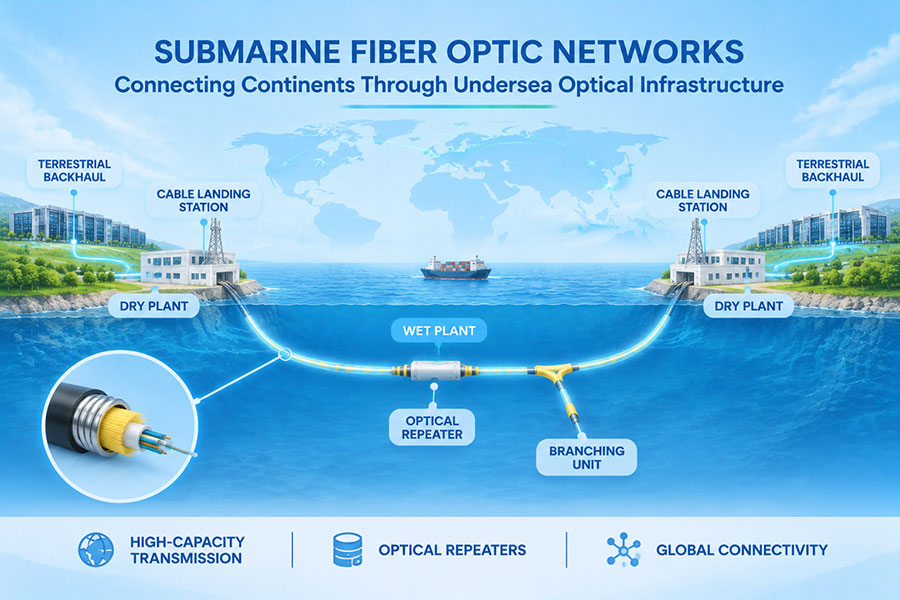
Scale-across connectivity: High-capacity optical transport will connect AI facilities across campuses and regions.
In October 2026, NVIDIA and Cisco announced plans for a new Ultra-Dense Small Form Factor Pluggable (USFP) architecture supporting 400 Gb/s-per-lane electrical signaling and a planned capacity of up to 12.8 Tb/s. This development illustrates how optical interface design is evolving beyond conventional 200G-per-lane approaches as AI network bandwidth requirements continue to increase.
Future AI fabrics will not rely on a single connectivity technology. Electrical interconnects, pluggable optics, active cables, silicon photonics, NPO, and CPO will serve different parts of the network according to distance, bandwidth density, power, and serviceability requirements.
15. Conclusion
AI training clusters are accelerating demand for high-bandwidth optical networks. As GPU counts increase and distributed training workloads become more complex, network infrastructure must support larger volumes of communication between accelerators, servers, and switching systems.
Scale-up networks provide high-bandwidth communication within tightly integrated accelerator domains, while Scale-out networks connect servers and racks across larger AI clusters. Ethernet, InfiniBand, and RoCE-based fabrics rely on suitable electrical and optical connectivity to deliver the required network performance.
800G optical transceivers are supporting the expansion of high-capacity AI fabrics, while 1.6T interfaces are emerging for next-generation switching architectures. DAC, AEC, and AOC products remain important for short-distance connections, and optical fiber provides scalable connectivity across larger network environments.
As AI infrastructure continues to expand, optical bandwidth, signal integrity, thermal management, fiber density, and interoperability will become increasingly important. High-performance optical networking will remain a fundamental part of the infrastructure required to build scalable and efficient AI training clusters.
For 800G and 1.6T optical transceivers, high-speed cables, and AI data center connectivity solutions, Contact C-LIGHT for product information, technical support, and customized optical networking solutions.
 >

 >
 >
 >
 >
 >
 >
 >