TEL:+86 132 6656 7067





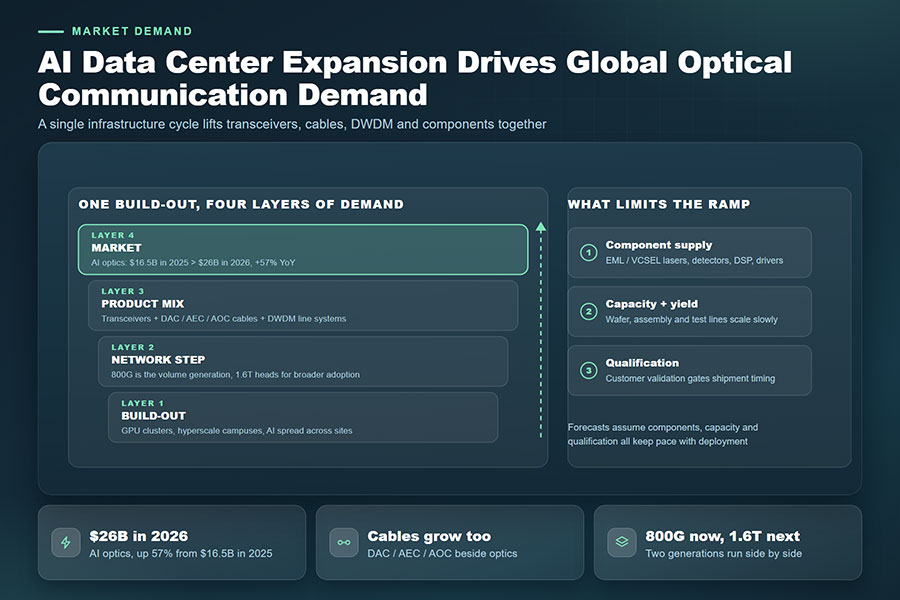
The rapid construction of AI data centers is creating a new energy challenge for digital infrastructure. Large GPU clusters require extensive networking between accelerators, switches, storage systems, and distributed computing facilities. As network speeds advance toward 800G and 1.6T, the energy required to move data is becoming an increasingly important part of data center design.
High-speed connectivity consumes power at several levels. Optical transceivers convert electrical signals into optical signals and back again, switches process and forward network traffic, and electrical or optical cables provide the physical connections between devices. Cooling systems must also remove the heat generated by these components.
Improving energy efficiency therefore requires more than selecting a lower-power optical module. Data center operators must evaluate the complete network architecture, including transmission distance, port density, switching capacity, cable technology, cooling requirements, and traffic utilization.
1. Why AI Data Center Connectivity Is Becoming an Energy Challenge
AI training and inference workloads generate substantial data traffic between computing accelerators. Distributed training requires frequent communication among GPUs, while storage access and model deployment create additional traffic across the network.
As AI clusters grow, network infrastructure must deliver higher bandwidth with predictable latency and reliability. This increases the number of high-speed switch ports, optical connections, and supporting components deployed throughout the facility.
Several factors contribute to the growing energy requirements:
Higher port speeds: Moving from 400G to 800G and 1.6T requires more advanced electrical and optical signal-processing technology.
Greater port density: Large switch systems may contain many high-speed interfaces operating simultaneously.
More network equipment: Larger GPU clusters require additional switching capacity and network connections.
Higher optical module power: Advanced transceivers integrate increasingly sophisticated DSP and optical components.
Cooling requirements: Electrical power consumed by network equipment ultimately becomes heat that must be managed.
Continuous operation: AI infrastructure often operates for extended periods, making even small per-port efficiency improvements meaningful at scale.
The energy challenge is not simply that individual components consume more power. It is that the total number of active connections and the aggregate traffic handled by the network continue to increase.
2. Where Does Network Energy Consumption Come From?
Data center electricity consumption is distributed across computing equipment, networking systems, storage, power conversion, and cooling infrastructure. Networking is only one part of the total energy profile, but it becomes increasingly important as AI clusters require more high-bandwidth communication.
| Infrastructure Component | Primary Function | Energy Consumption Factors |
|---|---|---|
| GPU and AI servers | Model training and inference | Accelerator utilization, processor power, memory, and server configuration |
| Network switches | Forward traffic between computing nodes | Switching capacity, port count, packet processing, and operating load |
| Optical transceivers | Convert electrical and optical signals | Data rate, DSP architecture, laser technology, and module design |
| Active electrical and optical cables | Connect servers and network equipment | Transmission distance, retiming, signal conditioning, and cable design |
| Storage systems | Store and retrieve training data and model information | Drive technology, storage density, access activity, and controller design |
| Cooling infrastructure | Remove heat from IT equipment | Cooling architecture, ambient conditions, heat density, and control efficiency |
| Power distribution | Deliver electricity to equipment | Conversion losses, UPS efficiency, distribution design, and redundancy |
These categories interact with one another. For example, increasing switch and transceiver density can raise the cooling load, while a more efficient network architecture may reduce the amount of equipment needed to deliver a given amount of traffic.
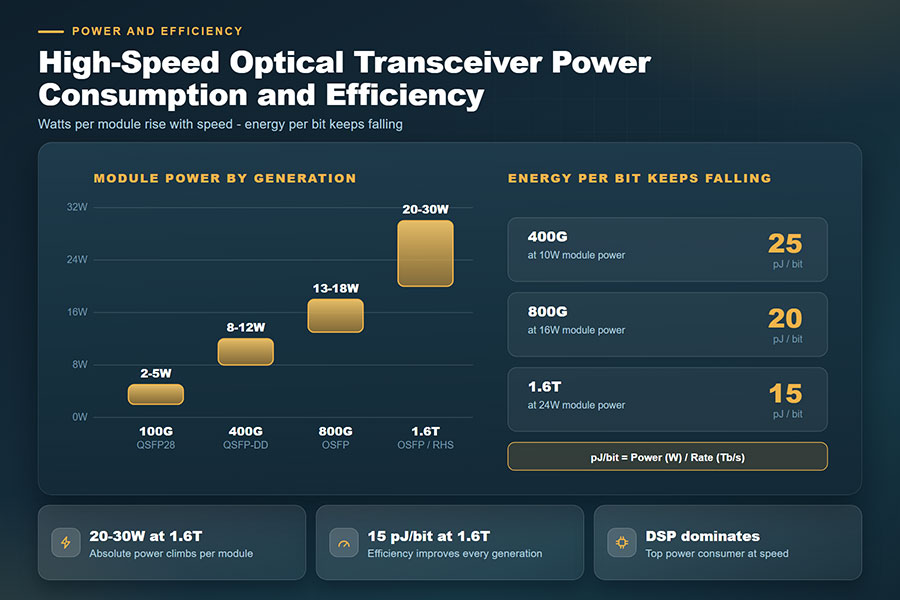
3. Optical Transceiver Power Consumption at 400G, 800G, and 1.6T
Optical transceivers are essential components in high-speed data center networks. Their power consumption depends on the transmission technology, optical reach, form factor, DSP requirements, and thermal design.
As data rates increase, manufacturers must integrate more capable electronic and optical components into compact modules. Higher-speed interfaces can require more advanced signal processing, while long-reach coherent modules have different processing and optical requirements from short-reach direct-detection products.
The following table describes broad design considerations rather than fixed power specifications for every product:
| Module Generation | Typical Technology Considerations | Energy Efficiency Priorities |
|---|---|---|
| 400G | PAM4 signaling, multi-lane optical interfaces, and DSP-based designs | Improve power per bit and optimize module operating conditions |
| 800G | Higher electrical and optical lane rates, advanced DSP, and dense packaging | Manage module power while increasing aggregate bandwidth |
| 1.6T | 200G-per-lane technologies in relevant designs and advanced optical integration | Improve bandwidth density, thermal performance, and energy per transmitted bit |
| Future optical I/O | Closer integration of optical interfaces with computing and switching devices | Reduce electrical interconnect power and improve system-level efficiency |
Comparing module power alone can be misleading. A higher-speed transceiver may consume more watts than an earlier-generation module but provide substantially greater bandwidth. A more useful metric is energy per transmitted bit, considered alongside reach, reliability, and the complete system architecture.
4. Why Optical Connectivity Matters for Energy Efficiency
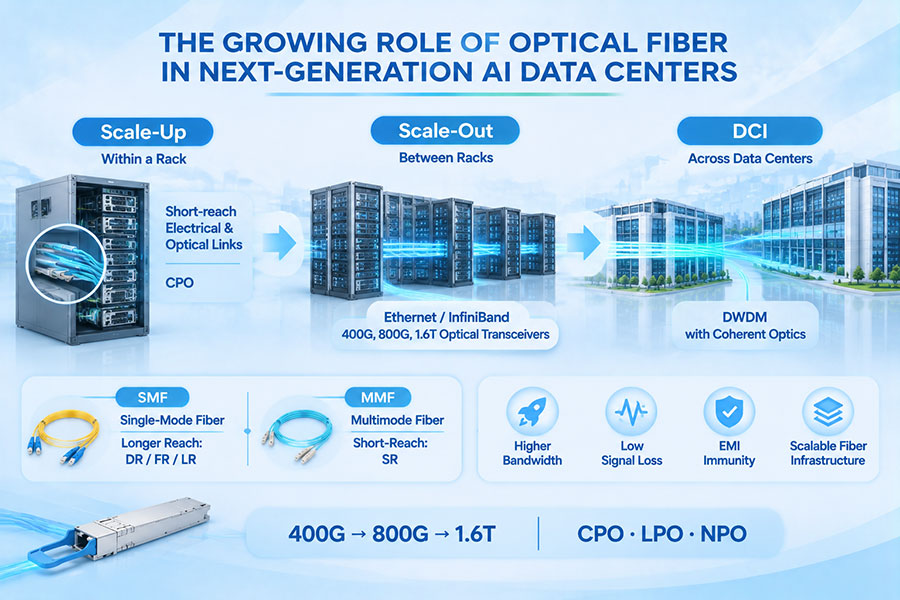
Optical communication offers important advantages for high-bandwidth connectivity, particularly when links extend beyond very short distances. Optical fibers transmit data using light rather than electrical signals traveling through long copper conductors.
At suitable distances and data rates, optical links can provide lower transmission loss and greater bandwidth than equivalent electrical connections. They also avoid some of the signal attenuation and equalization challenges associated with high-speed electrical cabling.
However, optical communication is not automatically lower-power in every application. Optical transceivers require electrical power for laser operation, photodetection, control circuitry, and potentially DSP. The most efficient choice depends on the link distance, data rate, host interface, and cable architecture.
Optical connectivity can contribute to network energy efficiency through:
Longer transmission capability: Optical links support high-bandwidth communication over distances that are difficult to achieve with passive copper cables.
Higher bandwidth density: Multiple optical channels can support substantial aggregate throughput within compact interfaces.
Reduced electrical transmission constraints: Optical fiber avoids some long-distance electrical signal-conditioning requirements.
Flexible network architecture: Optical links can connect equipment across racks, rooms, buildings, and data center campuses.
Future scalability: Fiber infrastructure can support successive generations of optical transceivers without replacing every physical cable route.
The overall energy benefit must be evaluated at the system level, including transceiver power, host electronics, cable losses, and cooling.
5. DAC, AEC, AOC, and Optical Transceivers: Different Energy Trade-Offs
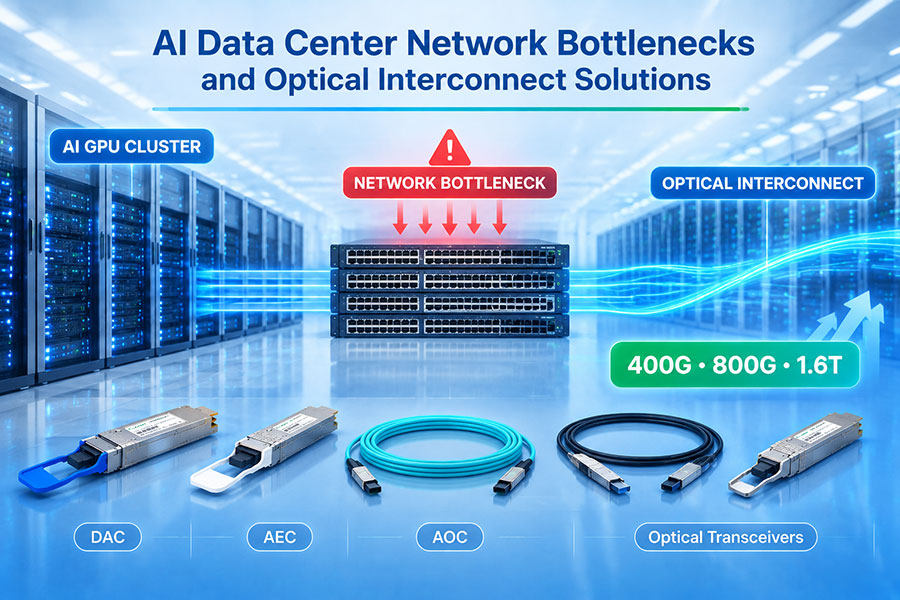
AI data centers use several types of connectivity products. Direct attach copper (DAC), active electrical cables (AEC), active optical cables (AOC), and pluggable optical transceivers serve different distance and deployment requirements.
Choosing the correct technology can help avoid unnecessary power consumption and equipment complexity.
| Connectivity Type | Transmission Medium | Typical Application | Energy Considerations |
|---|---|---|---|
| DAC | Passive copper | Very short connections within racks | No active cable electronics in passive designs |
| AEC | Active copper | Short-reach server and switch connections | Retimers and signal-conditioning electronics consume power |
| AOC | Optical fiber with integrated electronics | Short- and medium-reach equipment connections | Optical conversion electronics consume power, with fiber supporting longer reach than many copper options |
| Pluggable optical transceiver | Optical fiber with separate transceiver modules | Switch-to-switch, rack-to-rack, and longer links | Module power depends on data rate, optical technology, and transmission distance |
Passive DAC can be an efficient choice for suitable short connections because it does not require active signal-processing electronics within the cable. AEC uses active retiming and signal conditioning to support longer or more demanding electrical links. AOC and pluggable optics provide optical transmission for applications where fiber reach, bandwidth, or electromagnetic isolation is important.
There is no universal winner. A short passive copper connection may be more energy-efficient than an optical link, while optical connectivity can be more suitable for longer distances and higher-density network layouts.
6. High-Speed Switches and the Growing Power of Network Fabrics
AI data center networks rely on large switching fabrics to connect thousands of computing devices. As port speeds and switching capacities increase, network switches become important contributors to the facility's overall IT power consumption.
Switch power is influenced by more than the number of optical modules installed. ASIC design, memory, packet processing, SerDes interfaces, cooling fans, power conversion, and port utilization all contribute to total system consumption.
Several design approaches can improve network energy efficiency:
Higher-capacity switching: Consolidating traffic onto appropriately sized platforms can reduce unnecessary equipment duplication.
Efficient port utilization: Network capacity should be planned around actual traffic requirements rather than excessive overprovisioning.
Optimized topology: Appropriate leaf-spine architecture can balance bandwidth, latency, and equipment count.
Power-aware operation: Monitoring equipment load helps identify inefficient or underutilized network resources.
Thermal optimization: Efficient airflow and cooling design can reduce the additional energy required to maintain operating temperatures.
Network operators must also consider oversubscription, redundancy, congestion, and failure recovery. Reducing the number of switches without maintaining sufficient network capacity and resilience can create performance and availability problems.
7. Cooling Requirements Increase With Network Density
High-speed optical modules and network switches generate heat during operation. As more high-bandwidth ports are installed in a rack, thermal management becomes increasingly important.
Air cooling remains common across many data center environments, but high-density AI systems are also driving interest in liquid cooling technologies. These approaches can improve heat removal under suitable conditions, although their effectiveness depends on the equipment design and facility infrastructure.
Cooling considerations for high-speed network equipment include:
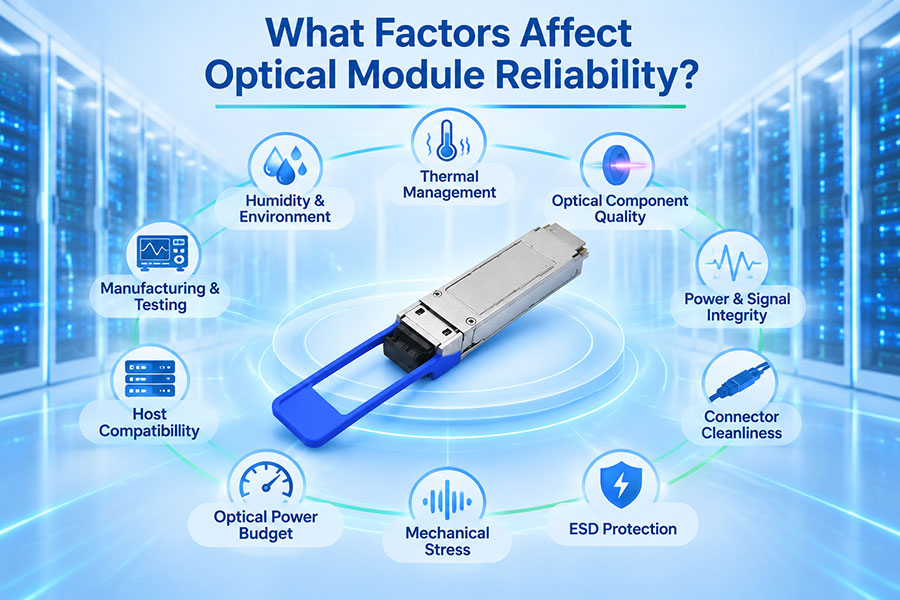
Module temperature: Optical transceivers must operate within their specified temperature ranges.
Airflow direction: Switches and modules must be installed in systems with compatible airflow designs.
Rack power density: Dense equipment layouts can create localized thermal challenges.
Cooling capacity: Facility systems must be designed for the heat generated by the complete IT load.
Liquid cooling compatibility: Equipment intended for immersion or other liquid cooling environments must be specifically designed and qualified for that use.
Cooling energy should be considered together with IT equipment power. Reducing module power can lower the heat that must be removed, but the resulting facility-level energy savings depend on the cooling architecture and operating conditions.
8. Co-Packaged Optics and Optical I/O: Approaches to Reducing Interconnect Energy
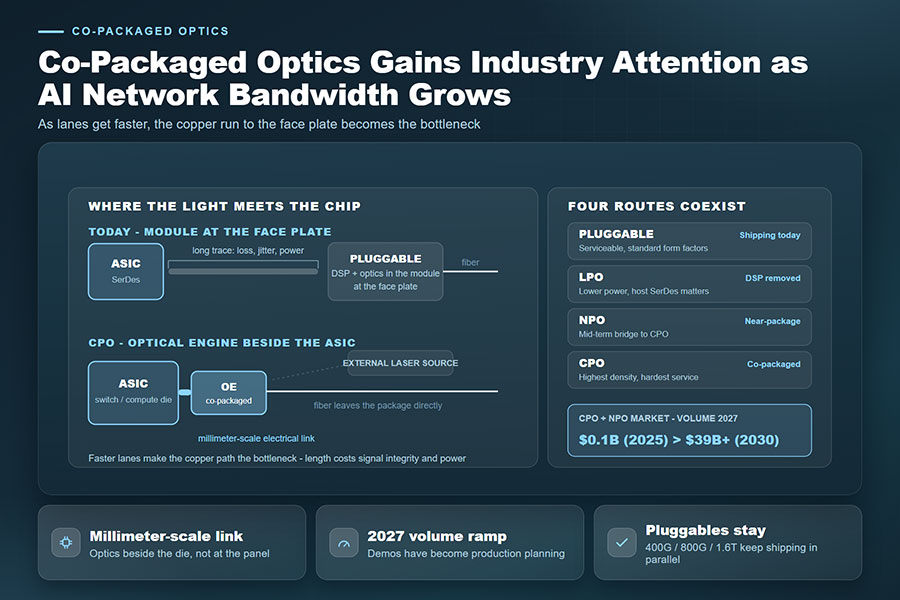
As electrical interfaces move toward higher data rates, the power required to transmit signals across electrical traces and cables becomes a growing design concern. This is one reason the industry is exploring optical integration closer to switching and computing silicon.
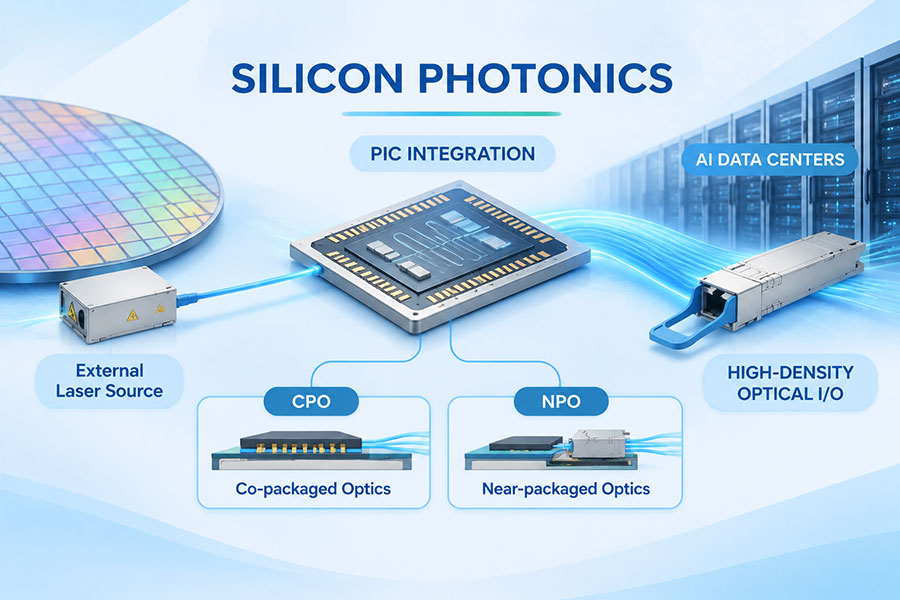
Co-packaged optics (CPO) places optical engines near the switching ASIC within a shared package or closely integrated assembly. The approach aims to reduce the length of high-speed electrical connections between the switch chip and optical interfaces.
Optical I/O research takes a related direction by integrating optical communication capabilities closer to computing devices. These architectures may help reduce electrical interconnect energy and support higher bandwidth density.
Potential advantages include:
Shorter high-speed electrical signal paths.
Reduced electrical interconnect losses in suitable architectures.
Higher bandwidth density around switching and computing devices.
New opportunities for optical integration and system-level energy optimization.
However, CPO and optical I/O introduce their own challenges, including laser reliability, thermal interaction, optical coupling, serviceability, packaging yield, and field replacement procedures. Their total energy benefits must be validated across the complete system rather than assumed from the optical interface alone.
9. How to Measure Energy Efficiency in AI Connectivity
Data center operators need consistent metrics to evaluate network energy consumption. A single power figure cannot describe the efficiency of a complex AI network because different components perform different functions and operate under different workloads.
| Metric | What It Measures | Why It Matters |
|---|---|---|
| Module power consumption | Electrical power used by an optical module | Helps evaluate port-level energy requirements |
| Energy per bit | Energy required to transmit a given amount of data | Allows bandwidth-normalized efficiency analysis |
| Switch power | Total electrical power consumed by a network switch | Captures ASIC, memory, port, and system power |
| Network power per port | Power associated with a network interface or port | Supports equipment and port-density planning |
| Network utilization | Actual traffic carried relative to available capacity | Helps identify underused infrastructure |
| Power Usage Effectiveness (PUE) | Total facility energy divided by IT equipment energy | Measures overall facility energy overhead |
| Cooling energy | Energy used by cooling equipment | Shows the facility impact of IT heat generation |
PUE is a facility-level metric, not a direct measure of optical network efficiency. A data center can improve its PUE while network equipment power continues to increase. Conversely, a more efficient optical module does not necessarily produce a measurable PUE improvement if other facility loads dominate energy consumption.
For meaningful comparisons, operators should measure equipment power under representative traffic and environmental conditions, while documenting the measurement boundary and system configuration.
10. Practical Strategies for Reducing AI Data Center Network Energy
Reducing connectivity energy requires coordinated decisions across network design, equipment selection, cabling, and operations. Small improvements across many ports can contribute to meaningful savings when deployed at scale.
Practical strategies include:
Match connectivity to distance: Use passive copper for suitable short links and optical solutions where reach or bandwidth requirements justify them.
Select the appropriate transceiver: Avoid deploying long-reach or higher-power modules when a shorter-reach solution meets the link requirements.
Evaluate power per bit: Compare modules and network platforms using consistent bandwidth and performance conditions.
Optimize network topology: Reduce unnecessary network stages while preserving required capacity and redundancy.
Improve port utilization: Monitor traffic and avoid maintaining excessive idle capacity without a clear operational reason.
Coordinate cooling and equipment layout: Reduce thermal bottlenecks through appropriate rack and airflow design.
Use standardized fiber infrastructure: Structured cabling can support upgrades without unnecessary replacement of existing pathways.
Monitor power continuously: Track equipment consumption and operating temperatures to identify opportunities for optimization.
These measures should be assessed together. For example, replacing copper links with optical connections may improve reach and bandwidth density but does not automatically reduce energy consumption. The final decision should reflect the complete link and network architecture.
11. The Role of C-LIGHT Connectivity Products in High-Density AI Networks
As AI data centers move toward higher bandwidth and denser network configurations, selecting appropriate optical transceivers and active connectivity products becomes increasingly important. C-LIGHT provides optical modules and high-speed cable solutions for AI clusters, data centers, and high-performance computing networks.
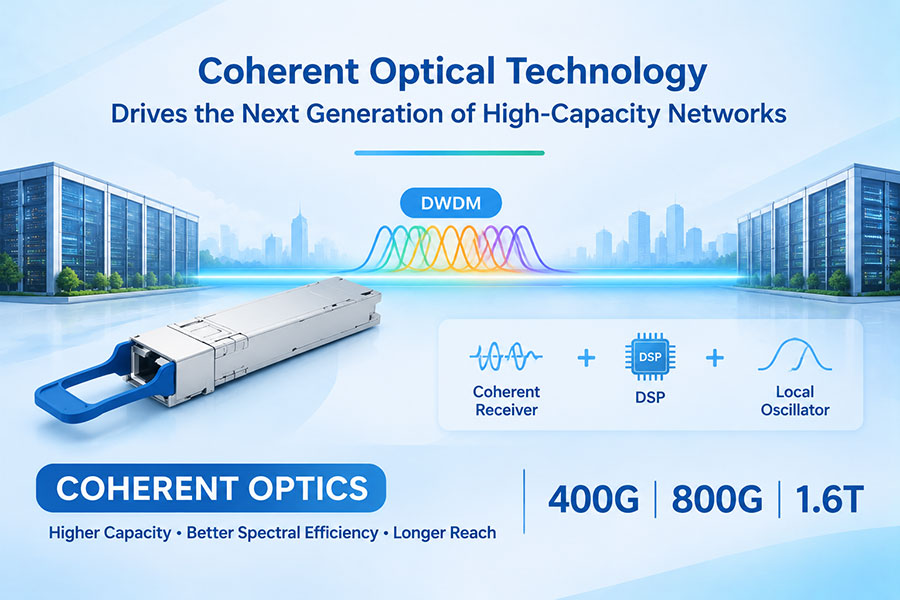
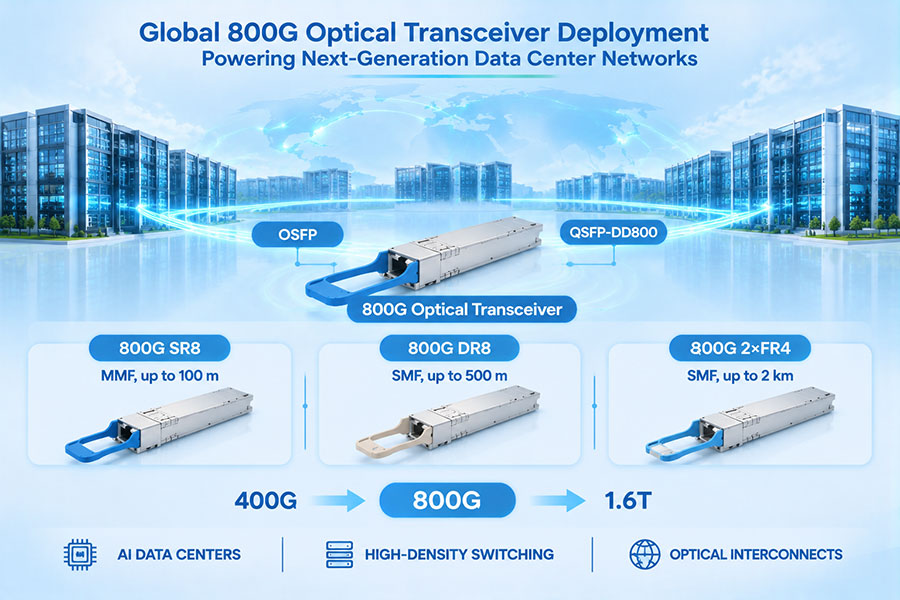
C-LIGHT's 800G OSFP portfolio covers multiple optical configurations, including SR8, DR8, and 2×FR4, as well as coherent options in the product range. These modules address different transmission distances and network architectures.
When evaluating energy efficiency, the selected variant's actual power specification should be checked alongside its reach, connector, host compatibility, and thermal requirements.
Product details: C-LIGHT 800G OSFP Optical Transceivers
C-LIGHT 800G AEC products integrate retimer technology and support selected OSFP and QSFP-DD configurations. The product range includes cable lengths up to 5 meters for applicable models and is designed for short-reach connections in AI server clusters and distributed rack environments.
AEC can be considered where active electrical signal conditioning is required over a short copper link. Its power consumption should be evaluated against the requirements of the corresponding optical alternative.
Product details: C-LIGHT 800G AEC Active Electrical Cables
C-LIGHT's 1.6T OSFP-RHS product family is designed for next-generation high-bandwidth network platforms. Listed configurations include 2×800G optical architectures, with model-specific DR4 and FR4 options.
For high-density AI infrastructure, the module's power consumption, thermal limits, host compatibility, and optical interface should be reviewed together during system design.
Product details: C-LIGHT 1.6T OSFP-RHS Optical Transceivers
C-LIGHT also lists liquid immersion optical transceiver solutions for AI data centers and high-performance computing environments. These products are intended for applications with specialized cooling requirements. Compatibility with the specific coolant, immersion system, materials, and operating conditions must be confirmed before deployment.
Product portfolio: C-LIGHT Optical Transceiver Portfolio
Choosing between optical transceivers, AEC, and other connectivity options should be based on the actual link distance, data rate, power budget, thermal environment, and host platform. C-LIGHT's product portfolio supports different connectivity requirements across modern data center networks.
12. Future Outlook: Energy Efficiency Becomes a Core Network Design Requirement
The continued expansion of AI infrastructure is expected to increase demand for high-speed networking while placing greater attention on electricity availability and operating costs. Optical connectivity will remain central to this development, but future improvements will depend on progress across both optical and electrical technologies.
Several trends are likely to influence the next generation of AI data center networks:
Higher bandwidth per watt: Manufacturers will continue improving transceiver and switching efficiency.
Advanced optical integration: Silicon photonics, CPO, and optical I/O will create new opportunities for reducing electrical interconnect requirements.
Improved cooling architectures: Air and liquid cooling technologies will evolve to support higher equipment density.
More efficient network fabrics: Switch architecture and topology optimization will become increasingly important.
Power-aware operations: Monitoring and workload management will help operators make better use of installed network capacity.
Next-generation optical interfaces: 1.6T and future high-speed modules will place additional emphasis on energy per bit and thermal performance.
Energy efficiency will increasingly influence optical module selection, switch design, network architecture, and data center construction. The most effective solutions will be those that balance bandwidth, latency, reliability, power consumption, and long-term scalability.
13. Conclusion
The growth of large-scale AI data centers is increasing the energy requirements of high-speed connectivity. Optical transceivers, network switches, active cables, and cooling infrastructure all contribute to the power needed to move data between computing systems.
Optical technology provides an important foundation for high-bandwidth communication, particularly across rack, room, and campus distances. However, improving network energy efficiency requires a complete system-level approach that considers the power consumption of every component and the amount of useful traffic it supports.
As 800G and 1.6T networks become more widely deployed, manufacturers and data center operators will place greater emphasis on energy per bit, thermal management, optimized network topology, and advanced optical integration. These developments will help shape the next generation of high-performance and energy-conscious AI infrastructure.
C-LIGHT provides 800G and 1.6T optical transceivers, active electrical cables, and optical connectivity solutions for AI data centers and high-performance computing networks. Contact our team for product specifications, compatibility information, and application-based connectivity support.
 >

 >
 >
 >
 >
 >
 >
 >