TEL:+86 132 6656 7067




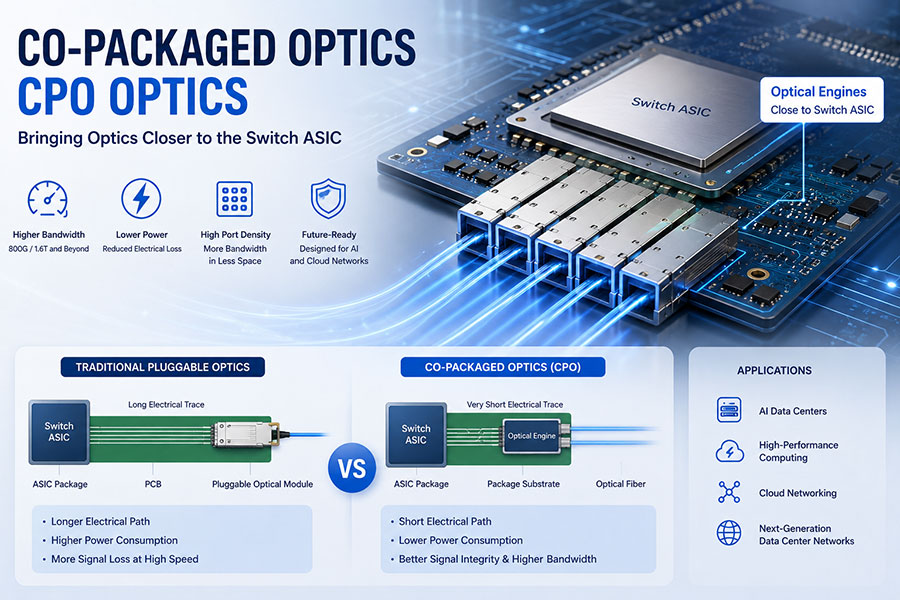
Co-Packaged Optics (CPO) is an optical networking architecture that places optical engines close to the network switch ASIC within the same package or package-level platform. Unlike traditional pluggable optical transceivers, where optical components are located at the front panel of a switch, CPO moves the optical interface much closer to the switching silicon.
CPO is gaining attention as data center networks move toward 800G, 1.6T, and higher-speed connectivity. The technology is particularly relevant to AI data centers, where large GPU clusters generate extremely high network traffic and electrical interconnects increasingly face challenges related to signal loss, power consumption, and bandwidth scaling.
1. What Is Co-Packaged Optics?
Co-Packaged Optics combines a high-speed switch ASIC and optical engines within a closely integrated package architecture. The electrical connection between the switch chip and optical engine is therefore much shorter than in conventional pluggable optical designs.
The basic concept is to convert electrical signals into optical signals closer to the switching silicon. Optical fiber can then carry the data over the required distance with lower electrical transmission loss and greater bandwidth scalability.
2. CPO vs Traditional Pluggable Optics
Traditional data center switches normally use pluggable optical transceivers installed on the front panel. The switch ASIC sends high-speed electrical signals across the PCB and electrical traces to the optical module, where the signals are converted into optical signals.
With CPO, the optical engine is positioned much closer to the switch ASIC. This reduces the length of high-speed electrical paths and can help address signal integrity and power challenges at very high data rates.
| Feature | Pluggable Optics | Co-Packaged Optics |
|---|---|---|
| Optical Location | Front-panel pluggable module | Close to switch ASIC |
| Electrical Path | Relatively longer | Much shorter |
| Serviceability | Easy module replacement | More integrated |
| Upgrade Flexibility | High | More limited |
| High-Speed Signal Loss | More challenging at higher rates | Reduced electrical reach |
| Power Optimization | Depends on module architecture | Strong potential for lower I/O power |
| Deployment | Widely deployed today | Emerging architecture |
3. Why Is CPO Important for AI Data Centers?
AI workloads require large numbers of GPUs to exchange data rapidly. As GPU clusters become larger, the bandwidth requirements of the network fabric increase significantly.
Moving from 400G to 800G and eventually 1.6T and higher-speed interfaces places greater demands on electrical channels inside switches. CPO addresses part of this challenge by shortening the electrical connection between the switch ASIC and optical engine.
This architecture can help improve bandwidth density while reducing the electrical I/O distance that becomes increasingly difficult to manage at higher signaling rates.
4. How Does CPO Work?
A simplified CPO architecture contains several key elements:
Switch ASIC: Performs packet switching and provides the high-speed electrical interfaces.
Optical Engine: Converts electrical signals to optical signals and optical signals back to electrical signals.
Laser Source: Provides the optical carriers required for transmission.
Optical Coupling: Connects the optical engine to external fiber.
Fiber Infrastructure: Carries optical signals between switches, servers, and other network equipment.
5. CPO Optical Engine
The optical engine is one of the most important components in a CPO system. It typically integrates optical transmit and receive functions in a compact architecture positioned near the switch ASIC.
Depending on the design, optical engines may use technologies such as silicon photonics, external laser sources, integrated lasers, modulators, photodetectors, and driver or receiver circuitry.
6. CPO and Silicon Photonics
Silicon photonics is closely associated with the development of CPO because it enables optical functions to be integrated into compact semiconductor-based platforms.
Silicon photonics can integrate optical components such as modulators and photodetectors with electronic circuitry. This makes it suitable for high-density optical engines where size, power, bandwidth, and manufacturing scalability are important.
7. CPO and LPO Are Not the Same
CPO and Linear-drive Pluggable Optics (LPO) are both being developed to address power and signal integrity challenges in high-speed optical networking, but they use different architectures.
| Technology | Architecture | Main Concept |
|---|---|---|
| CPO | Optical engine integrated close to ASIC | Minimize electrical interconnect distance |
| LPO | Pluggable optical module | Reduce DSP-related power and latency |
| Traditional Pluggable | Front-panel optical transceiver | Flexible and field-replaceable optics |
LPO retains the pluggable form factor, while CPO moves optical functionality much closer to the switching ASIC. Therefore, LPO and CPO should not be treated as interchangeable technologies.
8. Advantages of CPO Optics
8.1 Lower Electrical Interconnect Loss
Because the optical engine is positioned close to the switch ASIC, the electrical path between the two can be significantly shortened. This can help maintain signal integrity as data rates increase.
8.2 Potential Power Reduction
Reducing electrical transmission distance and optimizing the optical engine architecture can provide opportunities to lower the power required for high-speed I/O.
8.3 Higher Port Density
CPO can enable high-density optical I/O around a switching ASIC, which is valuable for AI and high-performance computing networks that require large amounts of bandwidth in a limited physical space.
8.4 Scalability to Higher Bandwidth
As switch bandwidth increases, conventional electrical interfaces become increasingly challenging. CPO provides an architecture that can scale optical I/O closer to the switching silicon.
9. Challenges of CPO
CPO also introduces several engineering and deployment challenges.
Thermal Management: The switch ASIC and optical engines are concentrated in a high-power package, increasing thermal design requirements.
Serviceability: Unlike a conventional pluggable module, an integrated optical engine is not as easy to replace in the field.
Manufacturing Complexity: Optical and electrical components must be integrated with high precision.
Laser Management: CPO architectures need reliable methods for supplying and managing optical laser sources.
System Design: CPO affects switch packaging, cooling, optical coupling, maintenance, and network architecture simultaneously.
10. CPO for 800G and 1.6T Networks
The transition toward 800G and 1.6T networking is one of the major drivers behind interest in CPO. At these speeds, electrical signal loss and power consumption become increasingly important design constraints.
CPO can provide a path toward higher optical bandwidth density by placing optical interfaces close to the switching silicon. However, pluggable 800G and emerging 1.6T optical transceivers remain important because they provide greater flexibility and field serviceability.
11. CPO Applications
AI and machine learning data centers
GPU cluster networking
High-performance computing
Cloud data center switching
High-bandwidth Ethernet networks
Large-scale data center fabrics
Next-generation optical interconnect systems
12. CPO vs Pluggable Optics: Which Is Better?
There is no universal answer because the two architectures target different system requirements. Pluggable optics offer excellent flexibility, easy replacement, and established deployment models. CPO can provide advantages in electrical reach, bandwidth density, and potential power efficiency.
For many current data center networks, pluggable optical transceivers remain the practical choice. CPO is more attractive when switch bandwidth and I/O density reach levels where conventional front-panel optical modules create significant electrical and thermal challenges.
13. C-LIGHT and High-Speed Optical Connectivity
C-LIGHT provides high-speed optical transceivers and active optical connectivity solutions for data centers, cloud networks, and AI infrastructure. As network speeds progress from 400G to 800G and higher, optical connectivity technologies such as pluggable optics, LPO, silicon photonics, and CPO are becoming increasingly important.
For current network deployments, high-speed pluggable optical transceivers and AOC solutions provide flexible connectivity, while CPO represents an emerging architecture for future high-density switching and AI data center networks.
14. Frequently Asked Questions
Q1. What is co-packaged optics?
Answer: Co-packaged optics is an optical networking architecture that places optical engines close to a high-speed switch ASIC, reducing the electrical distance between the switching silicon and optical interface.
Q2. What is CPO optics?
Answer: CPO optics refers to optical engines and related optical components integrated into a package-level architecture with or very close to the switch ASIC.
Q3. Why is CPO important for AI data centers?
Answer: AI clusters require extremely high network bandwidth. CPO can help address the signal integrity, power, and bandwidth-density challenges associated with very high-speed switch interfaces.
Q4. What is the difference between CPO and LPO?
Answer: CPO integrates optical engines close to the switch ASIC, while LPO uses a pluggable optical module and reduces or eliminates some digital signal processing functions to lower power and latency.
Q5. Is CPO replacing optical transceivers?
Answer: Not immediately. Pluggable optical transceivers remain highly useful because of their flexibility, serviceability, and established ecosystem. CPO is an emerging architecture aimed at future high-bandwidth systems.
Q6. What technologies are used in CPO?
Answer: CPO can incorporate technologies such as silicon photonics, optical engines, modulators, photodetectors, external or integrated laser sources, and high-speed electronic drivers and receivers.
Q7. Can CPO support 800G and 1.6T networking?
Answer: Yes. CPO is being considered for high-bandwidth switching architectures targeting 800G, 1.6T, and future higher-speed optical I/O.
Q8. What are the main disadvantages of CPO?
Answer: Key challenges include thermal management, manufacturing complexity, optical coupling, laser management, maintenance, and lower field-replaceability compared with conventional pluggable optics.
15.Conclusion
Co-Packaged Optics is an emerging optical architecture designed to bring optical connectivity closer to the switch ASIC. By shortening high-speed electrical paths, CPO can help address bandwidth density, signal integrity, and power challenges in next-generation data center networks.
CPO is particularly relevant to AI data centers and high-performance computing environments where 800G, 1.6T, and future optical interfaces are driving increasingly demanding network requirements. While pluggable optical transceivers remain important for today's deployments, CPO, LPO, and silicon photonics are expected to play increasingly important roles in the evolution of high-speed optical networking.
 >
>

 >
>
 >
>
 >
>
 >
>
 >
>
 >
>
 >
>