TEL:+86 132 6656 7067




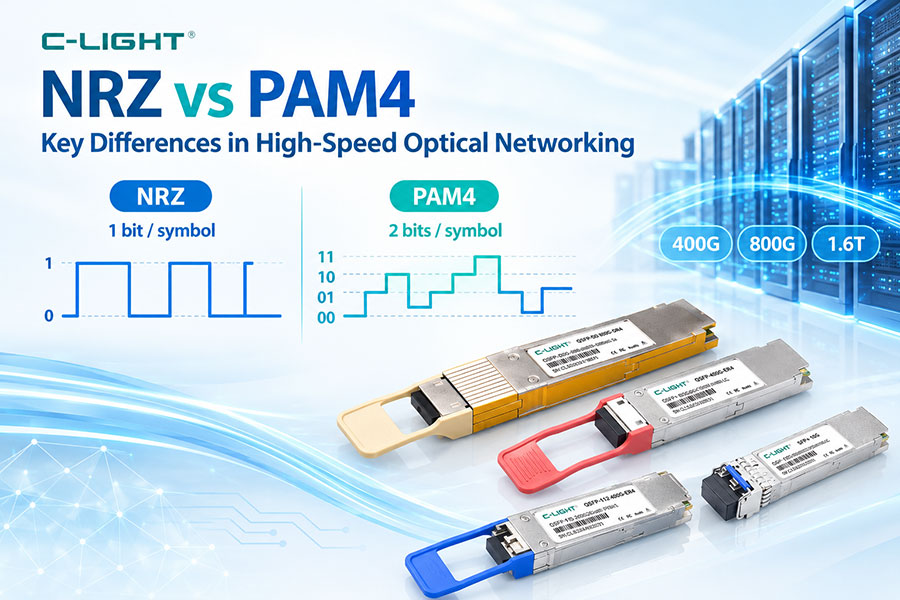
As data centers, AI clusters, cloud networks, and high-performance computing systems continue to demand higher bandwidth, signaling technologies must evolve to transmit more data without requiring a proportional increase in electrical bandwidth. Two of the most important modulation formats used in high-speed networking are NRZ (Non-Return-to-Zero) and PAM4 (Pulse Amplitude Modulation 4-level).
NRZ has been widely used in traditional Ethernet and optical communication systems, while PAM4 has become a key technology for modern 400G, 800G, and next-generation 1.6T interconnects. Although both technologies are designed to transmit digital information, they differ significantly in signaling levels, bandwidth efficiency, transmission complexity, power consumption, and signal quality requirements.
This article explains the key differences between NRZ and PAM4 and why PAM4 has become increasingly important in high-speed optical networking.
1、What Is NRZ?
NRZ, or Non-Return-to-Zero, is a binary signaling method that uses two signal levels to represent digital data:
0 – Low signal level
1 – High signal level
Each symbol carries one bit of information. For example, a 25 Gb/s NRZ electrical signal transmits data at approximately 25 Gbaud.
Because NRZ uses only two signal levels, it has a relatively simple architecture and larger signal margins. This makes it easier to design, test, and maintain reliable communication links.
NRZ has been widely used in earlier generations of Ethernet, including 10G, 25G, 40G, and many 100G optical interconnects.
2、What Is PAM4?
PAM4, or Pulse Amplitude Modulation with 4 Levels, uses four different signal levels instead of two.
These four levels represent two bits of information per symbol:
00
01
10
11
Because each symbol carries two bits, PAM4 can transmit twice as much information per symbol as NRZ.
For example:
50 Gb/s NRZ requires approximately 50 Gbaud.
100 Gb/s PAM4 requires approximately 50 Gbaud.
This improved spectral efficiency allows network equipment to achieve higher data rates without doubling the signaling bandwidth.
3、NRZ vs PAM4: Key Differences
| Feature | NRZ | PAM4 |
|---|---|---|
| Signal Levels | 2 levels | 4 levels |
| Bits per Symbol | 1 bit | 2 bits |
| Bandwidth Efficiency | Lower | Higher |
| Signal Complexity | Lower | Higher |
| Signal Margin | Larger | Smaller |
| DSP Requirement | Lower | Higher |
| Error Sensitivity | Lower | Higher |
| Typical Applications | 10G, 25G, 50G, 100G | 50G, 100G, 200G, 400G, 800G, 1.6T |
3.1. Signal Levels and Data Capacity
The most fundamental difference between NRZ and PAM4 is the number of signal levels used to transmit information.
NRZ uses two levels, meaning each symbol represents one bit. PAM4 uses four levels, allowing each symbol to represent two bits.
As a result, PAM4 can theoretically double the amount of information transmitted at the same symbol rate.
This advantage is especially important as network speeds increase. Instead of continuously increasing the baud rate, PAM4 allows system designers to increase data throughput while keeping the required electrical bandwidth more manageable.
3.2 Bandwidth Efficiency
PAM4 provides significantly higher bandwidth efficiency than NRZ.
To achieve a 100 Gb/s data rate:
NRZ requires approximately 100 Gbaud.
PAM4 requires approximately 50 Gbaud.
This reduction in baud rate can help address bandwidth limitations in electrical channels, connectors, PCBs, and other high-speed interconnect components.
As data center networks move toward 800G and 1.6T connectivity, PAM4 enables higher lane speeds without requiring a proportional increase in channel bandwidth.
3.3 Signal Quality and Noise Margin
Although PAM4 improves bandwidth efficiency, it also introduces additional signal integrity challenges.
NRZ uses only two signal levels, providing a relatively large vertical separation between logical states. PAM4 divides a similar signal amplitude into four levels, which means the spacing between adjacent levels is smaller.
This makes PAM4 more sensitive to:
Noise
Signal distortion
Jitter
Insertion loss
Inter-symbol interference
Crosstalk
As a result, PAM4 systems generally require more advanced signal processing and stricter signal integrity control than NRZ systems.
3.4 DSP and Signal Processing Requirements
PAM4 systems often require more sophisticated digital signal processing than NRZ systems.
Depending on the application and architecture, high-speed PAM4 links may use advanced functions such as:
Equalization
Pre-emphasis
Forward Error Correction (FEC)
Adaptive signal processing
These technologies help compensate for signal degradation and maintain reliable transmission at high data rates.
However, additional signal processing can also increase system complexity, latency, and power consumption.
3.5 Power Consumption
Power consumption is an important consideration when comparing NRZ and PAM4.
NRZ systems generally require less complex signal processing, which can simplify transceiver design. PAM4 systems may require additional DSP resources and signal conditioning to maintain performance.
However, PAM4 can also reduce the number of lanes required to achieve a specific aggregate bandwidth. For example, a higher-speed PAM4 interface may replace multiple lower-speed NRZ lanes.
Therefore, overall system power efficiency depends on the specific architecture, implementation, lane count, and transmission distance.
3.6 Error Performance and FEC
Because PAM4 has smaller signal margins, maintaining low error rates can be more challenging compared with NRZ.
Forward Error Correction (FEC) is therefore commonly used in high-speed PAM4 systems to improve link reliability.
FEC can detect and correct certain transmission errors, allowing high-speed links to operate reliably even when the raw signal quality is more limited.
However, FEC may introduce additional processing requirements and latency. The overall impact depends on the specific Ethernet standard, network architecture, and implementation.
4.Why Is PAM4 Important for 400G, 800G, and 1.6T Networks?
As network bandwidth continues to increase, simply scaling traditional NRZ signaling becomes increasingly challenging.
For example, achieving higher per-lane data rates with NRZ would require significantly higher baud rates, placing greater demands on:
Electrical channels
PCB materials
Connectors
SerDes technology
Optical components
PAM4 provides a practical path toward higher data rates by transmitting two bits per symbol.
This technology has become an important part of modern high-speed networking, supporting the evolution from 100G and 200G to 400G, 800G, and 1.6T optical interconnects.
5.NRZ and PAM4 in Optical Transceivers
Both NRZ and PAM4 continue to play important roles in optical networking.
NRZ remains suitable for many lower-speed and mature networking applications where simplicity, reliability, and cost efficiency are important.
PAM4 is increasingly used in higher-speed optical modules where bandwidth density and lane efficiency are critical.
Examples of high-speed optical interconnect technologies that may use PAM4 signaling include:
100G optical transceivers
200G optical transceivers
400G optical transceivers
800G optical transceivers
1.6T optical transceivers
High-speed DAC and AEC interconnects
The specific modulation format depends on the interface, lane architecture, transmission distance, standard, and system design.
6.NRZ vs PAM4: Which One Is Better?
Neither NRZ nor PAM4 is universally better. The best choice depends on the network application.
NRZ is generally better suited for:
Lower-speed communication
Simpler system architectures
Applications requiring larger signal margins
Cost-sensitive and mature networking environments
PAM4 is generally better suited for:
High-speed data center networks
AI and GPU clusters
400G and 800G Ethernet
1.6T next-generation optical interconnects
Applications where bandwidth density is critical
In practice, NRZ and PAM4 are complementary technologies serving different generations and applications of networking infrastructure.
7.How C-LIGHT Supports High-Speed Optical Interconnects
As data center networks evolve toward higher bandwidth, C-LIGHT provides optical interconnect solutions designed for a wide range of networking applications.
The product portfolio includes high-speed optical transceivers and interconnect solutions supporting technologies such as:
100G optical transceivers
200G optical transceivers
400G optical transceivers
800G optical transceivers
High-speed DAC and AEC solutions
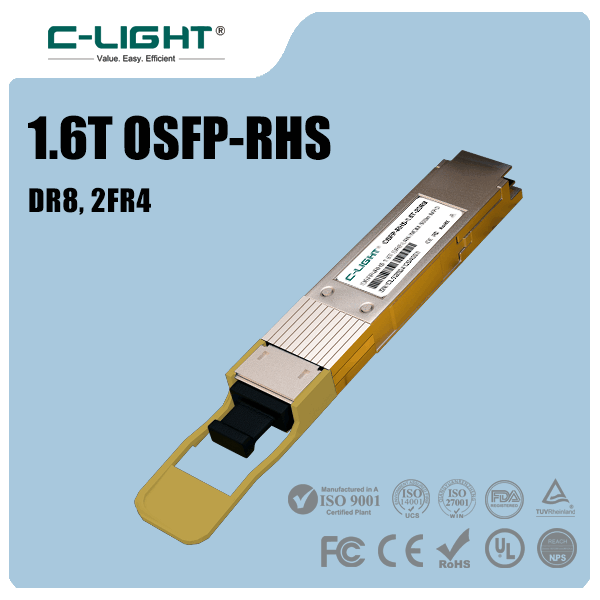
Next-generation 1.6T interconnect technologies
These solutions are designed for applications including AI data centers, cloud computing, high-performance computing, enterprise networks, and telecommunications infrastructure.
8.NRZ and PAM4 FAQ
Q1. What is the main difference between NRZ and PAM4?
Answer: NRZ uses two signal levels and carries one bit per symbol, while PAM4 uses four signal levels and carries two bits per symbol. PAM4 therefore provides higher data capacity at the same symbol rate.
Q2. Why does PAM4 require less bandwidth than NRZ for the same data rate?
Answer: PAM4 transmits two bits per symbol, while NRZ transmits one bit per symbol. This means PAM4 can achieve the same data rate at approximately half the symbol rate of NRZ.
Q3. Is PAM4 more sensitive to noise than NRZ?
Answer: Yes. PAM4 divides the available signal range into four levels, creating smaller spacing between adjacent signal levels. This makes PAM4 more sensitive to noise, distortion, and other signal integrity issues.
Q4. Does PAM4 always require FEC?
Answer: Not in every implementation, but FEC is commonly used in many high-speed PAM4 systems to improve link reliability and compensate for the smaller signal margins associated with multi-level signaling.
Q5. Is PAM4 used in 400G optical transceivers?
Answer: PAM4 is widely used in many modern 400G optical transceiver architectures because it enables higher per-lane data rates while reducing the required baud rate compared with equivalent NRZ signaling.
Q6. Is PAM4 used for 800G networking?
Answer: Yes. PAM4 is an important signaling technology for many 800G Ethernet and optical interconnect solutions, particularly where high lane bandwidth and port density are required.
Q7. Is NRZ still used in modern optical networks?
Answer: Yes. NRZ remains widely used in many lower-speed and established optical networking applications. Its simpler signaling architecture and larger signal margins continue to make it suitable for numerous applications.
Q8. Will PAM4 replace NRZ completely?
Answer: No. PAM4 and NRZ are expected to coexist because they serve different performance and application requirements. NRZ remains practical for many lower-speed links, while PAM4 is increasingly important for higher-speed networking.
9.Summary
The key difference between NRZ and PAM4 is how much information each signal symbol can carry. NRZ uses two signal levels and carries one bit per symbol, while PAM4 uses four levels and carries two bits per symbol.
PAM4 provides higher bandwidth efficiency and enables the continued evolution of high-speed networks toward 400G, 800G, and 1.6T connectivity. However, its smaller signal margins and increased sensitivity to noise require more advanced signal processing and stricter signal integrity control.
NRZ remains an efficient and reliable solution for many lower-speed applications, while PAM4 has become a key technology for modern AI data centers, cloud networks, and next-generation optical interconnects.
Understanding the differences between NRZ and PAM4 helps network designers select the appropriate signaling technology based on bandwidth requirements, transmission distance, power consumption, system complexity, and overall network architecture.
 >
>

 >
>
 >
>
 >
>
 >
>
 >
>
 >
>
 >
>