TEL:+86 132 6656 7067




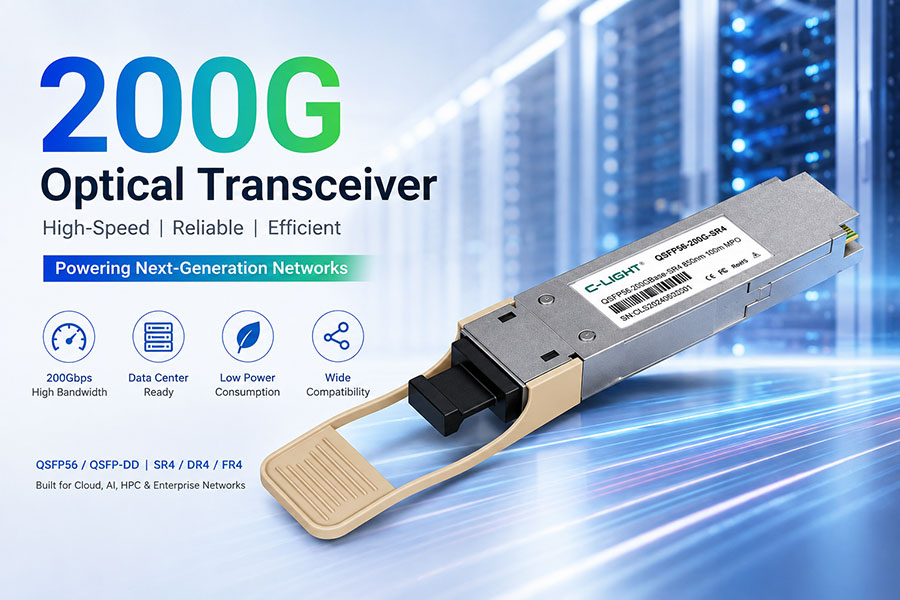
200G optical transceivers provide a practical solution for high-speed data transmission in data centers, enterprise networks, telecom infrastructure, and high-performance computing environments. Positioned between 100G and 400G technologies, 200G offers a balance of bandwidth, power consumption, port density, and deployment cost.
With the continued growth of cloud computing, AI workloads, distributed storage, and high-performance networking, 200G optical modules remain an important option for network upgrades where 400G deployment is not yet necessary or economically justified.
1.What Is a 200G Optical Transceiver?
A 200G optical transceiver is a pluggable optical module designed to transmit and receive data at an aggregate rate of approximately 200Gbps. It converts electrical signals from network equipment into optical signals for transmission over fiber and converts incoming optical signals back into electrical signals.
Depending on the application and optical architecture, 200G modules can use different electrical lane configurations and optical technologies. Common implementations include 4-lane architectures based on approximately 50G per lane, with PAM4 modulation widely used for higher-speed 200G solutions.
Typical form factors include QSFP56 and QSFP-DD, although the appropriate package depends on the network equipment, optical interface, reach, and application requirements.
2.200G Optical Transceiver Form Factors
The form factor is an important consideration when selecting a 200G optical module because it determines port compatibility, density, thermal characteristics, and supported electrical interfaces.
QSFP56: A compact form factor commonly used for 200G networking. Its compact design supports high port density and is suitable for switches, servers, and data center interconnects.
QSFP-DD: A higher-density pluggable form factor that can support high-speed electrical interfaces and is widely used in modern data center switching platforms.
3.How Does 200G Optical Technology Work?
Modern 200G optical transceivers commonly use PAM4 modulation to increase the amount of data transmitted per electrical or optical lane. Unlike traditional NRZ signaling, which represents two signal levels, PAM4 uses four signal levels to transmit two bits per symbol.
This enables higher data rates without simply doubling the signaling frequency. However, PAM4 also introduces greater sensitivity to signal quality, noise, crosstalk, and link loss, making high-quality electrical and optical design increasingly important.
A typical 200G module may use four lanes operating around 50Gbps per lane to achieve an aggregate 200Gbps data rate.
4.Common 200G Optical Transceiver Types
200G modules are available in different optical configurations to support different transmission distances and network architectures.
4.1 200G SR4 Optical Transceiver
200G SR4 modules are designed primarily for short-distance transmission over multimode fiber. They are suitable for data center environments where switches, servers, and network devices are located within relatively short distances.
The parallel optical architecture typically uses multiple optical lanes, making SR4 an efficient solution for short-reach data center connections.
4.2 200G DR4 Optical Transceiver
200G DR4 modules are designed for longer-reach single-mode fiber connections than typical multimode solutions. They are commonly considered for data center interconnects and high-density switch-to-switch applications.
The DR4 architecture uses parallel single-mode optical lanes and is particularly useful when higher transmission distance and optical reach are required.
4.3 200G FR4 Optical Transceiver
200G FR4 modules use multiple optical wavelengths over single-mode fiber and are designed for extended-reach applications. Wavelength multiplexing allows several optical channels to share a single duplex fiber connection.
This architecture can reduce fiber requirements while supporting longer connections within data center and enterprise networking environments.
5.Key Advantages of 200G Optical Modules
High Bandwidth
200Gbps connectivity: Provides twice the aggregate bandwidth of 100G and offers a practical intermediate step for networks transitioning toward higher-speed connectivity.
Higher Port Density
Compact form factors: QSFP56 and QSFP-DD designs allow network operators to increase bandwidth per rack unit while maintaining efficient switch port density.
Efficient Network Upgrades
Balanced performance: 200G can provide a useful upgrade path for networks that require more capacity than 100G but do not yet require the bandwidth of 400G or higher-speed interfaces.
Flexible Transmission Options
Multiple optical architectures: SR4, DR4, and FR4 configurations allow network designers to select the appropriate module according to fiber type, distance, and deployment requirements.
Data Center Friendly
High-density connectivity: 200G optical modules are well suited to server aggregation, leaf-spine networks, storage infrastructure, and switch-to-switch connections.
6.200G Optical Transceiver Applications
200G optical modules are used across several networking environments where higher bandwidth and efficient connectivity are required.
Data Centers: Used for switch-to-switch, server-to-switch, and high-density network connections.
AI and HPC Networks: Provides higher-speed connectivity for computing clusters, storage systems, and distributed workloads.
Cloud Infrastructure: Supports high-bandwidth connections within cloud and hyperscale data center networks.
Enterprise Networks: Enables bandwidth upgrades for large-scale enterprise switching and aggregation networks.
Storage Networks: Supports high-throughput data movement between storage systems, servers, and switches.
7.200G vs 100G vs 400G Optical Transceivers
| Feature | 100G | 200G | 400G |
|---|---|---|---|
| Aggregate Data Rate | 100Gbps | 200Gbps | 400Gbps |
| Typical Modulation | NRZ / PAM4 | PAM4 | PAM4 |
| Typical Form Factors | QSFP28 | QSFP56 / QSFP-DD | QSFP-DD / OSFP |
| Typical Application | Enterprise & Data Center | Data Center & HPC | AI & High-Density Data Center |
| Bandwidth Level | High | Very High | Ultra-High |
The choice between 100G, 200G, and 400G depends on network architecture, switch capabilities, required bandwidth, transmission distance, power budget, and overall deployment cost. For some infrastructure, 200G provides a practical middle ground between existing 100G equipment and newer 400G platforms.
8.What Should You Consider When Choosing a 200G Optical Module?
Before deploying 200G optical transceivers, network engineers should evaluate several technical parameters.
Form Factor: Verify QSFP56, QSFP-DD, or another module type is supported by the target switch or server.
Transmission Distance: Select SR4, DR4, FR4, or another optical configuration according to the required link distance.
Fiber Type: Confirm whether the application requires multimode fiber or single-mode fiber.
Power Consumption: Check the module power budget, especially when deploying large numbers of modules in high-density racks.
Optical Performance: Evaluate parameters such as transmit power, receiver sensitivity, wavelength, insertion loss, and link budget.
Host Compatibility: Confirm compatibility with the intended switches, network adapters, servers, and other networking equipment.
Temperature: High-density deployments require appropriate thermal management to maintain stable optical and electrical performance.
9.200G Optical Transceivers in Data Center Upgrades
As data center traffic continues to increase, network operators need scalable solutions that can improve bandwidth without unnecessarily increasing infrastructure complexity. 200G provides an intermediate bandwidth level that can be particularly useful for organizations upgrading from 100G architectures.
In leaf-spine networks, 200G can be deployed for higher-capacity switch connections and server aggregation. It can also support storage traffic and high-performance computing environments where network bandwidth is increasingly important.
For new AI-oriented infrastructure, however, network designers may increasingly evaluate 400G, 800G, and higher-speed optical technologies depending on the scale and architecture of the deployment.
10.200G Optical Transceiver Testing and Reliability
High-speed 200G modules require comprehensive testing because PAM4-based transmission is more sensitive to signal integrity than traditional lower-speed NRZ systems.
Typical validation can include electrical, optical, thermal, and compatibility testing.
Eye diagram and signal integrity testing
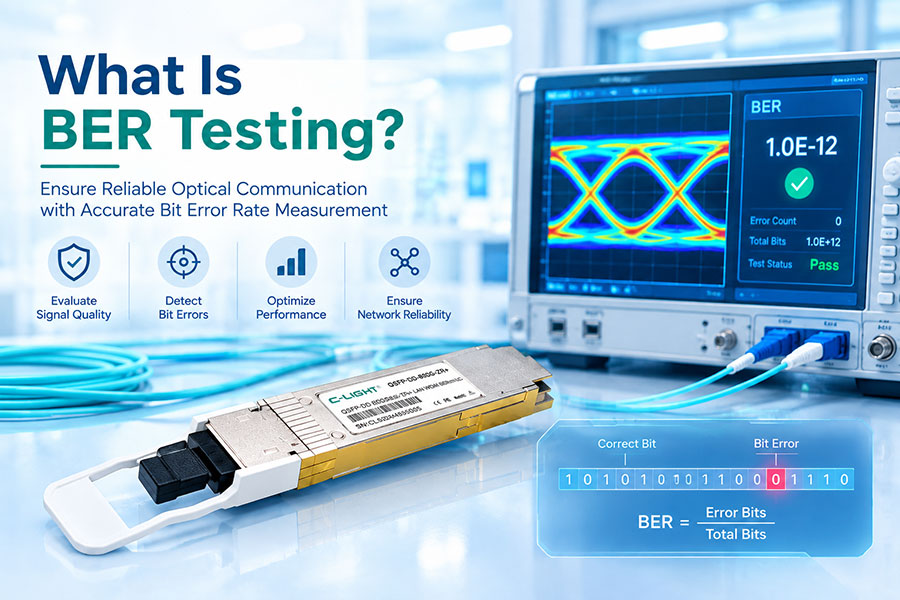
Bit error rate (BER) testing
Optical output power and receiver sensitivity testing
Wavelength and optical performance verification
Temperature and environmental testing
Host equipment interoperability testing
11.200G Optical Transceiver Market Outlook
The optical networking market is continuing to move toward 400G, 800G, and 1.6T connectivity as AI infrastructure and cloud computing drive higher network bandwidth requirements. Nevertheless, 200G remains relevant for network environments where existing equipment, cost considerations, or bandwidth requirements make a 200G upgrade more practical.
Its position between 100G and 400G gives 200G a useful role in network modernization, particularly in data center aggregation, enterprise infrastructure, storage networks, and selected high-performance computing applications.
12.FAQ About 200G Optical Transceivers
Q1:What is a 200G optical transceiver?
Answer: A 200G optical transceiver is a pluggable network module designed to provide an aggregate data rate of approximately 200Gbps over optical fiber.
Q2:What form factors are commonly used for 200G?
Answer: QSFP56 and QSFP-DD are common form factors for 200G optical connectivity, depending on the host equipment and network architecture.
Q3:Does 200G use PAM4?
Answer: Many modern 200G optical modules use PAM4 modulation, typically with multiple electrical or optical lanes to achieve the required aggregate bandwidth.
Q4:What is the difference between 200G and 400G?
Answer: The primary difference is aggregate bandwidth. 200G provides approximately 200Gbps, while 400G provides approximately 400Gbps. The appropriate choice depends on switch capability, network traffic, power requirements, reach, and deployment cost.
Q5:Where are 200G optical modules used?
Answer: They are commonly used in data centers, enterprise networks, storage networks, cloud infrastructure, and high-performance computing environments.
13.Summary
200G optical transceivers offer a practical high-speed connectivity option between 100G and 400G networking. With compact form factors, PAM4-based architectures, and multiple optical configurations such as SR4, DR4, and FR4, 200G modules can address a wide range of data center and enterprise networking requirements.
For network operators planning an upgrade, selecting the right 200G optical module requires consideration of form factor, transmission distance, fiber type, power consumption, optical performance, host compatibility, and thermal conditions. As network speeds continue to advance, 200G can serve as both a high-bandwidth solution for existing infrastructure and a transition point toward 400G and higher-speed optical networking.
 >
>

 >
>
 >
>
 >
>
 >
>
 >
>
 >
>
 >
>