TEL:+86 132 6656 7067




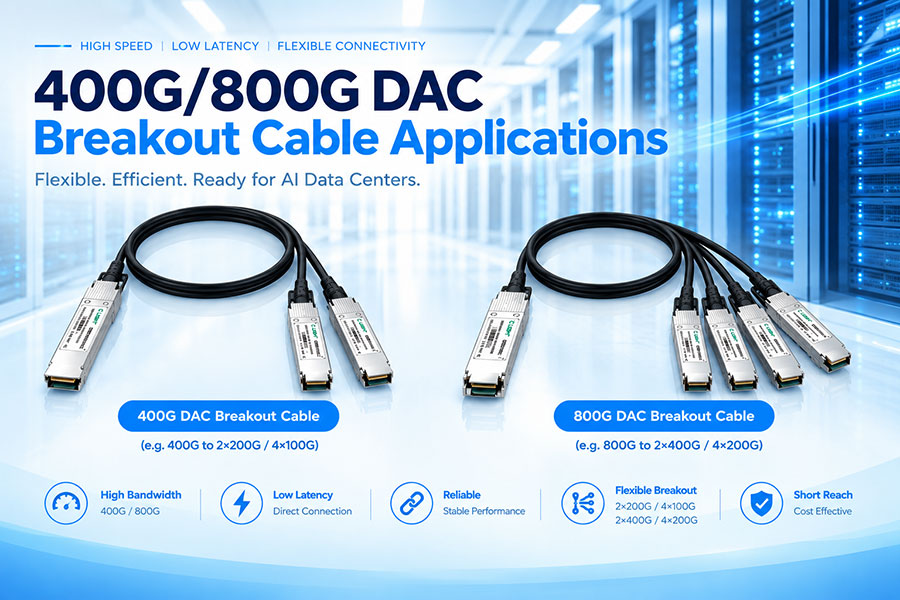
400G and 800G DAC breakout cables provide a practical way to connect high-speed switch ports with multiple lower-speed server, GPU, or switch interfaces. They are widely used in AI data centers, HPC clusters, high-density server racks, and data center networks where short-reach connectivity, low latency, and efficient port utilization are important.
1. What Is a DAC Breakout Cable?
A DAC breakout cable is a direct attach copper cable that connects one high-speed port to multiple lower-speed ports. Instead of using a single point-to-point connection, the breakout architecture divides the aggregate bandwidth into several independent lanes or channels.
For example, a 400G DAC can be configured as 400G-to-2×200G or 400G-to-4×100G, while an 800G DAC can support configurations such as 800G-to-2×400G or other supported breakout architectures.
2. How 400G DAC Breakout Works
400G DAC breakout cables typically use a high-speed 400G connector on one end and two or more lower-speed connectors on the other end.
The cable separates the electrical lanes from the 400G host interface into independent connections. The exact configuration depends on the switch, network adapter, port architecture, and supported signaling technology.
3. How 800G DAC Breakout Works
800G DAC breakout cables are designed for next-generation high-bandwidth networks. An 800G host port can be divided into multiple lower-speed connections when supported by the networking platform.
This allows a high-capacity switch port to connect with multiple 400G, 200G, 100G, or other compatible interfaces, depending on the specific cable and equipment configuration.
4. 400G DAC Breakout Configurations
| Configuration | Typical Application |
|---|---|
| 400G to 2×200G | High-speed server and GPU connections |
| 400G to 4×100G | Server, switch, and legacy network connections |
| 400G to 8×50G | Selected high-density network deployments |
| 400G to 400G | Direct switch-to-switch or server-to-switch connection |
5. 800G DAC Breakout Configurations
| Configuration | Typical Application |
|---|---|
| 800G to 2×400G | Switch-to-switch and AI network connections |
| 800G to 4×200G | High-density server and GPU connectivity |
| 800G to 8×100G | Connecting multiple lower-speed network ports |
| 800G to 800G | High-bandwidth switch-to-switch connections |
6. AI Data Center Applications
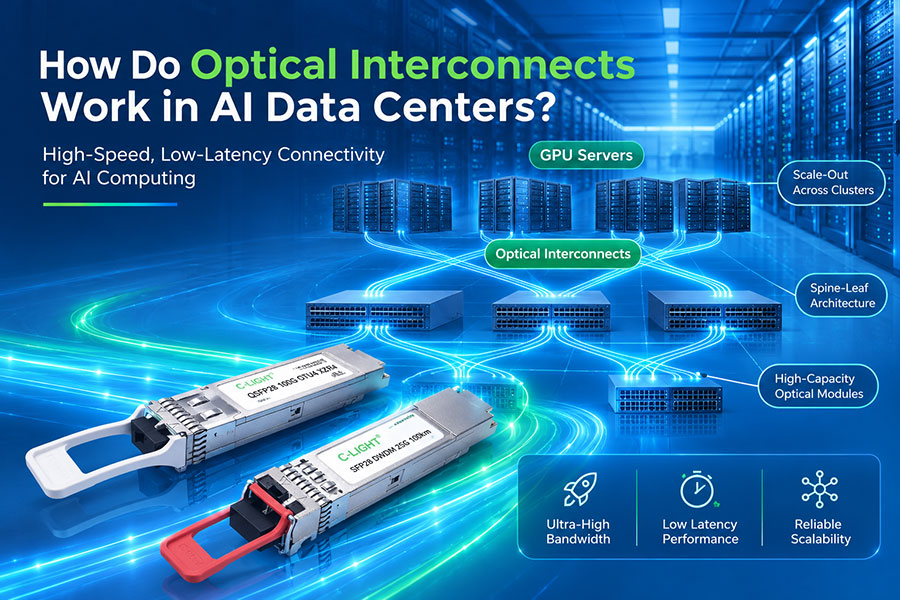
AI data centers require large numbers of high-speed connections between GPUs, servers, switches, and storage systems. DAC breakout cables can help distribute bandwidth from high-capacity switch ports to multiple endpoints.
They are particularly useful for short-distance connections inside GPU clusters and high-density racks where cable length is limited and low power consumption is preferred.
7. GPU-to-Switch Connectivity
GPU servers often contain multiple high-speed network interfaces for distributed AI workloads. A breakout DAC can connect a high-speed switch port to multiple GPU server interfaces when the switch and network adapters support the required configuration.
This can simplify short-reach cabling while providing a direct electrical connection between the network equipment.
8. Switch-to-Switch Applications
DAC breakout cables can also be used between network switches. A high-speed uplink can be divided into multiple lower-speed links to connect aggregation, leaf, spine, or other network layers.
This approach can provide flexible port utilization without requiring optical transceivers for every short-distance connection.
9. Server-to-Switch Applications
In high-density server racks, breakout DAC cables can connect a high-speed switch to multiple server network interfaces. This is useful when the switch provides higher aggregate bandwidth than the individual server ports.
Direct attach copper also eliminates separate optical transceivers and fiber patching for supported short-reach deployments.
10. DAC Breakout for AI GPU Clusters
Large GPU clusters require scalable network architectures with high aggregate bandwidth. Breakout connectivity allows switch capacity to be distributed across multiple compute nodes.
400G and 800G breakout DAC solutions can therefore be used in AI training clusters, inference systems, HPC environments, and other compute-intensive infrastructure.
11. InfiniBand Applications
DAC breakout cables can be used in supported InfiniBand environments where high-bandwidth, low-latency connections are required between switches and compute nodes.
The exact cable configuration must match the InfiniBand generation, switch port, adapter, connector type, and supported breakout mode.
12. Ethernet Applications
400G and 800G Ethernet networks are increasingly deployed in cloud, hyperscale, AI, and HPC environments. Breakout DAC cables provide a convenient option for dividing high-speed Ethernet ports into multiple lower-speed interfaces.
Common applications include leaf-spine networks, switch uplinks, server connectivity, and high-density rack networking.
13. Breakout DAC vs Standard DAC
| Feature | Standard DAC | Breakout DAC |
|---|---|---|
| Connection | One port to one port | One high-speed port to multiple ports |
| Bandwidth distribution | Single link | Divided across multiple links |
| Port utilization | Simple | More flexible |
| Cabling | Point-to-point | Multi-branch |
| Typical use | Direct server or switch connection | High-density network expansion |
14. Breakout DAC vs AOC
Both breakout DAC and AOC can provide multi-lane connectivity, but they use different transmission media. DAC uses copper conductors, while AOC uses optical fiber with integrated optical components.
DAC is generally preferred for very short connections where low cost and low power are priorities. AOC can provide longer reach and lighter cabling for applications that exceed the practical distance or physical requirements of copper.
15. Breakout DAC vs Optical Transceivers
Optical transceivers provide greater flexibility for longer-distance fiber connections, while DAC breakout cables are optimized for short-reach direct connections.
For connections within the same rack or between adjacent racks, DAC can provide a simple and cost-effective solution. Optical transceivers are more appropriate when greater reach, fiber infrastructure, or optical isolation is required.
16. Advantages of 400G/800G DAC Breakout Cables
High aggregate bandwidth
Low latency
Low power consumption
Direct electrical connection
Simple short-reach deployment
Flexible port breakout
Reduced need for separate transceiver pairs
Suitable for high-density rack environments
17. Cable Length and Deployment Distance
DAC breakout cables are designed primarily for short-reach connections. Typical 400G and 800G DAC products are available in configurations from approximately 0.5m to several meters, depending on the cable design and application.
Actual supported distance depends on conductor gauge, connector design, signal integrity, host equipment, and the specific product specification. For longer links, AOC or optical transceivers are generally more suitable.
18. Connector and Form Factor Selection
Breakout DAC cables are available with different connector and form-factor combinations, including QSFP-DD, QSFP112, OSFP, and related high-speed interfaces.
The connector must match the host equipment on both ends. For breakout configurations, each branch must also match the corresponding lower-speed port and supported electrical lane configuration.
19. Signal Integrity Considerations
At 400G and 800G data rates, signal integrity is an important consideration. Insertion loss, return loss, crosstalk, impedance consistency, and jitter can affect link performance.
High-quality DAC assemblies require appropriate cable construction, connector design, manufacturing control, and testing to maintain reliable high-speed electrical transmission.
20. Compatibility Considerations
Before deploying a breakout DAC cable, verify the switch port mode, supported breakout configuration, firmware, connector type, lane mapping, and network adapter compatibility.
A cable with the correct physical connector does not necessarily guarantee compatibility. The switch and connected devices must support the same bandwidth and breakout architecture.
21. 400G/800G DAC Breakout in High-Density Racks
High-density AI and HPC racks can contain a large number of network connections. Breakout DAC cables can reduce the number of separate cable assemblies required between high-capacity switches and multiple endpoints.
Proper cable routing and bend-radius management are still important, particularly in densely populated racks where many high-speed copper cables are installed together.
22. C-LIGHT 400G and 800G DAC Breakout Solutions
C-LIGHT provides 400G and 800G DAC solutions for high-speed data center, AI, HPC, and networking applications. Supported configurations include direct connections and breakout architectures for different switch and server interfaces.
C-LIGHT 400G DAC solutions include configurations such as 400G-to-2×200G and 400G-to-4×100G, while 800G DAC solutions support high-bandwidth connections and compatible breakout architectures. Cable lengths, connector types, wire gauges, and form factors can be selected according to deployment requirements.
23. How to Choose a 400G/800G DAC Breakout Cable
Consider the following factors when selecting a breakout DAC:
Host port bandwidth
Target port bandwidth
Breakout ratio
Connector and form factor
Cable length
Switch and NIC compatibility
Signal integrity requirements
Rack density and cable management
Power and thermal requirements
24. Conclusion
400G and 800G DAC breakout cables provide flexible short-reach connectivity for modern high-speed networks. By dividing a high-bandwidth port into multiple lower-speed connections, they can improve port utilization and simplify connections between switches, servers, GPUs, and other network equipment.
For AI data centers, HPC clusters, InfiniBand networks, and high-density Ethernet infrastructure, the appropriate breakout configuration depends on bandwidth, port architecture, connector type, distance, and equipment compatibility. DAC is particularly effective when low latency, low power, and cost-efficient short-reach connectivity are required.
 >
>

 >
>
 >
>
 >
>
 >
>
 >
>
 >
>
 >
>