TEL:+86 132 6656 7067





Background: A duplex transceiver has two optical ports: one for transmit and one for receive. A BiDi transceiver has one optical port that carries both directions on a single fiber by using two different wavelengths.
Question: Can an optical circulator be added to a duplex transceiver to combine its two ports onto a single fiber, achieving single-fiber bidirectional transmission without a BiDi module?
Analysis and Conclusion: On the surface, the idea is attractive. A circulator is a three-port directional device: light entering port 1 exits port 2, and light entering port 2 exits port 3. If the transmitter is connected to port 1, the fiber to port 2, and the receiver to port 3, the circulator routes the outgoing signal to the fiber and the incoming signal to the receiver. On paper, this converts a duplex transceiver into a single-fiber bidirectional device.
In practice, this approach fails fundamentally. A circulator separates directions, but it does not separate wavelengths. A duplex transceiver uses the same wavelength for transmit and receive. Any reflection or backscattering at that wavelength enters the receiver along with the desired incoming signal. A BiDi module avoids this problem by using two different wavelengths and an internal WDM filter. The circulator cannot perform wavelength filtering, and no amount of isolation can compensate for the absence of wavelength separation.
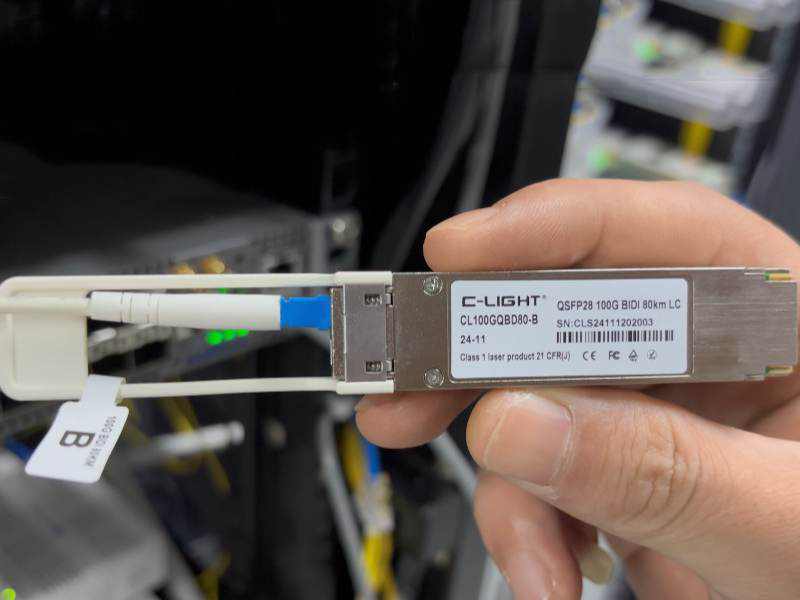
100G BiDi QSFP28 Optical Transceiver for Data Center Interconnect丨C-LIGHT
40G BiDi QSFP+丨C-LIGHT
1. The Role of a Circulator
An optical circulator is a nonreciprocal passive device. Light travels through it in one direction only, following a defined port sequence. In a typical three-port circulator, the signal path is port 1 to port 2, port 2 to port 3, and port 3 to port 1. The device uses Faraday rotators and polarizing beam splitters to achieve direction-dependent routing.
Circulators are used in optical systems where a signal must be separated from its reflection, such as in erbium-doped fiber amplifiers, optical add-drop multiplexers, and optical time-domain reflectometers. They are also used in some single-fiber bidirectional links, but only when the two directions use different wavelengths or when the link is short enough that reflections and backscattering are negligible.
| Parameter | Circulator |
|---|---|
| Function | Directional routing of light |
| Port Sequence | 1→2, 2→3, 3→1 |
| Wavelength Separation | None |
| Isolation | 40–60 dB typical |
| Insertion Loss | 0.5–1.5 dB per pass |
| Primary Use | Amplifiers, add-drop, OTDR |
2. The Role of a BiDi Module
A BiDi module integrates a wavelength division multiplexer inside the transceiver. The transmitter emits at one wavelength, and the receiver detects at a different wavelength. The WDM combines the outgoing wavelength and the incoming wavelength onto a single fiber, and separates them at the opposite end.
For 10G and 25G BiDi, the standard wavelength pairs are 1270 nm and 1330 nm. One endpoint transmits at 1270 nm and receives at 1330 nm; the other endpoint transmits at 1330 nm and receives at 1270 nm. The WDM filter at the receiver passes only the incoming wavelength and rejects the outgoing wavelength. This provides high isolation between transmit and receive, typically greater than 30 dB, and it is independent of reflections and backscattering because those occur at the transmitted wavelength, which the receiver filter blocks.
| Parameter | BiDi Module |
|---|---|
| Function | Single-fiber bidirectional transmission |
| Wavelength Separation | Two different wavelengths |
| Internal WDM | Yes |
| Receiver Filtering | Passes incoming wavelength, rejects outgoing wavelength |
| Isolation | >30 dB from WDM filter |
| Primary Use | Single-fiber access, campus, 5G fronthaul |
3. The Critical Difference: Direction Separation vs Wavelength Separation
The circulator and the BiDi module perform different functions. The circulator separates directions. The BiDi module separates wavelengths. These are not equivalent operations.
Direction separation is sufficient only if the two directions use different wavelengths, or if the link is short and clean enough that reflections and backscattering are negligible. Wavelength separation is necessary when the two directions use the same wavelength, because the receiver must distinguish the desired incoming signal from reflections of the transmitted signal.
A duplex transceiver uses the same wavelength for both directions. It has no internal WDM and no receiver filter. When a circulator combines its two ports onto a single fiber, the receiver sees both the desired incoming signal and any reflected or backscattered light at the transmitted wavelength. The circulator cannot filter out the transmitted wavelength because it does not separate wavelengths.
| Function | Circulator | BiDi Module |
|---|---|---|
| Direction Separation | Yes | Yes (by wavelength) |
| Wavelength Separation | No | Yes |
| Receiver Filtering | No | Yes |
| Suitable for Same-Wavelength Duplex | No | Not applicable |
| Suitable for Single-Fiber Bidirectional | Only with different wavelengths | Yes |
4. Why Same-Wavelength Reflections Blind the Receiver
In a duplex transceiver, the transmitter launches a signal at a specific wavelength. The receiver is sensitive to that same wavelength. When the transmitted signal encounters a connector, a splice, or any refractive index discontinuity, a fraction of the light is reflected back toward the source. This reflected light travels back through the fiber and enters the circulator at port 2. The circulator routes it to port 3, which is connected to the receiver.
The reflected power can be substantial. A typical connector reflection is -14 dB to -20 dB. If the transmitter output is 0 dBm, the reflected power at the receiver is -14 dBm to -20 dBm. A typical receiver sensitivity is -20 dBm to -28 dBm. The reflected power is therefore at or above the receiver sensitivity, and it can blind the receiver or cause a high bit error rate.
A BiDi module does not have this problem. The reflected light is at the transmitted wavelength. The receiver filter passes only the incoming wavelength, which is different. The reflected light is rejected by the filter, typically by more than 30 dB. The receiver sees only the desired signal from the far end.
| Parameter | Circulator + Duplex | BiDi Module |
|---|---|---|
| Transmit Wavelength | λ | λ1 |
| Receive Wavelength | λ | λ2 |
| Reflection Wavelength | λ | λ1 |
| Receiver Filter | None | Passes λ2, rejects λ1 |
| Reflection Rejection | None | >30 dB |
| Receiver Blinding Risk | High | Low |
5. Rayleigh Backscattering and the Fiber Itself
Even if all connectors and splices were perfect, the fiber itself scatters light. Rayleigh backscattering is the scattering of light by microscopic density fluctuations in the glass. A small fraction of the transmitted light is scattered backward toward the source. For a long fiber, the accumulated Rayleigh backscattering can be significant.
In a duplex transceiver with a circulator, the Rayleigh backscattered light is at the transmitted wavelength. It travels back through the fiber, enters the circulator at port 2, and is routed to the receiver at port 3. The receiver cannot distinguish this backscattered light from the desired incoming signal because they are at the same wavelength.
In a BiDi module, the Rayleigh backscattered light is at the transmitted wavelength, which is different from the received wavelength. The receiver filter rejects it. The desired signal from the far end is at the received wavelength, which the filter passes. The BiDi module is therefore immune to Rayleigh backscattering.
| Impairment | Circulator + Duplex | BiDi Module |
|---|---|---|
| Connector Reflection | Reaches receiver | Rejected by filter |
| Splice Reflection | Reaches receiver | Rejected by filter |
| Rayleigh Backscattering | Reaches receiver | Rejected by filter |
| Receiver Blinding | Possible | Minimized |
| Link Margin | Reduced | Preserved |
6. Isolation, Return Loss, and Connector Quality
Circulator isolation is typically 40 to 60 dB. This is the attenuation from port 1 to port 3, which is the leakage path from the transmitter to the receiver. If the circulator were the only source of crosstalk, an isolation of 50 dB would reduce a 0 dBm transmit signal to -50 dBm at the receiver, which is below the receiver sensitivity. The circulator isolation itself is not the problem.
The problem is the reflection path. The reflected signal does not travel through the leakage path from port 1 to port 3. It travels out of port 2, reflects from the fiber or connector, returns to port 2, and is routed to port 3 by the circulator's intended path. The circulator isolation does not attenuate this path because the reflected signal enters port 2, not port 1. The circulator routes it to port 3 with the same insertion loss as the desired incoming signal.
This is why circulator isolation cannot solve the reflection problem. The reflected signal is treated as a legitimate incoming signal. The only way to reject it is to use a different wavelength and a receiver filter, which is what a BiDi module does.
| Parameter | Circulator + Duplex | BiDi Module |
|---|---|---|
| Circulator Isolation | 40–60 dB | Not applicable |
| Reflection Path | Port 2 → Port 3 | Filtered by WDM |
| Reflection Attenuation | None (treated as incoming) | >30 dB rejection |
| Connector Quality Requirement | Very high | Moderate |
| Return Loss Requirement | Very high | Moderate |
7. Power Budget and Insertion Loss
A circulator adds insertion loss to both the transmit and receive paths. A typical circulator has 0.5 to 1.5 dB of insertion loss per pass. In a single-fiber bidirectional link, the circulator is used at both ends, so the total insertion loss is 1 to 3 dB, plus the connector losses. This reduces the link budget and shortens the achievable reach.
A BiDi module integrates the WDM inside the transceiver, and the insertion loss of the WDM is accounted for in the module's power budget. The BiDi module does not add external components or connectors to the link. The power budget is optimized as part of the module design.
| Parameter | Circulator + Duplex | BiDi Module |
|---|---|---|
| External Components | Two circulators | None |
| Insertion Loss per End | 0.5–1.5 dB | Included in module |
| Total Added Loss | 1–3 dB | None external |
| Link Budget Impact | Reduced | Optimized |
| Reach Impact | Shorter | Rated reach |
8. Standards, Interoperability, and Deployment
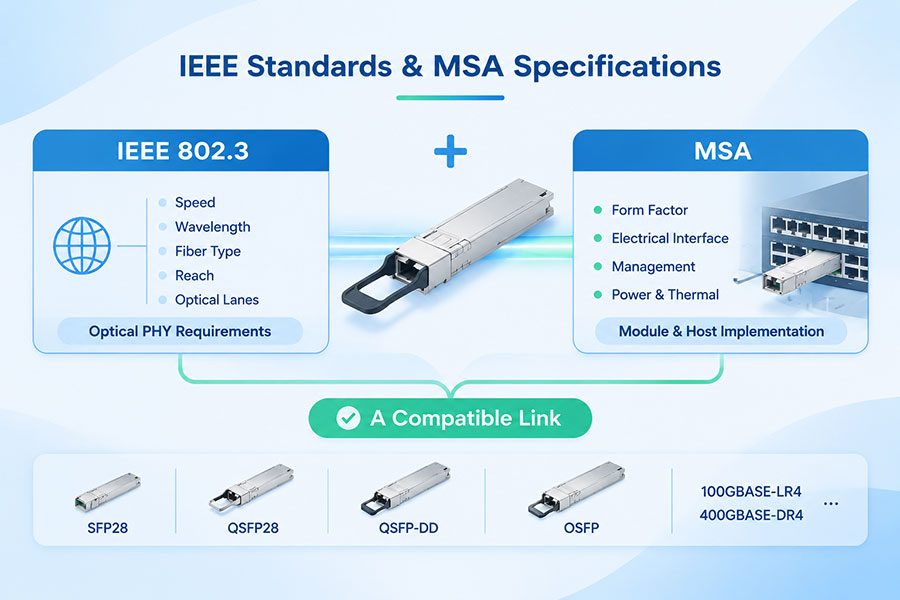
BiDi modules are standardized in IEEE 802.3 for 10GBASE-BX, 25GBASE-BX, and other interfaces. The wavelength pairs, the power budgets, and the connector types are defined by the standard. BiDi modules from different vendors interoperate when they follow the same standard and the same wavelength pairing rules.
A duplex transceiver with a circulator is not a standardized configuration. There is no IEEE specification for combining a duplex transceiver with an external circulator to achieve single-fiber bidirectional transmission. The performance depends on the circulator, the connectors, the fiber quality, and the transceiver's tolerance to reflected power. Interoperability between different vendors is not guaranteed. Deployment in a production network would require custom engineering, testing, and operational procedures that are not supported by the standard ecosystem.
| Parameter | Circulator + Duplex | BiDi Module |
|---|---|---|
| Standardized | No | Yes (IEEE 802.3) |
| Interoperability | Not guaranteed | Standard-defined |
| Deployment Model | Custom engineering | Plug-and-play |
| Operational Familiarity | Low | High |
| Field Support | Limited | Broad |
9. Cost and Complexity
A circulator-based solution requires two circulators, one at each end of the link, plus the connectors and the patch cords to connect them. The circulators are precision optical components that cost more than a simple patch cord. The total cost of the circulator approach may exceed the cost difference between a duplex transceiver and a BiDi transceiver.
A BiDi module integrates the WDM inside the transceiver. There are no external components to purchase, install, or maintain. The cost is contained in the module, and the deployment is as simple as plugging in a patch cord.
| Cost Element | Circulator + Duplex | BiDi Module |
|---|---|---|
| External Components | Two circulators | None |
| Connectors and Patch Cords | Additional | Standard |
| Installation Complexity | Higher | Lower |
| Maintenance | More components | Fewer components |
| Total Cost | Often higher | Lower |
10. Where Circulators Are Used
Circulators are not useless in optical networks. They are used in erbium-doped fiber amplifiers to separate the input signal from the amplified output, in optical add-drop multiplexers to route wavelengths, and in optical time-domain reflectometers to separate the transmitted pulse from the backscattered signal. They are also used in some single-fiber bidirectional links, but only when the two directions use different wavelengths or when the link is short and the reflections are controlled.
The circulator is a valuable component. It is simply not a substitute for a BiDi module in a duplex transceiver link, because it does not provide wavelength separation.
| Application | Circulator Role |
|---|---|
| EDFA | Separates input and output |
| Optical Add-Drop | Routes wavelengths |
| OTDR | Separates pulse and backscatter |
| Single-Fiber Bidirectional | Only with different wavelengths or short links |
| Duplex Transceiver Single-Fiber | Not suitable |
11. Summary of Key Points
| Dimension | Circulator + Duplex | BiDi Module |
|---|---|---|
| Direction Separation | Yes | Yes |
| Wavelength Separation | No | Yes |
| Receiver Filtering | No | Yes |
| Reflection Rejection | None | >30 dB |
| Rayleigh Backscattering Rejection | None | >30 dB |
| External Components | Two circulators | None |
| Insertion Loss | 1–3 dB added | Included in module |
| Standardized | No | Yes |
| Interoperability | Not guaranteed | Standard-defined |
| Cost | Often higher | Lower |
| Deployment Complexity | Higher | Lower |
12. Conclusion
A circulator cannot replace a BiDi module in a duplex transceiver link because it performs a different function. The circulator separates directions. The BiDi module separates wavelengths. A duplex transceiver uses the same wavelength for transmit and receive, so any reflection or backscattering at that wavelength is routed to the receiver along with the desired signal. The circulator cannot filter out the transmitted wavelength because it does not separate wavelengths.
A BiDi module uses two different wavelengths and an internal WDM filter. The receiver filter passes only the incoming wavelength and rejects the transmitted wavelength, providing more than 30 dB of isolation against reflections and Rayleigh backscattering. This is what makes single-fiber bidirectional transmission reliable over distance.
The circulator approach may work in a laboratory with short fiber, high-quality connectors, and controlled reflections. It is not suitable for production networks, where connector quality varies, fiber lengths are longer, and reflections and backscattering are unavoidable. The BiDi module is the standardized, interoperable, and cost-effective solution for single-fiber bidirectional transmission.
 >

 >
 >
 >
 >
 >
 >
 >