TEL:+86 132 6656 7067





Modern AI computing infrastructure depends on high-bandwidth connections between GPU servers and network switches. As GPU clusters expand to support large-scale model training and inference, communication between compute nodes becomes increasingly important for overall system performance.
High-speed optical transceivers, fiber optic cables, Active Optical Cables (AOCs), and Direct Attach Copper (DAC) solutions provide different ways to connect GPU servers with network switches. The appropriate connectivity architecture depends on bandwidth requirements, link distance, switch port configuration, network topology, and deployment density.
1. Why GPU Servers Require High-Speed Network Connectivity
A GPU server typically contains multiple accelerators that exchange data during distributed AI workloads. When a model is distributed across multiple servers, GPUs must continuously communicate intermediate results, synchronize parameters, and exchange training data.
The network connecting these servers directly influences communication efficiency. Insufficient bandwidth or excessive network latency can limit GPU utilization, particularly during large-scale distributed training.
2. How GPU Servers Connect to Network Switches
In a typical AI data center, GPU servers connect to top-of-rack or leaf switches through high-speed network interface cards (NICs) or Host Channel Adapters (HCAs). These interfaces provide the electrical connection between the server and the external network.
At the switch-facing and server-facing ports, compatible optical or copper interconnect solutions establish the physical link. The exact connection depends on the port type, supported signaling rate, and network interface design.
The switch fabric connects multiple GPU servers and enables communication between different racks. In larger AI deployments, multiple leaf and spine switches form a scalable network architecture.
3. Optical Transceivers, DAC and AOC Connection Options
Different interconnect technologies serve different distances and deployment requirements. Copper-based solutions are often preferred for short connections, while optical solutions become increasingly important as link distances and aggregate bandwidth increase.
Optical Transceivers with Fiber Optic Cables
Optical transceivers convert electrical signals from the host interface into optical signals for transmission over fiber. At the receiving end, another transceiver converts the optical signals back into electrical signals.
This architecture supports flexible cable routing and longer transmission distances compared with conventional passive copper connections. It is particularly suitable for GPU clusters distributed across multiple racks.
Common optical connectivity options include:
400G QSFP-DD / OSFP: High-bandwidth connectivity for current AI and data center networks.
800G OSFP / QSFP-DD: Higher port bandwidth for next-generation GPU clusters.
1.6T OSFP: Emerging high-density connectivity for future AI infrastructure.
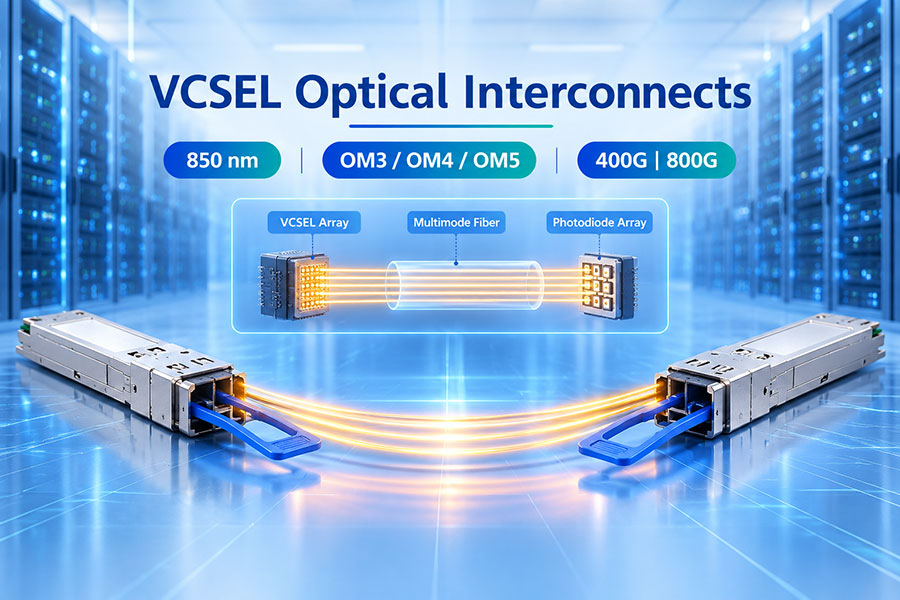
SR and DR optical solutions: Short-reach multimode or single-mode fiber connections, depending on the selected module.
FR and LR solutions: Single-mode optical connectivity for longer transmission distances where supported by the platform.
Direct Attach Copper (DAC)
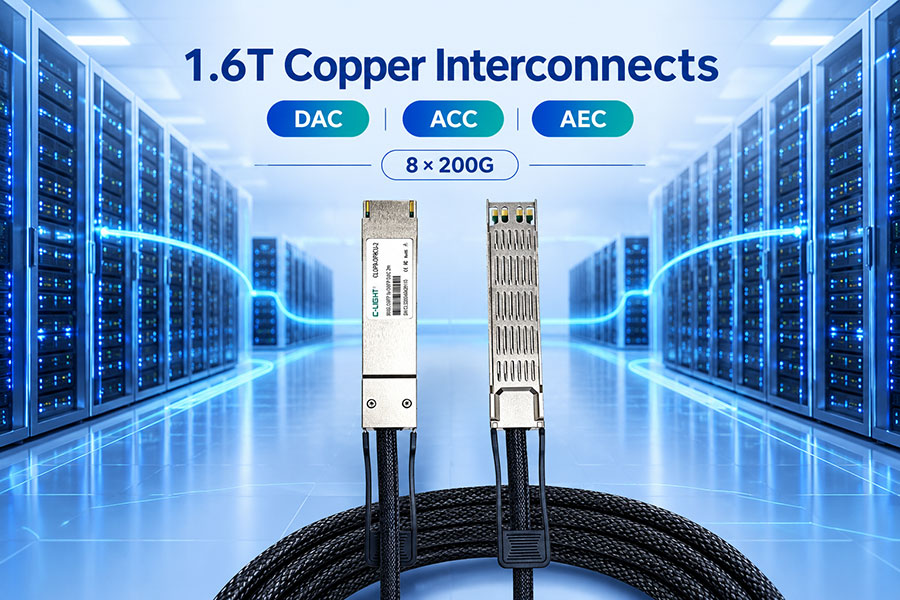
DAC cables provide a direct electrical connection between compatible server NICs and switch ports. They are commonly used for short-distance connections within the same rack.
Passive DAC solutions do not require optical-to-electrical conversion. Their relatively low power consumption and simple installation make them attractive for short-reach connections.
Active Optical Cables (AOC)
AOC assemblies integrate optical transmitters and receivers into the cable ends. They provide a complete optical connection without requiring separate transceivers and fiber patch cables.
AOCs are useful when GPU servers and network switches are separated by longer cable routes or when lighter, more flexible cabling is preferred.
| Connectivity Type | Transmission Medium | Typical Application | Main Advantage |
|---|---|---|---|
| DAC | Copper | Short server-to-switch links | Low power and cost |
| AOC | Integrated optical fiber | Short-to-medium reach connections | Flexible optical cabling |
| Optical Transceiver + Fiber | Multimode or single-mode fiber | Rack-to-rack and longer links | Flexible distance and bandwidth options |
4. Common Bandwidth Options for GPU Network Connectivity
The transition from 400G to 800G and 1.6T networking is driven by increasing GPU density and the growing communication requirements of AI workloads. Higher-speed ports allow more data to move through each physical connection and can help reduce the number of links required for a given aggregate bandwidth target.
| Network Speed | Common Form Factors | Typical Optical Solutions | Application |
|---|---|---|---|
| 100G | QSFP28 | SR4, DR, LR4 | Existing data center infrastructure |
| 400G | QSFP-DD, OSFP, QSFP112 | SR8, DR4, FR4, LR4 | AI clusters and high-speed Ethernet / InfiniBand |
| 800G | OSFP, QSFP-DD | SR8, 2DR4, 2FR4 and other supported variants | Large-scale GPU clusters |
| 1.6T | OSFP and next-generation form factors | 2DR4, DR8 and emerging optical implementations | Next-generation AI data centers |
These are representative product and interface categories rather than universal port specifications. Actual compatibility depends on the Ethernet or InfiniBand generation, electrical lane configuration, modulation format, optical standard, and host platform.
5. Ethernet and InfiniBand in GPU Server Networks
Ethernet and InfiniBand are two important networking technologies used in AI and high-performance computing environments. Both can use high-speed optical transceivers, fiber connections, DACs, and AOCs, but their network architectures and protocol implementations differ.
Ethernet with RoCEv2
RoCEv2 enables Remote Direct Memory Access over Ethernet and is widely used in AI data center networking. It allows servers to exchange data with reduced CPU involvement while supporting high-throughput communication between GPU nodes.
Network configurations may incorporate congestion management, traffic prioritization, and lossless or low-loss transport mechanisms to maintain predictable performance under heavy workloads.
InfiniBand
InfiniBand is designed for high-performance computing and large-scale distributed workloads. It provides a high-performance fabric for communication between GPU servers and supports low-latency data exchange.
High-speed InfiniBand switches and compatible server adapters are commonly deployed in GPU computing clusters where communication performance is a major infrastructure requirement.
| Feature | Ethernet / RoCEv2 | InfiniBand |
|---|---|---|
| Network Architecture | Ethernet switching fabric | InfiniBand fabric |
| RDMA Support | Through RoCEv2 | Native RDMA architecture |
| Deployment | AI, cloud and enterprise data centers | HPC and large-scale AI clusters |
| Optical Connectivity | Compatible high-speed optical modules and cables | Compatible InfiniBand optical modules and cables |
| Key Consideration | Congestion control and network configuration | Fabric design and adapter-switch compatibility |
6. Single-Rack and Multi-Rack Optical Connectivity
The physical arrangement of GPU servers has a significant influence on interconnect selection. Single-rack systems and multi-rack clusters have different cable lengths, routing requirements, and optical deployment considerations.
Single-Rack GPU Connectivity
When GPU servers and switches are installed within the same rack, short-reach DAC cables and AOCs can provide practical connectivity. The selection depends on cable length, port density, signal integrity, and power requirements.
For high-density racks, cable organization and airflow management are also important because excessive cable congestion can complicate maintenance and thermal management.
Multi-Rack GPU Connectivity
In larger AI clusters, GPU servers may be distributed across several racks. Optical transceivers connected through single-mode or multimode fiber can support these inter-rack links.
Single-mode optical solutions are particularly useful when longer distances, higher bandwidth, or future network expansion are required. The specific SR, DR, FR, or LR optical implementation should match the link distance and switch specifications.
7. Key Factors When Selecting Optical Connectivity
Selecting an optical interconnect for GPU servers requires more than matching the transmission rate. Network engineers should evaluate the complete physical and electrical interface between the server adapter, cable assembly, and switch.
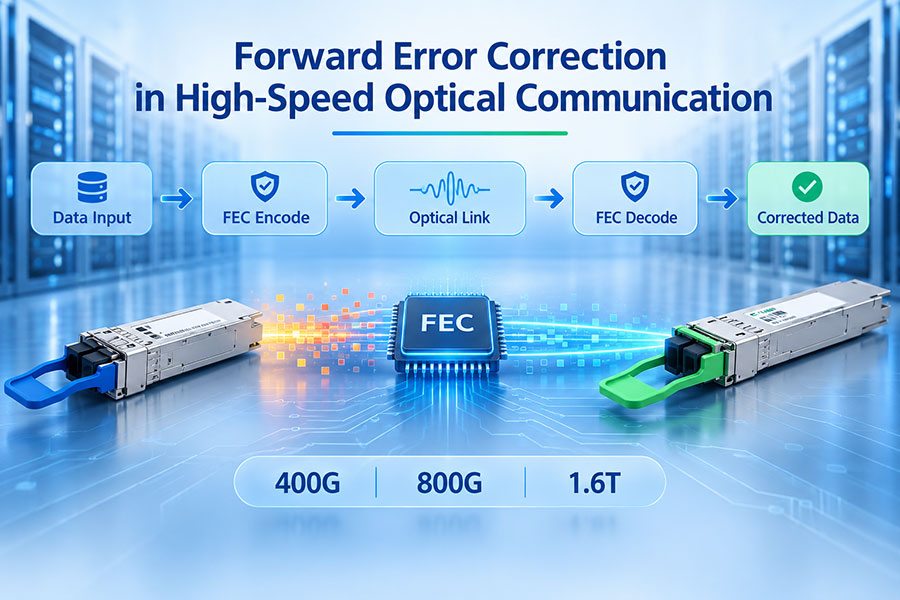
For large-scale deployments, interoperability testing is particularly important. A transceiver that matches the physical form factor may still require verification of firmware recognition, EEPROM coding, signal integrity, FEC settings, and host-specific compatibility.
8. C-LIGHT High-Speed Connectivity Solutions for AI Data Centers
As AI infrastructure moves toward higher port speeds and denser GPU clusters, reliable connectivity products are essential for server-to-switch communication. C-LIGHT.COM provides high-speed optical transceivers and direct-attach connectivity solutions for data center and high-performance networking applications.
High-Speed DAC and AOC Solutions
High-bandwidth copper-based interconnect options for compatible next-generation switch and server platforms.
Short-reach connectivity for 800G network interfaces in high-density AI infrastructure.
High-speed direct connections for compatible 400G server and switch interfaces.
Breakout connectivity for compatible 400G switch ports connecting to multiple 100G network interfaces.
High-Speed Optical Transceiver Solutions
Multimode optical connectivity for compatible 800G short-reach network links.
Single-mode optical connectivity for compatible 800G links requiring extended reach.
Next-generation high-bandwidth optical solutions for emerging AI and data center network architectures.
Longer-reach single-mode connectivity for compatible 400G network applications.
The appropriate solution depends on the host platform, port configuration, protocol, optical interface, and transmission distance. Product specifications and interoperability should be confirmed before deployment.
9. The Future of GPU Server Optical Connectivity
The increasing scale of AI computing is driving higher bandwidth requirements throughout data center networks. As GPU clusters expand, optical connectivity is becoming increasingly important not only for long-distance communication but also for high-density interconnects within and between racks.
The development of 800G and 1.6T optical transceivers, advanced OSFP interfaces, improved optical engines, and co-packaged optics is expected to influence future network architectures.
At the same time, improvements in optical power efficiency, thermal management, signal integrity, and fiber density will remain essential for building scalable AI infrastructure.
10. Conclusion
Optical connectivity between GPU servers and network switches is a fundamental part of modern AI data center infrastructure. It enables high-bandwidth communication between distributed computing nodes and supports the expansion of large-scale Ethernet and InfiniBand networks.
DAC and AOC solutions provide practical options for short-reach server-to-switch connections, while optical transceivers and fiber optic cables support flexible, higher-distance connectivity. With the continued development of 400G, 800G, and 1.6T technologies, selecting compatible and reliable interconnect solutions will remain essential for future GPU clusters.
Explore optical transceivers, DAC, AOC, and high-speed connectivity solutions for GPU servers and network switches.
Contact C-LIGHT >

 >
 >
 >
 >
 >
 >
 >