 TEL:+86 132 6656 7067





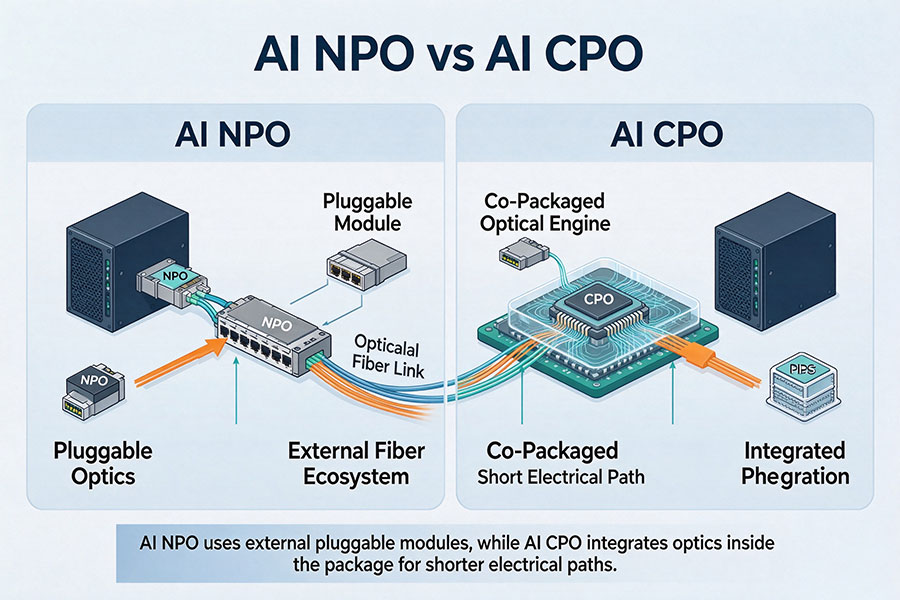
The rapid expansion of AI computing, large-scale GPU clusters and hyperscale data centers is creating new challenges for high-speed network interconnects. Increasing switch bandwidth and electrical lane rates place greater demands on signal integrity, power efficiency, optical density and thermal management.
Near-Packaged Optics (NPO) and Co-Packaged Optics (CPO) are two advanced optical interconnect architectures developed to address these challenges. Both move optical conversion closer to high-speed switching silicon compared with conventional front-panel pluggable optics.
The fundamental difference lies in the degree of integration. NPO places optical engines close to the switch ASIC while keeping them physically separate from its package. CPO integrates optical engines much more closely with the ASIC, typically within the same package or a closely coupled package structure.
These architectural differences influence electrical transmission distance, optical I/O density, power consumption, cooling requirements, serviceability and manufacturing complexity. For AI infrastructure, selecting between NPO and CPO requires evaluating the complete switch and network architecture rather than optical bandwidth alone.
1. What Is AI NPO?
NPO stands for Near-Packaged Optics. It is an optical interconnect architecture that positions optical engines close to the host ASIC or switching silicon while maintaining physical separation from the ASIC package itself.
In conventional pluggable optical systems, electrical signals travel from the switch ASIC through PCB traces, connectors and the host cage before reaching the front-panel transceiver. As electrical lane rates increase, this path can become a major signal-integrity limitation.
NPO moves the optical conversion point closer to the ASIC. Instead of routing high-speed electrical signals across a long board-level channel, the switch sends them through a much shorter electrical connection to a nearby optical engine.
The optical engine converts the electrical signals into optical signals for transmission through external fiber connections. At the receiving end, the corresponding optical engine performs optical-to-electrical conversion.
Depending on the system architecture, NPO optical engines may be mounted on the same PCB or incorporated into a separate near-package assembly. Some implementations use sockets or detachable connections to improve serviceability and simplify manufacturing.
Its main characteristics include:
Optical engines positioned close to the switch ASIC.
Physical separation between the optical engine and ASIC package.
Shorter high-speed electrical connections than conventional front-panel optics.
Reduced electrical channel loss and signal-conditioning requirements.
Potentially improved optical density and system power efficiency.
More flexibility for optical engine testing and replacement in modular implementations.
2. What Is AI CPO?
CPO stands for Co-Packaged Optics. It is an optical interconnect architecture in which optical engines are integrated closely with the host ASIC, typically within a common package, substrate or tightly coupled package assembly.
Conventional pluggable optics and many NPO systems retain PCB-level electrical connections between the ASIC and optical engine. CPO takes the integration further by reducing this electrical distance to a much shorter package-level connection.
In a CPO system, the switching ASIC and optical engines are designed as part of a coordinated package architecture. Electrical data from the ASIC reaches the optical engines through short package-level interconnects, where it is converted into optical signals.
The optical signals then travel through external fiber connections to other switches, computing systems or network endpoints.
Silicon photonics is an important technology used in many CPO implementations. It can integrate optical functions such as waveguides, modulators and photodetectors into compact photonic integrated circuits. The exact optical architecture depends on the design of the optical engine.
Some CPO systems use an external laser source (ELS) to supply continuous-wave optical power to the optical engines. This separates the laser source from the high-temperature region surrounding the switching ASIC and can provide additional flexibility for laser maintenance.
The main characteristics of CPO include:
Optical engines integrated closely with the switch ASIC package.
Extremely short high-speed electrical connections.
Reduced electrical signal loss between electronic and optical components.
High optical I/O density in compact switching systems.
Potential improvements in bandwidth density and interconnect energy efficiency.
More demanding advanced packaging, thermal integration and fiber attachment requirements.
3. AI NPO vs AI CPO: Core Technical Comparison
Both architectures bring optical conversion closer to high-speed switching silicon, but they use different levels of physical integration.
| Parameter | NPO | CPO |
|---|---|---|
| Full Name | Near-Packaged Optics | Co-Packaged Optics |
| Optical Engine Position | Near the ASIC but physically separate from its package | Integrated closely with the ASIC package |
| Integration Level | Board-level or near-package integration | Package-level optical and electronic integration |
| ASIC-to-Optics Electrical Path | Short | Extremely short |
| Electrical Channel Loss | Reduced compared with front-panel pluggable optics | Further reduced through package-level integration |
| Optical Engine Modularity | Can remain a separate assembly | More tightly integrated with the ASIC package |
| Serviceability | Potentially higher, depending on socket or mounting design | More complex, depending on optical engine and package design |
| Power Efficiency Potential | High | Very high |
| Thermal Design | Board-level optical engine and ASIC cooling | Closely coordinated ASIC and optical engine cooling |
| Manufacturing Complexity | High | Very high |
| Fiber Management | Board-level fiber routing | Dense package-level fiber attachment and routing |
| Typical Design Priority | Balance between integration, performance and modularity | Maximum optical integration and electrical path reduction |
NPO emphasizes shorter electrical connections while preserving a degree of optical engine separation. CPO places greater emphasis on integration and reducing the electrical distance to the minimum practical level within the package architecture.
4. ASIC-to-Optical Engine Distance and Signal Integrity
Electrical distance is one of the most important factors behind the development of NPO and CPO.
In a traditional pluggable architecture, the switch ASIC is located on the main PCB while the optical module sits at the front panel. High-speed electrical signals must travel through PCB traces, connectors and the module electrical interface before reaching the optical engine.
As signaling rates increase, this channel becomes more difficult to manage. PCB dielectric loss, conductor loss, connector discontinuities, reflections and crosstalk can all reduce the available signal margin.
NPO reduces the electrical channel length by moving the optical engine closer to the ASIC. This allows high-speed electrical signals to enter the optical conversion stage before accumulating the loss associated with a longer front-panel connection.
CPO reduces the electrical connection even further by integrating the optical engine within the ASIC package ecosystem. The electrical path is therefore largely restricted to short package-level connections.
| Architecture | Simplified Signal Path | Electrical Distance |
|---|---|---|
| Conventional Pluggable Optics | ASIC → PCB → Host Connector → Optical Module → Fiber | Longer board-level electrical channel |
| NPO | ASIC → Short PCB Connection → Near-Package Optical Engine → Fiber | Short board-level electrical channel |
| CPO | ASIC → Package-Level Electrical Connection → Optical Engine → Fiber | Very short package-level electrical channel |
The reduction in electrical distance can lower the amount of equalization and compensation required at high signaling rates. It also allows system designers to allocate more of the interconnect budget to the optical portion of the network.
However, shorter electrical paths do not eliminate signal integrity requirements. Package routing, electrical impedance, crosstalk, optical coupling and the quality of the ASIC-to-engine interface remain important design parameters.
5. Power Consumption and Energy Efficiency
Power efficiency is a major reason for adopting NPO and CPO in AI data centers. Large GPU clusters rely on many high-speed network connections, and optical interconnect power can become a significant part of the total switching system budget.
NPO reduces the electrical path between the ASIC and optical engine. This can reduce electrical signal-conditioning requirements and improve energy efficiency compared with conventional front-panel pluggable implementations.
CPO takes this concept further. Its extremely short ASIC-to-optical-engine connection can reduce the power required to drive high-speed electrical signals through longer PCB channels.
Both architectures still require power for optical engines, transmitters, receivers and supporting circuits. Some CPO systems also use external laser sources, which introduce additional optical power distribution and control requirements.
| Power Factor | NPO | CPO |
|---|---|---|
| Electrical Signal Drive | Reduced requirements due to a shorter ASIC-to-optics path | Further reduced through package-level integration |
| Optical Engine Power | Required for each near-package optical engine | Required for each co-packaged optical engine |
| DSP and Retiming | Implementation-dependent | Implementation-dependent |
| Laser Power | May use integrated or external laser arrangements | May use integrated or external laser source architecture |
| Power Distribution | Board-level and optical engine power management | Package-level optical engine and laser power management |
| System-Level Efficiency | Improved electrical reach and optical integration | Greater potential for minimizing electrical interconnect power |
| Thermal Requirements | ASIC and nearby optical engine cooling | ASIC, optical engine and package thermal co-design |
CPO has strong power-efficiency potential because it minimizes the high-speed electrical connection between the ASIC and optics. Nevertheless, its actual system-level advantage depends on the complete design, including optical engines, laser sources, cooling, package losses and control electronics.
6. Thermal Management and Cooling Architecture
Thermal management becomes more complicated when optical engines move closer to high-power switch ASICs.
In NPO, the optical engine is located near the ASIC but remains a separate assembly. This provides some flexibility in positioning the optical engine and designing its thermal interface independently from the ASIC package.
NPO systems must still account for the temperature of both the switching silicon and the nearby optical components. The optical engine must remain within its specified operating temperature range under sustained AI workloads.
In CPO, optical engines are integrated much more closely with the ASIC package. This can increase thermal coupling between the switching silicon and optical components.
The cooling structure must therefore be designed for the combined thermal environment. Heat spreading, package materials, optical engine placement and cooling hardware all affect the final design.
External laser sources can provide another level of thermal flexibility. Moving laser components away from the hottest ASIC region may help maintain stable laser operating conditions and simplify certain service procedures.
| Thermal Design Factor | NPO | CPO |
|---|---|---|
| Optical Engine Location | Near the ASIC on the board or a separate near-package assembly | Closely integrated with the ASIC package |
| Thermal Coupling | Some physical separation between ASIC and optical engine | Greater thermal interaction within the integrated package |
| Cooling Design | Board-level and local optical engine cooling | Combined ASIC and optical engine thermal management |
| Heat Spreading | Local thermal paths for separate components | Package-level heat spreading is critical |
| External Laser Source | Possible depending on optical engine design | Common in some architectures to separate laser heat from the package |
| Thermal Qualification | ASIC, board and optical engine temperatures | ASIC, package, optical engine and laser conditions |
CPO may reduce electrical power overhead, but its tightly integrated thermal structure requires more coordinated cooling design. NPO provides more physical separation, although it still requires careful thermal planning around the ASIC and optical engine.
7. Serviceability, Modularity and System Maintenance
Serviceability is a major practical consideration when comparing NPO and CPO for large AI data center deployments.
NPO keeps the optical engine separate from the ASIC package. Depending on the implementation, the engine may use a socketed or detachable interface. This can make optical engine testing, replacement and system repair more manageable.
However, NPO does not automatically mean that every optical engine can be hot-swapped. Some implementations may use fixed board-level assemblies that require equipment shutdown or board-level service.
CPO integrates optical engines more tightly with the ASIC package. A failure in the optical engine or its package-level interface can therefore require a larger assembly replacement rather than a simple front-panel module change.
Some CPO implementations use detachable optical subassemblies and replaceable external laser sources. These designs can improve serviceability compared with completely fixed optical packaging, although they still differ from conventional pluggable transceiver maintenance.
| Maintenance Factor | NPO | CPO |
|---|---|---|
| Optical Engine Position | Separate assembly near the ASIC | Integrated within the ASIC package structure |
| Component Modularity | Can be modular or socketed | More tightly integrated; modularity depends on the design |
| Optical Engine Replacement | Potentially independent replacement | May require package or board-level maintenance |
| External Laser Replacement | Possible depending on the optical architecture | Possible in systems using replaceable external laser sources |
| Fault Isolation | Board-level and optical engine diagnostics | Package, optical engine and fiber interface diagnostics |
| Upgrade Flexibility | Potentially higher with modular optical engines | More closely tied to ASIC and package generation |
| Maintenance Complexity | Depends on mounting and socket design | Generally more complex than modular optical engine designs |
NPO generally provides more opportunities for component-level maintenance because the optical engine is physically separated from the ASIC package. CPO prioritizes integration and density, which can make service and upgrade procedures more demanding.
8. Optical Fiber Management and External Laser Sources
Both NPO and CPO rely on external optical fiber connections, but their internal fiber-routing requirements are different from conventional pluggable systems.
NPO places optical engines near the ASIC. Fibers must therefore be routed from the board-level optical engines toward the system's external optical connection points. This requires carefully designed connector placement, fiber routing and mechanical support.
CPO concentrates optical engines around the ASIC package. The high density of optical connections creates additional requirements for fiber attachment, alignment, connector reliability and package-level mechanical tolerances.
Fiber attachment units (FAUs), fiber ribbons and precision optical connectors may be used to organize the optical paths. Their design must maintain stable optical coupling while accommodating assembly tolerances and thermal expansion.
External laser sources are particularly relevant to CPO. A remote laser can supply continuous-wave optical power to multiple optical engines, separating the laser components from the main ASIC package.
| Fiber and Laser Factor | NPO | CPO |
|---|---|---|
| Optical Fiber Origin | Near-package optical engine | Co-packaged optical engine |
| Fiber Routing | Board-level fiber routing | Dense package-level fiber attachment and routing |
| Connector Arrangement | Depends on the optical engine and host layout | Depends on the package and optical I/O design |
| Alignment Requirements | Board and optical engine alignment | High-precision package and fiber alignment |
| External Laser | Possible | Used in many CPO designs |
| Fiber Management | Board-level optical cabling and connector planning | High-density optical routing and package-level fiber management |
Optical fiber management is a critical part of both architectures. Connector contamination, fiber bending, mechanical strain and coupling alignment can affect optical performance and long-term system reliability.
9. Manufacturing Complexity and Reliability
NPO and CPO require different levels of manufacturing integration. Their manufacturing challenges extend beyond the optical engine itself and involve electrical connections, optical alignment, mechanical packaging and thermal design.
NPO can use separate optical engine assemblies that are tested independently before installation near the ASIC. A socketed implementation may also simplify replacement and reduce the need for permanent attachment during system assembly.
However, the board-level integration still requires precise positioning, high-speed electrical interfaces, mechanical tolerances and reliable fiber connections.
CPO introduces more demanding package-level integration. The optical engines and switching ASIC must be coordinated within a tightly coupled assembly, requiring high-precision manufacturing and advanced packaging processes.
Optical engine yield, package assembly, fiber attachment and thermal behavior can all influence the final manufacturing result. Known-good optical engines and robust pre-assembly testing are important for improving system yield and production consistency.
| Manufacturing Factor | NPO | CPO |
|---|---|---|
| Primary Integration | Board-level or near-package assembly | ASIC and optical engine package integration |
| Optical Engine Testing | Can be tested separately before system installation | Requires coordinated engine and package validation |
| Mechanical Precision | Requires board-level and connector alignment | Requires tighter package-level alignment and integration |
| Electrical Validation | Near-package electrical interface and optical engine testing | Package-level ASIC-to-engine signal integrity validation |
| Optical Validation | Optical engine and fiber interface performance | Optical engine, package and fiber coupling performance |
| Manufacturing Yield | Depends on engine assembly and board integration | Depends on optical engine, advanced packaging and fiber attachment |
| Production Complexity | High | Very high |
| Reliability Qualification | Board, connector and optical engine reliability | Package, optical engine, fiber and system reliability |
NPO can reduce some of the manufacturing and maintenance challenges associated with direct co-packaging, while CPO aims for a higher level of integration. Neither architecture eliminates manufacturing risk, and both require comprehensive reliability qualification.
10. AI Scale-Up and Scale-Out Network Applications
AI data center networks use different connectivity architectures to link accelerators, servers and switching systems. Scale-up and scale-out networks place different demands on bandwidth, latency and physical distance.
Scale-up connects accelerators into a tightly coupled computing domain. Within a single rack, conventional electrical connections remain attractive because of their low latency and established implementation. As the scale-up domain expands across multiple racks, electrical channel distance becomes more challenging and optical connectivity becomes increasingly relevant.
NPO and CPO can provide optical connectivity closer to the switching or computing ASIC. These approaches are relevant when a system needs high bandwidth while reducing the electrical distance between processing silicon and optical conversion.
Scale-out networks connect many GPU servers and switches across a large data center fabric. Their high port counts and aggregate bandwidth requirements create demand for energy-efficient optical switching and dense optical I/O.
CPO is particularly relevant to switch architectures that require large numbers of optical interfaces around a high-bandwidth ASIC. NPO offers an alternative when system designers want shorter electrical paths but prefer to retain more separation between optical engines and the ASIC package.
| AI Network Scenario | NPO Application | CPO Application |
|---|---|---|
| GPU-to-Switch Connectivity | Near-ASIC optical connectivity for compatible system designs | Integrated optical I/O within high-bandwidth switch systems |
| Scale-Up Networking | Optical connectivity for expanded accelerator domains | Highly integrated optical connections in purpose-built switching platforms |
| Scale-Out Switching | Board-level optical engine integration | Dense optical I/O around high-radix switch ASICs |
| Hyperscale Data Centers | Balance between electrical performance and optical engine modularity | High port density and system-level interconnect optimization |
| Distributed AI Fabrics | Potential option for high-bandwidth near-package optical systems | Potential option for highly integrated network switching |
| Next-Generation AI Platforms | Modular optical engine architecture | More tightly integrated optical and electronic packaging |
These applications are not exclusive to either technology. The selection depends on the specific AI network topology, switch architecture, optical I/O requirements and operational priorities.
11. 800G, 1.6T and Future Optical Interconnect Scaling
The move toward 800G and 1.6T networking increases the importance of electrical channel design and optical engine bandwidth.
At 800G, 100G-class electrical lanes are commonly used in relevant host architectures. Both NPO and CPO can address the need for higher optical bandwidth density by reducing the distance between the ASIC and optical conversion components.
At 1.6T, 200G-class electrical lane rates create additional challenges for PCB routing, electrical insertion loss, SerDes design and package interconnects. Shortening the electrical path becomes increasingly important as these technologies develop.
NPO can help manage the electrical channel by bringing optical engines closer to the ASIC while retaining an independent near-package assembly. CPO goes further by placing the optical engine within the ASIC package ecosystem.
| Network Generation | NPO Development Considerations | CPO Development Considerations |
|---|---|---|
| 400G | Near-package integration for selected high-density optical systems | Co-packaged optical engines in advanced switch architectures |
| 800G | Reduced ASIC-to-optics distance and increased optical I/O density | High-density optical integration for large switching bandwidth |
| 1.6T | Near-package optical engines for demanding electrical lane rates | Package-level optical I/O for reducing high-speed electrical path length |
| Beyond 1.6T | Further development of optical engine density and electrical interfaces | Advanced photonic integration, package technology and optical I/O scaling |
NPO and CPO are not data-rate standards. Neither architecture is restricted to one specific bandwidth, optical wavelength or transmission distance. Those parameters depend on the optical engine, lane architecture, modulation format and system implementation.
12. Industry Deployment and Technology Development
NPO and CPO are progressing through different development and deployment paths. NPO is attracting attention as an intermediate architecture that shortens electrical channels while preserving greater separation between the optical engine and ASIC package.
Socket-based NPO implementations are one approach to improving modularity. A detachable mechanical interface can support optical engine replacement, improve assembly flexibility and simplify certain service procedures.
CPO has also moved beyond the research and demonstration stage in selected switch platforms. In May 2026, NVIDIA announced that its Spectrum-X Ethernet Photonics switching platform, based on CPO, had entered production. This demonstrates that CPO has reached a production phase in specific commercial systems, although it does not indicate that the broader pluggable optics market has been replaced.
The wider industry continues to develop both approaches. Optical engine suppliers, switch ASIC designers, packaging manufacturers, connector companies and system integrators are working on the electrical, optical, mechanical and manufacturing requirements of next-generation systems.
| Development Area | NPO | CPO |
|---|---|---|
| Optical Engine Packaging | Separate near-package assembly | Co-packaged engine assembly |
| Socket Technology | Can support detachable optical engine designs | Depends on package-level optical engine implementation |
| Optical Fiber Attachment | Board-level optical connector and routing | Advanced package-level fiber attachment |
| System Integration | Board, optical engine and ASIC coordination | Advanced ASIC, photonic engine and package co-design |
| Manufacturing Ecosystem | Optical engine, socket, PCB and fiber assembly suppliers | ASIC packaging, silicon photonics, optical engines and precision fiber assembly |
| Deployment Considerations | Modularity and system integration flexibility | Bandwidth density and highly integrated switching systems |
The two technologies should not be viewed as mutually exclusive. Different network platforms may adopt different integration levels according to the required port density, manufacturing capability, service model and power targets.
13. How to Choose Between NPO and CPO
Selecting between NPO and CPO requires a system-level evaluation. The correct choice depends on the required optical bandwidth, ASIC architecture, electrical channel, thermal conditions, fiber routing and long-term maintenance strategy.
| Selection Requirement | Recommended Evaluation | Engineering Reason |
|---|---|---|
| Optical Engine Modularity | NPO | Can preserve an independent optical engine assembly |
| Shortest ASIC-to-Optics Connection | CPO | Provides package-level electrical integration |
| Board-Level Optical Integration | NPO | Places optical engines close to the ASIC without full co-packaging |
| Maximum Optical I/O Density | CPO | Supports dense optical engine placement around the ASIC package |
| Independent Optical Engine Testing | NPO | Separate assemblies can be tested before system installation |
| High-Radix Switch Architecture | Evaluate CPO | High optical port density can benefit from close ASIC integration |
| Flexible Optical Engine Maintenance | Evaluate modular NPO designs | Socketed or detachable engines can simplify replacement |
| Advanced ASIC and Photonic Package Integration | CPO | Designed for tightly coordinated electronic and optical packaging |
NPO is attractive when designers want to shorten electrical paths while retaining more modularity and flexibility. CPO is more suitable for platforms designed around maximum optical integration and high-density switch connectivity.
NPO and CPO cannot be selected based on optical bandwidth alone. ASIC power, SerDes performance, optical engine design, fiber routing, packaging yield, cooling requirements and maintenance procedures all influence the final system architecture.
14. C-LIGHT Optical Transceiver Solutions for AI Data Centers
C-LIGHT provides high-speed optical transceiver solutions for AI data centers, GPU clusters, cloud computing and high-performance networking. Its 800G OSFP, 800G QSFP-DD and 1.6T OSFP-RHS product families support conventional pluggable optical connectivity across different reach and optical architecture requirements.
These products represent existing pluggable optical solutions that can be used as a reference when evaluating the transition from front-panel optics toward more integrated optical interconnect architectures.
| C-LIGHT Product Family | Form Factor | Optical Configurations | Typical Application |
|---|---|---|---|
| 800G OSFP | OSFP | VR8, SR8, DR8, 2xFR4 and other configurations | AI clusters, hyperscale data centers and HPC |
| 800G QSFP-DD | QSFP-DD | Multiple parallel and WDM optical configurations | High-density Ethernet and AI switching platforms |
| 1.6T OSFP-RHS | OSFP-RHS | 2xDR4 and 2xFR4 configurations | Next-generation AI data center and optical network deployments |
The 800G OSFP product series includes multiple optical transmission configurations for high-speed AI networking, cloud computing and data center switching.
The 800G QSFP-DD product series provides high-bandwidth pluggable optical connectivity for compatible switching platforms and data center network infrastructure.
The 1.6T OSFP-RHS product series includes 2xDR4 and 2xFR4 configurations for next-generation 1.6T optical connectivity in AI and hyperscale data center environments.
The C-LIGHT product pages above describe pluggable optical transceiver solutions. They should not be classified as NPO or CPO optical engines. NPO and CPO require different optical engine placement, host integration and system-level mechanical architectures. The exact product architecture must be verified against the corresponding design specification.
15. Conclusion
AI NPO and AI CPO are two advanced optical interconnect architectures designed to address the bandwidth, power and signal-integrity challenges of next-generation GPU clusters and high-performance data centers.
NPO places optical engines close to the switch ASIC while keeping them physically separate from the ASIC package. It shortens the electrical transmission path, reduces channel loss and can preserve more flexibility in optical engine testing, replacement and system maintenance.
CPO integrates optical engines much more closely with the ASIC package. This minimizes the high-speed electrical connection and supports very high optical I/O density, making it attractive for advanced switching systems with demanding bandwidth and power requirements.
The main trade-off is between integration and modularity. NPO provides a balance between electrical performance, optical engine separation and serviceability, while CPO focuses on maximum integration and electrical path reduction.
As AI networks advance toward 800G, 1.6T and higher-speed optical interconnects, both architectures are relevant to different system requirements. Their long-term adoption will depend on optical engine performance, ASIC design, thermal integration, manufacturing yield, fiber management and operational maintenance.
C-LIGHT provides 800G OSFP, 800G QSFP-DD and 1.6T OSFP-RHS optical transceiver solutions for AI data centers, GPU clusters and high-performance computing networks. For product specifications, host compatibility assessment or customized optical connectivity requirements, please Contact C-LIGHT.
 >

 >
 >
 >
 >
 >
 >
 >















