TEL:+86 132 6656 7067




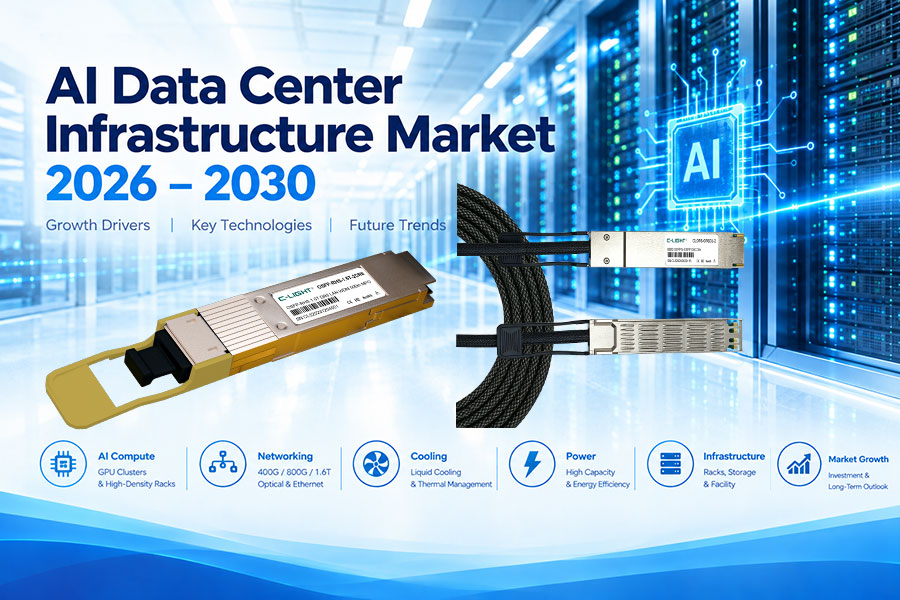
AI data centers are accelerating the transition toward higher-speed optical networking. The growing scale of GPU clusters, high-radix switches, and distributed AI workloads is increasing demand for 400G, 800G, and emerging 1.6T optical connectivity, while power efficiency, signal integrity, and network density are becoming increasingly important.
1. AI Data Center Optical Networking in 2026
AI data center networks are designed to move large amounts of data between GPUs, servers, switches, storage systems, and other computing resources. Compared with conventional data center traffic, AI workloads can generate highly synchronized and bandwidth-intensive communication.
Optical networking is becoming an important part of this infrastructure because fiber supports high bandwidth over practical data-center distances while avoiding many of the reach and electromagnetic-interference limitations associated with high-speed electrical connections.
2. The Main Drivers of Optical Networking Growth
Several factors are shaping AI data center optical networking in 2026:
Rapid growth of GPU and accelerator clusters
Increasing AI training and inference traffic
Higher switch ASIC bandwidth
Migration toward 800G networking
Emerging 1.6T optical interfaces
Higher port density
Growing power and thermal constraints
Demand for lower network latency
3. 800G Becomes a Major AI Networking Generation
800G optical networking is one of the major trends in AI data centers in 2026. Higher bandwidth per port allows network operators to build high-capacity fabrics while reducing the number of physical ports required for a given aggregate bandwidth.
Common 800G optical architectures include SR8, DR8, 2xFR4, and other implementations designed for different fiber types and transmission distances.
| 800G Type | Fiber | Typical Application |
|---|---|---|
| 800G SR8 | MMF | Short-reach AI data center links |
| 800G DR8 | SMF | Data center fabric connections |
| 800G 2xFR4 | SMF | Longer-reach data center links |
| 800G LPO | MMF or SMF depending on design | Lower-power high-speed connectivity |
4. 1.6T Optical Networking Is Emerging
As AI clusters continue to grow, 1.6T optical networking is emerging as the next major bandwidth generation. Many 1.6T implementations are based on eight 200G-class lanes, although exact architectures vary.
Moving from 800G to 1.6T introduces additional requirements for electrical signaling, optical components, packaging, thermal management, and system-level signal integrity.
Key development areas include:
200G-class SerDes lanes
Advanced PAM4 signaling
Higher-bandwidth optical engines
Improved laser and modulator performance
Lower power per bit
Advanced thermal management
5. PAM4 Continues to Support Higher Data Rates
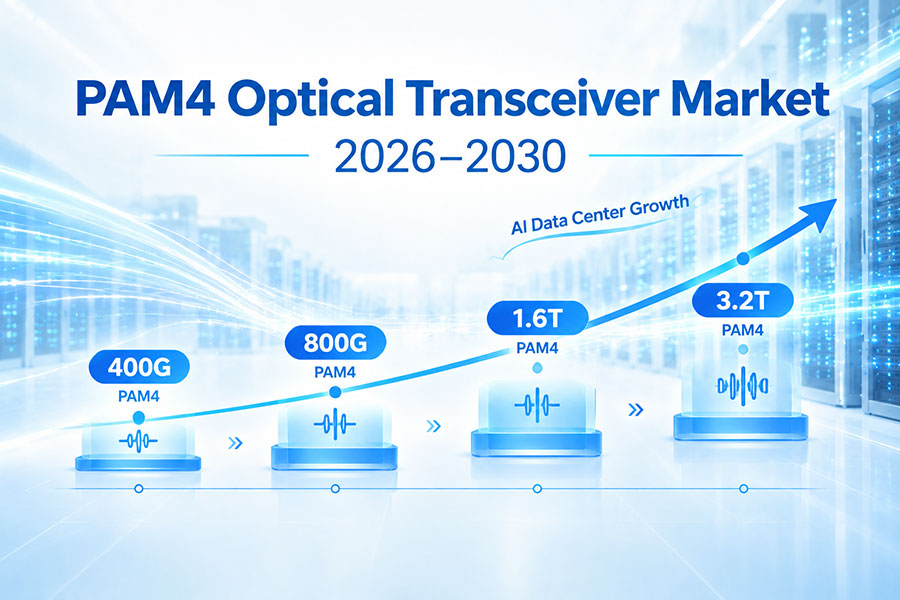
PAM4 remains an important signaling technology for high-speed optical networking. By using four amplitude levels, PAM4 carries two bits per symbol and enables higher data rates within practical bandwidth limits.
The tradeoff is a smaller eye opening compared with NRZ. This makes high-speed PAM4 links more sensitive to noise, insertion loss, crosstalk, distortion, and other channel impairments.
As a result, 800G and 1.6T systems require careful coordination between the switch ASIC, SerDes, PCB, connectors, optical module, and fiber link.
6. LPO Gains Attention in AI Data Centers
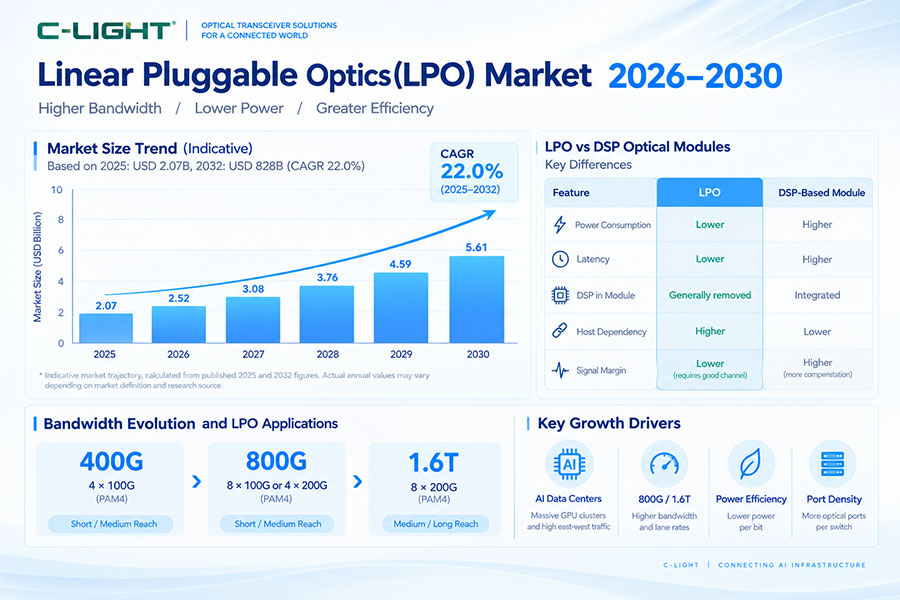
Linear Pluggable Optics (LPO) is an important optical architecture being evaluated for high-speed AI networks. LPO reduces or removes major signal-processing functions from the optical module and relies more heavily on the host SerDes and switching ASIC.
The architecture can reduce module power and potentially reduce latency by simplifying the optical signal path.
However, LPO also increases the importance of electrical channel quality. Host SerDes capability, PCB loss, connector performance, module design, and signal integrity must be carefully validated.
7. LPO and Conventional Retimed Optics
| Feature | LPO | Retimed Optics |
|---|---|---|
| Module DSP | Reduced or removed | Typically included |
| Module Power | Potentially lower | Generally higher |
| Latency | Potentially lower | Additional processing latency |
| Host SerDes Dependence | Higher | Lower |
| Electrical Channel Requirement | More demanding | More processing margin |
8. Silicon Photonics Becomes More Important
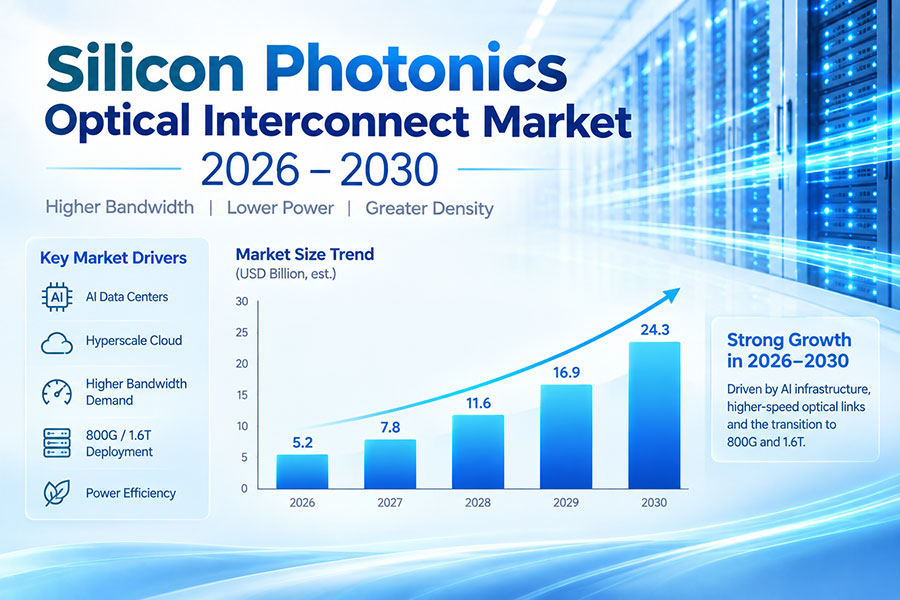
Silicon photonics is another major trend in AI optical networking. Photonic integrated circuits can integrate functions such as waveguides, modulators, wavelength multiplexers, splitters, and photodetectors into compact optical architectures.
This level of integration is particularly relevant as AI data centers demand greater bandwidth density and more compact optical systems.
Silicon photonics can be used in 400G, 800G, 1.6T, optical engines, and advanced optical packaging. It should not be considered synonymous with LPO because silicon photonics describes an optical integration technology, while LPO describes a module signal architecture.
9. Optical Engines and Advanced Photonics
Optical engines integrate multiple optical functions into a compact subsystem. They can include lasers, modulators, photodetectors, drivers, TIAs, and photonic integrated circuits depending on the architecture.
As bandwidth increases, optical engines can help address the challenges of component density, electrical channel loss, packaging, and power efficiency.
10. CPO and NPO Development
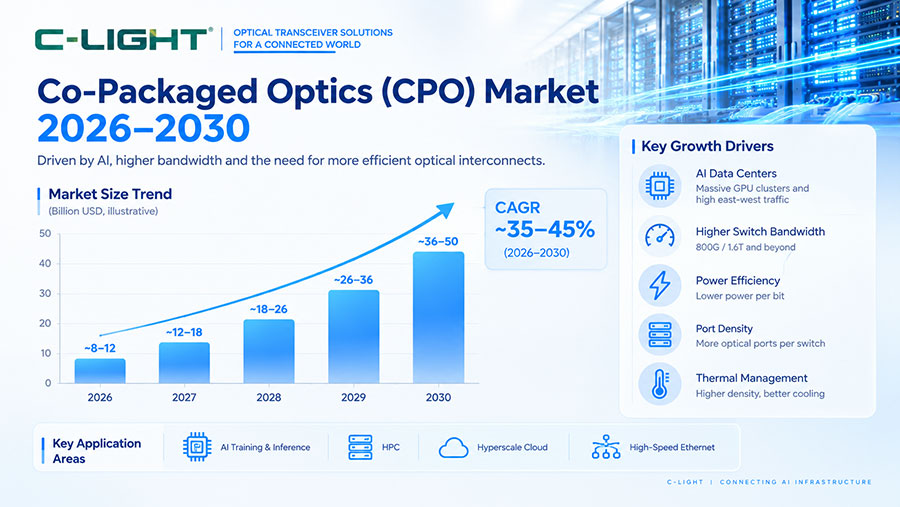
Co-Packaged Optics (CPO) and Near-Packaged Optics (NPO) are being developed to place optical functions closer to high-speed switching silicon.
The motivation is largely related to electrical channel limitations. As switch ASIC bandwidth increases, the electrical path between the ASIC and front-panel optical modules becomes increasingly difficult to manage.
Moving photonics closer to the ASIC can reduce electrical interconnect distance and potentially improve bandwidth density and energy efficiency.
Pluggable optics remain important because they provide modularity, field replacement, and deployment flexibility. CPO and NPO therefore represent additional architectures rather than a universal replacement for pluggable modules.
11. AI Network Architecture: Scale-Up, Scale-Out and Scale-Across
11.1 Scale-Up
Scale-up networking connects accelerators and computing resources within tightly integrated systems. These links are generally short, making electrical interconnects and short-reach copper or optical technologies important.
11.2 Scale-Out
Scale-out connects large numbers of GPU servers through leaf and spine switching architectures. High-speed optical transceivers are increasingly used throughout these network fabrics.
11.3 Scale-Across
Scale-across connects computing resources between geographically separated data centers. Longer-reach single-mode optics, coherent pluggables, DWDM, and optical transport technologies become more important as distance increases.
12. GPU-to-Switch Optical Connectivity
GPU servers generate substantial east-west traffic during distributed AI workloads. Network adapters connect the servers to leaf or ToR switches, while high-speed optical links connect those switches to higher-level spine networks.
Common physical interconnect technologies include:
DAC for very short connections
AEC for extended short-reach electrical links
AOC for integrated optical cable connections
Optical transceivers for modular network links
13. Ethernet and InfiniBand Optical Networks
Ethernet and InfiniBand are both used for AI cluster networking. The appropriate architecture depends on the workload, switching platform, software ecosystem, congestion management, and overall system design.
Optical transceivers can support both environments when the physical-layer requirements, data rate, reach, and interoperability specifications are satisfied.
14. AI Traffic Patterns and Optical Network Requirements
Distributed AI training generates communication patterns that can place significant pressure on network fabrics. Examples include all-reduce, all-to-all, parameter synchronization, and gradient communication.
Large numbers of GPUs can transmit simultaneously, making congestion and oversubscription important design considerations.
| Network Factor | Importance |
|---|---|
| Bandwidth | Supports large data transfers |
| Latency | Reduces communication delay |
| Jitter | Influences traffic consistency |
| Packet Loss | Can affect application efficiency |
| Congestion | Can reduce effective network throughput |
| Topology | Determines communication paths and scalability |
15. Optical Fiber Trends in AI Data Centers
Fiber selection depends on transmission distance, optical architecture, connector design, and link budget.
OM3: Multimode fiber for short-reach applications.
OM4: Higher-performance multimode infrastructure.
OM5: Multimode fiber supporting specific wavelength-division applications.
OS2: Single-mode fiber for DR, FR, LR, and longer optical links.
MPO/MTP connectivity is particularly important for parallel optical architectures, while LC connectors remain common for duplex single-mode and other optical links.
16. Optical Transceiver Power Becomes a Key Metric
AI data centers can deploy large numbers of optical modules, making power consumption a major infrastructure consideration.
Module power can come from the DSP, laser, driver, TIA, FEC-related processing, management electronics, and other components. Higher-speed modules therefore require careful thermal and power planning.
Power per bit is increasingly useful when comparing different optical generations because a higher-bandwidth module may consume more absolute power while still delivering better energy efficiency per transmitted bit.
17. Thermal Management for High-Speed Optics
High-density optical ports generate heat inside switches and network racks. As 800G and 1.6T modules become more common, thermal design becomes increasingly important.
Key considerations include:
Module power consumption
Switch airflow
Heat sink design
Optical module temperature
Port density
Rack-level cooling
Liquid cooling integration
Thermal management should be considered during network architecture design rather than treated only as a module-level issue.
18. High-Density Optical Cabling
Increasing switch bandwidth also increases the number of high-speed optical connections. AI data centers therefore require high-density fiber infrastructure with controlled polarity, bend radius, insertion loss, and cable routing.
Common infrastructure elements include:
MPO/MTP trunk cables
LC duplex patch cables
Fiber patch panels
High-density adapters
Cross-connect systems
Structured fiber cabling
19. Optical Link Budget and Signal Integrity
Reliable AI optical networking requires both optical and electrical link-budget analysis.
Optical link design must account for transmitter output power, fiber attenuation, connector loss, splice loss, passive component loss, and receiver sensitivity.
At high electrical data rates, the electrical channel must also be evaluated for insertion loss, return loss, crosstalk, inter-symbol interference, and equalization requirements.
20. Optical Transceiver Testing in AI Networks
High-speed optical modules should be tested under realistic host and environmental conditions.
Optical output power
Receiver sensitivity
Bit error rate
Pre-FEC and post-FEC performance
PAM4 eye quality
Temperature performance
Module power consumption
Host electrical channel performance
Interoperability
Testing should include both module-level validation and system-level validation because the final link performance depends on the complete host-to-optical-to-fiber architecture.
21. Interoperability Becomes More Important
AI networks often combine switches, NICs, optical modules, fiber systems, and different generations of hardware. A module that meets its standalone specifications may still require additional validation with a specific host platform.
Important interoperability factors include:
Host SerDes generation
Switch ASIC compatibility
NIC compatibility
CMIS management
FEC configuration
Optical reach
Electrical channel characteristics
Temperature range
22. 2026 AI Optical Networking Technology Stack
| Layer | Key Technologies |
|---|---|
| Compute | GPU, CPU, AI Accelerator |
| Network Interface | NIC, High-Speed SerDes |
| Switching | Leaf, Spine, High-Radix Switch ASIC |
| Interconnect | DAC, AEC, AOC, Optical Transceiver |
| Optics | VCSEL, EML, Silicon Photonics |
| Optical Architecture | LPO, LRO, Retimed Optics |
| Advanced Packaging | Optical Engine, NPO, CPO |
| Fiber Infrastructure | MPO/MTP, LC, MMF, SMF |
23. Key AI Optical Networking Trends in 2026
The major trends can be summarized as follows:
800G deployment: Increasing use in high-density AI data-center fabrics.
1.6T development: Moving toward 200G-class lane architectures.
Linear optics: Growing interest in LPO and related low-power architectures.
Silicon photonics: Increasing optical integration and multi-channel capability.
Advanced packaging: Greater interest in optical engines, NPO, and CPO.
Power efficiency: Greater focus on power per port and power per bit.
High-density cabling: Increasing adoption of MPO/MTP and structured optical infrastructure.
System-level validation: Greater emphasis on interoperability and complete link performance.
24. What to Expect Beyond 2026
The development path beyond 2026 is likely to continue toward higher bandwidth, lower power consumption, greater photonic integration, and shorter electrical paths between switching silicon and optical interfaces.
800G will continue to serve a large and expanding installed base, while 1.6T technologies develop alongside next-generation switch ASICs and SerDes. Silicon photonics, LPO, optical engines, CPO, and NPO will provide different approaches for addressing bandwidth density and power constraints.
25. Conclusion
AI data center optical networking in 2026 is being shaped by rapid growth in GPU clusters, higher switch bandwidth, increasing network density, and the need for efficient data movement. 800G is becoming a key generation for AI fabrics, while 1.6T is emerging as the next bandwidth step.
At the same time, LPO, silicon photonics, optical engines, CPO, and NPO are changing the architecture of optical connectivity. Power consumption, thermal management, signal integrity, interoperability, and fiber infrastructure are becoming as important as raw transmission speed.
The overall direction is toward higher bandwidth per port, greater optical integration, lower power per bit, and scalable optical fabrics designed specifically for AI workloads.
 >
>

 >
>
 >
>
 >
>
 >
>
 >
>
 >
>
 >
>