TEL:+86 132 6656 7067




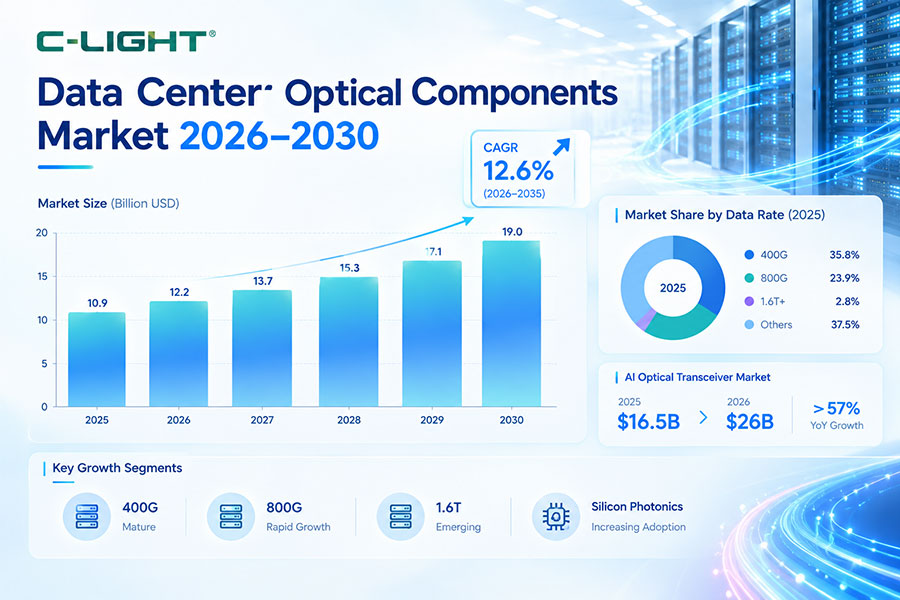
Optical connectivity is becoming one of the most important infrastructure layers in modern data centers. AI clusters, hyperscale cloud platforms, higher-speed switching, and growing data traffic are increasing demand for optical transceivers, lasers, DSPs, silicon photonics, coherent optics, and other optical components. At the same time, the transition from 400G to 800G and 1.6T is changing both the value distribution and technical requirements of the market.
1. Data Center Optical Components Market Overview
The data center optical components market covers a broad ecosystem that includes optical transceivers, laser sources, photodetectors, optical engines, DSPs, TIAs, laser drivers, silicon photonics devices, coherent components, and related optical interconnect technologies.
Because research companies use different market definitions, reported market values can vary significantly. For a consistent comparison, the data center transceiver market can be used as a core measurable segment, while AI optical connectivity represents a faster-growing subset driven by GPU clusters and hyperscale infrastructure.
2. Data Center Transceiver Market Size
| Year | Market Size | Growth / Reference |
|---|---|---|
| 2025 | USD 10.9 Billion | Base year |
| 2026 | USD 12.2 Billion | 12.6% CAGR forecast |
| 2030 | Approx. USD 19–20 Billion* | Long-term growth trajectory |
| 2035 | USD 35.4 Billion | 12.6% CAGR, 2026–2035 |
*The 2030 figure is an indicative trajectory derived from the published 2026 market size and 12.6% forecast CAGR rather than a separately published 2030 point estimate.
3. AI Optical Transceiver Market Growth
AI infrastructure is growing considerably faster than the broader data center transceiver market. TrendForce estimates that the global AI-focused optical transceiver market could increase from USD 16.5 billion in 2025 to USD 26 billion in 2026, representing more than 57% year-over-year growth.
| Market Segment | 2025 | 2026 | Growth |
|---|---|---|---|
| Data Center Transceivers | USD 10.9B | USD 12.2B | Steady expansion |
| AI-Focused Optical Transceivers | USD 16.5B | USD 26B | >57% YoY |
The difference illustrates an important point: AI-related optical connectivity is becoming a major growth engine within the wider optical networking ecosystem.
4. Why AI Data Centers Are Driving Optical Demand
AI training and inference systems require large numbers of GPUs, switches, accelerators, and storage systems to communicate at extremely high bandwidth. As cluster size increases, the number of optical ports required for scale-out and scale-up networks also increases.
Higher bandwidth requirements are moving data center architectures from 100G and 200G toward 400G, 800G, 1.6T and eventually higher-speed interfaces.
5. 400G, 800G and 1.6T Market Comparison
| Data Rate | 2025 Market Data | Technology Position | Main Application |
|---|---|---|---|
| 400G | USD 3.9B | Largest revenue segment | Data center, cloud, enterprise |
| 800G | USD 2.6B | Fastest major deployment transition | AI clusters, hyperscale |
| 1.6T+ | USD 0.3B | Early commercialization | Next-generation AI networks |
6. 400G Optical Transceivers
400G remained the largest individual data-rate category in the 2025 data center transceiver market, generating approximately USD 3.9 billion. It represented about 35.8% of market revenue.
400G remains important for existing hyperscale networks, enterprise data centers, cloud infrastructure, and AI deployments. However, increasing port density and bandwidth requirements are gradually shifting new deployments toward 800G.
7. 800G Optical Transceivers
800G generated approximately USD 2.6 billion in 2025 and has become one of the most important growth segments for AI data centers. QSFP-DD and OSFP platforms support different 800G architectures, including 8×100G and 4×200G lane configurations.
800G is increasingly positioned between established 400G infrastructure and emerging 1.6T networks, making it a major transition generation for AI clusters.
8. 1.6T Optical Transceivers
The 1.6T and above category generated approximately USD 0.3 billion in 2025 and is projected to reach about USD 0.6 billion in 2026 according to current market analysis.
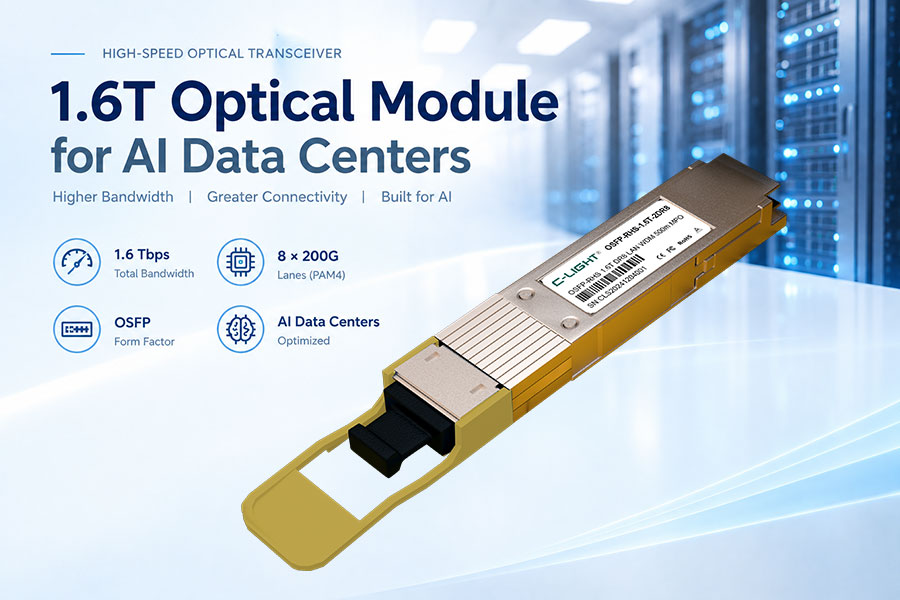
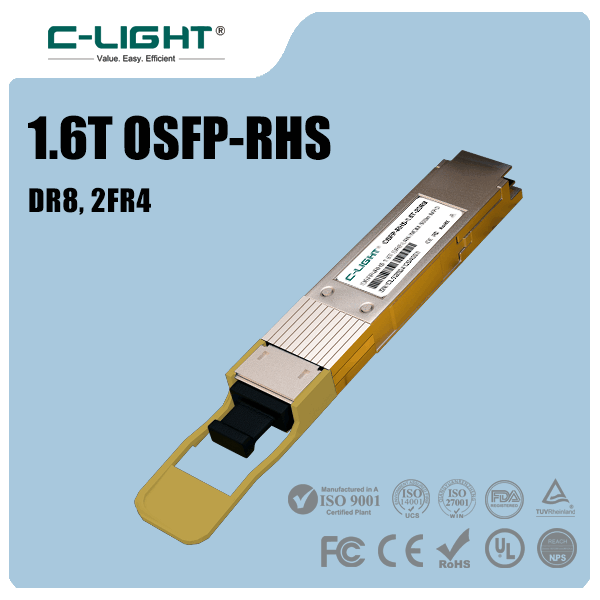
The transition to 1.6T is closely associated with 200G-per-lane electrical and optical technologies, advanced DSPs, EML and silicon photonics platforms, and higher-performance OSFP architectures.
9. 400G vs 800G vs 1.6T
| Feature | 400G | 800G | 1.6T |
|---|---|---|---|
| Typical Lane Architecture | 4×100G | 8×100G / 4×200G | 8×200G |
| Market Position | Mature / high volume | Rapid growth | Emerging |
| AI Deployment | Established | Major growth platform | Next-generation |
| Thermal Requirement | Moderate | Higher | Very high |
| Key Technology | PAM4 | PAM4 / DSP | 200G-per-lane PAM4 / advanced DSP |
10. AI GPU Cluster Optical Connectivity
AI and ML GPU cluster fabric networking generated approximately USD 2.2 billion in 2025, representing about 20.2% of the data center transceiver market in the cited analysis.
This segment is particularly important because GPU clusters require high port density, low latency, high bandwidth, and predictable power consumption.
11. Intra-Data Center Optical Connectivity
Intra-data-center connections represented the largest application category in 2025, with approximately USD 5.9 billion in revenue and about 54.1% of the market.
| Application | 2025 Revenue | Share |
|---|---|---|
| Intra-Data Center | USD 5.9B | 54.1% |
| AI & ML GPU Fabric | USD 2.2B | 20.2% |
| Other Data Center Applications | Remaining market | 25.7% |
12. Data Center Interconnect and Coherent Optics
Optical components are no longer limited to short intra-rack links. Coherent optical technology is increasingly used for DCI and campus connectivity where higher bandwidth must be transported over longer distances.
400ZR, 400ZR+, 800ZR and 800LR technologies are extending coherent optics into data center and metro environments, creating additional demand for coherent DSPs, lasers, receivers, and optical engines.
13. Silicon Photonics Market Influence
Silicon photonics is becoming increasingly important because it can integrate optical functions at higher density while supporting advanced packaging and power-efficiency requirements.
Current market analysis estimates that silicon-photonics-based transceivers generated approximately USD 1.63 billion in data center applications in 2025, representing about 15% of the market in that segment.
14. Optical Components by Technology
| Technology | Role | Growth Direction |
|---|---|---|
| EML | High-speed optical transmission | Strong demand for high-speed links |
| VCSEL | Short-reach MMF connectivity | Important for SR applications |
| Silicon Photonics | High-density optical integration | Rapid growth |
| DSP | Signal processing and compensation | Critical for 800G/1.6T |
| Coherent Optics | Longer-reach DCI and metro | Expanding beyond telecom |
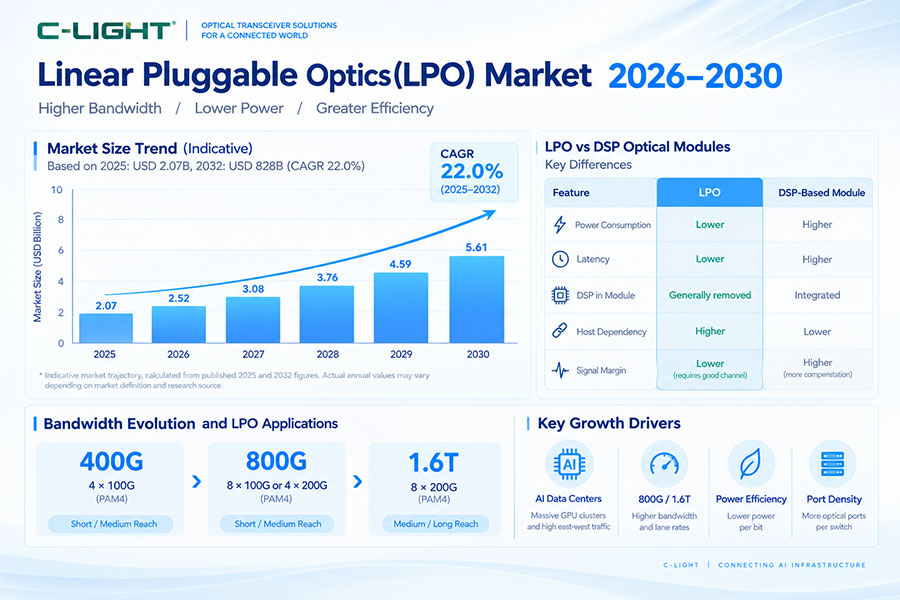
| LPO | Low-power linear optical connectivity | Growing interest in AI networks |
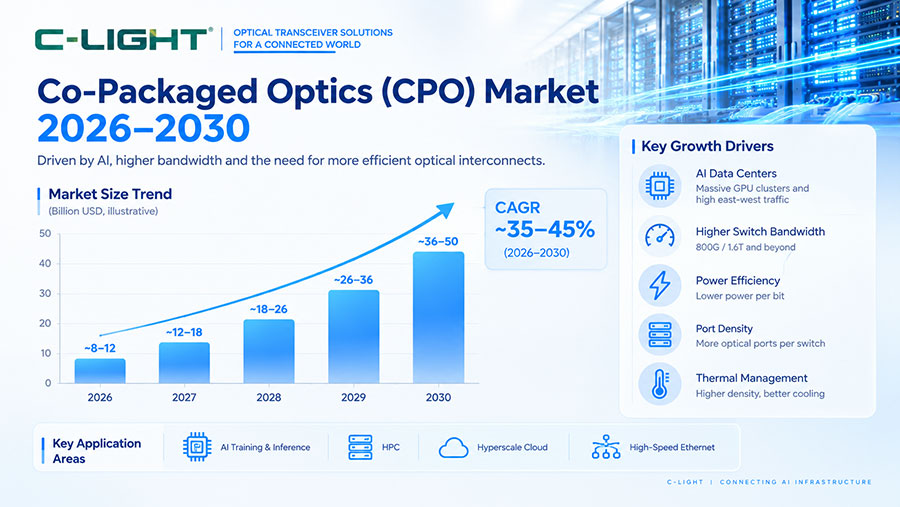
| CPO | Optics integrated near switch ASIC | Long-term growth |
15. Optical Transceiver Form Factor Comparison
| Form Factor | 2025 Market Position | Main Role |
|---|---|---|
| QSFP-DD | USD 3.8B | 400G/800G data center networks |
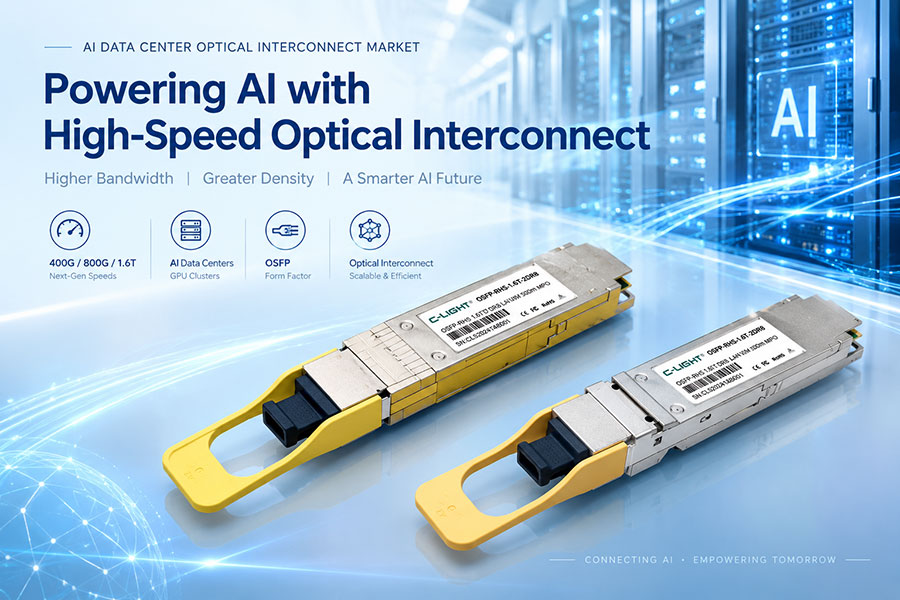
| OSFP | USD 0.9B | 800G and 1.6T high-density systems |
| QSFP28 | Mature | 100G infrastructure |
| SFP/SFP28 | Mature / specialized | Access, enterprise and edge |
16. QSFP-DD vs OSFP
QSFP-DD remains an important platform for 400G and 800G deployments because of its compact form factor and established QSFP ecosystem. OSFP provides greater thermal capacity and is increasingly associated with 800G and 1.6T high-performance platforms.
The choice between the two depends on switch architecture, thermal design, power budget, port density, connector configuration, and interoperability requirements.
17. SMF vs MMF Optical Components
| Feature | SMF | MMF |
|---|---|---|
| Typical Use | DR/FR/LR/ER/DCI | SR intra-data-center |
| Typical Reach | Hundreds of meters to tens of kilometers | Usually short reach |
| Typical Laser | EML / DFB / silicon photonics | VCSEL |
| Typical Wavelength | 1310nm / 1550nm | 850nm |
| AI Network Role | Increasingly important | Important for short links |
18. North America vs Europe vs Asia Pacific
| Region | 2025 Market Revenue | Share | Market Characteristics |
|---|---|---|---|
| North America | USD 4.6B | 42.2% | Hyperscale and AI infrastructure |
| Europe | USD 2.7B | 24.8% | Cloud, colocation and edge |
| Asia Pacific | USD 2.9B | 26.6% | Manufacturing, cloud and AI growth |
| Latin America | USD 0.4B | — | Emerging data center investment |
| Middle East & Africa | USD 0.3B | — | Emerging infrastructure |
19. Why 800G Is Becoming the Key Growth Segment
400G remains the largest established revenue category, but 800G is gaining momentum because AI clusters require substantially higher bandwidth per switch port.
LightCounting reported that 800G optical transceiver shipments are expected to more than double in 2026, while 1.6T shipments are expected to grow from a relatively small 2025 base into the tens of millions of ports.
20. 1.6T and 200G-per-Lane Technology
The move from 800G to 1.6T requires a major increase in lane bandwidth. 200G-per-lane technology is therefore becoming a critical development direction for next-generation optical transceivers.
| Generation | Typical Electrical Architecture | Market Stage |
|---|---|---|
| 400G | 4×100G | Mass deployment |
| 800G | 8×100G / 4×200G | Rapid deployment |
| 1.6T | 8×200G | Qualification / early deployment |
| 3.2T | 16×200G or future higher-rate lanes | Longer-term development |
21. LPO and CPO in Data Center Optical Networks
LPO and CPO represent two different approaches to improving optical connectivity efficiency.
| Technology | Main Advantage | Position |
|---|---|---|
| Traditional DSP Pluggable | Strong signal conditioning and interoperability | Current mainstream |
| LPO | Lower module power and latency potential | Growing |
| CPO | Short electrical path and high density | Long-term growth |
These technologies are not simply replacements for existing modules. They represent different system-level approaches to managing bandwidth, power, latency, thermal density, and signal integrity.
22. Optical Component Supply Chain
The rapid increase in 800G and 1.6T demand is putting pressure on several parts of the optical supply chain. Laser diodes, EML devices, DSPs, coherent receiver components, optical engines, packaging capacity, and testing resources can all influence module availability.
Supply constraints are particularly important for advanced 800G coherent and 1.6T products because these products require more sophisticated optical and electrical components than mature 100G and 400G platforms.
23. 400G Price Pressure vs 800G and 1.6T Value
Mature 400G products face increasing price competition as manufacturing volume grows. Higher-speed products generally maintain greater value because of their more complex optical engines, DSPs, thermal requirements, and manufacturing processes.
| Segment | Volume | ASP Pressure | Technology Value |
|---|---|---|---|
| 100G | Mature | High | Established |
| 400G | Very High | Increasing | Established / optimized |
| 800G | Rapidly increasing | Moderate | High |
| 1.6T | Early growth | Limited initially | Very High |
24. Key Market Drivers Through 2030
AI training and inference cluster expansion
800G and 1.6T switch deployment
Hyperscale cloud infrastructure investment
Higher GPU and accelerator density
Growing data center interconnect requirements
Silicon photonics adoption
LPO and CPO development
Increasing demand for power-efficient optical connectivity
25. Key Market Challenges
Laser and optical component supply constraints
High power consumption at 800G and 1.6T
Thermal management requirements
DSP availability and cost
Manufacturing yield for advanced optical engines
Interoperability between different platforms
Rapid price erosion in mature products
26. Data Center Optical Components Market Outlook 2026–2030
The data center optical components market is entering a transition from volume-driven 400G deployment toward higher-value 800G, 1.6T, coherent, silicon photonics, LPO, and CPO technologies.
400G will remain an important installed-base and high-volume product category, while 800G is positioned as the major near-term growth platform for AI infrastructure. 1.6T is moving into a more important commercialization phase as 200G-per-lane technology becomes available.
Through 2030, market growth will increasingly depend not only on bandwidth but also on optical power efficiency, thermal management, integration density, supply-chain capacity, and system-level interoperability.
 >
>

 >
>
 >
>
 >
>
 >
>
 >
>
 >
>
 >
>