TEL:+86 132 6656 7067





As AI computing clusters expand across geographically distributed data centers, the demand for high-capacity interconnects is moving beyond traditional 400G transmission. Operators increasingly need optical links that can transport hundreds of gigabits per second over metropolitan and regional distances while maintaining manageable power consumption, equipment density, and network complexity.
800ZR coherent optics is emerging as an important part of this transition. By combining an 800G coherent transmission interface with compact pluggable form factors, 800ZR enables routers and switches to connect directly to amplified DWDM optical networks. This approach can reduce the need for separate transponder equipment in suitable data center interconnect applications and creates a more integrated architecture for high-capacity optical networking.
1. Why 800ZR Is Gaining Attention in Data Center Interconnect
Data center interconnect networks carry large volumes of traffic between facilities used for cloud computing, AI training, distributed storage, and enterprise applications. As these workloads grow, network operators must increase link capacity without continuously expanding equipment footprints and operational costs.
Traditional short-reach optical transceivers are suitable for connections within data center buildings and campuses, but longer-distance links often require coherent transmission technology and an optical transport system. Earlier generations of coherent modules established a practical way to integrate high-capacity optical transmission into routers and switches.
800ZR extends this approach to 800G. It provides a standardized coherent interface designed for amplified, single-span DWDM links in the approximate 80–120 km application range, depending on the implementation and system conditions.
Its development is driven by several network requirements:
Higher bandwidth: A single coherent wavelength can carry an 800G-class client signal.
Compact integration: Coherent transmission functions can be incorporated into QSFP-DD and OSFP pluggable modules.
Reduced equipment complexity: Suitable router-to-router links can avoid a separate transponder at every endpoint.
DWDM compatibility: Tunable wavelengths support channel-based transmission over amplified optical infrastructure.
Network scalability: Operators can increase capacity by deploying additional wavelengths and upgrading line-system components where supported.
2. What Is 800ZR Coherent Optics?
800ZR is a coherent optical interface developed for high-capacity data center interconnect applications. It defines the transmission characteristics needed to transport an 800G Ethernet client over a coherent DWDM wavelength across an amplified optical link.
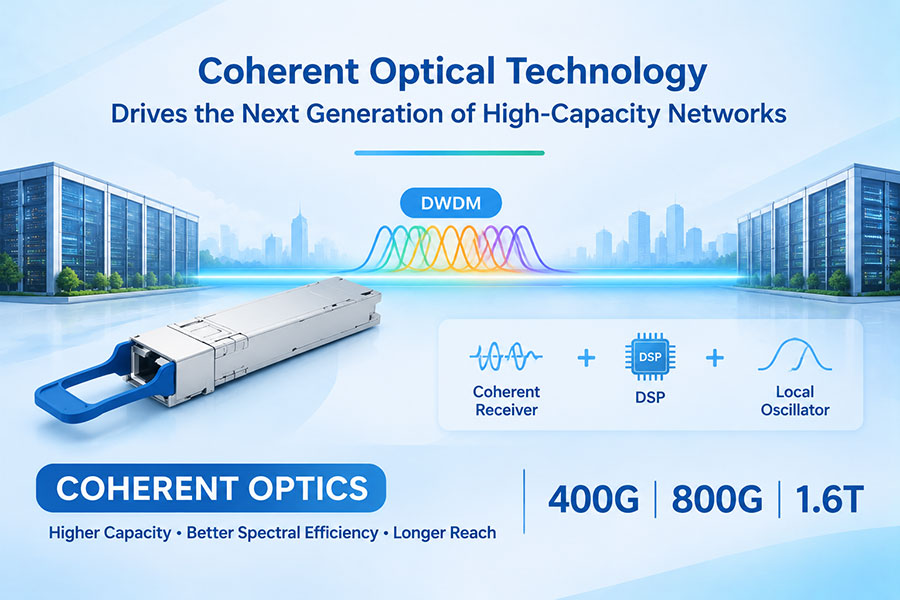
Unlike conventional intensity-modulated direct-detection modules, coherent optics uses both the amplitude and phase information of an optical signal. A coherent receiver combines the incoming signal with a local oscillator and uses digital signal processing to recover the transmitted information.
This architecture supports advanced modulation formats and signal compensation techniques that are important for high-capacity transmission over longer fiber spans.
The Optical Internetworking Forum (OIF) published its 800ZR Implementation Agreement in October 2024. The agreement establishes a common technical foundation for interoperable 800G coherent interfaces targeting single-span amplified DWDM links.
3. How 800ZR Transmission Works
An 800ZR link uses coherent optical technology to transmit high-capacity data over a DWDM channel. The host router or switch supplies the client-side electrical signal, while the coherent module performs the optical transmission and reception functions.
A typical transmission path includes the following stages:
Host electrical interface: The router or switch provides the high-speed client data interface.
Coherent DSP: Digital signal processing performs functions such as signal mapping, compensation, and FEC-related processing.
Optical transmitter: The module generates a modulated optical carrier at a selected C-band wavelength.
DWDM line system: Optical multiplexers and amplifiers support transmission across the fiber link.
Coherent receiver: The receiving module detects the optical signal and reconstructs the transmitted data.
In an amplified DWDM system, optical amplifiers compensate for fiber attenuation. The actual link performance depends on the fiber route, amplifier configuration, channel loading, optical signal-to-noise ratio (OSNR), dispersion, and other transmission impairments.
Coherent DSP is particularly important because it enables the receiver to compensate for several fiber-related impairments within the supported operating range. However, DSP cannot eliminate every physical limitation. Proper optical engineering and link-budget validation remain necessary.
4. 800ZR vs. 800ZR+: Different Transmission Requirements
800ZR and 800ZR+ both address 800G coherent transmission, but they serve different network requirements. 800ZR focuses on a defined single-span DCI application, while 800ZR+ implementations extend the operating envelope through additional performance options and system configurations.
| Parameter | 800ZR | 800ZR+ |
|---|---|---|
| Primary application | Single-span data center interconnect | Extended metro, regional, and multi-span networks |
| Transmission capacity | 800G coherent | Up to 800G, depending on configuration |
| Optical architecture | Coherent DWDM | Coherent DWDM with extended performance options |
| Typical deployment | Amplified point-to-point link | Longer or more demanding optical paths |
| Interoperability framework | OIF 800ZR Implementation Agreement | OpenZR+ ecosystem and implementation-specific profiles |
| Reach | 80–120 km application range | Can extend substantially farther, depending on mode and line system |
The reach figures should not be treated as universal guarantees. A particular 800ZR+ module may support different distances at different data rates or modulation settings. Fiber quality, amplifier spacing, OSNR, and channel configuration also influence the achievable distance.
For network planning, 800ZR is generally relevant when a standardized 800G coherent interface is required for a relatively direct DCI connection. 800ZR+ is worth evaluating when the optical route requires additional transmission margin or a longer multi-span configuration.
5. QSFP-DD and OSFP Form Factors for 800ZR
Compact pluggable form factors are central to the adoption of coherent optics in modern switching and routing platforms. QSFP-DD and OSFP allow high-capacity optical interfaces to be installed directly into compatible network equipment.
| Feature | QSFP-DD | OSFP |
|---|---|---|
| Mechanical design | Compact double-density form factor | Designed for high-density, high-power optical applications |
| Host application | Compatible QSFP-DD ports | Compatible OSFP ports |
| Coherent application | 800ZR and selected extended coherent implementations | 800ZR and selected extended coherent implementations |
| Thermal design | Depends on module power and host platform | Depends on module power, cooling design, and host platform |
| Deployment consideration | Port compatibility and host support | Port compatibility and host support |
The form factor alone does not determine whether a module will work in a particular switch or router. Host electrical interfaces, firmware, management specifications, power limits, thermal conditions, and vendor qualification all need to be considered.
For operators planning an 800ZR deployment, confirming the exact module part number and host platform compatibility is essential before procurement.
6. DWDM and Optical Amplification in 800ZR Networks
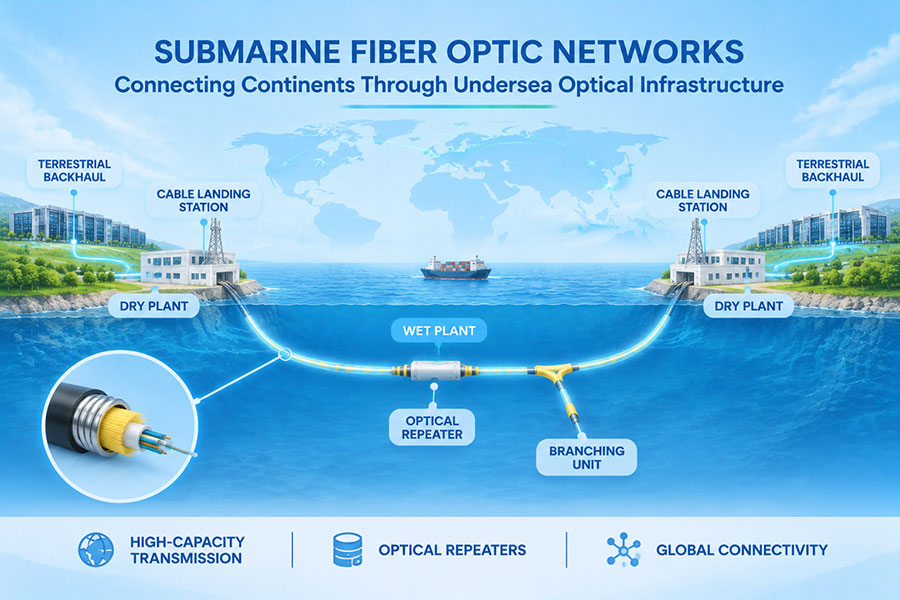
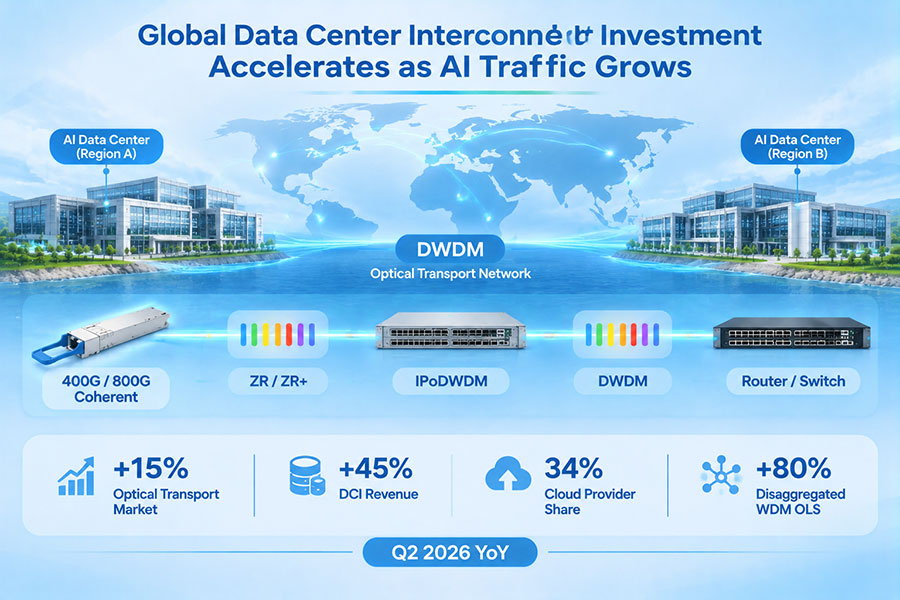
DWDM is a key technology behind high-capacity 800ZR deployments. It allows multiple optical wavelengths to share a single fiber pair, increasing the capacity of existing fiber infrastructure without requiring a separate fiber for every data channel.
In a typical DCI system, each coherent transceiver operates on a configurable wavelength within the supported optical band. A DWDM multiplexer combines multiple channels onto the transmission fiber, while a demultiplexer separates them at the receiving end.
Optical amplifiers are used when the link requires additional signal power. Their placement and operating parameters must be engineered around the optical loss, channel count, OSNR requirements, and available transmission margin.
Several components contribute to the overall system:
DWDM multiplexer and demultiplexer: Combine and separate wavelength channels.
Optical amplifiers: Compensate for transmission loss across suitable fiber spans.
Optical monitoring: Tracks channel power, wavelength, and other relevant optical parameters.
Coherent transceivers: Generate and receive high-capacity wavelength channels.
Network management: Coordinates configuration, alarms, and operational monitoring.
Increasing the number of wavelengths does not automatically increase usable system capacity. Channel spacing, amplifier bandwidth, nonlinear effects, and the performance of the entire optical line system must be taken into account.
7. 800ZR Applications in AI and Cloud Data Center Networks
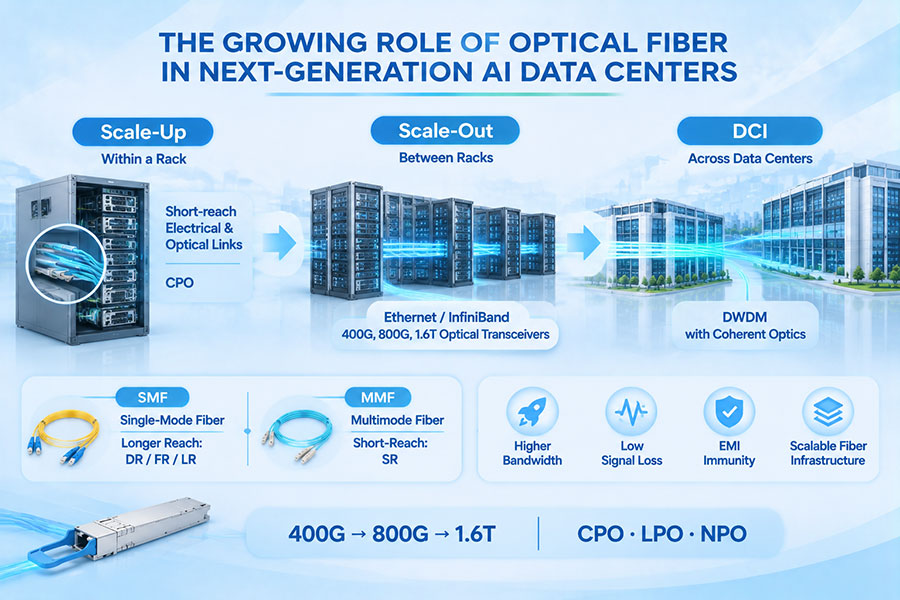
AI infrastructure is creating new traffic patterns between geographically distributed computing facilities. Large training jobs, shared datasets, distributed storage, and inference services can require substantial bandwidth between data centers.
800ZR provides a high-capacity coherent option for connecting facilities over suitable metropolitan and regional fiber routes. It can help operators scale DCI capacity while keeping optical transmission functions closer to the IP routing layer.
Important application areas include:
AI data center interconnect: High-bandwidth links between distributed AI computing facilities.
Cloud infrastructure: Connections between availability zones and regional cloud sites.
Enterprise data centers: High-capacity links between primary and secondary facilities.
Storage networks: Connectivity for distributed storage and data replication.
Telecom and internet infrastructure: High-capacity optical links between network facilities.
For AI clusters, 800ZR is most relevant to connections between separate sites or facilities. It should not be confused with short-reach optical links used inside a server rack or between adjacent data center switches. Those applications have different distance, latency, and interconnection requirements.
8. Power Consumption, Thermal Management, and Deployment Challenges
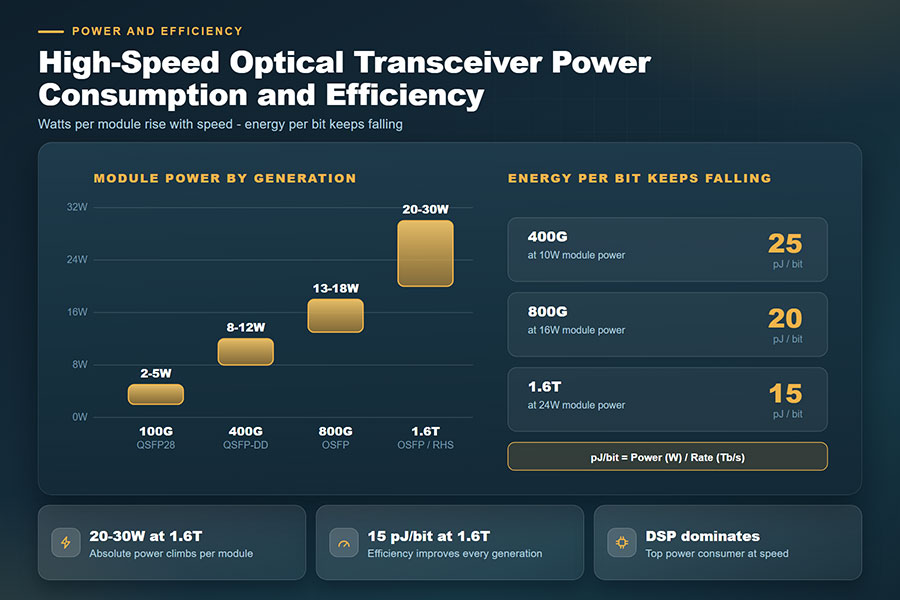
Coherent processing introduces substantial functionality into a compact optical module. The DSP, optical components, and supporting electronics all contribute to power consumption and heat generation.
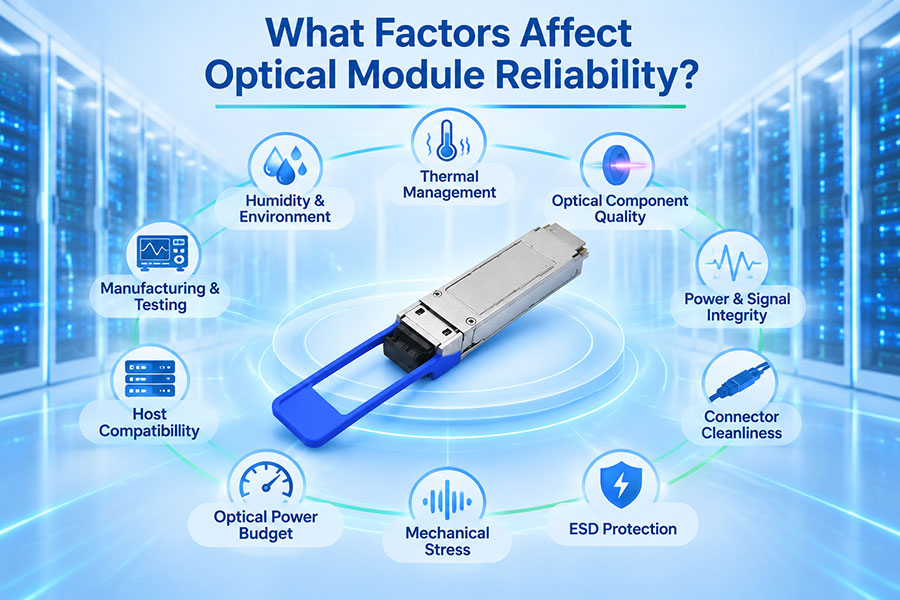
As port speeds increase, thermal management becomes an important consideration for high-density router and switch deployments. A system populated with multiple coherent modules must maintain suitable operating temperatures while staying within the host platform's power and cooling limits.
Several factors influence deployment readiness:
Module power: Confirm the specified maximum power consumption for the exact module.
Host compatibility: Verify that the switch or router supports the module's form factor and operating requirements.
Thermal conditions: Evaluate airflow, inlet temperature, and port density.
Optical performance: Validate OSNR, launch power, receive power, and link margin.
Interoperability: Test management functions and optical performance across the intended equipment combination.
Operational monitoring: Ensure that module diagnostics and line-system monitoring are available to network operators.
Standardized interfaces reduce integration uncertainty, but they do not remove the need for system-level testing. Multi-vendor deployments should be validated under representative operating conditions before large-scale rollout.
9. 800ZR and the Future Development of 1.6T Coherent Optics
The development of 800ZR is part of a broader transition toward higher-capacity coherent interfaces. As network traffic continues to increase, the industry is already advancing the next generation of coherent transmission technology.
In September 2026, OIF published its 1600ZR Implementation Agreement. The specification defines a 1.6T coherent line interface for amplified, single-span point-to-point DWDM links up to 120 km. It builds on the 800ZR framework and doubles the nominal interface capacity.
This development is significant for future DCI architectures. Instead of relying only on increasing the number of 800G wavelengths, operators will have another path toward higher capacity per wavelength, subject to product availability and system qualification.
However, publication of an implementation agreement does not mean that every 1.6T coherent module is already commercially available or interoperable across all platforms. Module development, host electrical interfaces, power consumption, thermal design, and multi-vendor testing will determine the practical deployment timeline.
Over time, the progression from 400ZR to 800ZR and 1600ZR is expected to provide network operators with additional options for scaling high-capacity optical connectivity.
10. C-LIGHT 800G Coherent Optical Connectivity Solutions
C-LIGHT provides coherent optical transceiver solutions for DWDM networks, data center interconnect, cloud infrastructure, and high-capacity optical transport. Its product portfolio includes QSFP-DD and OSFP coherent modules designed for different transmission capacities and reach requirements.
C-LIGHT's DWDM DCO product portfolio includes 800G coherent modules in QSFP-DD and OSFP form factors. The product matrix lists 800ZR configurations with C-band tunable wavelengths and LC connectors, targeting transmission distances of up to 120 km under the specified system conditions.
The portfolio also lists selected 800ZR+ configurations with longer reach options. These include 340 km and 500 km variants, with the supported distance depending on the specific modulation mode and module configuration.
Product details: C-LIGHT DWDM DCO Coherent Transceiver
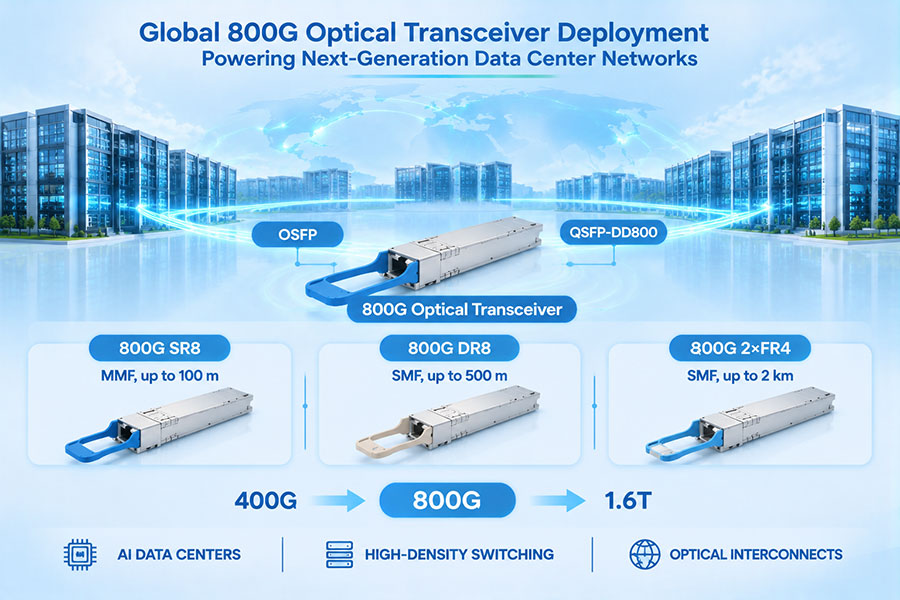
For high-density data center connectivity, C-LIGHT also offers an 800G OSFP optical transceiver portfolio covering multiple application types. Available configurations include SR8, DR8, and 2×FR4 variants, alongside coherent options listed in the company's DCO portfolio.
Product details: C-LIGHT 800G OSFP Optical Transceivers
The 800G QSFP-DD portfolio supports high-speed optical connectivity for compatible network platforms. Different optical variants address different reach and fiber requirements, making it important to select the correct module according to the intended application.
Product details: C-LIGHT 800G QSFP-DD Optical Transceivers
When selecting an 800ZR or 800ZR+ module, network operators should confirm the required transmission distance, modulation mode, wavelength range, host compatibility, power consumption, connector type, and optical line-system specifications. C-LIGHT can provide product information and technical support for project-specific requirements.
11. Conclusion
800ZR is an important development in the evolution of high-speed data center interconnect. By bringing 800G coherent transmission into compact pluggable modules, it gives network operators a practical option for connecting routers and switches across amplified DWDM links.
Its value extends beyond higher transmission capacity. Standardized coherent interfaces, tunable wavelengths, and integration into compatible network equipment can simplify selected DCI architectures and support more flexible network expansion.
As AI and cloud infrastructure continue to grow, 800ZR, extended coherent solutions, and emerging 1.6T interfaces will contribute to the next generation of high-capacity optical networks. Successful deployment will depend on matching transceiver capabilities with the optical line system, host platform, and operational requirements.
C-LIGHT provides 800G coherent optical connectivity solutions, including QSFP-DD and OSFP DCO modules for DWDM and data center interconnect applications. Contact our team for product specifications, compatibility support, and customized optical connectivity requirements.
 >

 >
 >
 >
 >
 >
 >
 >