TEL:+86 132 6656 7067





The evolution of 5G-Advanced (5G-A) is expanding the capabilities of mobile networks beyond conventional high-speed broadband. Enhanced uplink performance, improved network intelligence, integrated sensing, massive connectivity, and more demanding industrial applications are creating new requirements for the transport infrastructure connecting radio access networks with the mobile core.
Optical transport networks are central to this transition. Fiber links provide the bandwidth, reach, and scalability needed to connect distributed radio units, centralized processing facilities, aggregation sites, and core network locations. As mobile traffic grows and network architectures become more distributed, operators are reassessing the capacity and flexibility of their fronthaul, midhaul, and backhaul infrastructure.
For optical communication suppliers, 5G-A creates opportunities across several technology categories, including 25G and 50G transceivers, 100G and 400G aggregation links, CWDM and DWDM systems, and optical transport equipment.
1. 5G-Advanced Introduces New Requirements for Mobile Transport Networks
5G-Advanced is the evolution of 5G technology associated with 3GPP Release 18 and subsequent development work. It builds on the existing 5G system while introducing enhancements to radio performance, network intelligence, coverage, positioning, and support for emerging services.
These developments can increase the demands placed on transport networks. Higher uplink capacity, more complex radio configurations, distributed processing, and additional data exchange between network functions all influence how traffic moves across the mobile infrastructure.
Important factors include:
Higher traffic capacity: More demanding mobile applications and improved radio performance can increase traffic across access and aggregation networks.
Enhanced uplink performance: Industrial connectivity, video applications, and interactive services can generate greater uplink traffic.
Network densification: Additional radio sites and distributed network equipment increase the number of fiber connections.
Cloud-native RAN: Centralized and virtualized network functions create new traffic patterns between distributed and centralized units.
Low-latency services: Some applications require carefully engineered transport paths and predictable network performance.
Network synchronization: Radio systems require accurate frequency and time synchronization across distributed sites.
These requirements do not translate into one universal transmission speed for every link. The capacity of each connection depends on radio configuration, functional split, traffic aggregation, distance, and operator network design.
2. The Three Main Transport Segments: Fronthaul, Midhaul, and Backhaul
Mobile transport networks are commonly divided into three functional segments. Each connects different parts of the radio access network and has its own requirements for bandwidth, latency, synchronization, and transmission distance.
| Transport Segment | Typical Connection | Main Requirements | Optical Network Role |
|---|---|---|---|
| Fronthaul | AAU/RRU to DU | High-capacity radio transport, latency control, synchronization | Fiber links, 25G optics, WDM aggregation |
| Midhaul | DU to CU | Aggregated traffic, flexible routing, low latency | 50G/100G interfaces and optical aggregation |
| Backhaul | CU or aggregation network to mobile core | High capacity, longer reach, resilience, service aggregation | 100G/400G optics, DWDM, OTN transport |
The exact boundaries depend on the RAN architecture and functional split selected by the operator. Some deployments integrate functions differently, and not every network uses the same physical arrangement.
For optical network planning, the key point is that fronthaul, midhaul, and backhaul should not be treated as interchangeable links. Their traffic characteristics and performance requirements determine the appropriate optical interfaces and transport technologies.
3. 5G Fronthaul Creates Demand for High-Performance 25G Optical Connectivity
Fronthaul connects radio equipment with distributed processing functions. In common 5G architectures, this can involve links between an active antenna unit (AAU) or remote radio unit (RRU) and a distributed unit (DU).
eCPRI-based fronthaul can reduce transport bandwidth requirements compared with some traditional CPRI configurations, but actual capacity depends on radio bandwidth, antenna configuration, compression, functional split, and implementation.
25G SFP28 optical transceivers are widely used in 5G fronthaul applications because they provide a practical balance between bandwidth, form factor, cost, and power consumption for many deployments.
Important selection factors include:
Data rate: The optical interface must match the fronthaul equipment and transport design.
Transmission distance: Shorter urban links and longer rural links may require different optical specifications.
Fiber availability: Existing fiber resources can influence the selection of duplex or bidirectional solutions.
Temperature range: Outdoor radio sites may require industrial-temperature optical modules.
Latency: Optical transport equipment and network topology must meet the end-to-end latency budget.
Synchronization: The complete network must support the timing accuracy required by the radio system.
25G BiDi modules can also help operators use a single fiber strand for bidirectional transmission. This can be useful where fiber resources are limited, provided the wavelength pairing, optical budget, and endpoint compatibility are correctly designed.
4. Midhaul Aggregation Increases Demand for 50G and 100G Optical Interfaces
Midhaul connects distributed units with centralized units in architectures that separate these functions. As traffic from multiple radio sites is aggregated, the capacity required at intermediate network nodes can exceed the bandwidth of an individual fronthaul connection.
50G and 100G optical interfaces provide options for this aggregation layer. The appropriate rate depends on the number of connected sites, traffic patterns, oversubscription policy, redundancy design, and expected growth.
50G SFP56 can support capacity upgrades while retaining a compact pluggable form factor. 100G QSFP28 provides a higher-capacity interface for aggregation nodes and connections between network elements.
Operators may consider the following factors when designing midhaul links:
Aggregate bandwidth from connected DUs.
Traffic growth during peak usage periods.
Latency introduced by intermediate switching and transport equipment.
Redundant paths and protection requirements.
Compatibility with existing Ethernet and optical transport equipment.
Capacity planning should account for both current traffic and the expected service profile after 5G-A features are introduced. Installing higher-rate optics without evaluating the actual network bottleneck may increase costs without delivering a corresponding improvement in service performance.
5. Backhaul Networks Need Higher Capacity and Longer-Reach Optical Transport
Backhaul connects mobile aggregation networks with the core network and other major network locations. It carries traffic from multiple radio sites and must support a broad range of services, including mobile broadband, enterprise connectivity, and network signaling.
As 5G-A deployments expand, backhaul networks may need to accommodate higher traffic volumes and more complex service requirements. This creates opportunities for higher-capacity optical interfaces and wavelength-division multiplexing systems.
Common technologies include:
100G QSFP28: Provides high-capacity Ethernet connectivity for aggregation and metro transport applications.
100G DWDM: Supports wavelength-based transmission over existing fiber infrastructure.
400G optical transceivers: Provide higher-capacity interfaces for major aggregation and backbone nodes.
OTN systems: Support service mapping, transport management, and network protection functions.
Optical amplification: Extends transmission capability in suitable long-distance optical systems.
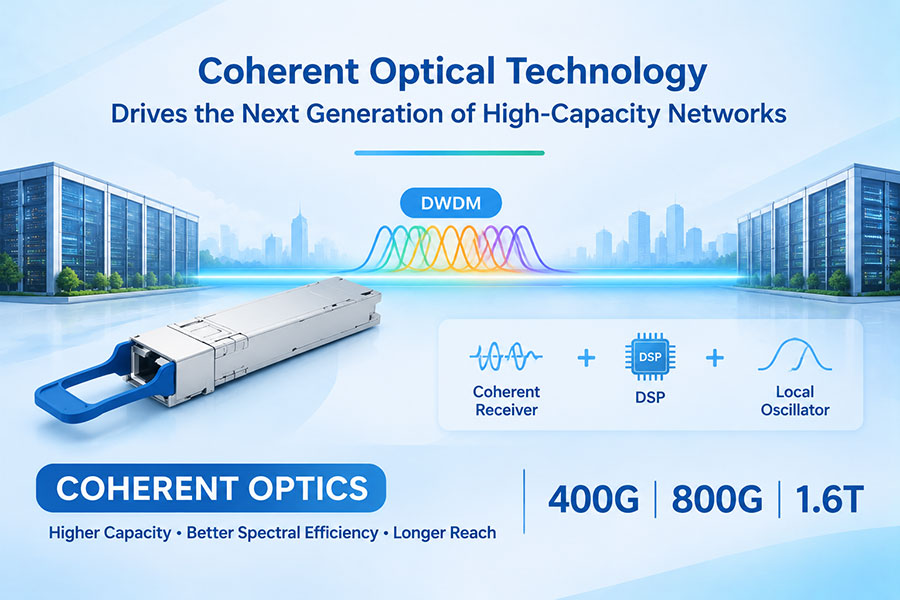
In metro and regional networks, DWDM can increase the capacity of existing fiber routes by carrying multiple wavelengths over a shared fiber pair. This is particularly valuable where new fiber construction is expensive or difficult.
6. CWDM and DWDM Help Optimize Fiber Resources
Fiber availability is an important consideration in mobile transport expansion. Dense urban areas may contain large numbers of radio sites, while available duct space and fiber routes can be limited. Wavelength-division multiplexing allows multiple optical channels to share the same fiber infrastructure.
Coarse wavelength-division multiplexing (CWDM) and dense wavelength-division multiplexing (DWDM) offer different approaches to wavelength utilization.
| Technology | Wavelength Arrangement | Typical Advantages | Common Deployment Considerations |
|---|---|---|---|
| CWDM | Wider channel spacing | Relatively simple wavelength multiplexing and cost-effective capacity expansion | Channel count, optical budget, wavelength plan |
| DWDM | Narrower channel spacing | Higher wavelength density and scalable fiber capacity | Channel planning, optical filtering, amplification, dispersion and power management |
CWDM can be suitable for access and aggregation applications that need a moderate number of optical channels. DWDM is more appropriate where operators require greater wavelength density or need to scale metro and backbone capacity.
Neither technology automatically increases the bandwidth of an individual transceiver. Instead, WDM systems combine multiple optical wavelengths on a shared fiber path, with each channel carrying its own signal.
7. 5G-A Places Greater Emphasis on Latency and Network Synchronization
High bandwidth is only one part of mobile transport performance. 5G-A services can also require predictable latency, accurate timing, and stable synchronization between distributed radio and network functions.
Time-sensitive radio operations depend on coordinated timing across network elements. Inappropriate transport design or synchronization errors can affect radio performance even when the optical link has sufficient bandwidth.
Important engineering considerations include:
Precision Time Protocol (PTP): Supports time distribution across packet-based networks.
Synchronous Ethernet (SyncE): Provides frequency synchronization through Ethernet physical-layer timing.
Transparent and boundary clocks: Help manage timing distribution through network equipment.
Path asymmetry: Differences between forward and reverse path delays can affect time accuracy.
Latency budgeting: Transport delay must be considered together with radio processing and other network functions.
Network monitoring: Timing performance should be monitored continuously across critical transport paths.
Optical fiber itself provides a predictable physical transmission medium, but synchronization performance depends on the complete network architecture and timing implementation. Selecting a transceiver based only on its data rate does not guarantee that a transport link will satisfy timing requirements.
8. Network Densification Increases the Need for Flexible Optical Infrastructure
Higher-capacity mobile services and localized coverage requirements can encourage operators to deploy additional radio equipment in urban areas, transport hubs, industrial sites, and indoor environments.
More radio locations create additional connections to aggregation points. This can increase the need for fiber access, optical distribution frames, patching systems, WDM equipment, and protection paths.
Flexible optical infrastructure helps operators manage this growth through:
Structured fiber distribution and patching.
Modular CWDM and DWDM systems.
Scalable optical aggregation nodes.
Redundant fiber routes for critical sites.
Standardized optical interfaces across equipment generations.
Centralized monitoring and fault management.
In many deployments, the physical fiber network has a longer service life than the active optical equipment. Planning fiber pathways and distribution capacity for future upgrades can therefore reduce the need for repeated civil construction.
9. Open RAN and Cloud RAN Create New Transport Architecture Requirements
Open RAN and cloud RAN approaches are changing how mobile network functions are deployed and connected. By separating functions across distributed and centralized processing environments, these architectures can provide greater flexibility in network design.
However, disaggregation also makes transport planning more important. The selected functional split determines how much data must move between network components and what latency and synchronization requirements apply.
Optical transport networks can support these architectures by providing:
High-capacity fiber links between radio and processing locations.
Scalable aggregation for distributed network sites.
Wavelength-based connectivity across shared fiber routes.
Transport paths with controlled latency and synchronization performance.
Flexible connectivity for network expansion and equipment relocation.
Open interfaces do not eliminate the need for interoperability testing. Radio equipment, transport systems, optical transceivers, and timing functions must all be validated as part of the complete network design.
10. 100G and 400G Optics Support the Evolution of Mobile Aggregation
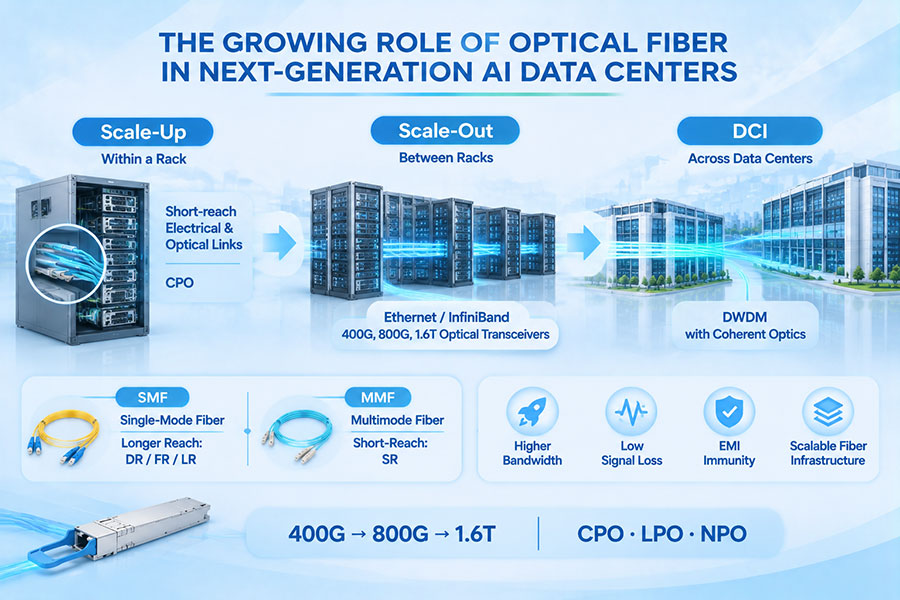
As mobile traffic is aggregated across multiple sites, higher-capacity optical interfaces become increasingly relevant at metro and core-facing network nodes. 100G remains important for many existing and evolving transport deployments, while 400G can provide additional capacity for high-density aggregation and backbone connections.
The choice between 100G and 400G depends on traffic demand, equipment capability, optical reach, and the available transport architecture.
| Optical Interface | Potential Network Role | Key Design Considerations |
|---|---|---|
| 25G SFP28 | Fronthaul and access links | Radio interface rate, reach, fiber type, temperature |
| 50G SFP56 | Midhaul and aggregation | Traffic aggregation, host compatibility, link budget |
| 100G QSFP28 | Midhaul, backhaul, metro aggregation | Reach, wavelength plan, interface compatibility |
| 400G QSFP-DD/OSFP | High-capacity aggregation and backbone | Optical architecture, fiber infrastructure, equipment support |
These are representative application areas, not mandatory assignments. A 100G interface may be used in different network layers depending on the operator's design, while 400G is generally selected where the traffic aggregation and equipment architecture justify the additional capacity.
11. Optical Transport Network Reliability and Protection Become More Important
Mobile networks support services that depend on continuous connectivity. A fiber cut or equipment failure can affect multiple radio sites when they share an aggregation route. As network traffic increases, transport resilience becomes a critical part of 5G-A deployment planning.
Operators can improve transport reliability through:
Route diversity: Separate physical fiber paths reduce the risk of a single route failure affecting all services.
Optical line protection: Protection systems can support traffic switching when a primary optical path fails.
OTN protection: Transport-layer protection mechanisms help maintain service continuity.
Optical monitoring: Continuous monitoring helps identify degradation and emerging faults.
Redundant power and equipment: Critical aggregation locations may require redundant system components.
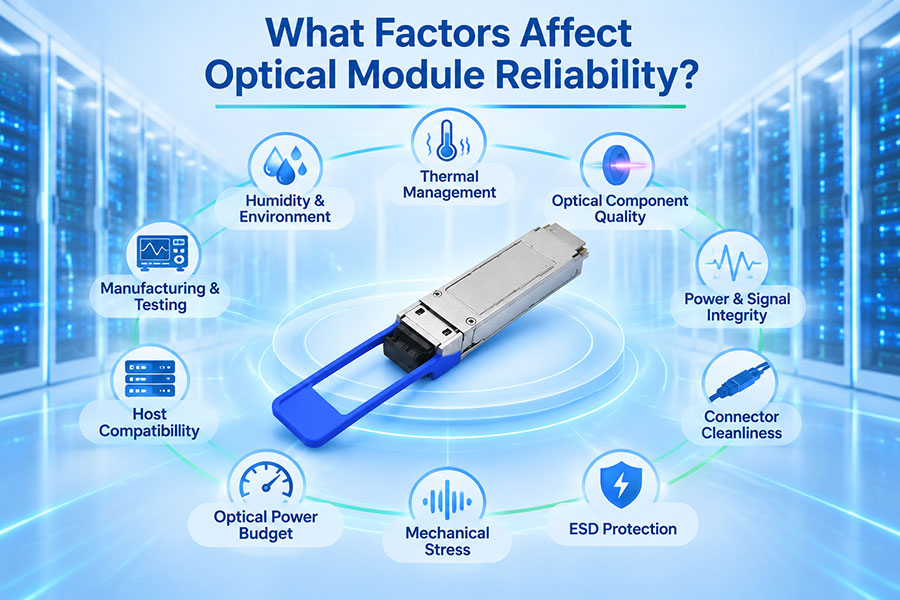
Fiber maintenance: Connector inspection, cleaning, and appropriate testing help reduce avoidable link failures.
Protection design should consider the required recovery time, service criticality, network topology, and the cost of redundant capacity. Resilience is an end-to-end network property rather than a feature of an individual optical transceiver.
12. Industrial and Outdoor Optical Modules Support Diverse 5G-A Environments
Mobile transport infrastructure is deployed in a wide range of environments, including indoor equipment rooms, outdoor cabinets, roadside sites, and industrial facilities. Temperature, humidity, vibration, and power conditions can vary considerably between locations.
Optical transceiver selection should therefore consider the operating environment as well as data rate and transmission distance.
Relevant factors include:
Commercial or industrial operating-temperature range.
Optical output and receiver sensitivity across the specified temperature range.
Module power consumption and thermal characteristics.
Connector type and fiber compatibility.
Host equipment compatibility and management interface.
Environmental qualification and reliability requirements.
Industrial-temperature modules can be appropriate for selected outdoor or harsh-environment deployments. However, an industrial temperature rating alone does not establish suitability for every outdoor installation. The complete equipment enclosure, thermal design, and environmental requirements must also be considered.
13. C-LIGHT Optical Connectivity Solutions for 5G Transport Networks
5G-A transport networks require optical connectivity across different network layers, from radio access links to aggregation and longer-distance optical transport. C-LIGHT provides optical transceivers and WDM-related products that address a range of mobile network applications.
C-LIGHT's 25G SFP28 product family supports data rates up to 25Gb/s and includes multiple transmission options, with listed distances ranging from 100m to 80km depending on the model. Available configurations include single-mode and multimode variants for different network requirements.
These modules can be considered for suitable 25G fronthaul and aggregation links after confirming the radio equipment interface, optical budget, temperature requirements, and compatibility.
Product details: C-LIGHT 25G SFP28 Optical Transceivers
C-LIGHT 25G BiDi SFP28 modules support single-fiber bidirectional transmission. Listed distance options include 10km, 20km, 40km, and 60km, depending on the model. BiDi technology can help conserve fiber resources in deployments where a single strand is available for a bidirectional link.
Endpoint modules must use the appropriate complementary wavelengths and match the optical budget and equipment requirements.
Product details: C-LIGHT 25G BiDi SFP28 Optical Transceivers
C-LIGHT's 50G SFP56 portfolio provides an option for higher-capacity optical links in compatible network equipment. Product selection should be based on the required transmission distance, fiber type, host interface, and operating environment.
Product portfolio: C-LIGHT Optical Transceiver Portfolio
C-LIGHT offers DWDM optical modules in 100G, 40G, and 25G categories. The product range includes selected 10km and 40km transmission options, supporting wavelength-based transport applications where operators need to increase fiber utilization.
Product details: C-LIGHT DWDM 100G/40G/25G Optical Transceivers
C-LIGHT provides 5G fronthaul WDM products for applications that aggregate optical channels over shared fiber infrastructure. These systems can help address fiber resource constraints in mobile access networks, subject to channel planning, optical budget, and equipment compatibility.
Product details: C-LIGHT 5G Fronthaul WDM
For broader network planning, C-LIGHT also provides optical transport and WDM-related products for metro and backbone applications. Specific configurations should be confirmed against the operator's transmission distance, fiber route, interface, and protection requirements.
14. Market Opportunities for Optical Transport Suppliers
5G-A deployment creates opportunities for optical communication suppliers across both new network construction and existing infrastructure upgrades. The demand is not limited to high-speed transceivers; it extends to fiber distribution, wavelength management, optical transport equipment, and network maintenance.
Potential growth areas include:
25G fronthaul optics: Continued deployment and replacement of radio access connections.
50G and 100G aggregation: Capacity upgrades for midhaul and access aggregation networks.
400G transport: Higher-capacity metro and backbone interfaces where traffic demand justifies the upgrade.
WDM systems: Improved utilization of existing fiber routes.
OTN infrastructure: Managed transport and protection for critical mobile services.
Industrial-temperature optics: Connectivity for outdoor and industrial network environments.
Fiber management products: Distribution, patching, and maintenance solutions for increasingly dense optical infrastructure.
Suppliers that can provide multiple optical rates, transmission distances, and wavelength options may be better positioned to support network operators and system integrators working across different deployment scenarios.
15. Future Outlook: Optical Transport Remains Essential to 5G-A and Beyond
As 5G-Advanced capabilities continue to develop, mobile networks will place greater emphasis on transport capacity, synchronization, service flexibility, and network automation. These requirements will influence the design of both access and backbone infrastructure.
Several developments are likely to shape future optical transport investment:
Higher-capacity radio interfaces: New radio configurations and traffic profiles will influence fronthaul and midhaul capacity planning.
More flexible RAN architectures: Open RAN and cloud RAN deployments will create additional transport design considerations.
Wider use of WDM: CWDM and DWDM can help operators expand capacity over existing fiber routes.
Higher-speed aggregation: 100G and 400G interfaces will support selected high-capacity transport nodes.
Improved synchronization: Accurate timing distribution will remain essential for radio network performance.
Preparation for 6G: Long-term fiber and transport planning will help operators accommodate future network generations.
The evolution of mobile networks will not eliminate existing optical technologies. Instead, operators are likely to combine established 25G and 100G interfaces with newer high-capacity solutions according to the needs of each network segment.
16. Conclusion
5G-Advanced is creating new requirements for mobile transport infrastructure through higher traffic capacity, enhanced uplink performance, distributed network functions, and more demanding synchronization and latency needs. These changes are increasing the importance of scalable optical transport across fronthaul, midhaul, and backhaul networks.
25G optical transceivers remain important for many fronthaul applications, while 50G and 100G interfaces support aggregation and backhaul scenarios. CWDM and DWDM systems help operators use fiber resources more efficiently, and higher-capacity optical transport solutions provide additional scalability for metro and backbone networks.
For optical communication manufacturers and suppliers, the development of 5G-A represents an opportunity to support a broader range of mobile network applications. The most suitable solutions will combine the right data rate, transmission distance, wavelength architecture, synchronization capability, and environmental performance for each deployment.
C-LIGHT provides 25G, 50G, and 100G optical transceivers, BiDi modules, DWDM products, and 5G fronthaul WDM solutions for mobile transport and fiber network applications. Contact our team for product specifications, compatibility information, and project-based technical support.
 >

 >
 >
 >
 >
 >
 >
 >