TEL:+86 132 6656 7067





25 Gigabit Ethernet is becoming an important bandwidth tier between conventional 10GbE access networks and higher-capacity 100GbE aggregation infrastructure. Industrial switches, 5G transport equipment, edge computing platforms, and distributed automation systems increasingly require faster uplinks without moving immediately to larger QSFP-based interfaces.
The 25G SFP28 form factor addresses this requirement with a compact, high-density optical interface. For industrial deployments, the challenge is not simply achieving a 25Gb/s data rate. Modules must also maintain stable operation under wider temperature variations, support the required fiber distance, and work reliably with the intended network equipment. Industrial 25G SFP28 transceivers combine high-speed optical transmission with temperature-qualified designs and flexible optical configurations.
1. What Is a 25G Industrial SFP28 Optical Transceiver?
A 25G industrial SFP28 optical transceiver is a hot-pluggable optical module designed to transmit and receive data at rates up to approximately 25.78Gb/s through an SFP28 interface. It converts electrical signals from a switch, router, server, or network interface into optical signals and converts received optical signals back into electrical signals.
SFP28 has a compact physical form similar to SFP and SFP+ modules, but its electrical interface is designed for a higher data rate. This allows network equipment manufacturers to increase port bandwidth while retaining a familiar pluggable module architecture.
Industrial versions are intended for installations where equipment may experience wider temperature variations than those found in conventional data centers. Depending on the product, industrial temperature options may include a case-temperature range of -40°C to +85°C.
These modules are used in industrial Ethernet networks, 5G fronthaul and transport, outdoor communication cabinets, utility networks, and high-speed connections between distributed industrial systems.
2. Why Industrial Networks Are Moving from 10G to 25G
Industrial network traffic is increasing as factories adopt machine vision, real-time monitoring, connected robotics, high-resolution video, and centralized data processing. A 10GbE connection may become a bandwidth constraint when multiple access switches, production systems, or monitoring devices share the same uplink.
25GbE provides 2.5 times the nominal bandwidth of 10GbE while retaining a compact SFP28 port. It can therefore provide a practical upgrade path for network aggregation and server connectivity.
Higher uplink capacity: 25GbE supports greater traffic aggregation from industrial access switches.
Higher port density: SFP28 allows network equipment to provide more high-speed ports within a limited front-panel space.
Improved infrastructure utilization: Existing single-mode or multimode fiber may be reusable when its characteristics meet the selected optical specification.
5G transport support: 25G optical links can serve as transport connections for selected fronthaul and related network architectures.
Flexible network migration: Multi-rate modules can support selected 10G and 25G applications when both the module and host platform explicitly support those rates.
Moving to 25GbE does not automatically require replacing every fiber connection. However, existing fiber type, length, insertion loss, connector condition, and transceiver compatibility must be evaluated before reusing installed cabling.
3. Industrial Temperature Grades and Environmental Requirements
Operating temperature is one of the most important differences between commercial and industrial optical modules. Commercial transceivers are commonly specified for a case-temperature range of 0°C to +70°C. Industrial-temperature versions often support -40°C to +85°C.
| Temperature Category | Typical Case-Temperature Range | Typical Deployment |
|---|---|---|
| Commercial | 0°C to +70°C | Temperature-controlled data centers and enterprise equipment rooms |
| Extended | Manufacturer-specific; commonly wider than commercial grade | Equipment rooms with moderate environmental variation |
| Industrial | Commonly -40°C to +85°C | Factory floors, outdoor cabinets, utility sites, and transportation infrastructure |
| Special extended-temperature designs | Product-specific | Applications requiring operating limits beyond conventional industrial specifications |
Temperature ratings generally refer to the transceiver case temperature rather than the ambient temperature surrounding the switch. Internal equipment heat, port density, airflow, and cabinet design can cause the module temperature to differ significantly from outside air temperature.
Industrial network designers should therefore evaluate the complete thermal environment. A module specified for -40°C to +85°C may be appropriate for a wide range of outdoor and factory installations, but the actual operating conditions must remain within the module's published limits.
Temperature qualification also does not automatically establish resistance to humidity, condensation, vibration, shock, dust, or electromagnetic interference. These environmental factors require separate evaluation according to the deployment requirements.
4. Main Types of 25G Industrial SFP28 Optical Transceivers
25G SFP28 modules are available in multiple optical configurations. The main differences involve wavelength, fiber type, transmission distance, and optical power budget.
25GBASE-SR: Short-Reach Multimode Fiber
25GBASE-SR modules generally operate at 850nm and use multimode fiber. They are designed for short-distance connections between switches, servers, and network equipment within the same facility.
Standard 25GBASE-SR reach depends on the multimode fiber grade. Representative specifications include up to 70m over OM3 and up to 100m over OM4. Some product families offer additional extended-reach multimode configurations, but these should not automatically be treated as standard 25GBASE-SR links.
Industrial-temperature SR modules are useful where short fiber connections are installed in factory cabinets, equipment rooms, and other locations with wider temperature fluctuations.
25GBASE-LR: 10km Single-Mode Fiber
25GBASE-LR typically uses a 1310nm DFB laser and single-mode fiber. A 10km reach makes LR a common option for connecting separate buildings, industrial campus networks, remote aggregation switches, and 5G transport equipment.
Industrial-temperature LR modules combine this optical interface with a wider operating case-temperature range. They are useful for network connections where both transmission distance and environmental conditions are important.
25G Extended-Reach Optical Modules
Extended-reach 25G SFP28 modules support distances beyond conventional 10km LR configurations. Depending on the design, available products may support 20km, 40km, 60km, or longer transmission distances.
These modules may use higher-power transmitters, more sensitive receivers, or other optical design approaches. Long-distance links require careful evaluation of transmitter power, receiver sensitivity, overload limits, fiber attenuation, dispersion, and any required FEC support.
Not every extended-reach product uses the same optical interface or has the same standards status. The module datasheet and host-system requirements should define the supported link configuration.
25G BiDi SFP28: Single-Fiber Bidirectional Transmission
25G BiDi SFP28 modules transmit and receive at different wavelengths over a single strand of single-mode fiber. This arrangement can reduce fiber usage in networks where cable capacity is limited or only one fiber strand is available for a connection.
BiDi modules operate in complementary pairs. One end transmits at one wavelength and receives at another, while the opposite end uses the reverse wavelength arrangement. The two ends must be matched according to the manufacturer's specified wavelength pair and transmission distance.
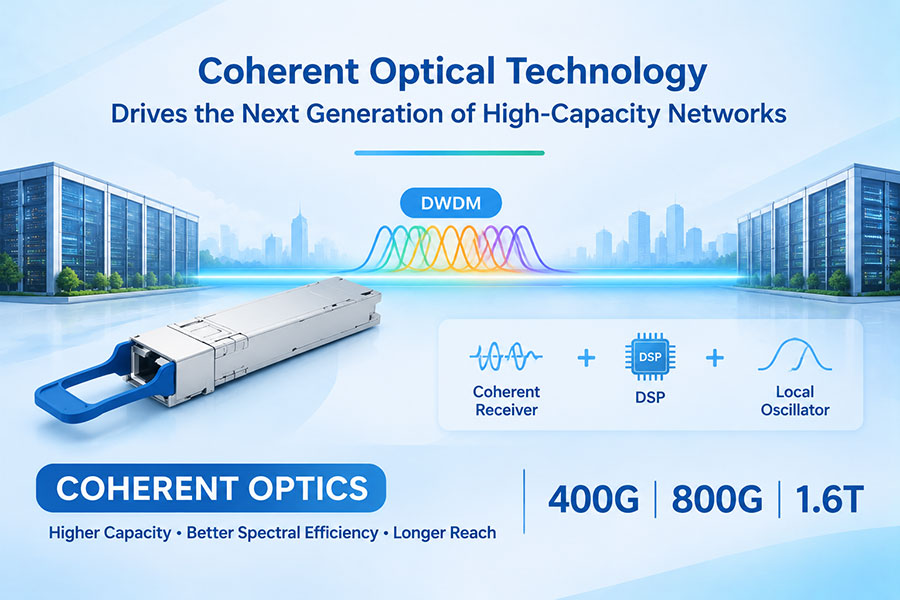
25G CWDM and DWDM SFP28
Wavelength-division multiplexing enables multiple optical channels to share the same fiber infrastructure. CWDM and DWDM SFP28 modules are used in access networks, metro transport, 5G fronthaul, and other applications where fiber resources need to be used efficiently.
CWDM and DWDM links require compatible optical wavelengths, channel spacing, multiplexers, demultiplexers, and optical power budgets. Industrial-temperature options are available for selected product families, but temperature specifications must be checked for each exact model.
| 25G SFP28 Type | Typical Wavelength | Fiber Type | Representative Reach | Common Application |
|---|---|---|---|---|
| 25GBASE-SR | 850nm | Multimode | 70m OM3; 100m OM4 | Short-distance equipment connections |
| 25GBASE-LR | 1310nm | Single-mode | 10km | Campus and 5G transport links |
| 25G Extended Reach | Model-dependent | Single-mode | 20km to 80km in selected products | Long-distance industrial and metro links |
| 25G BiDi | Complementary wavelength pair | Single-mode | Model-dependent | Single-fiber bidirectional links |
| 25G CWDM/DWDM | Specified WDM channel | Single-mode | Model and optical-budget dependent | Wavelength-multiplexed transport |
These are representative configurations rather than guaranteed specifications for every industrial SFP28 module. Actual reach depends on the exact product, fiber characteristics, optical budget, link engineering, and host-system configuration.
5. Key Technical Features of Industrial 25G SFP28 Modules
High-Speed 25Gb/s Transmission
25G SFP28 modules support data rates up to approximately 25.78Gb/s. This bandwidth is suitable for high-speed Ethernet uplinks, server connectivity, storage networks, and selected telecom transport applications.
Compact SFP28 Form Factor
The compact package allows network equipment to provide high port density. This is valuable in industrial switches and aggregation equipment where rack space and front-panel capacity may be limited.
Digital Diagnostic Monitoring
Many SFP28 modules support Digital Diagnostic Monitoring (DDM), also known as Digital Optical Monitoring (DOM). Through a management interface, supported host equipment can access operating information such as:
Module temperature
Supply voltage
Laser bias current
Transmitter optical power
Receiver optical power
These measurements help network operators monitor optical link conditions and identify changes that may indicate a developing problem. DDM support and the availability of individual parameters should be confirmed for the module and host platform.
Low Power Consumption and Thermal Management
Power consumption contributes directly to heat generation inside network equipment. Industrial SFP28 designs must maintain stable operation while meeting the thermal requirements of the host switch. Actual power consumption varies by optical reach, transmitter technology, receiver architecture, and module design.
CDR and Signal Integrity
Clock and Data Recovery (CDR) circuits are included in some SFP28 designs to support signal conditioning and timing recovery. Whether CDR is required or configurable depends on the module architecture and the electrical characteristics of the host equipment.
For 25G links, electrical signal integrity is important because high-speed interfaces are sensitive to channel loss, jitter, and host-board design. The module's electrical interface and retiming behavior should match the equipment specifications.
Hot-Pluggable Interface
The SFP28 interface supports hot-pluggable installation in compatible host ports. This helps simplify maintenance and module replacement, although insertion and removal procedures should follow the network equipment manufacturer's instructions.
6. Applications of 25G Industrial SFP28 Transceivers
Industrial Ethernet and Factory Automation
Factories increasingly connect machine vision systems, industrial computers, robotics, programmable controllers, and supervisory systems through high-speed Ethernet networks. 25G SFP28 modules can provide uplinks between access switches, aggregation switches, and central computing systems.
Industrial-temperature versions are particularly relevant when network switches are installed close to production lines or in cabinets without conventional air conditioning. Fiber also provides electrical isolation between network devices and avoids electromagnetic interference issues associated with long copper connections.
5G Fronthaul and Transport Networks
5G radio access networks require high-capacity connections between radio equipment, distributed units, centralized units, and transport infrastructure. 25G optical modules can support selected fronthaul and transport interfaces where the network architecture specifies compatible optical parameters.
Industrial-temperature options are useful for outdoor radio cabinets and remote communication sites. The required protocol, reach, latency, and optical specification should be checked against the radio and transport equipment documentation.
Power Utilities and Substation Communication
Utility networks use fiber connectivity for monitoring, control, operational communications, and data aggregation. 25G SFP28 links can support higher-capacity connections between network aggregation equipment and distributed communication systems.
For substation applications, optical transceiver selection must follow the complete equipment and system qualification requirements. A wide operating temperature range alone does not establish compliance with every utility or substation standard.
Railway and Transportation Infrastructure
Railway communication systems, station networks, traffic monitoring platforms, and intelligent transportation infrastructure often include remote cabinets and equipment exposed to changing environmental conditions. 25G fiber uplinks can aggregate traffic from distributed network nodes and support high-bandwidth communication between locations.
Industrial Edge Computing
Edge computing platforms process production data closer to the source, reducing the need to send every workload to a centralized data center. 25G SFP28 connectivity can link industrial servers, storage systems, and aggregation switches where higher bandwidth is needed.
Renewable Energy and Remote Monitoring
Solar farms, wind power installations, and energy storage facilities use distributed communication systems for monitoring and operational data collection. Industrial SFP28 modules can support high-speed fiber links between local control networks and centralized monitoring infrastructure.
7. Compatibility and Interoperability Testing
Correct optical specifications do not guarantee that a 25G SFP28 module will operate in every switch or router. Host compatibility depends on the port hardware, firmware, module identification, supported optical types, and vendor-specific configuration requirements.
A complete compatibility evaluation should include the following checks:
Module recognition: Confirm that the host detects the SFP28 module and reads its identification information correctly.
Port configuration: Verify the required 25G speed, interface mode, and supported port settings.
Optical diagnostics: Check whether DDM parameters are available and reported correctly.
Link establishment: Confirm stable operation between the local and remote optical modules.
FEC configuration: Verify that the module and host use compatible Forward Error Correction settings where required.
Traffic performance: Evaluate packet transmission, error counters, and link stability under representative traffic loads.
Environmental operation: Where required, test the module under the specified temperature conditions.
For long-distance or engineered links, FEC requirements deserve particular attention. A module may support a reach that depends on the host enabling a specific FEC mode. If the host and transceiver use incompatible configurations, the link may fail to establish or may experience excessive errors.
Compatibility testing should use the actual switch model, hardware revision, software version, and port configuration planned for deployment. Passing tests on one equipment model does not automatically establish compatibility across an entire vendor product family.
8. Optical Link Budget and Fiber Selection
Reliable 25G transmission requires sufficient optical power at the receiver while remaining within its permitted input range. The optical link budget is determined by transmitter output power, receiver sensitivity, fiber attenuation, connector losses, splice losses, and other passive components in the optical path.
A basic link-budget calculation is:
Available optical budget = Minimum transmitter output power - Receiver sensitivity
The available budget must cover the total loss of the installed link while retaining an appropriate engineering margin. The receiver overload limit must also be considered, especially when high-power transmitters are used on relatively short links.
| Parameter | Engineering Consideration |
|---|---|
| Transmitter output power | Confirm the minimum and maximum optical output specified by the module. |
| Receiver sensitivity | Check the minimum received optical power required for the specified performance. |
| Receiver overload | Ensure received power does not exceed the receiver's permitted input level. |
| Fiber attenuation | Calculate loss based on fiber type, wavelength, and installed length. |
| Connector and splice loss | Include all patch panels, connectors, adapters, and fusion splices in the path. |
| Engineering margin | Allow for aging, maintenance changes, and measurement uncertainty. |
| FEC requirements | Confirm the required FEC mode for the selected module and host platform. |
Fiber selection must also match the optical module. SR modules use compatible multimode fiber, while LR and most extended-reach configurations use single-mode fiber. Connector cleanliness and correct polarity are important for both types.
9. C-LIGHT 25G Industrial SFP28 Optical Transceiver Solutions
C-LIGHT provides a 25G SFP28 optical transceiver portfolio covering short-reach multimode, single-mode, extended-reach, BiDi, and wavelength-division multiplexing configurations. The range supports high-speed Ethernet, industrial connectivity, data center interconnection, storage networks, and selected 5G transport applications.
The published 25G SFP28 product range includes the following configurations:
| Product Model | Fiber Type | Wavelength | Listed Reach | Temperature Information |
|---|---|---|---|---|
| CLSFP25GSR | MMF | 850nm | 100m | Commercial / Industrial options listed |
| CLSFP25GXSR | MMF | 850nm | 400m | Commercial / Industrial options listed |
| CLSFP25GLR | SMF | 1310nm | 10km | Commercial / Industrial options listed |
| CLSFP25GLR20 | SMF | 1310nm | 20km | Commercial / Industrial options listed |
| CLSFP25GER | SMF | 1310nm | 40km | Commercial / Industrial options listed |
| CLSFP25GER60 | SMF | 1310nm | 60km | Commercial / Industrial options listed |
| CLSFP25GZR | SMF | 1310nm | 80km | Commercial / Industrial options listed |
| CLSFP10G/25GLR | SMF | 1310nm | 10km | Multi-rate; verify exact grade by SKU |
| CLSFP10G/25GSR | MMF | 850nm | 100m | Multi-rate; verify exact grade by SKU |
The product portfolio lists commercial and industrial temperature options for selected configurations. The exact case-temperature range should be confirmed against the individual model datasheet and ordering code before deployment. The 400m multimode and 20km-to-80km single-mode products should also be evaluated against their own optical specifications rather than assumed to be standard 25GBASE-SR or 25GBASE-LR interfaces.
For applications requiring single-fiber transmission, C-LIGHT also offers 25G BiDi SFP28 optical transceiver solutions. For wavelength-multiplexed links, the 25G DWDM optical transceiver series provides another option for high-capacity single-mode fiber networks.
For detailed model information, reach options, and available temperature configurations, refer to the C-LIGHT 25G SFP28 optical transceiver portfolio. Custom configurations can be evaluated according to wavelength, fiber type, transmission distance, temperature range, and host-device requirements.
10. How to Select the Right 25G Industrial SFP28 Module
Choosing the correct industrial SFP28 module requires matching the optical interface to the network architecture and the environmental conditions of the installation.
| Selection Factor | What to Confirm |
|---|---|
| Data rate | Confirm 25G operation and any required 10G or multi-rate compatibility. |
| Temperature grade | Match the module's specified case-temperature range to the installation conditions. |
| Fiber type | Determine whether the link uses multimode or single-mode fiber. |
| Transmission distance | Select SR, LR, or an appropriate extended-reach configuration. |
| Wavelength | Match both ends of the link and any WDM equipment. |
| Connector | Verify LC interface type, fiber polarity, and connector condition. |
| Optical power budget | Evaluate transmitter power, receiver sensitivity, overload, and total link loss. |
| FEC support | Check whether the selected reach requires a specific host FEC configuration. |
| Host compatibility | Verify switch model, port speed, firmware, module coding, and supported optics. |
| Diagnostics | Confirm DDM availability and compatibility with the host monitoring interface. |
For example, a short connection between industrial switches in the same facility may use an 850nm SR module over compatible multimode fiber. A 10km connection between buildings may use a 1310nm LR module over single-mode fiber. A remote network connection may require a longer-reach module with a carefully engineered optical budget and compatible FEC settings.
11. Conclusion
25G industrial SFP28 optical transceivers provide a practical way to increase network bandwidth while retaining a compact, high-density pluggable interface. Their combination of 25Gb/s transmission, flexible optical reach, and industrial temperature options makes them suitable for a broad range of industrial Ethernet, 5G transport, utility, transportation, and edge computing applications.
SR, LR, extended-reach, BiDi, CWDM, and DWDM configurations address different fiber infrastructures and network distances. Selecting the right module requires more than matching the nominal data rate. Engineers must verify the temperature grade, fiber type, wavelength, optical budget, FEC requirements, and host compatibility.
With appropriate product selection and system-level validation, industrial 25G SFP28 modules can help build higher-capacity fiber networks that support the growing communication demands of modern industrial infrastructure.
Looking for 25G industrial SFP28 optical connectivity?
C-LIGHT provides 25G SFP28 optical transceiver options for different fiber types, transmission distances, wavelengths, and operating environments. Contact the team to discuss module specifications, temperature requirements, and equipment compatibility.
 >

 >
 >
 >
 >
 >
 >
 >