TEL:+86 132 6656 7067





100G LR4 and 100G ZR4 are long-reach optical transceiver options for single-mode fiber networks. Both commonly use four LAN-WDM wavelengths and duplex LC connectivity, but they serve different transmission distances. IEEE 100GBASE-LR4 is designed for links up to 10 km, whereas many QSFP28 ZR4 products target approximately 80 km. The extended reach requires a substantially larger optical link budget and careful attention to receiver performance, host compatibility, and module specifications.
1. The Optical Architecture of 100G ZR4 and 100G LR4
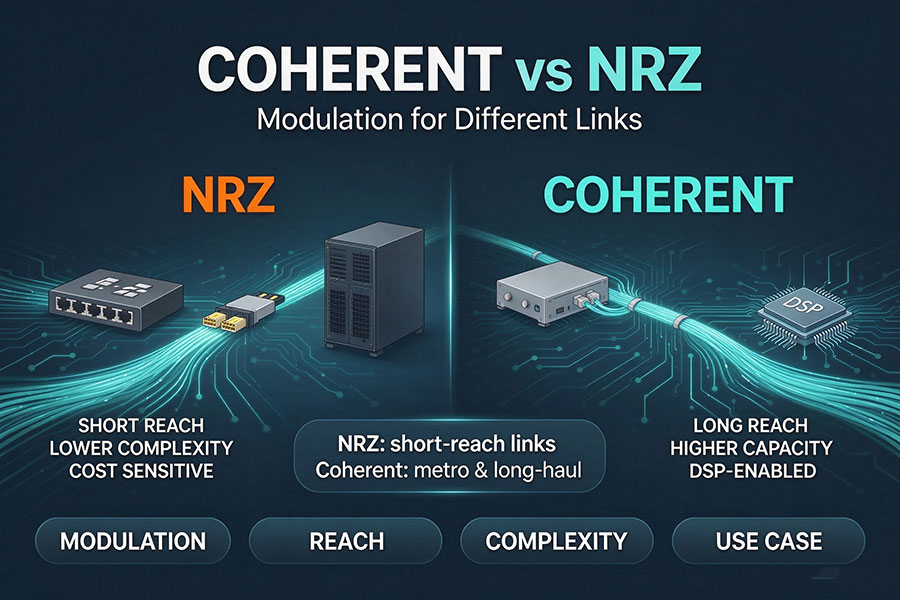
Both LR4 and common direct-detection ZR4 implementations transmit 100 Gb/s through four optical channels. Each channel carries approximately 25 Gb/s using NRZ modulation. A wavelength multiplexer combines the four optical signals onto one transmit fiber, while a demultiplexer separates them at the receiving end.
The two interfaces commonly use the LAN-WDM wavelength region around 1310 nm. Their nominal channel center wavelengths are approximately 1295.56 nm, 1300.05 nm, 1304.58 nm, and 1309.14 nm. This allows both designs to use a duplex single-mode fiber connection with an LC connector.
The main architectural difference is not simply the number of wavelengths. ZR4 products are engineered for much longer transmission distances, requiring higher optical output capability and more sensitive receiving performance than conventional LR4 modules.
2. 100G ZR4 vs 100G LR4: Key Specifications
| Parameter | 100G LR4 | 100G ZR4 |
|---|---|---|
| Data rate | 100 Gb/s | 100 Gb/s |
| Common form factor | QSFP28 | QSFP28 |
| Optical channels | 4 | 4 in common direct-detection implementations |
| Lane rate | Approximately 25.78 Gb/s | Approximately 25.78 Gb/s in common four-lane implementations |
| Modulation | NRZ / OOK | NRZ / OOK in common direct-detection ZR4 products |
| Wavelength technology | LAN-WDM | LAN-WDM in common direct-detection ZR4 products |
| Nominal wavelengths | 1295.56, 1300.05, 1304.58 and 1309.14 nm | Typically the same four LAN-WDM channels |
| Fiber type | Single-mode fiber | Single-mode fiber |
| Connector | Duplex LC | Duplex LC |
| Typical specified reach | Up to 10 km | Approximately 80 km for common products |
| Optical link budget | Designed for the 10 km LR4 application | Substantially larger; product-specific |
| Standards basis | IEEE 100GBASE-LR4, IEEE 802.3 | Vendor-specific implementation; verify the applicable specification |
| Typical applications | Enterprise, campus and data center links | Extended metro, regional and long-distance network links |
The specifications above describe common QSFP28 direct-detection products. ZR4 is not a universally interchangeable IEEE interface designation, so the exact module datasheet should be used to confirm optical parameters, FEC requirements, power consumption, and supported host platforms.
3. Wavelength Allocation and Optical Channel Design
100G LR4: Four LAN-WDM Channels
100GBASE-LR4 uses four LAN-WDM channels in the 1310 nm region. Each channel carries one 25G-class NRZ signal. The multiplexer combines the four channels for transmission over one single-mode fiber, and the receiver separates them before optical-to-electrical conversion.
The wavelength arrangement allows four optical channels to share a duplex fiber pair rather than requiring eight separate fibers for parallel transmission. This makes LR4 suitable for 10 km single-mode connections using standard LC cabling.
100G ZR4: Extended-Reach LAN-WDM
Common direct-detection ZR4 products use the same nominal four-channel LAN-WDM wavelength set. However, their transmitter and receiver specifications are designed around a much larger optical power budget.
Higher launch power and more sensitive receiving components can help maintain signal quality over longer fiber routes. Depending on the manufacturer, the module may use different laser, amplifier, and photodetector implementations. These component choices should be checked in the product documentation rather than assumed from the ZR4 label.
| Optical channel | Nominal center wavelength | Function |
|---|---|---|
| Channel 0 | 1295.56 nm | 25G-class optical lane |
| Channel 1 | 1300.05 nm | 25G-class optical lane |
| Channel 2 | 1304.58 nm | 25G-class optical lane |
| Channel 3 | 1309.14 nm | 25G-class optical lane |
Although the nominal wavelength plan may be similar, the optical power levels, receiver limits, and link-performance requirements are not necessarily the same. A matching wavelength set does not guarantee that two different module types can interoperate.
4. Transmission Distance and Optical Link Budget
The most visible difference between LR4 and ZR4 is their specified transmission distance. LR4 is designed for single-mode fiber links up to 10 km. Common ZR4 products extend the target distance to approximately 80 km, making them suitable for network routes that exceed the operating range of standard LR4 modules.
As fiber distance increases, attenuation reduces the optical power reaching the receiver. Connector insertion loss, splice loss, fiber condition, and passive components also contribute to total path loss. The receiver must still receive a signal within its specified operating range.
A simplified optical link budget is calculated as:
Available optical power budget = Minimum transmitter output power − Receiver sensitivity
The available budget must accommodate the total optical path loss and a suitable engineering margin. The actual calculation should use the transmitter and receiver limits specified for the selected module, not generic values associated with its product category.
| Design consideration | 100G LR4 | 100G ZR4 |
|---|---|---|
| Target reach | Up to 10 km | Approximately 80 km for common products |
| Fiber attenuation | Must remain within the LR4 link budget | Must remain within the larger ZR4 link budget |
| Connector and splice losses | Included in total path-loss calculation | Included in total path-loss calculation |
| Engineering margin | Required for stable operation | Important for extended-distance links |
| Validation | Check link loss against LR4 specifications | Check the complete ZR4 optical budget and receiver limits |
5. Transmitter Output Power and Receiver Sensitivity
ZR4 modules need to maintain an acceptable optical signal over much longer fiber routes than LR4 modules. Their optical designs therefore generally provide higher transmitter output capability, greater receiver sensitivity, or a combination of both.
For example, Cisco's QSFP-100G-LR4-S datasheet specifies a 10 km LR4 module, while its QSFP-100G-ZR4-S product is specified for 80 km and has substantially different transmitter and receiver power limits. NEC also lists separate 10 km LR4 and 80 km ZR4 QSFP28 products with different power consumption specifications.
Receiver sensitivity is only one part of the design. Receiver overload is equally important. A high-power ZR4 transmitter connected over a short fiber route may deliver more optical power than the receiving module is designed to accept.
6. FEC and Host Compatibility
Forward Error Correction (FEC) improves the ability of a receiving system to recover data affected by transmission errors. Its use depends on the optical module implementation and the host platform. Some long-reach products require a particular host-side FEC mode to achieve their specified transmission distance.
LR4 and ZR4 should not be assumed to share identical FEC requirements. Traditional 100GBASE-LR4 implementations are commonly specified for operation without host RS-FEC, while some extended-reach ZR4 products require host-side FEC. Other vendor implementations may specify different operating conditions.
Before deployment, verify:
Whether the module requires host-side FEC or supports operation without it.
Which FEC mode is supported by the switch or router.
Whether both link endpoints use compatible FEC settings.
Whether the published reach is conditional on FEC being enabled.
Whether the module coding and firmware are supported by the host equipment.
Whether the module's power consumption and thermal requirements are within platform limits.
A module's optical reach rating should always be read together with its FEC conditions. A ZR4 product rated for 80 km with RS-FEC should not be treated as an 80 km FEC-free interface.
7. Typical Applications of 100G LR4 and 100G ZR4
100G LR4 Applications
LR4 is widely suited to 100G connections within data centers, enterprise campuses, and metropolitan network facilities where the single-mode fiber route is no longer than 10 km.
Its standardized interface and duplex LC connection make it a practical option for switches, routers, and transport equipment that explicitly support 100GBASE-LR4. It can provide the required reach without the additional optical budget of an extended-reach module.
100G ZR4 Applications
ZR4 is intended for longer single-mode fiber connections. Common 80 km products may be considered for extended metropolitan links, regional aggregation networks, and data center interconnection routes where a standard LR4 module cannot meet the distance requirement.
Long-distance deployments require more careful optical engineering. Network designers should assess fiber attenuation, intermediate connection points, optical power levels, FEC configuration, and the compatibility of both endpoint devices.
8. ZR4 Naming and Coherent Optical Technology
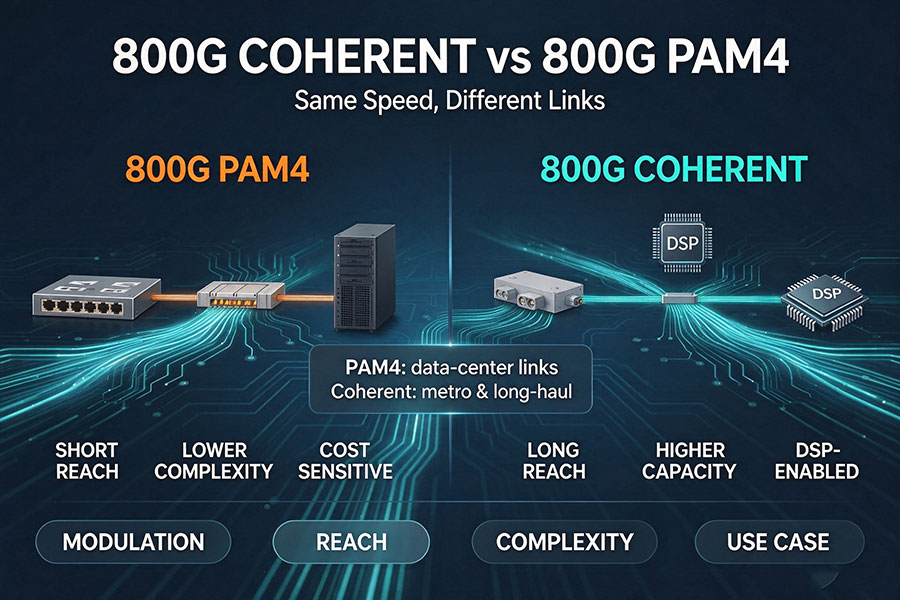
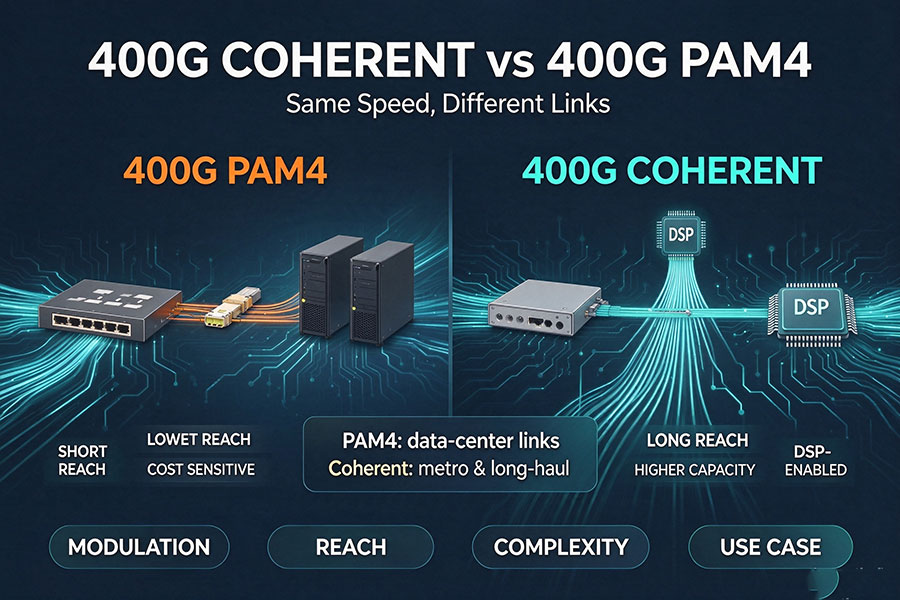
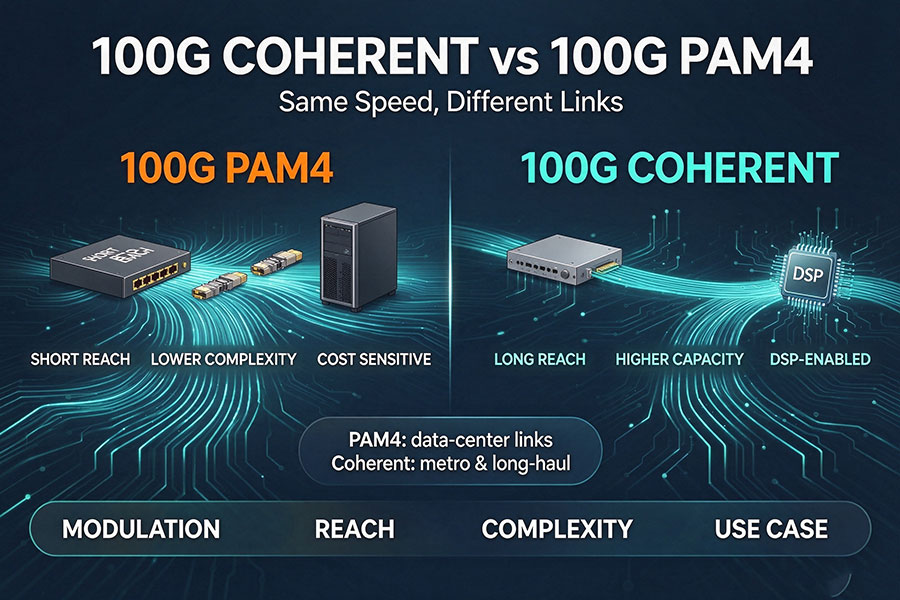
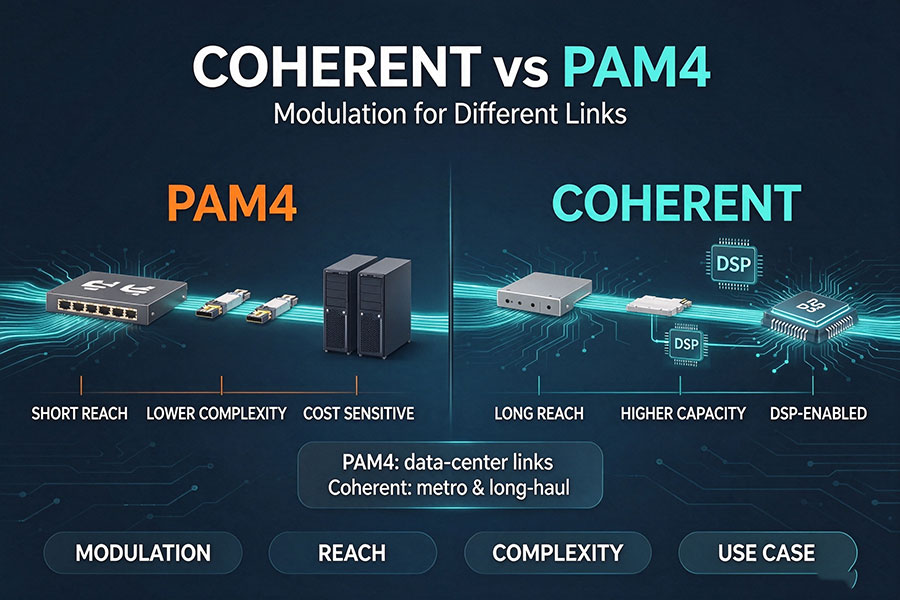
The term ZR is used in different contexts across the 100G optical market. A common QSFP28 product marketed as 100G ZR4 uses four LAN-WDM channels and direct detection. This should not automatically be confused with coherent 100G ZR technology.
Coherent optical transceivers use coherent detection, advanced modulation, and digital signal processing. They are designed to work with optical transport systems and may use tunable DWDM wavelengths. Their architecture differs from conventional four-channel direct-detection ZR4 modules.
Product naming can vary between vendors. When evaluating a module described as ZR or ZR4, check its actual modulation format, receiver architecture, wavelength behavior, host interface, and applicable implementation specification. The product label alone is not enough to establish whether it is coherent or direct detection.
9. Choosing Between 100G ZR4 and 100G LR4
The selection should begin with the actual fiber route and its measured or calculated optical loss. If the link is within 10 km and the equipment supports LR4, a standard 100GBASE-LR4 module may be sufficient. If the route is substantially longer and approaches 80 km, a suitable ZR4 product may be necessary.
| Network requirement | Interface to evaluate |
|---|---|
| Single-mode link up to 10 km | 100G LR4 |
| Single-mode link beyond 10 km and up to approximately 80 km | 100G ZR4, subject to product specifications |
| IEEE 100GBASE-LR4 interface requirement | 100G LR4 |
| Extended-reach direct-detection LAN-WDM connection | Evaluate a compatible 100G ZR4 implementation |
| DWDM transport system requiring coherent optics | Evaluate a coherent transceiver rather than assuming direct-detection ZR4 is suitable |
Other factors include module power consumption, temperature range, receiver overload, FEC configuration, DDM monitoring, and host compatibility. For routes that include optical amplifiers or transport equipment, the overall optical system must also be evaluated rather than relying solely on the transceiver's nominal reach.
10. Conclusion
100G LR4 and 100G ZR4 both provide four-channel optical transmission over single-mode fiber, but they target different network distances. LR4 is a standardized 10 km interface, while common QSFP28 ZR4 products extend the reach to approximately 80 km through a larger optical link budget and more demanding transmitter and receiver specifications.
For shorter 100G links, LR4 is generally the more straightforward option when supported by the host platform. For longer routes, ZR4 can provide the required reach, but its FEC conditions, receive power limits, module architecture, and equipment compatibility must be verified before deployment.
For 100G long-distance optical connectivity, module compatibility, or application-specific requirements, contact our team for further technical assistance.
Contact C-LIGHT >

 >
 >
 >
 >
 >
 >
 >