TEL:+86 132 6656 7067





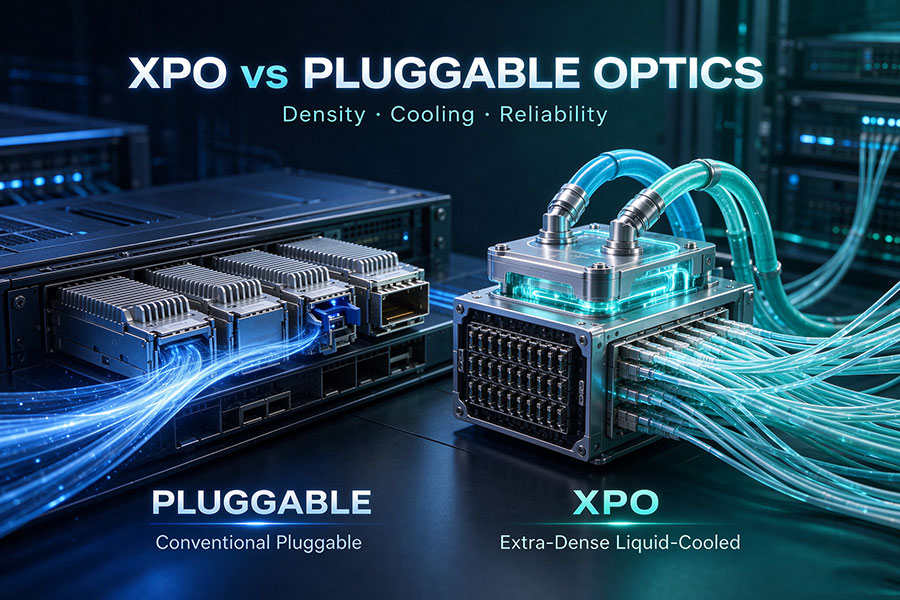
Pluggable optical transceivers have been central to data center networking for decades. Form factors such as SFP, QSFP-DD, and OSFP have enabled network operators to upgrade link speeds while retaining removable modules, standardized host interfaces, and flexible optical reach options.
However, AI infrastructure is increasing the bandwidth requirements of network switches while placing greater pressure on front-panel space, power delivery, and thermal management. Traditional 400G, 800G, and 1.6T optical modules are approaching practical density and cooling limits in some hyperscale switch designs.
XPO (eXtra-dense Pluggable Optics) is designed to address these constraints without abandoning the pluggable architecture. Its announced 12.8 Tbps module combines a high-density electrical interface, an integrated liquid-cooled cold plate, and a removable module structure.
The important distinction is that XPO is itself a form of pluggable optics. Its architectural change lies in the module's physical dimensions, bandwidth capacity, electrical interface, power delivery, and cooling design rather than replacing the basic concept of a removable optical transceiver.
1. What Are Conventional Pluggable Optics?
Conventional pluggable optics are removable optical transceiver modules installed in compatible cages or ports on switches, routers, servers, and other networking equipment.
The module converts electrical signals from the host device into optical signals for fiber transmission. On the receive side, it converts incoming optical signals back into electrical signals for the host system.
Common pluggable optical form factors include:
SFP and SFP+: Widely used for 1G and 10G Ethernet connectivity.
SFP28 and SFP56: Used for 25G and 50G-class interfaces.
QSFP28: Commonly used for 100G Ethernet.
QSFP-DD: Supports 400G and higher-capacity applications, depending on the generation and implementation.
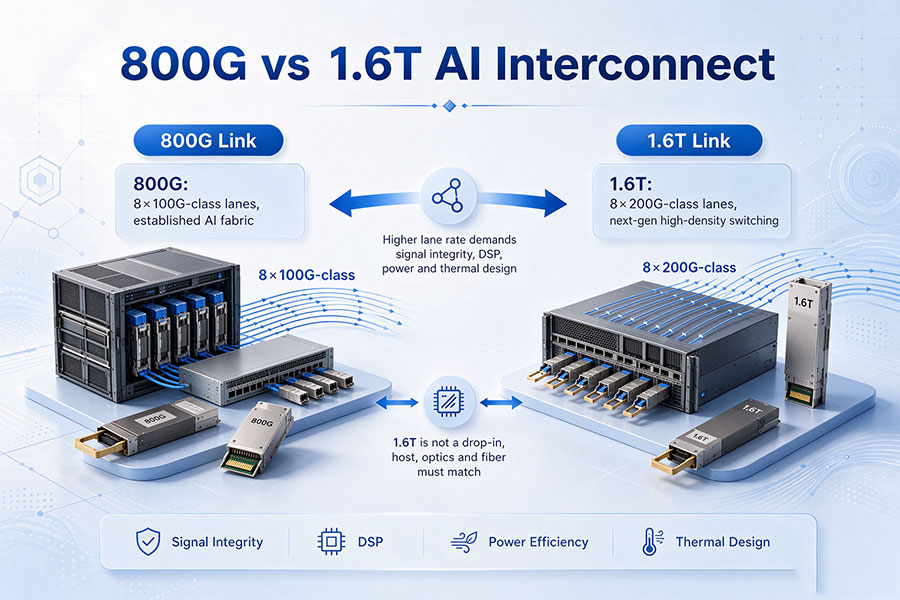
OSFP: Designed for high-speed data center applications, including 400G, 800G, and 1.6T implementations.
The host ASIC connects electrically to a removable transceiver installed at the front panel.
One of the biggest advantages of conventional pluggable optics is operational flexibility. If a module fails or a link needs a different optical reach, an operator can replace the transceiver without replacing the entire switch.
Conventional modules also support a wide range of optical technologies and transmission distances, including SR, DR, FR, LR, ER, ZR, and coherent applications, depending on the form factor and product specification.
2. What Is XPO (eXtra-dense Pluggable Optics)?
XPO stands for eXtra-dense Pluggable Optics. It is a high-density, liquid-cooled pluggable module architecture announced by Arista Networks in March 2026 through an industry Multi-Source Agreement (MSA).
XPO is designed for next-generation AI data center networks that require substantially more bandwidth per switch front panel. Instead of relying on many individual OSFP modules, XPO consolidates much greater bandwidth into a single removable module.
The announced XPO design includes the following characteristics:
12.8 Tbps per module: Supports 64 electrical lanes operating at 200 Gbps per lane.
Eight times the bandwidth: Provides eight times the nominal bandwidth of a 1.6T OSFP module.
Four times front-panel density: Targets up to 204.8 Tbps per Open Rack Unit, based on the announced comparison with OSFP.
Integrated liquid cooling: Includes a cold plate designed to support cooling requirements exceeding 400W.
High-density electrical interface: Uses two 32-channel paddle cards in a compact mechanical assembly.
Removable module design: Retains the ability to replace or upgrade optical modules without servicing the entire switch.
Multiple optical technologies: Designed to support DR, FR, LR, SR, ZR/ZR+, coherent-lite, and other optical or interconnect technologies.
XPO remains a separate pluggable module, with its own electrical, optical, mechanical, and cooling interfaces.
Although XPO is physically larger than a conventional OSFP module, it provides much greater aggregate bandwidth within the same front-panel space. The architecture also retains the operational advantages of removable optical modules.
3. XPO vs Conventional Pluggable Optics: Key Differences
The fundamental difference is the scale of integration. Conventional pluggable optics use established module sizes and host interfaces, while XPO introduces a much higher-capacity module designed around AI data center bandwidth and thermal requirements.
| Technical Dimension | Conventional Pluggable Optics | XPO |
|---|---|---|
| Architecture | Removable optical transceiver | High-density removable optical module |
| Typical form factors | SFP, QSFP28, QSFP-DD, OSFP, and others | Dedicated XPO mechanical interface |
| Bandwidth per module | Commonly 100G, 400G, 800G, or 1.6T, depending on form factor | 12.8 Tbps in the announced design |
| Electrical lane count | Depends on form factor and generation | 64 lanes |
| Electrical lane rate | Depends on the module generation | 200 Gbps per lane in the announced design |
| Module dimensions | Established compact form factors | Approximately 2.7 times the width of OSFP |
| Front-panel density | Depends on module size and chassis layout | Up to four times the cited OSFP density |
| Cooling | Generally heatsink and airflow-based; platform-dependent | Integrated liquid-cooled cold plate |
| Power delivery | Depends on the form factor and host power architecture | Announced design uses a higher-voltage power architecture |
| Signal processing | DSP, LRO, LPO, or other supported implementations | Supports linear, half-retimed, and fully retimed architectures |
| Maintenance | Replaceable module | Replaceable module with liquid-cooling interfaces |
| Host compatibility | Requires a compatible cage, electrical interface, and platform | Requires a dedicated XPO-compatible host design |
XPO is not simply a higher-speed version of OSFP. It changes the physical module architecture and the host-side integration needed to support a much larger number of electrical lanes and optical channels.
4. Bandwidth per Module and Front-Panel Density
Bandwidth density is the most visible advantage of XPO. Traditional OSFP platforms can support high-capacity 400G, 800G, and 1.6T optical modules, but the number of modules that fit into a given rack-unit height limits total front-panel bandwidth.
According to Arista's published XPO white paper, a conventional OSFP configuration supports up to 32 modules per rack unit. Using 1.6T OSFP modules, this provides 51.2 Tbps of nominal module bandwidth per rack unit.
The announced XPO architecture provides up to 204.8 Tbps per Open Rack Unit. This represents a fourfold increase in the cited front-panel bandwidth density.
| Parameter | 1.6T OSFP Reference | XPO |
|---|---|---|
| Bandwidth per module | 1.6 Tbps | 12.8 Tbps |
| Modules per rack unit in cited design | 32 | 16 |
| Aggregate bandwidth per rack unit | 51.2 Tbps | 204.8 Tbps |
| Relative bandwidth density | 1× | 4× |
| Number of modules for 204.8 Tbps | 128 | 16 |
The calculation uses nominal module bandwidth and the specific front-panel population assumptions in the XPO white paper. Actual switch capacity also depends on ASIC bandwidth, internal fabric design, port configuration, and chassis implementation.
At the individual module level, one 12.8T XPO module replaces the nominal bandwidth of eight 1.6T OSFP modules. At the rack level, the higher density can reduce the number of switch units and associated infrastructure required for a given aggregate network capacity.
5. Cooling and Thermal Management
Thermal management is one of the main limitations of high-density conventional pluggable optics. As module bandwidth increases, optical engines, electrical components, and power conversion circuits generate more heat within a limited mechanical space.
Conventional OSFP modules use established thermal designs, commonly involving module heatsinks and host airflow. Some platforms can also use liquid-cooled arrangements, but the cooling interface and mechanical implementation vary by product.
XPO integrates liquid cooling directly into the module. Its announced design places a central cold plate between two 32-channel paddle cards, allowing heat to be removed from both sides of the assembly.
| Thermal Factor | Conventional OSFP | XPO |
|---|---|---|
| Primary cooling approach | Typically heatsink and airflow, depending on platform | Integrated liquid-cooled cold plate |
| Thermal structure | Module heatsink and host airflow path | Cold plate integrated within the module assembly |
| Cooling capability | Depends on module and host thermal design | Designed to support cooling requirements exceeding 400W |
| Liquid interface | Not inherent to conventional OSFP | Integrated liquid inlet and outlet connections |
| Thermal density | Limited by module size, heatsink, airflow, and chassis design | Designed for high-power optical integration |
The XPO white paper describes a liquid cooling arrangement using quick-disconnect fluid connections between the module and host cooling manifold. This enables the module to be removed while maintaining a serviceable cooling architecture, subject to the platform's handling and maintenance procedures.
Liquid cooling does not eliminate thermal design requirements. Coolant temperature, flow rate, pressure, connector reliability, leak management, and system-level heat rejection must all be considered.
6. Electrical Interface and Power Delivery
Conventional pluggable modules use established electrical host interfaces defined by their respective form-factor specifications. As module speeds increase, the host PCB and connector must support higher signaling rates while controlling insertion loss, crosstalk, and signal reflections.
XPO uses 64 high-speed electrical lanes to provide its 12.8 Tbps aggregate capacity. Its architecture uses two 32-channel paddle cards and separates high-speed signal connections from power and management interfaces.
The announced XPO design also introduces a higher-voltage power delivery architecture, using a nominal 48V to 50V supply rather than relying exclusively on the traditional low-voltage module power arrangement.
| Electrical Factor | Conventional Pluggable Optics | XPO |
|---|---|---|
| Host electrical interface | Form-factor-specific cage and connector | Dedicated high-density XPO interface |
| Electrical lanes | Depends on module generation | 64 lanes |
| Lane signaling | Depends on form factor and generation | 200 Gbps PAM4 per lane in the announced design |
| Power architecture | Platform and form-factor dependent | Higher-voltage 48V/50V-class architecture |
| Signal routing | Host PCB routing to the module cage | High-density interface with optimized electrical routing |
| Compatibility | Requires matching host electrical specifications | Requires an XPO-compatible host platform |
Arista's XPO white paper also describes a clean linear electrical channel designed to support low-power linear optical interfaces. This is important because XPO is not limited to one signal-processing architecture. It can support linear, half-retimed, and fully retimed implementations.
7. DSP, LPO, and Signal Processing Compatibility
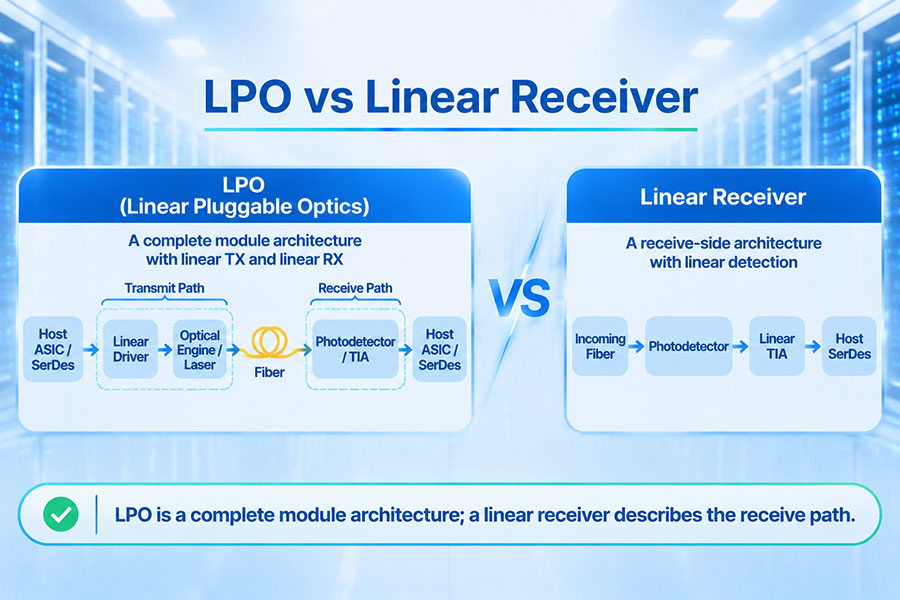
Pluggable optical modules can use different signal-processing architectures. Conventional fully retimed modules typically include DSP functions to condition and recover high-speed electrical signals. Linear Pluggable Optics (LPO) removes conventional module DSP retiming from the high-speed transmit and receive paths, relying more heavily on host SerDes and linear analog components.
XPO does not prescribe one fixed DSP architecture. Its physical module structure can support different signal-processing implementations.
| Signal-Processing Type | Conventional Pluggable Optics | XPO |
|---|---|---|
| Fully retimed | Supported in suitable modules | Supported by the announced architecture |
| Half-retimed / LRO | Supported by suitable implementations | Supported by the announced architecture |
| Linear / LPO | Available in suitable form factors and platforms | Supported by the announced architecture |
| Host SerDes dependency | Depends on module signal-processing design | Depends on selected XPO implementation |
This flexibility allows XPO to combine high bandwidth density with different electrical signaling strategies. For example, an XPO module using an LPO-style linear interface can reduce module DSP power while retaining the XPO physical and cooling architecture.
However, an XPO module should not automatically be classified as LPO. Its actual DSP and retiming architecture must be confirmed through the module specification.
8. Optical Reach and Application Flexibility
Conventional pluggable optics support a wide range of optical applications. The selected transceiver determines the optical wavelength, modulation format, fiber type, connector, reach, and link budget.
XPO is designed to preserve this application flexibility while increasing the capacity of the physical module. Its announced architecture identifies support for multiple optical categories, including short-reach, data center, and longer-distance applications.
| Optical Application | Conventional Pluggable Optics | XPO Design Direction |
|---|---|---|
| SR | Short-reach multimode fiber connectivity | Supported application category |
| DR | Short-reach single-mode fiber connectivity | Supported application category |
| FR | Single-mode fiber connectivity for longer data center links | Supported application category |
| LR | Longer-reach single-mode fiber connectivity | Supported application category |
| ZR / ZR+ | Coherent optical connectivity for extended reach | Supported application category |
| Coherent-lite | Application-specific coherent solutions | Included in the announced XPO roadmap |
Support for an optical application category does not mean every XPO module supports every wavelength, reach, or protocol. Each implementation still requires a specific optical design, fiber interface, power budget, and interoperability validation.
9. Maintenance, Reliability, and Deployment
One reason conventional pluggable optics remain widely used is their serviceability. A failed module can generally be replaced independently of the host switch, and network operators can maintain spare modules for different speeds and optical reaches.
XPO preserves this basic service model. The module is removable and designed for field replacement, avoiding the need to service the entire switch or ASIC assembly when an optical module fails.
However, XPO introduces additional operational considerations because it integrates liquid cooling and a higher-density electrical interface into the module.
| Operational Factor | Conventional Pluggable Optics | XPO |
|---|---|---|
| Module replacement | Established removable transceiver model | Removable high-density module |
| Cooling connection | Usually no module-level liquid connection | Requires compatible liquid-cooling interfaces |
| Maintenance process | Relatively established module handling procedures | Requires procedures for electrical and liquid interfaces |
| Spare inventory | Multiple module types according to speed and reach | Dedicated XPO modules and supported optical configurations |
| Host compatibility | Established form-factor compatibility requirements | Requires XPO-compatible switch hardware |
| Reliability considerations | Module temperature, component count, connector, and host conditions | Module temperature, liquid connections, high-density contacts, and component reliability |
XPO's integrated cooling and reduced component count are intended to improve thermal performance and reliability. However, actual field reliability must be evaluated through production data, environmental qualification, connector life, coolant-interface performance, and long-term operating experience.
10. XPO vs OSFP vs QSFP-DD
OSFP and QSFP-DD are established pluggable form factors used across data center networking. XPO represents a different physical scale, designed for much higher aggregate bandwidth per module.
| Feature | QSFP-DD | OSFP | XPO |
|---|---|---|---|
| Form-factor role | Compact high-speed pluggable transceiver | High-speed pluggable transceiver | Extra-dense high-capacity pluggable module |
| Common application rates | 400G and supported higher-speed implementations | 400G, 800G, and 1.6T | 12.8T announced module architecture |
| Electrical interface | Form-factor-specific host interface | Form-factor-specific host interface | 64-lane high-density interface |
| Cooling | Platform-dependent | Typically heatsink and airflow, with platform-specific alternatives | Integrated liquid-cooled cold plate |
| Physical dimensions | Compact QSFP-family design | Wider than QSFP-family modules | Approximately 2.7 times the width of OSFP |
| Module replacement | Pluggable | Pluggable | Pluggable |
| Host compatibility | QSFP-DD-compatible port | OSFP-compatible port | Dedicated XPO-compatible port |
QSFP-DD, OSFP, and XPO are not mechanically interchangeable. A switch designed for conventional OSFP or QSFP-DD modules cannot accept an XPO module simply because both belong to the pluggable optics family. XPO requires a compatible mechanical cage, electrical interface, power architecture, and cooling infrastructure.
11. Where XPO Fits in AI Data Center Networks
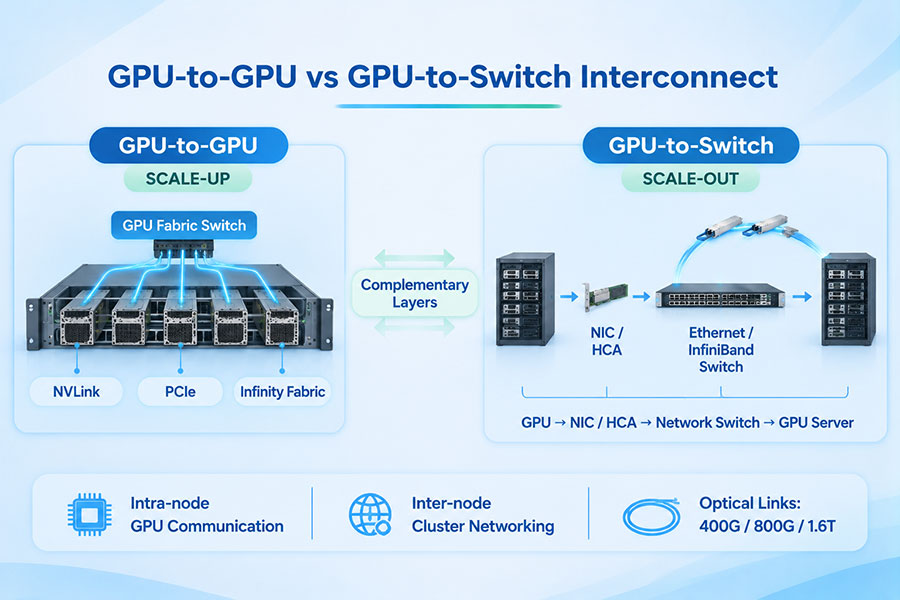
AI data centers increasingly rely on high-radix switches to connect GPU servers and accelerator clusters. Large-scale training workloads generate substantial east-west traffic, making aggregate network bandwidth and switching density important factors in cluster design.
Conventional 800G and 1.6T optical modules remain important for existing AI fabrics and network upgrades. XPO targets deployments where the aggregate bandwidth requirement is high enough that conventional module density becomes a significant constraint.
AI scale-up networks: High-density switching connectivity for large accelerator domains, depending on the selected network architecture.
AI scale-out networks: High-capacity optical connectivity between server racks and network switching layers.
AI scale-across networks: Large-scale interconnection across data center infrastructure and distributed compute environments.
Hyperscale data centers: Reduced switch-rack footprint for a given aggregate switching capacity, subject to system-level design.
Liquid-cooled infrastructure: Optical connectivity designed to operate within liquid-cooled network equipment.
Arista's published architecture uses a 204.8 Tbps switch example to illustrate how XPO can reduce the required rack-unit space compared with an equivalent OSFP-based configuration. This is a platform-level density example, not a guarantee that every XPO deployment will reduce the entire data center footprint by the same percentage.
12. How to Choose Between Conventional Pluggable Optics and XPO
The selection depends on the network's bandwidth requirements, switch platform, cooling infrastructure, and operational model. Conventional pluggable optics remain suitable for a broad range of enterprise, telecom, cloud, and data center applications.
Conventional pluggable optics are appropriate when:
400G, 800G, or 1.6T connectivity meets the required port bandwidth.
The switch uses established QSFP-DD or OSFP interfaces.
Air-cooled module operation is suitable for the platform.
Flexible module selection across different wavelengths and transmission distances is required.
Existing network equipment and optical infrastructure need to remain compatible.
Operators want to use established module replacement and inventory processes.
XPO is relevant when:
Aggregate bandwidth per front-panel position is a major design constraint.
Very high-radix AI switches require greater optical density.
The data center has suitable liquid-cooling infrastructure.
The switch platform is designed for XPO's electrical, mechanical, and power interfaces.
Reducing the physical footprint of high-capacity switching infrastructure is a priority.
Before deployment, engineers should evaluate optical reach, fiber type, connector configuration, host electrical interface, module power, cooling capacity, link budget, FEC requirements, and equipment interoperability.
13. Conclusion
XPO represents an important development in the evolution of pluggable optical transceivers. Rather than replacing the pluggable architecture, it extends it with a much higher-capacity module, a dense 64-lane electrical interface, and integrated liquid cooling.
Conventional QSFP-DD and OSFP modules remain valuable because they offer established mechanical interfaces, broad optical application support, and flexible module-level maintenance. XPO addresses a different requirement: delivering substantially more bandwidth per front-panel position for large AI data center networks.
The announced 12.8 Tbps XPO module provides eight times the nominal bandwidth of a 1.6T OSFP module and targets four times the front-panel density of the cited OSFP configuration. Its liquid-cooled design is intended to support higher thermal loads while retaining a removable optical module structure.
For network operators, the decision is not simply whether XPO is better than conventional pluggable optics. It is whether the additional bandwidth density, cooling infrastructure, dedicated host interface, and deployment requirements match the scale and operating model of the target network.
For conventional high-speed optical connectivity, including 100G, 400G, 800G, and 1.6T optical transceivers, DAC and AOC solutions, visit the C-LIGHT optical transceiver portfolio. For optical connectivity requirements and product compatibility support, Contact C-LIGHT.
 >

 >
 >
 >
 >
 >
 >
 >