TEL:+86 132 6656 7067





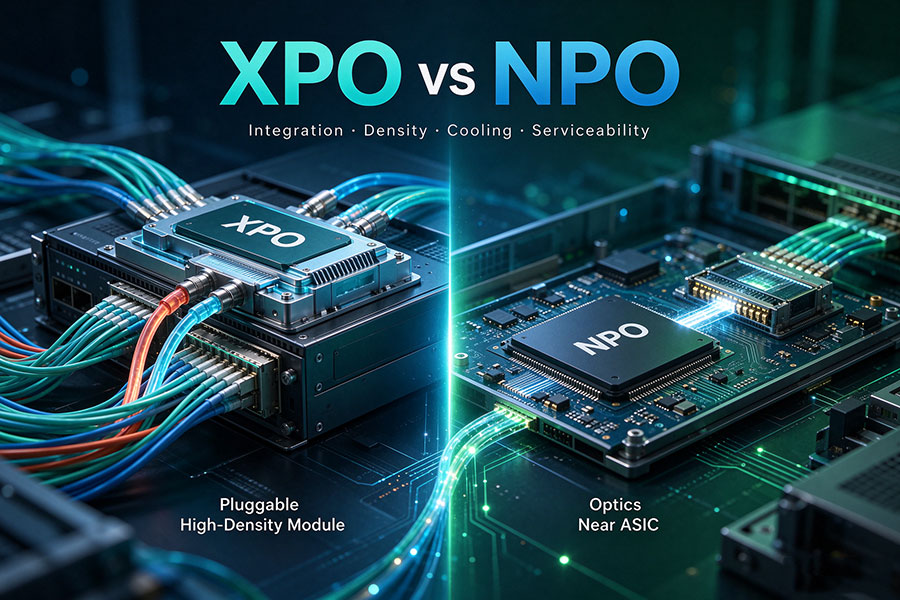
AI data center networks are facing two simultaneous challenges: increasing bandwidth per switch and delivering more optical connectivity within a limited rack footprint. As 800G, 1.6T, and higher-capacity network interfaces develop, traditional front-panel pluggable optics face growing pressure from electrical channel limitations, power consumption, thermal density, and port spacing.
XPO (eXtra-dense Pluggable Optics) and NPO (Near-Packaged Optics) address these challenges through different architectural approaches. XPO retains a removable front-panel optical module while dramatically increasing its bandwidth density and integrating liquid cooling. NPO moves optical engines close to the switch ASIC to shorten the high-speed electrical connection between the switching silicon and optical conversion components.
The distinction is important: XPO changes the capacity and cooling design of pluggable optics, whereas NPO changes the physical integration of optical engines within the switch system. Both target high-performance AI networking, but their implications for electrical signaling, maintenance, cooling, and system design are different.
1. What Is XPO (eXtra-dense Pluggable Optics)?
XPO stands for eXtra-dense Pluggable Optics. It is a high-density, liquid-cooled optical module architecture introduced for next-generation AI networking and hyperscale data center infrastructure.
Unlike NPO and CPO, XPO retains a pluggable module structure. The optical module is installed at the switch front panel and can be removed or replaced without replacing the complete switching system.
The XPO architecture announced by Arista in March 2026 introduces several notable design characteristics:
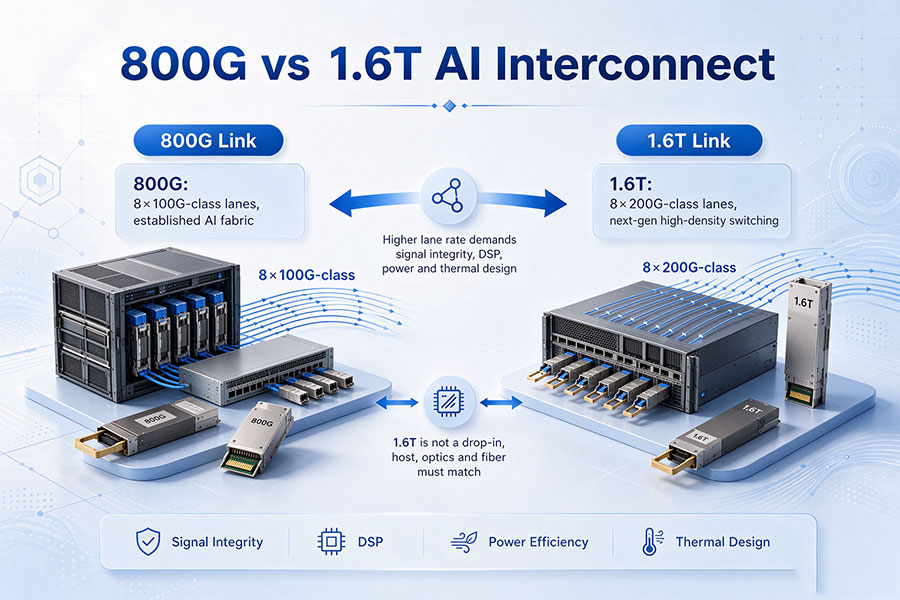
12.8 Tbps per module: Each announced module supports 64 high-speed electrical lanes operating at 200 Gbps per lane.
High front-panel density: Its bandwidth capacity is equivalent to eight 1.6T OSFP modules.
Integrated liquid cooling: A built-in cold plate is designed to support cooling requirements of modules exceeding 400W.
High-density electrical interface: A dual-paddle-card structure supports the large number of high-speed electrical connections.
Pluggable maintenance: The module retains a removable interface for replacement and system upgrades.
Multiple optical applications: The announced architecture targets DR, FR, LR, SR, ZR/ZR+, and other connectivity technologies.
Simplified system-level representation. The XPO module remains a separate, removable front-panel component.
One important difference from conventional OSFP modules is the physical scale of XPO. It is designed to accommodate substantially more electrical lanes, optical connectivity, power delivery, and cooling within one pluggable module.
Its integrated cold plate is particularly relevant to AI infrastructure, where high-density switching systems increasingly operate alongside liquid-cooled GPU and accelerator racks.
2. What Is Near-Packaged Optics (NPO)?
Near-Packaged Optics places optical engines close to the host switch ASIC while keeping them physically separate from the ASIC itself. Its primary objective is to shorten the high-speed electrical connection between the electronic switching interface and optical conversion components.
In a conventional pluggable architecture, electrical signals travel from the ASIC package through PCB routing to the front-panel transceiver. This creates a relatively long electrical channel that becomes more difficult to manage as signaling rates increase.
NPO brings the optical engine closer to the ASIC through a near-package arrangement. Depending on the implementation, the engine may be mounted on the host PCB adjacent to the ASIC or connected through a local high-performance substrate or interposer arrangement.
A typical NPO system includes:
Switch ASIC: Performs packet processing and provides high-speed electrical interfaces.
Optical engine: Converts electrical signals into optical signals and performs the corresponding receive-side conversion.
Electrical and photonic components: May include an electronic integrated circuit (EIC), photonic integrated circuit (PIC), drivers, and receivers.
Near-package interconnection: Provides a short electrical connection between the ASIC and optical engine.
Fiber attachment: Connects the optical engine to external fiber infrastructure.
Simplified NPO arrangement. The optical engine is located near the ASIC rather than in a conventional front-panel module cage.
NPO can reduce the electrical channel length and associated signal-conditioning requirements. However, the optical engine is no longer positioned as a conventional front-panel transceiver. Fiber routing, internal component access, and service procedures become part of the switch platform's mechanical and thermal design.
NPO terminology is not always used identically across vendors and industry proposals. The exact mounting structure, substrate arrangement, socket design, and serviceability must be evaluated against the specific implementation.
3. XPO vs NPO: Key Technical Differences
XPO and NPO both target higher-capacity AI networking, but they make different decisions about where optical conversion takes place. XPO keeps the optical engine inside a high-density front-panel module, while NPO positions it near the switch ASIC.
| Technical Dimension | XPO | NPO |
|---|---|---|
| Full name | eXtra-dense Pluggable Optics | Near-Packaged Optics |
| Optical engine location | Inside a front-panel pluggable module | Near the host ASIC |
| Integration approach | High-density module integration | Near-package optical integration |
| ASIC relationship | Connected through the host electrical interface | Connected through a short near-package electrical path |
| Module structure | Separate removable optical module | Internal optical engine, separate from the ASIC package |
| Announced bandwidth example | 12.8 Tbps per XPO module | Depends on optical-engine and host-platform implementation |
| Electrical lanes | 64 lanes at 200 Gbps in the announced design | Depends on ASIC interface and optical-engine design |
| Electrical path | Host interface to front-panel module | Short ASIC-to-engine connection |
| Cooling | Integrated liquid-cooled cold plate in the announced design | Depends on internal engine and switch cooling architecture |
| Maintenance | Designed for pluggable module replacement | Depends on engine socketing and internal service design |
| Front-panel density | Primary design objective | Moves optical connectivity away from conventional front-panel cages |
| Primary advantage | High bandwidth density with a pluggable service model | Reduced electrical distance between ASIC and optical engine |
The most important architectural difference is the location of the optical engine. XPO concentrates more bandwidth and cooling capability into a removable module. NPO places optical conversion closer to the switching silicon to reduce electrical interconnect distance.
4. Bandwidth Density and Electrical Interface
Bandwidth density is one of the defining characteristics of XPO. Its announced 12.8 Tbps capacity per module is based on 64 electrical lanes operating at 200 Gbps each.
This provides eight times the nominal bandwidth of a 1.6T OSFP module. Arista's announcement also describes a target front-panel density of up to 204.8 Tbps per Open Rack Unit, representing a fourfold improvement over the cited 1.6T OSFP configuration.
| Parameter | 1.6T OSFP Reference | Announced XPO Design |
|---|---|---|
| Bandwidth per module | 1.6 Tbps | 12.8 Tbps |
| Electrical lane count | 8 lanes in a typical 1.6T implementation | 64 lanes |
| Electrical lane rate | Approximately 200 Gbps | 200 Gbps |
| Bandwidth multiplier | 1× | 8× |
| Cooling approach | Platform-dependent module cooling | Integrated liquid-cooled cold plate |
NPO does not define one fixed module bandwidth or lane count. Its capacity depends on the host ASIC, electrical interface, optical engine, and system implementation. It is therefore not technically accurate to assign a universal 800G, 1.6T, or 3.2T rate to NPO as an architecture.
The two approaches also address electrical signaling differently. XPO uses a high-density host interface designed to carry a large number of electrical lanes to the removable module. NPO reduces the distance over which high-speed electrical signals must travel by moving optical conversion closer to the ASIC.
5. Power Consumption and Thermal Management
Power and cooling are central to both architectures, but their thermal challenges are concentrated in different locations.
XPO is designed around a high-density removable module that integrates its own liquid-cooled cold plate. This allows heat generated by the module's high-speed electrical and optical components to be transferred directly into the liquid cooling system.
The announced design also uses a high-voltage power delivery approach and a dense electrical interface. These features address the current and thermal challenges associated with operating many high-speed lanes in one module.
NPO has a different thermal profile. Optical engines are placed near the switching ASIC, where they share a compact physical environment with other high-power electronic components. The system must manage heat from both the ASIC and optical engines without compromising optical performance or long-term reliability.
| Thermal Factor | XPO | NPO |
|---|---|---|
| Heat concentration | Inside the high-density pluggable module | Near the switch ASIC and optical-engine assembly |
| Cooling structure | Integrated cold plate in the announced design | System-specific board, package, or liquid-cooling arrangement |
| Cooling integration | Requires liquid connections at the module interface | Integrated into the switch's internal thermal architecture |
| Thermal isolation | Module-level component placement and cold-plate design | Requires attention to ASIC-to-engine thermal interaction |
| Design priority | Remove heat from a very high-density removable module | Control temperatures around closely integrated electronic and optical components |
Neither architecture automatically guarantees lower total system power. XPO can improve the power efficiency of a high-density pluggable design through its electrical and thermal architecture. NPO can reduce the electrical channel and associated signal-conditioning burden. Actual savings depend on the complete switch design, optical technology, cooling system, and operating conditions.
6. Maintenance, Reliability, and Deployment Flexibility
Maintenance is one of the most significant differences between XPO and NPO.
XPO retains the pluggable service model. A failed module can be removed and replaced through the front-panel interface without replacing the complete switch or its ASIC assembly. This is valuable for hyperscale data centers that operate large optical inventories and need predictable component replacement procedures.
NPO places the optical engine inside the switch near the ASIC. Its maintenance model therefore depends on the physical implementation. Some designs may use socketed or separately replaceable engines, while others may require more extensive internal access or board-level servicing.
| Operational Consideration | XPO | NPO |
|---|---|---|
| Field replacement | Designed for front-panel module replacement | Implementation-dependent |
| Optical engine access | Through the removable module | Through the internal switch assembly |
| Failure isolation | Module-level diagnostics and replacement | Requires diagnosis of internal optical and electrical components |
| Spare inventory | Can use a dedicated replaceable module inventory | Depends on engine and platform modularity |
| Upgrade flexibility | Module replacement may support upgrades within platform compatibility limits | Depends on socket, substrate, and system compatibility |
| Service complexity | Front-panel access, with additional liquid-cooling connections to manage | Internal access and potentially more involved fiber and cooling procedures |
XPO's removable structure is an important operational advantage, but liquid cooling introduces additional system interfaces, including coolant connections and manifold integration. Maintenance procedures must account for these interfaces.
NPO can potentially support replaceable optical engines, but it should not automatically be described as hot-swappable. Its serviceability depends on whether the design provides a socketed interface, accessible fiber connections, and a practical replacement process.
7. XPO vs NPO vs CPO: Optical Integration Architecture
XPO and NPO are part of a broader evolution in optical interconnect architecture. CPO (Co-Packaged Optics) represents another approach that moves optical engines into the package-level environment of the host ASIC.
The three architectures differ primarily in optical-engine placement and the boundary between the optical components and switching system.
| Architecture | Optical Engine Location | Electrical Path | Service Model | Main Design Objective |
|---|---|---|---|---|
| XPO | High-density front-panel pluggable module | Host electrical interface to module | Removable module | Extreme front-panel bandwidth density |
| NPO | Near the host ASIC | Short near-package electrical connection | Implementation-dependent | Reduce ASIC-to-optical-engine electrical distance |
| CPO | Within the host ASIC's package-level environment | Very short package-level connection | Package-level service strategy | Deep integration of electronic and optical components |
XPO is not simply another name for NPO or CPO. Its defining characteristic is that the optical engine remains in a removable, high-density pluggable module. NPO and CPO instead move optical conversion closer to the switching ASIC.
These architectures do not necessarily represent a fixed migration sequence. A data center operator may select different optical integration models for different network layers according to bandwidth, power, cooling, serviceability, and system cost requirements.
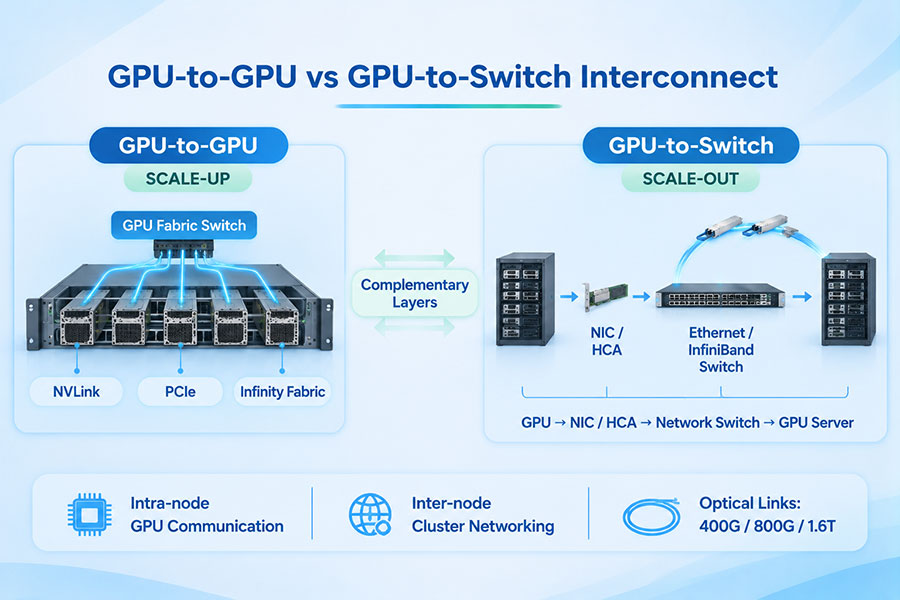
8. Applications in AI Scale-Up and Scale-Out Networks
Large AI clusters require high-bandwidth communication across accelerators, servers, and network switches. As the number of GPUs and other accelerators increases, network infrastructure must support high port density, low communication overhead, and predictable thermal performance.
XPO is designed to address the bandwidth density and serviceability requirements of high-capacity AI fabrics. Its high-capacity module structure can reduce the number of individual front-panel modules required to deliver a given aggregate bandwidth.
NPO addresses a different constraint: the electrical path between the switch ASIC and optical engine. This is particularly relevant when high-speed electrical channels become difficult to route across a conventional PCB while meeting signal-integrity and power requirements.
| AI Networking Scenario | Potential XPO Value | Potential NPO Value |
|---|---|---|
| High-radix AI switches | More aggregate bandwidth per front-panel module position | Closer optical integration with the switch ASIC |
| GPU scale-up fabrics | High-density connectivity where the selected system uses pluggable optical interfaces | Reduced electrical distance for internal optical interconnects |
| GPU scale-out fabrics | High-capacity optical interfaces between network devices | Potentially lower electrical channel burden inside switches |
| Liquid-cooled data centers | Integrated module-level liquid cooling | Requires cooling integration around the ASIC and optical engines |
| High-density switching systems | Higher front-panel bandwidth density | Reduced dependence on long electrical PCB routing |
The selection depends on the complete network architecture. A high-density optical module does not automatically improve the switching ASIC's internal bandwidth, and a shorter NPO electrical path does not automatically guarantee a higher network throughput. Switch fabric capacity, port configuration, optical reach, and traffic engineering remain essential.
9. How to Choose Between XPO and NPO
The choice between XPO and NPO should reflect the operator's priorities for bandwidth density, electrical performance, thermal infrastructure, and maintenance.
XPO may be attractive when:
Very high front-panel bandwidth density is a primary requirement.
The data center already has or plans to deploy liquid-cooling infrastructure.
Operators want to retain a removable optical module service model.
High-radix switching systems need substantial optical capacity within a compact rack footprint.
Module-level replacement and inventory management are important operational requirements.
NPO may be attractive when:
Reducing the electrical distance between the switch ASIC and optical engine is a key objective.
High-speed PCB channel loss and signal-conditioning requirements are major design constraints.
The switch platform supports the required near-package optical-engine integration.
The system can accommodate internal fiber routing and thermal management.
The manufacturer has a defined strategy for optical-engine testing, replacement, and long-term reliability.
Before selecting either architecture, system designers should evaluate the following factors:
Switch ASIC bandwidth and electrical SerDes capability.
Optical engine data rate, lane count, and optical reach.
Electrical channel insertion loss and signal integrity.
Module power, system power delivery, and cooling capacity.
Fiber connector density and internal fiber routing.
Module or optical-engine replacement procedures.
Manufacturing yield, reliability qualification, and total cost of ownership.
10. Conclusion
XPO and NPO address the bandwidth and integration challenges of next-generation AI data center networks through fundamentally different approaches.
XPO retains a pluggable optical architecture while increasing module capacity to 12.8 Tbps in its announced design. Its integrated liquid-cooled structure and high-density electrical interface target hyperscale AI networks that need more bandwidth within a limited front-panel and rack footprint.
NPO places optical engines close to the switch ASIC, reducing the electrical distance between electronic switching and optical conversion. This can improve signal integrity and reduce the electrical interconnect burden, but requires more integrated system packaging, thermal design, fiber routing, and maintenance planning.
For network operators prioritizing extreme front-panel density and removable optical modules, XPO presents a distinct architecture. For switch designers prioritizing short electrical paths and near-ASIC optical integration, NPO offers another direction. Neither is universally superior; the right choice depends on the complete switching platform and its operational requirements.
For conventional high-speed optical connectivity, including 400G, 800G, and 1.6T optical transceivers, DAC and AOC solutions, visit the C-LIGHT optical transceiver portfolio. For optical connectivity requirements and product compatibility support, Contact C-LIGHT.
 >

 >
 >
 >
 >
 >
 >
 >