TEL:+86 132 6656 7067





AI data center networks are pushing optical connectivity toward higher bandwidth, lower power consumption, and greater port density. As 800G, 1.6T, and next-generation multi-terabit interfaces develop, optical module architecture is becoming an increasingly important part of switch design.
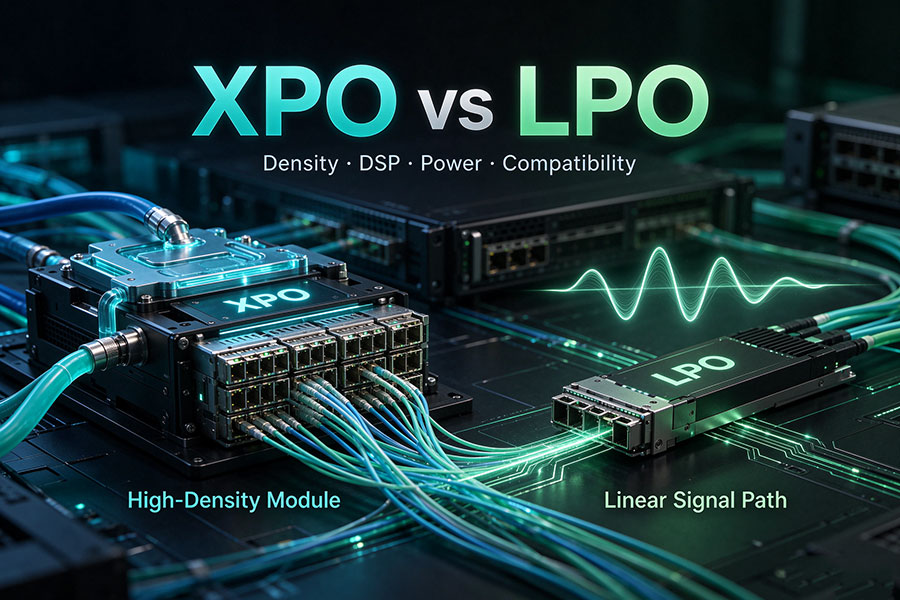
Two industry approaches address different parts of this challenge: XPO (eXtra-dense Pluggable Optics) and LPO (Linear Pluggable Optics). XPO introduces an extremely high-density, liquid-cooled pluggable module architecture. LPO changes how electrical signals are processed by removing conventional DSP retiming from the optical module's high-speed signal path.
Although both technologies can reduce some limitations associated with conventional optical connectivity, they are not direct alternatives. XPO defines the physical module architecture, while LPO defines the electrical signal-processing architecture. An XPO module can therefore support linear signaling without requiring every XPO implementation to use LPO.
1. What Is XPO (eXtra-dense Pluggable Optics)?
XPO stands for eXtra-dense Pluggable Optics. It is a high-density optical module architecture developed for next-generation AI networking and hyperscale data center infrastructure.
Unlike near-packaged optics and co-packaged optics, XPO retains a removable front-panel pluggable module structure. Its objective is to deliver significantly more bandwidth per module position while addressing the power and thermal requirements of high-capacity optical connectivity.
The XPO architecture announced by Arista in March 2026 introduces several notable specifications and design characteristics:
12.8 Tbps per module: The announced design supports 64 electrical lanes operating at 200 Gbps per lane.
High front-panel bandwidth density: One XPO module provides eight times the nominal bandwidth of a 1.6T optical module.
Liquid cooling: An integrated cold plate is designed to support cooling requirements of up to 400W per module.
High-density electrical interface: The architecture uses a dense multi-lane host connection to support its high aggregate bandwidth.
Pluggable maintenance: The module remains removable, preserving a module-level replacement model.
Multiple optical architectures: The announced design supports linear, half-retimed, and fully retimed electrical interfaces, alongside different optical application types.
Simplified XPO system architecture. The optical engine remains inside a separate, removable high-density module.
XPO is primarily a module-level integration and density innovation. Its physical architecture does not require one specific DSP implementation. Depending on the selected design, the module can use linear, partially retimed, or fully retimed signal processing.
2. What Is LPO (Linear Pluggable Optics)?
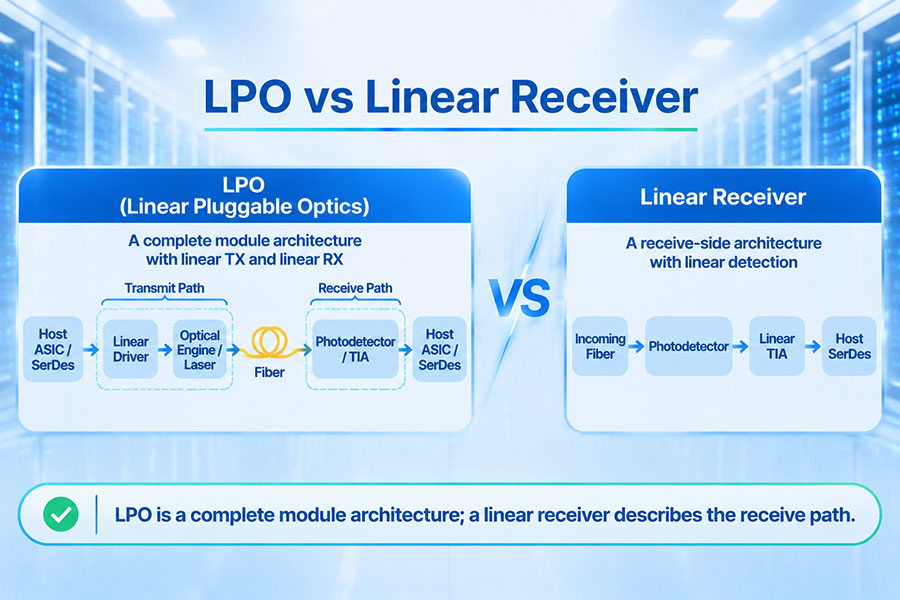
LPO stands for Linear Pluggable Optics. It is a pluggable optical transceiver architecture that removes the conventional DSP or retimer from the module's high-speed transmit and receive signal paths.
In a traditional DSP-based optical transceiver, the module processes and retimes incoming electrical signals before optical transmission. On the receive side, the module also performs electrical signal recovery and retiming before sending the signal back to the host.
LPO uses a more direct linear electrical interface. Its main components typically include:
Linear driver: Drives the optical transmitter without conventional DSP retiming.
Optical transmitter: Converts the electrical signal into an optical signal using the selected laser and photonic technology.
Photodetector: Converts the received optical signal into an electrical signal.
Linear TIA: Amplifies the received electrical signal while maintaining a linear interface.
Host SerDes: Performs a greater share of equalization and signal conditioning that would otherwise be handled by the module DSP.
Simplified bidirectional LPO signal path. The conventional module DSP or retimer is removed from the relevant high-speed data path.
Removing the module DSP can reduce module power consumption, heat generation, component count, and signal-processing latency. However, the host SerDes must handle a more demanding end-to-end electrical channel.
This makes LPO more dependent on host ASIC capabilities, PCB signal integrity, optical component linearity, and link-level compatibility than conventional fully retimed optical modules.
3. XPO vs LPO: Key Technical Differences
The main difference is the architectural dimension each technology addresses. XPO focuses on module bandwidth density and physical integration, while LPO focuses on signal processing and the location of electrical equalization and retiming functions.
| Technical Dimension | XPO | LPO |
|---|---|---|
| Full name | eXtra-dense Pluggable Optics | Linear Pluggable Optics |
| Primary focus | Module density, bandwidth, and cooling | Signal processing and DSP removal |
| Architecture type | Physical module architecture | Electrical signal-processing architecture |
| Form factor | High-density pluggable module | Pluggable module using a linear interface |
| Module DSP | Can be linear, half-retimed, or fully retimed | Conventional DSP retiming removed from the high-speed data path |
| Electrical interface | Depends on the selected module implementation | Linear electrical interface |
| Host SerDes dependency | Depends on the selected signaling architecture | High; host performs more signal conditioning |
| Bandwidth example | 12.8 Tbps announced module capacity | Depends on the form factor and lane configuration |
| Cooling | Integrated liquid-cooled cold plate in the announced design | Depends on module power and system cooling design |
| Latency | Depends on the selected signal-processing implementation | Can reduce module DSP-related latency |
| Power efficiency | Depends on module architecture and cooling design | Can reduce power by removing module DSP retiming |
| Compatibility requirements | Requires compatible XPO host interface and platform | Requires suitable host SerDes, channel quality, and LPO interoperability |
It is therefore inaccurate to describe XPO as a DSP-based technology and LPO as its direct replacement. XPO can support different signal-processing implementations, including LPO-style linear operation.
4. DSP-Based Optics vs LPO Signal Processing
To understand LPO, it is necessary to examine where digital signal processing takes place in a conventional optical link.
A fully retimed optical module typically contains DSP or retiming functions on both the transmit and receive paths. These functions help isolate the host electrical interface from the optical channel and provide signal conditioning within the module.
LPO removes conventional module DSP retiming from both high-speed signal directions. The host SerDes must compensate for more of the electrical channel and work with the linear optical module directly.
| Signal-Processing Architecture | Transmit Path | Receive Path | Typical Characteristics |
|---|---|---|---|
| Fully Retimed | Module DSP / retiming | Module DSP / retiming | More module processing and electrical channel isolation |
| LPO | Linear driver | Linear TIA | Lower module DSP power and latency, greater host dependency |
| LRO / Half-Retimed | Retimed or DSP-assisted | Linear receive path | Intermediate architecture with different transmit and receive processing |
LRO (Linear Receive Optics) is particularly relevant because it demonstrates that not all optical modules need to be either fully retimed or fully linear. A half-retimed architecture can retain more signal conditioning on one side while simplifying the other.
XPO's physical module architecture can accommodate these different approaches. The selected signal-processing configuration depends on the optical engine, host electrical interface, and system requirements.
5. Bandwidth Density: XPO's Main Advantage
XPO is designed to address a different scaling problem from LPO. Instead of primarily removing module DSP, it increases the amount of bandwidth that can be delivered through a single removable optical module.
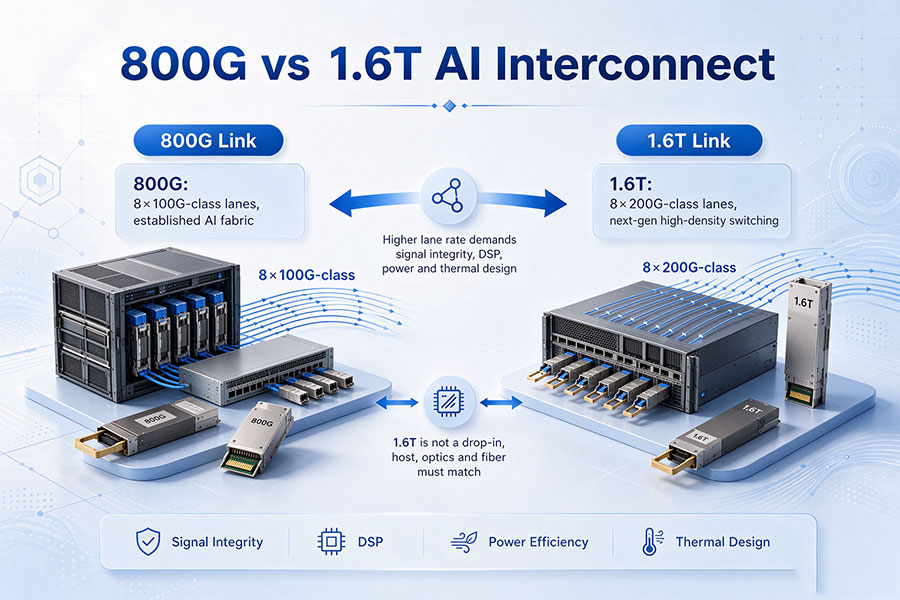
The announced XPO design provides 12.8 Tbps of aggregate bandwidth using 64 electrical lanes at 200 Gbps per lane. Its bandwidth is equivalent to eight 1.6T optical modules.
| Parameter | 1.6T OSFP Reference | Announced XPO Design |
|---|---|---|
| Bandwidth per module | 1.6 Tbps | 12.8 Tbps |
| Electrical lane count | 8 lanes in a typical implementation | 64 lanes |
| Electrical lane rate | Approximately 200 Gbps | 200 Gbps |
| Relative bandwidth | 1× | 8× |
| Cooling architecture | Platform-dependent | Integrated liquid-cooled cold plate |
LPO does not define a fixed aggregate bandwidth. A linear optical module can be designed for different data rates and form factors, provided that the host interface, electrical channel, optical components, and interoperability requirements are satisfied.
For AI networks, XPO's bandwidth density can reduce the number of individual front-panel optical modules required to provide a given aggregate capacity. LPO can reduce the power associated with signal processing in suitable optical links.
6. Power Consumption and Thermal Management
Power efficiency is one of the main reasons LPO has attracted attention in high-density data center networking. Removing the module DSP reduces the number of active electronic processing components and can lower module power consumption.
However, LPO transfers more signal-conditioning responsibility to the host ASIC. The host SerDes must handle the combined electrical channel and optical interface, so the total system power saving depends on the capabilities and configuration of the host platform.
XPO addresses thermal management through its physical module design. The announced architecture includes an integrated liquid-cooled cold plate designed to support cooling requirements of up to 400W per module.
| Power and Thermal Factor | XPO | LPO |
|---|---|---|
| Main objective | Support extremely high module bandwidth and thermal density | Reduce module power by removing DSP retiming |
| Power-saving mechanism | Depends on selected electrical and optical architecture | Removes conventional module DSP power consumption |
| Heat generation | High-density module requires advanced thermal management | Typically lower module heat from reduced DSP processing |
| Cooling method | Integrated liquid cold plate in announced design | Depends on module power and platform cooling |
| Host power considerations | Depends on host interface and module configuration | Host SerDes may perform more signal-conditioning work |
The two technologies address different parts of the system power budget. XPO provides a cooling architecture for very high-density modules, while LPO reduces the processing power required inside the optical module.
7. Signal Integrity and Compatibility Requirements
LPO's lower module power comes with stricter electrical channel requirements. In a conventional DSP-based transceiver, the module's retiming and signal-conditioning functions help isolate the host from some electrical channel impairments.
With LPO, the host SerDes must work with the complete electrical and optical path. The quality of the host PCB channel, transmitter equalization, receiver equalization, module linearity, and optical link performance becomes more important.
Key engineering considerations include:
Host SerDes capability: The switch ASIC must support the required equalization and signal recovery performance.
Electrical channel loss: PCB traces, connectors, vias, and module interfaces must meet the applicable channel requirements.
Signal reflections and crosstalk: Poor channel design can degrade signal quality and reduce link margin.
Optical component linearity: The driver and receiver must maintain suitable linear performance across the intended operating range.
FEC compatibility: The host and link must support the required forward error correction configuration.
Interoperability: Module and host combinations require validation rather than assuming that every pluggable port supports LPO operation.
XPO has a different compatibility requirement. The host platform must support the XPO physical interface, mechanical structure, electrical lane configuration, power delivery, and liquid-cooling connections.
If an XPO implementation uses LPO-style signaling, it must satisfy both sets of requirements: the XPO module and host interface requirements, plus the electrical and interoperability requirements of linear optics.
8. Can XPO Support LPO? Understanding XPO-LPO
Yes. XPO and LPO can be combined because they describe different aspects of optical connectivity.
XPO determines the physical module architecture, including its high-density electrical interface, module structure, optical connectivity, and cooling arrangement. LPO determines how the electrical signal is processed inside and outside the module.
In an XPO-LPO implementation, the module can retain the high-density XPO physical structure while using linear drivers and receivers instead of conventional module DSP retiming.
Conceptual XPO-LPO combination: XPO defines the module architecture, while LPO defines the linear signal-processing approach.
This combination can offer two complementary benefits:
Higher bandwidth density: XPO provides a high-capacity removable optical module architecture.
Reduced module DSP power: LPO-style signaling removes conventional module DSP retiming from the high-speed signal path.
However, combining the two does not eliminate the engineering challenges of either technology. The host must still support the XPO interface and provide the electrical signal quality required by the selected linear optical implementation.
The XPO announcement also describes support for fully retimed and half-retimed configurations. This means the XPO architecture is not restricted to one DSP or retiming strategy.
9. XPO vs LPO vs LRO vs DSP-Based Optics
These terms are often discussed together because they influence the power, latency, and physical integration of optical links. However, they do not all describe the same architectural dimension.
| Technology | What It Defines | DSP / Retiming | Primary Benefit |
|---|---|---|---|
| XPO | High-density pluggable module architecture | Can support linear, half-retimed, or fully retimed designs | Very high bandwidth density and liquid cooling |
| LPO | Linear pluggable signal-processing architecture | No conventional module DSP retiming in the high-speed path | Lower module power and DSP-related latency |
| LRO | Half-retimed optical architecture | Retimed transmit with linear receive in a typical implementation | Intermediate approach between fully retimed and fully linear designs |
| DSP-Based Optics | Fully retimed module signal-processing architecture | DSP or retiming on both transmit and receive paths | Greater signal conditioning and electrical channel isolation |
A useful way to classify these technologies is to separate the physical module architecture from the signal-processing implementation. XPO belongs to the first category, while LPO and LRO describe the second.
10. Applications in 800G, 1.6T, and AI Data Center Networks
High-performance AI networks need to connect large numbers of accelerators, servers, and switches while controlling power consumption and thermal density. The move toward 800G and 1.6T optical connectivity increases the importance of both module architecture and electrical signal processing.
XPO is designed for high-capacity switch platforms where front-panel bandwidth density and cooling are major constraints. Its 12.8 Tbps module architecture targets a different density level from conventional 800G and 1.6T pluggable optics.
LPO is relevant where the host ASIC has sufficient SerDes performance and the electrical and optical channels can meet the requirements of a linear interface. It can reduce module power and latency in suitable short-reach and high-density links.
| Application | XPO Contribution | LPO Contribution |
|---|---|---|
| 800G data center switching | Part of a broader high-density module architecture roadmap | Potential reduction in module DSP power for supported links |
| 1.6T switching platforms | High aggregate bandwidth per removable module | Linear signaling options where host SerDes and channel performance allow |
| AI scale-out networks | Higher optical bandwidth density at switch front panels | Lower module power in suitable optical connections |
| High-radix switches | More aggregate bandwidth within a compact physical footprint | Reduced DSP processing power across supported optical links |
| Liquid-cooled data centers | Integrated module-level liquid cooling | Lower module heat generation from reduced DSP processing |
Neither architecture guarantees a specific network throughput or application performance. Actual results depend on the switch ASIC, port configuration, SerDes implementation, optical reach, fiber infrastructure, network topology, and workload traffic.
11. How to Select Between XPO and LPO
The selection process should begin with the system requirement rather than treating XPO and LPO as competing products.
XPO is relevant when:
Very high aggregate bandwidth per optical module is required.
Front-panel density is a major switch design constraint.
The platform supports the XPO mechanical and electrical interface.
Liquid-cooling infrastructure is available for high-density optical modules.
A removable module architecture is important for maintenance and replacement.
LPO is relevant when:
Reducing optical module DSP power is a priority.
The host ASIC provides capable SerDes and equalization functions.
The electrical channel has sufficient signal integrity and link margin.
The optical components meet the required linearity and performance specifications.
The complete host-module combination has been validated for interoperability.
An XPO-LPO combination may be relevant when:
The system needs XPO's high-density pluggable architecture.
The host and optical engine support a linear electrical interface.
Reducing module DSP power is important alongside increasing bandwidth density.
The platform can meet both the XPO mechanical and thermal requirements and the LPO signal-integrity requirements.
12. Conclusion
XPO and LPO address different challenges in next-generation optical networking. XPO focuses on high-density pluggable module architecture, delivering up to 12.8 Tbps per module in its announced design with integrated liquid cooling. LPO focuses on removing conventional DSP retiming from the optical module to reduce module power and latency.
The two technologies are not mutually exclusive. An XPO module can use linear, half-retimed, or fully retimed signal-processing architectures. An XPO-LPO implementation can therefore combine high bandwidth density with a DSP-free linear optical interface, provided that the host SerDes and electrical channel meet the necessary requirements.
For AI data center networks, the important design decision is not simply whether to select XPO or LPO. Engineers must evaluate module density, electrical signaling, host SerDes capability, power consumption, cooling, optical reach, interoperability, and serviceability as part of the complete system architecture.
For conventional high-speed optical connectivity, including 400G, 800G, and 1.6T optical transceivers, DAC and AOC solutions, visit the C-LIGHT optical transceiver portfolio. For optical connectivity requirements and product compatibility support, Contact C-LIGHT.
 >

 >
 >
 >
 >
 >
 >
 >