TEL:+86 132 6656 7067





Optical interconnect design increasingly depends on the relationship between laser technology, photonic integration, and the electrical architecture surrounding the optical link. VCSELs have established a strong position in short-reach data communication, while silicon photonics provides an integration platform for compact, high-density optical systems. Although these technologies are often discussed as competing approaches, they address different layers of the optical system.
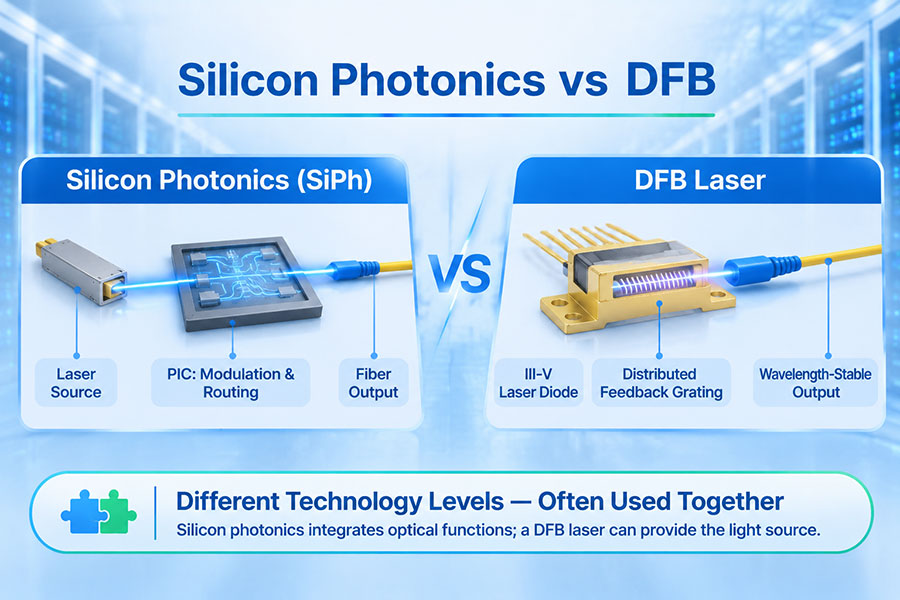
A VCSEL is a semiconductor laser with a vertical optical cavity that emits light perpendicular to the wafer surface. Silicon photonics, by contrast, integrates optical waveguides, modulators, filters, and photodetectors on a photonic integrated circuit (PIC). Because silicon is not an efficient conventional light-generating material, a silicon photonics design generally needs a separate or integrated laser source, often based on III-V semiconductor materials.
1. What Is a VCSEL?
VCSEL stands for Vertical-Cavity Surface-Emitting Laser. Unlike an edge-emitting laser, which emits light from the side of a semiconductor chip, a VCSEL emits light through its surface. Its resonant cavity is formed by reflective layers surrounding the active region.
This vertical structure supports compact devices and enables multiple emitters to be arranged in arrays. VCSEL arrays are widely used in short-reach optical communication, particularly in multimode-fiber links inside data centers and high-performance computing systems.
Common datacom VCSEL implementations operate around 850 nm. Other wavelength designs are also under development, including longer-wavelength devices intended to expand the potential use of VCSEL technology in optical interconnects.
VCSEL operating characteristics
Emission direction: Light exits perpendicular to the semiconductor wafer surface.
Typical wavelength: Around 850 nm for conventional multimode datacom applications.
Modulation: Direct modulation is commonly used, allowing the laser output to respond to the electrical data signal.
Fiber interface: Commonly paired with multimode fiber for short-reach links.
Array capability: Multiple VCSELs can be arranged in compact parallel optical arrays.
Manufacturing: Wafer-level fabrication and testing can support high-volume production.
VCSELs are attractive where many short optical channels must be implemented at relatively low cost and with compact optical packaging. Their practical reach and data rate depend on the laser design, modulation bandwidth, fiber modal bandwidth, connector quality, and receiver performance.
2. What Is a Silicon Photonics Laser?
The term Silicon Photonics Laser is commonly used in discussions of silicon photonics systems, but it requires a technical distinction: silicon photonics is not itself a single laser structure. It is an integration platform that uses silicon-based waveguides and other photonic components to guide, modulate, filter, and detect optical signals.
Silicon has an indirect bandgap, making it inefficient for conventional light emission. Consequently, silicon photonics systems generally obtain their optical energy from a laser fabricated using another semiconductor material or supplied as an external source.
Common laser-source arrangements include:
External laser source (ELS): A separate laser supplies continuous-wave light to the silicon photonic chip through an optical coupling interface.
Hybrid integration: A laser die is assembled with the silicon photonic chip, creating a compact optical subsystem.
Heterogeneous integration: III-V gain material is integrated with silicon through bonding or other integration processes.
Monolithic or direct integration research: Semiconductor laser structures are developed directly on or within a silicon-based platform, although material and manufacturing challenges remain.
After light enters the photonic circuit, silicon waveguides route it to modulators and other optical components. The modulated signal is then coupled into an optical fiber or another photonic device.
3. VCSEL vs Silicon Photonics Laser: Core Technical Differences
The most important distinction is the level at which the technologies operate. VCSEL describes the physical laser architecture, whereas silicon photonics describes the platform used to integrate multiple optical functions. A practical comparison therefore needs to consider the complete optical transmitter rather than only the laser chip.
| Technical Factor | VCSEL-Based Optical System | Silicon Photonics Optical System |
|---|---|---|
| Technology category | Semiconductor laser structure | Photonic integration platform |
| Light generation | Generated directly in the VCSEL active region | Usually supplied by an external or integrated III-V laser source |
| Typical datacom wavelength | Approximately 850 nm in conventional multimode applications | Commonly 1310 nm or 1550 nm, depending on the laser and optical architecture |
| Common fiber type | Multimode fiber | Single-mode fiber |
| Optical modulation | Often direct laser modulation | Often external modulation using integrated photonic modulators |
| Optical integration | Laser arrays and associated optical components | Waveguides, modulators, filters, and photodetectors on a PIC |
| Wavelength multiplexing | Possible with suitable architectures, but conventional parallel VCSEL links commonly use separate optical channels | Well suited to WDM architectures using multiple wavelengths on shared optical paths |
| Typical application focus | Short-reach parallel optical connectivity | High-density single-mode connectivity and integrated optical systems |
| Major design considerations | Fiber modal bandwidth, lane rate, array alignment, and reach | Laser integration, coupling loss, modulator performance, thermal control, and packaging |
These are common implementation patterns rather than mandatory rules. Silicon photonics can use different wavelengths and laser structures, while VCSEL research is extending beyond conventional 850 nm applications. The final configuration depends on the intended link architecture.
4. Wavelength and Fiber Compatibility
Wavelength selection strongly influences the optical fiber and component architecture. Conventional datacom VCSELs commonly operate around 850 nm and are paired with multimode fiber. This combination is widely used for short connections within racks and between nearby network equipment.
Silicon photonics transceivers commonly operate in the 1310 nm or 1550 nm wavelength regions. These wavelengths are suitable for single-mode fiber systems, which support longer transmission distances and are widely used in high-density data center and data center interconnect applications.
| Parameter | Conventional VCSEL Link | Common Silicon Photonics Link |
|---|---|---|
| Wavelength region | 850 nm | 1310 nm or 1550 nm |
| Fiber | OM3, OM4, or other specified multimode fiber | OS2 single-mode fiber |
| Optical path | Multimode propagation | Single-mode propagation |
| Typical deployment | Short-reach rack and equipment connections | Rack-to-rack, data center fabric, and longer-reach links |
| Important limitations | Modal bandwidth and fiber-dependent reach | Laser coupling, waveguide loss, modulation, and receiver sensitivity |
VCSEL links are not automatically limited to one fixed distance, and silicon photonics does not guarantee a particular reach. The supported distance must be taken from the complete transceiver specification, including its optical power budget, receiver sensitivity, fiber requirements, and operating conditions.
5. Direct Modulation vs External Modulation
Modulation architecture is another important difference between common VCSEL and silicon photonics implementations.
In a directly modulated VCSEL transmitter, the electrical data signal controls the laser drive current. The resulting changes in optical output carry the transmitted information. This approach can reduce the number of optical components and support compact parallel transmitters.
In many silicon photonics transmitters, the laser provides continuous-wave optical power while an integrated modulator encodes the electrical data onto the light. Mach-Zehnder modulators and microring modulators are examples of devices used in silicon photonics architectures.
| Design Aspect | Directly Modulated VCSEL | Silicon Photonics with External Modulator |
|---|---|---|
| Light source | Laser generates and modulates the optical output | Laser supplies continuous-wave light |
| Data encoding | Changes in laser drive current | Changes in the optical properties of an integrated modulator |
| Component architecture | Can be relatively compact and direct | Requires coordination between laser, modulator, and driver |
| Design priorities | Laser bandwidth, chirp, output power, and thermal behavior | Modulator bandwidth, insertion loss, extinction ratio, and bias stability |
Neither approach is universally superior. Direct modulation can simplify short-reach optical transmitters, while external modulation offers additional design flexibility for high-speed and wavelength-multiplexed systems. The appropriate choice depends on lane rate, reach, optical budget, power target, and manufacturing requirements.
6. Power Consumption and Energy Efficiency
VCSELs can be attractive for short-reach links because they support direct modulation and compact parallel arrays. In suitable architectures, the optical source and associated electronics can achieve low energy consumption per transmitted bit.
Silicon photonics can integrate multiple optical functions into one PIC, potentially reducing component count and enabling dense wavelength multiplexing. However, the complete system still requires a laser source, electrical drivers, receivers, control circuitry, and optical coupling. An external laser may also introduce additional power and packaging requirements.
For a meaningful power assessment, engineers should distinguish between laser power and complete-link power. The following components may contribute to the overall energy budget:
Laser bias and modulation current
Electrical driver and receiver circuitry
Optical modulator and thermal-control circuits
DSP, retiming, and clock-recovery functions, where used
External laser distribution and optical coupling losses
Cooling and power-delivery requirements
Energy efficiency should therefore be evaluated in pJ/bit at a clearly defined measurement boundary. A laser-only figure cannot be directly compared with a complete transceiver or end-to-end link figure.
7. VCSEL and Silicon Photonics in AI Data Centers
AI infrastructure creates demand for high-bandwidth connections between GPUs, accelerators, switches, and storage systems. The optical architecture depends on the distance between endpoints, the number of channels, the required aggregate bandwidth, and the power available for each connection.
VCSEL-based links remain relevant for short-reach parallel optical connectivity. Their array structure can support multiple channels in compact packages, making them attractive for selected near-package and short-distance interconnect designs.
Silicon photonics is particularly relevant where high optical integration, single-mode transmission, and wavelength multiplexing are important. Its waveguide and modulator platform can support multiple optical channels within a compact photonic circuit.
| AI Infrastructure Requirement | VCSEL-Based Approach | Silicon Photonics Approach |
|---|---|---|
| Short electrical-to-optical escape links | Potentially suitable for short-reach parallel optical designs | Can support compact integrated optical engines |
| High channel density | Parallel VCSEL arrays provide multiple optical lanes | PIC integration and WDM can increase optical channel density |
| Longer single-mode links | Requires an appropriate wavelength and fiber architecture | Commonly used in single-mode optical systems |
| Near-package optics | Can be considered for short-reach optical engine designs | Can integrate waveguides and modulators near the host ASIC |
| Co-packaged optics | Can be considered in suitable parallel optical architectures | Provides an established PIC integration approach for CPO designs |
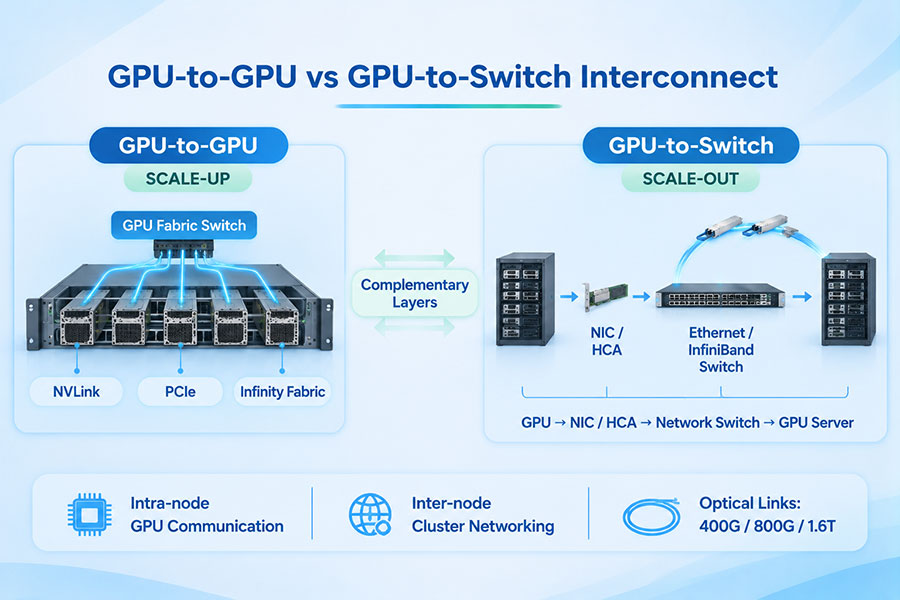
Neither technology should be treated as the default solution for every AI network. Scale-up connections within a tightly coupled accelerator domain may prioritize extremely short electrical paths, bandwidth density, and low energy per bit. Scale-out networks between servers and racks place greater emphasis on reach, optical budgets, switch compatibility, and serviceability.
8. Laser Integration Challenges in Silicon Photonics
Integrating a suitable laser source remains an important engineering challenge for silicon photonics. Silicon provides a mature platform for optical routing and modulation, but the light-generation function generally relies on other semiconductor materials.
Several engineering considerations influence the choice of laser integration method:
Coupling efficiency: Light must transfer efficiently from the laser into the silicon waveguide. Poor alignment or an unsuitable coupling structure can increase insertion loss.
Thermal management: Laser wavelength and output characteristics are temperature-dependent. Thermal design must account for the laser, PIC, drivers, and surrounding package.
Optical feedback: Reflections from the optical path can affect laser stability. Isolation or reflection-tolerant designs may be required.
Packaging complexity: External lasers, fiber interfaces, alignment structures, and electrical connections all affect manufacturing cost and reliability.
Manufacturing yield: Laser integration must be compatible with production processes and the required assembly tolerances.
External laser sources can simplify some PIC manufacturing steps by separating the light source from the silicon photonic chip. Hybrid and heterogeneous integration can reduce the physical separation between the laser and PIC, but require precise material, thermal, and packaging control.
9. Cost, Reliability, and Manufacturing Considerations
VCSEL manufacturing benefits from mature production processes and established use in short-reach optical communication. Its array-based structure can support high-volume manufacturing, although yield, testing, optical alignment, and high-speed performance remain important considerations.
Silicon photonics benefits from semiconductor-style fabrication and the ability to integrate multiple optical functions on a PIC. This integration can improve channel density and reduce the need for separately packaged optical components. However, laser integration, fiber coupling, thermal stabilization, and advanced packaging can add cost and manufacturing complexity.
| Evaluation Factor | VCSEL | Silicon Photonics |
|---|---|---|
| Manufacturing maturity | Established in short-reach datacom applications | Established commercial platform with continuing integration development |
| Integration strategy | Laser arrays and optical assembly | Photonic integration with external, hybrid, or heterogeneous laser sources |
| Packaging priorities | Array alignment, fiber coupling, and thermal control | Laser-to-PIC coupling, fiber attachment, thermal control, and PIC packaging |
| Cost drivers | Laser array, driver, fiber, assembly, and testing | PIC fabrication, laser source, coupling, packaging, and testing |
| Reliability priorities | Laser aging, temperature, optical alignment, and fiber integrity | Laser stability, coupling stability, PIC performance, and package reliability |
There is no universal cost or reliability winner. Production volume, data rate, number of wavelengths, optical reach, packaging method, and system architecture can change the result significantly.
10. How to Select the Right Optical Technology
The choice between a VCSEL-based link and a silicon photonics solution should begin with the required optical interface rather than the laser name alone.
Choose a VCSEL-based architecture when: The link is short-reach, multimode fiber is suitable, parallel optical channels are required, and a mature, compact laser-array solution fits the system cost and power targets.
Consider silicon photonics when: Single-mode connectivity, wavelength multiplexing, high optical integration, or a compact photonic engine is important to the system architecture.
Evaluate hybrid approaches when: The design requires silicon photonic integration but also needs a particular laser structure or wavelength that is better supplied by a separate semiconductor device.
Before selecting a transceiver or optical engine, verify the following parameters:
Required aggregate bandwidth and optical lane rate
Transmission distance and supported fiber type
Operating wavelength and channel spacing
Optical output power, receiver sensitivity, and link budget
Modulation format and transmitter architecture
Electrical interface, host SerDes, and FEC requirements
Power consumption, thermal limits, and cooling method
Form factor, connector type, and equipment compatibility
For pluggable optical connectivity, the C-LIGHT optical transceiver portfolio provides a relevant product category for evaluating optical interfaces across different data rates and applications. The exact product choice should be based on verified wavelength, fiber, reach, optical budget, and host-platform requirements.
11. Conclusion
VCSEL and silicon photonics represent different approaches to building optical communication systems. VCSEL is a laser architecture that has become widely established in short-reach multimode connectivity. Silicon photonics is an integration platform that combines optical routing, modulation, and detection, generally working with an external or integrated semiconductor laser source.
For short-reach parallel links, VCSEL arrays can offer a compact and mature solution. For high-density single-mode links and wavelength-multiplexed architectures, silicon photonics provides significant integration flexibility. In advanced AI infrastructure, both approaches may have a role depending on link distance, bandwidth density, energy targets, and packaging constraints.
The practical decision is not simply which laser is better. It is which complete optical architecture provides the required performance, power efficiency, reliability, manufacturability, and system compatibility.
Planning an optical connectivity project?
Share your target data rate, transmission distance, fiber type, wavelength, and equipment platform with the C-LIGHT team for product and compatibility support.
 >

 >
 >
 >
 >
 >
 >
 >