TEL:+86 132 6656 7067





Artificial intelligence is changing the scale and structure of data center networking. As GPU clusters grow and distributed training moves more data between servers, racks, and facilities, optical components are becoming essential to the bandwidth, reach, and power efficiency of modern AI infrastructure. Demand is expanding beyond complete optical transceivers to the lasers, photodetectors, photonic integrated circuits, optical engines, and precision packaging technologies that make high-speed links possible.
1. AI Workloads Are Reshaping Data Center Connectivity
Traditional data center networks were designed around a mixture of application traffic, storage access, and general-purpose server communication. AI infrastructure introduces a different traffic profile. Large GPU clusters exchange substantial volumes of data during distributed training, model synchronization, parameter updates, and inference operations. These exchanges place sustained pressure on the network connecting accelerators and switches.
As deployments expand from individual servers to multi-rack and multi-row systems, electrical connections become increasingly difficult to scale over longer distances and at higher data rates. Signal attenuation, equalization requirements, cable bulk, and power consumption all influence the practical limits of copper connectivity.
Optical links address many of these constraints by carrying data over fiber with lower transmission loss over distance and strong resistance to electromagnetic interference. This makes optical connectivity particularly important for high-bandwidth connections between racks, switch tiers, and separate data center facilities.
The resulting demand affects an entire component ecosystem. A high-speed optical link requires more than a transceiver housing: it depends on light sources, modulation devices, receiving photodiodes, signal-processing electronics, optical interfaces, and reliable manufacturing processes.
2. High-Speed Transceivers Are Increasing Component Requirements
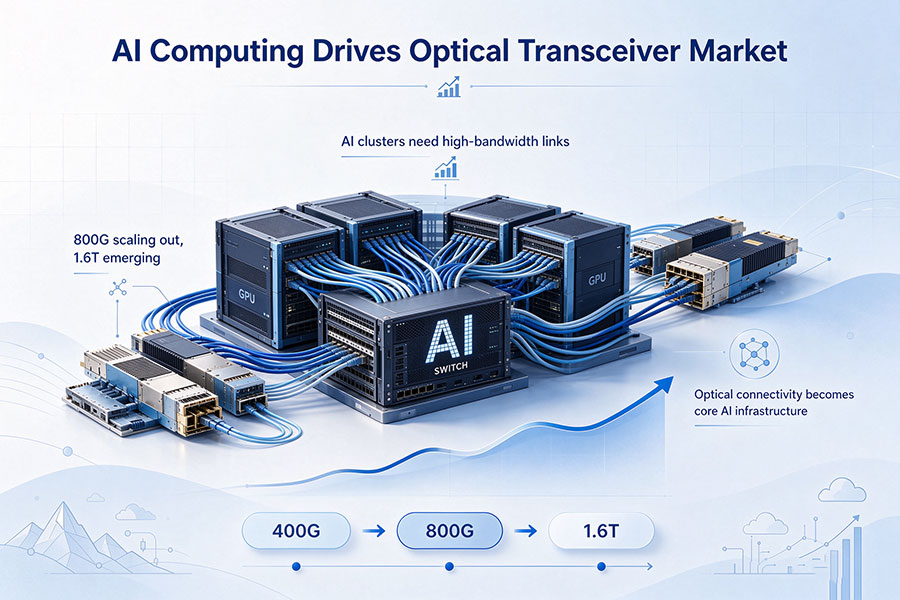
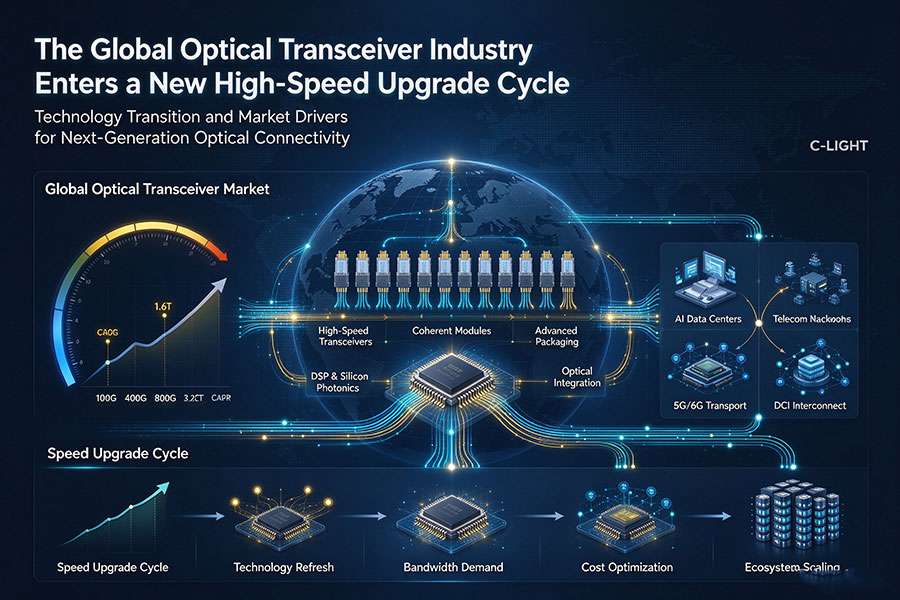
The migration from 400G to 800G and 1.6T connectivity is one of the clearest drivers of optical component demand. Higher aggregate bandwidth requires faster electrical and optical lanes, tighter signal integrity, and more demanding thermal and optical performance.
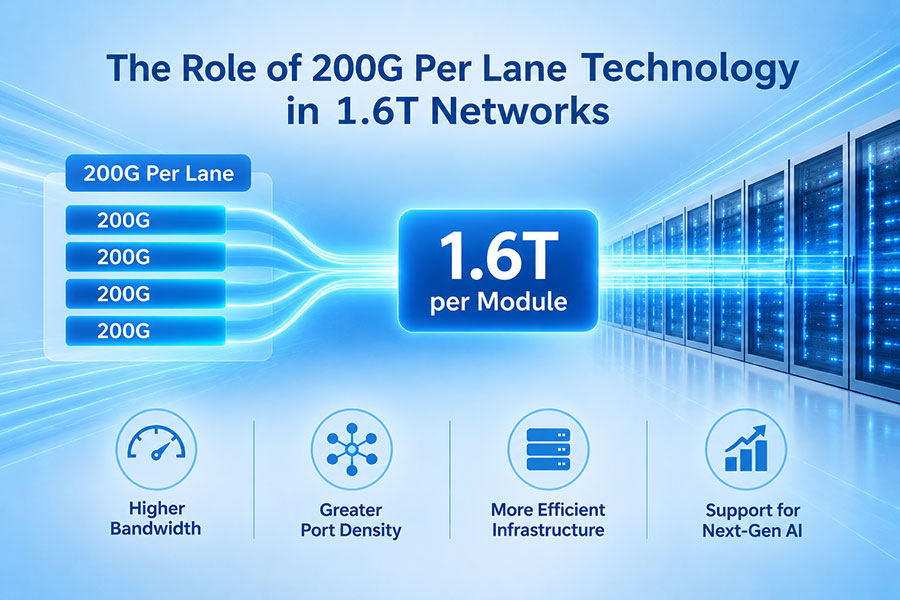
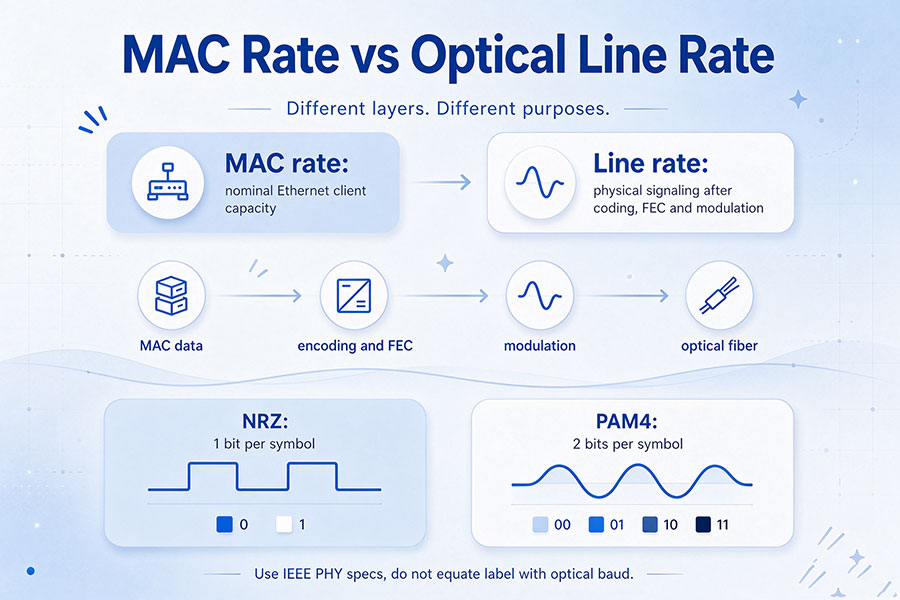
Many 800G designs use eight approximately 100G-class electrical lanes, while emerging 1.6T implementations move toward eight approximately 200G-class lanes. Actual lane configurations depend on the interface specification and product architecture. Higher lane rates place additional demands on laser performance, modulation bandwidth, receiver sensitivity, DSP capability, and optical assembly accuracy.
| Connectivity generation | Typical design direction | Component implications |
|---|---|---|
| 400G | Established high-speed data center interconnects | High-speed laser and detector devices, PAM4 signal processing, precision optical packaging |
| 800G | Increasingly deployed in large AI and cloud networks | Higher-volume laser supply, improved photonic integration, advanced DSP and thermal design |
| 1.6T | Emerging next-generation high-bandwidth connectivity | 200G-class lane technology, advanced photonic integration, tighter manufacturing and test requirements |
| Beyond 1.6T | Development toward higher lane rates and denser optical architectures | Further advances in modulators, laser sources, materials, packaging, and signal integrity |
TrendForce reported in April 2026 that the AI-focused optical transceiver market was projected to grow from US$16.5 billion in 2025 to US$26 billion in 2026. This estimate covers the AI-focused segment rather than the entire optical communications market. The same research identifies growing demand for 800G-and-above modules as a major driver of upstream component requirements.
3. Laser Sources Are a Critical Part of the Supply Chain
Laser diodes generate the optical signals transmitted through fiber. Their output power, wavelength stability, linewidth, modulation characteristics, and operating reliability directly affect link performance. As AI networks move toward higher speeds and more demanding reach requirements, laser technology becomes an increasingly important part of system design.
EML laser technology
An electro-absorption modulated laser integrates a laser source and an electro-absorption modulator on a semiconductor chip. EML devices are used in high-performance optical links where modulation quality, signal integrity, and transmission reach are important. They are particularly relevant to demanding single-mode applications.
Continuous-wave laser sources
Continuous-wave lasers provide a stable optical carrier that can be modulated by a separate photonic device. They are important in silicon photonics architectures, where the laser source and silicon-based modulation and routing functions may be implemented as separate components or integrated through advanced packaging.
TrendForce reported in June 2026 that suppliers were expanding EML and continuous-wave distributed-feedback laser capacity in response to AI data center demand. Its analysis also highlighted the growing role of continuous-wave sources in silicon photonics and co-packaged optics applications.
These technologies serve different design requirements rather than representing a universal replacement sequence. Selection depends on data rate, reach, optical architecture, power budget, manufacturing maturity, and system cost.
4. Silicon Photonics Is Expanding the Role of Photonic Integration
Silicon photonics integrates optical functions such as waveguides, modulators, and other photonic structures on a silicon-based platform. Instead of assembling every optical function as a separate discrete component, designers can integrate multiple functions into a photonic integrated circuit.
This approach is attractive for AI data centers because it can support compact optical engines, high channel density, and scalable manufacturing. It also creates opportunities to combine silicon photonics with external continuous-wave lasers, optical amplifiers, and detector technologies made from other semiconductor materials.
Silicon photonics does not eliminate the need for specialized optical materials. Silicon is not an efficient native light source for conventional telecom applications, so many designs rely on separately manufactured or heterogeneously integrated III-V laser devices. InP-based materials remain important for lasers and other active photonic components.
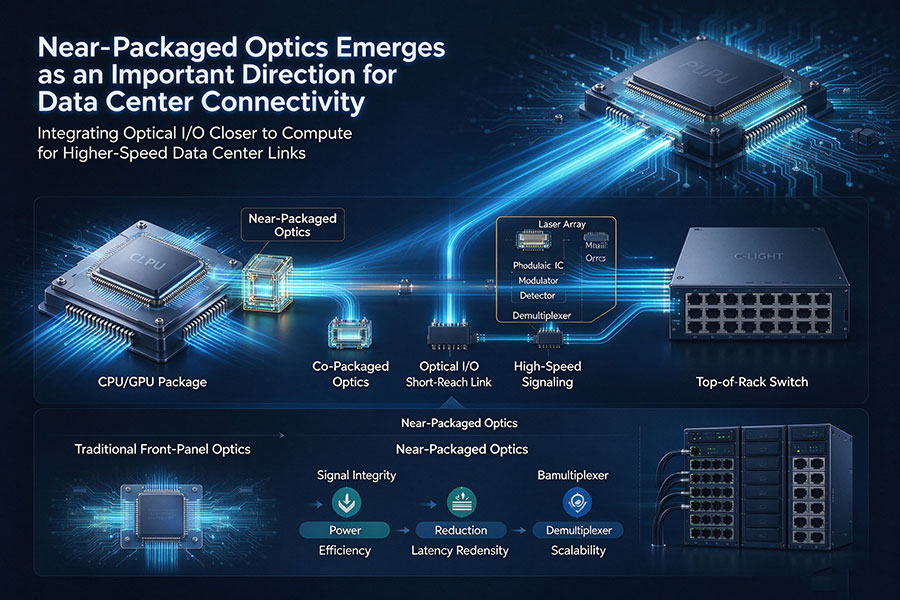
As optical engines move closer to switch ASICs, photonic integration also becomes relevant to near-packaged optics and co-packaged optics. These approaches aim to shorten high-speed electrical paths and address power and bandwidth-density constraints in next-generation switching systems.
5. Photodetectors and Receiver Components Must Keep Pace
At the receiving end of an optical link, photodetectors convert incoming light into electrical current. Their responsivity, bandwidth, noise characteristics, and operating stability influence the quality of the recovered signal.
PIN photodiodes and avalanche photodiodes are two established detector technologies. PIN devices are widely used in high-speed receivers because of their relatively straightforward operation and low noise. APDs provide internal gain through avalanche multiplication, which can improve sensitivity in suitable applications but introduces additional bias, noise, and temperature considerations.
The photodetector is only one part of the receiver chain. The transimpedance amplifier converts the small photocurrent into a usable voltage signal. Additional amplification, equalization, clock recovery, and digital signal processing may be used depending on the architecture.
At higher data rates, receiver performance must be considered together with the transmitter, fiber channel, connector losses, and system-level error budget. A detector with strong standalone specifications cannot compensate for every weakness elsewhere in the link.
6. DSPs, Drivers, and Analog Components Support Higher Data Rates
Optical transceivers contain a combination of photonic and electronic components. Laser drivers control the electrical signals supplied to optical transmitters, while transimpedance amplifiers and other receiver electronics process signals from photodetectors.
Digital signal processors are used in many high-speed optical modules to compensate for channel impairments, manage signal quality, and support reliable transmission. Their capabilities become increasingly important as lane rates rise and electrical and optical margins become more challenging.
However, not every optical architecture uses the same signal-processing arrangement. Linear pluggable optics reduce or remove conventional module DSP functions in selected designs, placing greater responsibility on the host electrical interface and system-level signal integrity. Co-packaged and near-packaged architectures also change where electrical and optical functions are located.
LightCounting's February 2026 industry update described strong growth in PAM4 chipset demand associated with 800G and 1.6T optical connectivity. It also discussed active cables and linear optical architectures as additional parts of the evolving AI interconnect market.
7. Optical Engines and Advanced Packaging Are Becoming More Important
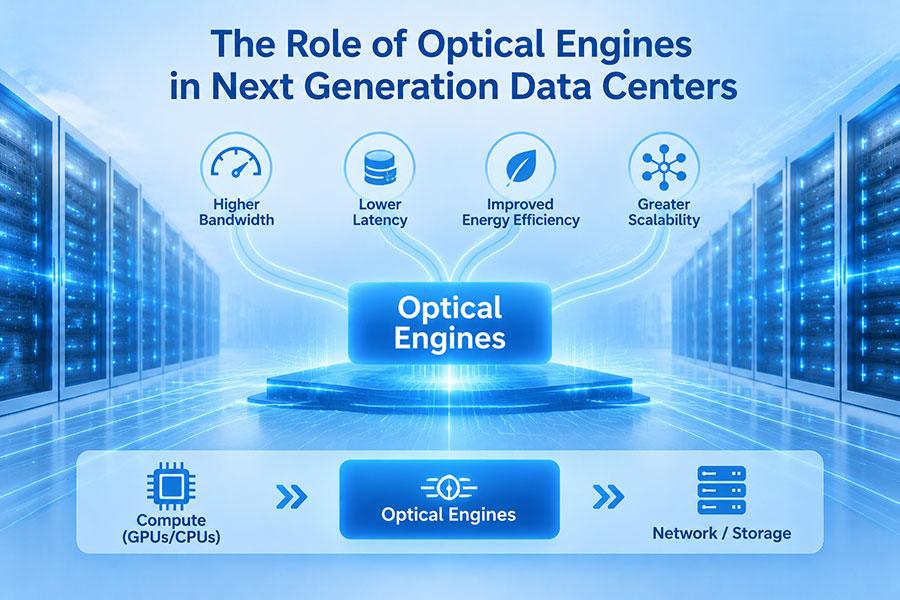
An optical engine combines key photonic functions required to transmit or receive optical signals. Depending on the design, it may contain laser or modulator interfaces, photodetectors, waveguides, coupling structures, and associated electrical connections.
As bandwidth density increases, the packaging process becomes a major determinant of manufacturing yield and reliability. Optical alignment must be accurate, fiber attachment must remain stable, and thermal behavior must be controlled across the assembly.
Near-packaged optics places optical engines close to the switching ASIC while retaining a degree of physical separation. Co-packaged optics brings optical engines into the same package environment as the switch ASIC. Both approaches seek to reduce the distance traveled by high-speed electrical signals before conversion to optical signals.
These designs create demand for precision fiber-array units, optical connectors, photonic integrated circuits, laser sources, thermal-management structures, and specialized test equipment. They also introduce new requirements for repairability, service access, and system-level reliability.
8. Fiber, Connectors, and Passive Optical Components Remain Essential
Active components generate, modulate, and detect optical signals, but passive components provide the physical optical paths that connect them. Fiber, connectors, adapters, splitters, wavelength filters, and high-density cable assemblies all contribute to the performance of an AI data center network.
As switch port counts and optical lane counts increase, fiber infrastructure must support more connections within limited rack and cable-tray space. High-density MPO/MTP trunk cables, breakout assemblies, and structured fiber distribution systems help organize these connections.
Connector cleanliness, insertion loss, return loss, polarity, fiber mapping, and bend radius require careful control. A high-speed optical link can experience instability or reduced margin if its passive connection path is poorly designed or maintained.
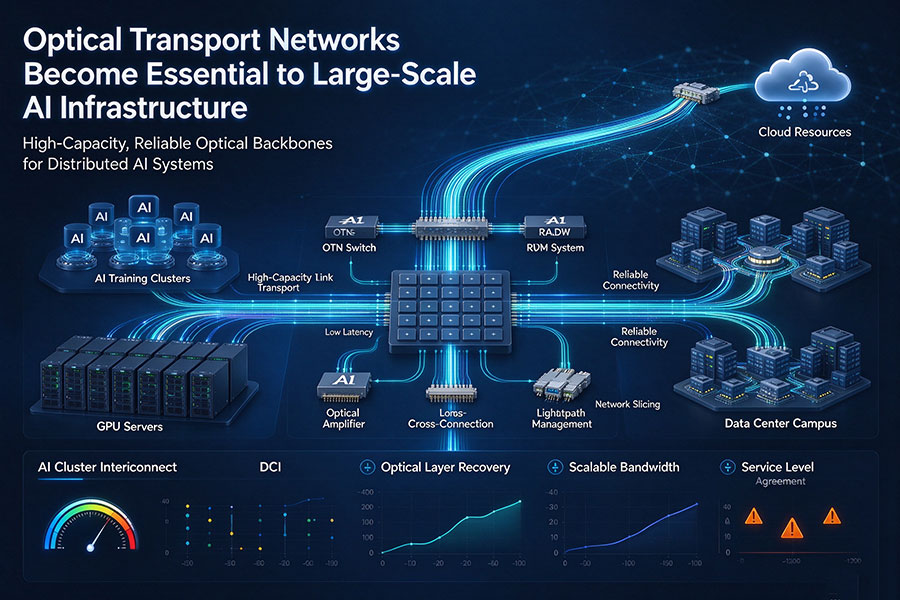
Wavelength-division multiplexing components also support applications that transmit multiple optical channels over a shared fiber pair. In data center interconnect and other longer-reach environments, filters, multiplexers, demultiplexers, and coherent optical components can help increase fiber capacity.
9. Supply Constraints Are Moving Further Upstream
Growing demand for complete optical modules creates additional pressure on the upstream component supply chain. Laser chips, indium phosphide substrates, photonic integrated circuits, DSPs, optical fiber, and precision packaging capacity all influence how quickly manufacturers can increase output.
TrendForce identified EML and continuous-wave laser availability, high-precision optical alignment, and thermal management as important constraints on AI optical transceiver capacity expansion. Its June 2026 analysis also described increased investment in laser production capacity as suppliers respond to higher-speed optical requirements.
These constraints show why optical module production cannot be expanded simply by adding final assembly lines. A shortage of one specialized component can limit the output of an otherwise capable manufacturing operation. Qualification cycles and consistency requirements also make rapid supplier substitution difficult.
| Supply-chain segment | Representative components | Key production considerations |
|---|---|---|
| Semiconductor materials | InP substrates, silicon wafers, epitaxial materials | Material quality, wafer availability, process consistency |
| Active optical chips | EML, CW lasers, PIN and APD photodiodes | Optical performance, yield, reliability, wavelength control |
| Photonic integration | Silicon photonics PICs, optical engines, modulators | Integration density, coupling efficiency, thermal stability |
| Electronic components | DSPs, drivers, TIAs, retimers | Bandwidth, power consumption, signal integrity, availability |
| Passive components | Fiber, connectors, filters, fiber arrays | Insertion loss, alignment accuracy, mechanical reliability |
| Module assembly and testing | Optical subassemblies, transceiver packages | Precision alignment, calibration, test throughput, quality control |
10. Power Efficiency Is Influencing Component Selection
AI data centers consume substantial power across compute, memory, switching, cooling, and networking systems. As the number of optical ports increases, the power used by each link becomes an important factor in overall facility efficiency.
Transceiver power depends on data rate, reach, optical architecture, DSP implementation, laser requirements, and thermal conditions. A module with a higher bandwidth rating is not automatically more efficient on a per-bit basis; the relevant comparison includes actual power consumption, usable throughput, and operating conditions.
LPO, NPO, and CPO are receiving attention partly because they change the location and complexity of electrical-to-optical conversion. LPO seeks to reduce module-side signal processing in suitable systems. NPO places optical engines near the ASIC, while CPO integrates them more closely with the switch package.
These architectures involve trade-offs. Lower electrical power may come with stricter host requirements, different service procedures, or more complex packaging and testing. The best solution depends on the system design rather than one technology being suitable for every link.
11. AI Networking Is Expanding Demand Across Different Optical Applications
Optical component demand is not limited to connections between adjacent switches. AI infrastructure uses several networking domains, each with different bandwidth, reach, and reliability requirements.
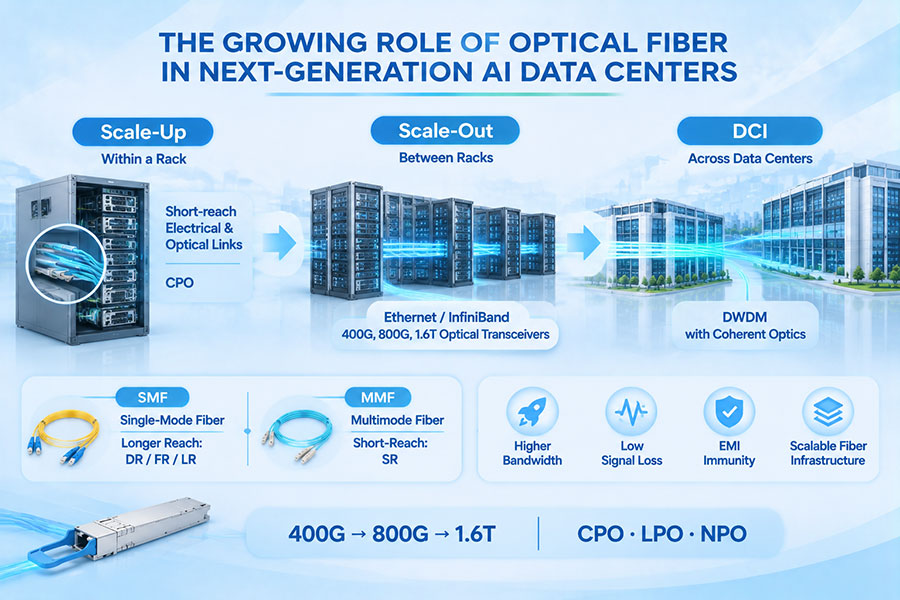
Scale-out networking: Connects servers and accelerator racks through Ethernet or InfiniBand fabrics. High-speed pluggable transceivers and optical cable assemblies are widely relevant.
Scale-up connectivity: Links accelerators within tightly coupled compute systems. Electrical connections remain important, while optical approaches are being developed for architectures that require greater reach or bandwidth density.
Data center interconnect: Connects separate buildings, campuses, or facilities. Coherent optics and DWDM systems can support higher-capacity transmission over longer distances.
Optical switching: Uses configurable optical paths to connect selected network endpoints. Optical circuit switching can complement electronic packet switching in architectures with suitable traffic patterns.
These application areas create demand for different combinations of transceivers, lasers, photodetectors, optical engines, fiber assemblies, and wavelength-management components. As AI infrastructure becomes more distributed, the range of optical technologies used across the network is likely to broaden.
12. Manufacturing and Testing Requirements Are Becoming More Demanding
Higher optical data rates leave less room for manufacturing variation. Laser alignment, fiber coupling, optical power calibration, receiver sensitivity, wavelength accuracy, and thermal behavior all need to be controlled within the product's design limits.
Testing should cover both component-level characteristics and complete module performance. Depending on the product, validation may include transmitter optical power, extinction ratio, eye diagrams, receiver sensitivity, overload, wavelength accuracy, power consumption, temperature behavior, and bit error rate.
For high-speed modules, electrical host compatibility is also essential. A module must operate correctly with the intended switch or network device, firmware, lane mapping, management interface, and FEC configuration. Mechanical fit alone does not establish interoperability.
As optical engines and photonic integration become more complex, manufacturers also need repeatable assembly processes and appropriate reliability testing. Production scalability depends on achieving consistent optical performance across large volumes, not simply demonstrating a successful engineering sample.
13. Market Development Will Depend on Both Volume and Technology Transition
AI data center investment is increasing demand for optical components, but market growth is not uniform across every product category. The transition to 800G and 1.6T creates opportunities for high-speed lasers, photonic integration, advanced DSPs, and precision packaging. At the same time, established 400G and 800G products remain important in networks that are expanding or upgrading in stages.
TrendForce projected the AI-focused optical transceiver market to reach US$26 billion in 2026, while its June 2026 research highlighted the growing importance of NPO and CPO development. These estimates describe different market segments and should not be combined as if they measured the same product category.
Technology adoption will also vary by network architecture. Pluggable transceivers offer modularity and field replacement. LPO can reduce selected module-side processing requirements. NPO and CPO can shorten electrical paths and increase integration density, but they bring different serviceability, manufacturing, and reliability considerations.
For component manufacturers, long-term competitiveness will depend on product performance, production yield, qualification with system customers, supply-chain resilience, and the ability to support multiple optical architectures.
14. Conclusion
The growth of AI data centers is increasing demand throughout the optical component ecosystem. Higher-speed transceivers are only one part of this development. Laser diodes, photodetectors, silicon photonics devices, DSPs, optical engines, fiber assemblies, and precision packaging technologies all contribute to the capacity and reliability of AI networking infrastructure.
As networks move toward 800G, 1.6T, and more integrated optical architectures, component performance and manufacturing capability will become increasingly important. The companies able to deliver reliable devices, consistent production quality, and compatibility across evolving network platforms will play an important role in the next stage of optical connectivity.
For network operators and equipment manufacturers, component selection should therefore consider the complete optical link—from the light source and photonic integration platform to the receiver, fiber path, host interface, and system-level validation.
Reliable optical connectivity depends on the right combination of transceiver technology, component performance, and network compatibility. For optical transceiver solutions and application support, visit the optical transceiver product range or Contact C-LIGHT.
 >

 >
 >
 >
 >
 >
 >
 >