TEL:+86 132 6656 7067





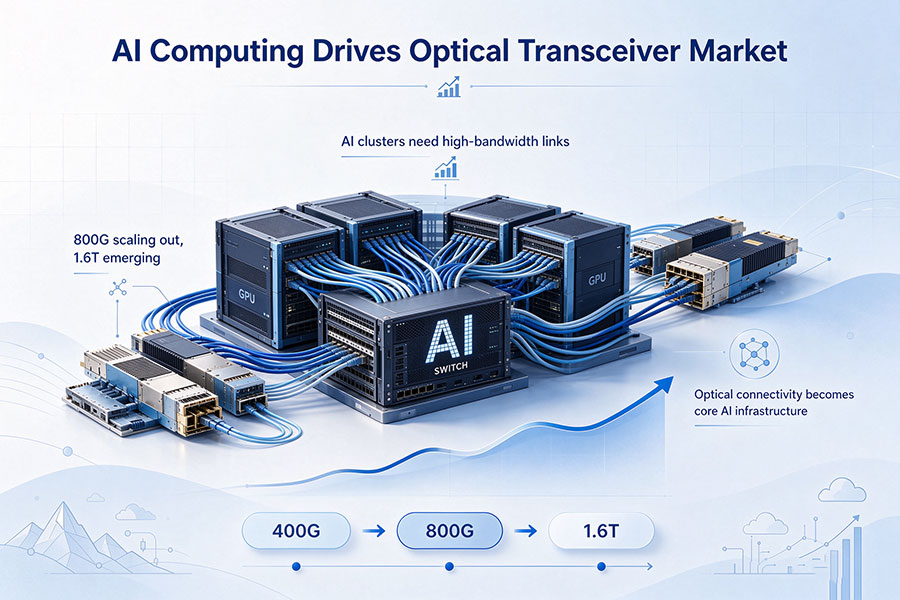
Next-generation data centers require significantly higher bandwidth, greater connection density, and more efficient data transmission between processors, switches, and storage systems. As AI workloads expand and network speeds move toward 800G, 1.6T, and beyond, conventional electrical interconnects face increasing challenges in signal integrity, power consumption, and transmission distance.
Optical engines are becoming an important part of this transition. By converting electrical signals into optical signals and optical signals back into electrical signals, they enable high-speed communication over fiber while supporting increasingly compact optical interconnect architectures. Their integration with silicon photonics, near-packaged optics (NPO), and co-packaged optics (CPO) is changing how optical connectivity is designed inside data centers.
1. What Is an Optical Engine?
An optical engine is an optoelectronic subsystem that performs electrical-to-optical (E/O) and optical-to-electrical (O/E) conversion. It combines photonic components and electronic circuits to transmit and receive high-speed optical signals.
Unlike a conventional pluggable optical transceiver, an optical engine is not necessarily a complete, independently removable module. It is often designed as an internal component of a larger optical interconnect system, such as an NPO or CPO assembly.
The exact configuration varies by architecture and manufacturer. A typical optical engine may contain the following components:
Photonic Integrated Circuit (PIC): Integrates optical functions such as modulation, wavelength handling, and photodetection on a photonic chip.
Electronic Integrated Circuit (EIC): Provides electrical signal processing and interfaces with the host system, including driver and receiver circuitry.
Laser source: Supplies the optical carrier used for transmission. It may be integrated into the engine or supplied externally through a remote laser architecture.
Optical coupling components: Connect the photonic circuit to optical fibers or other optical interfaces.
Packaging and thermal components: Provide mechanical support, electrical connections, alignment, and heat management.
The integration of these components allows an optical engine to provide high-speed optical connectivity in a compact footprint. Its design depends on the required bandwidth, reach, power budget, packaging architecture, and system interface.
2. How Does an Optical Engine Work?
An optical engine supports two primary signal-conversion processes: electrical-to-optical conversion at the transmitter and optical-to-electrical conversion at the receiver.
2.1 Electrical-to-Optical Conversion
At the transmitting side, high-speed electrical data from a switch ASIC, processor, or host interface reaches the optical engine. Driver circuits condition the electrical signal and control an optical modulator or laser-based transmitter.
The optical transmitter encodes the data onto light. Depending on the implementation, this may involve directly modulating a laser or using an external laser with a separate optical modulator. The resulting optical signal is then coupled into a fiber for transmission.
2.2 Optical-to-Electrical Conversion
At the receiving side, optical signals enter the engine through an optical fiber. A photodetector converts the incoming light into an electrical current. Transimpedance amplifiers (TIAs) and other receiver circuits process the signal before it is delivered to the host electrical interface.
This conversion enables data to travel over optical fiber while maintaining an electrical interface with the connected switching or computing hardware.
2.3 Signal Conversion and Data Flow
A simplified optical transmission path can be represented as follows:
Host ASIC → Electrical Interface → Optical Engine → Optical Fiber → Optical Engine → Electrical Interface → Host ASIC
In more integrated architectures, the electrical path between the host chip and optical engine becomes shorter. This can reduce electrical channel loss and simplify high-speed signal transmission, although the overall benefit depends on the design of the complete system.
3. Why Optical Engines Matter in Next-Generation Data Centers
Optical engines are becoming increasingly important as data center networks approach the limits of conventional electrical connectivity. Their value comes from several related improvements in bandwidth, signal transmission, and system integration.
3.1 Higher Bandwidth Density
AI clusters and high-performance computing systems require large volumes of data to move between GPUs, switches, and other processing devices. Optical engines can support multiple high-speed optical lanes within a compact package, helping increase the amount of bandwidth available within a limited physical space.
This is particularly important for switch platforms with aggregate capacities of 51.2T, 102.4T, and higher. As switch bandwidth increases, the optical interface must scale without creating excessive limitations in front-panel space, electrical routing, or fiber management.
3.2 Lower Electrical Interconnect Power
High-speed electrical signals become increasingly difficult to transmit over longer PCB traces as data rates rise. Signal attenuation, reflections, and other channel impairments may require additional equalization, retiming, or signal-conditioning circuitry.
Placing optical engines closer to the host ASIC can shorten high-speed electrical connections. This creates an opportunity to reduce electrical channel losses and the power associated with driving long, high-speed copper traces.
However, the actual system power savings depend on the optical engine, laser architecture, electronic circuitry, cooling requirements, and integration design. Optical connectivity does not automatically consume less power in every application.
3.3 Improved Signal Integrity Over Longer Links
Optical fiber offers low attenuation and immunity to electromagnetic interference compared with electrical copper connections. Optical engines make it possible to convert electrical data into optical signals close to the source, allowing data to travel over fiber between racks, switches, and other network devices.
This is especially useful in large AI data centers, where high-bandwidth connections may need to span multiple racks or equipment areas.
3.4 Greater Integration Flexibility
Optical engines can be integrated into different system architectures. They may be used in pluggable optical modules, near-packaged optics, or co-packaged optics, depending on the required balance between serviceability, electrical channel length, bandwidth density, and system complexity.
This flexibility allows data center designers to adopt optical connectivity at different levels rather than relying on a single packaging approach.
4. Optical Engines in Different Integration Architectures
The position of an optical engine in the system determines how electrical signals reach it and how optical connections are managed. Several integration approaches are used or being developed for high-performance data center networks.
| Architecture | Optical Engine Position | Main Characteristics | Key Considerations |
|---|---|---|---|
| Pluggable Optics | Inside a removable optical transceiver at the front panel | Modular design, established ecosystem, field replaceability | Longer electrical path between the host ASIC and module |
| On-Board Optics (OBO) | Mounted directly on the host PCB | Shorter electrical connections than front-panel pluggables | Board-level integration and maintenance complexity |
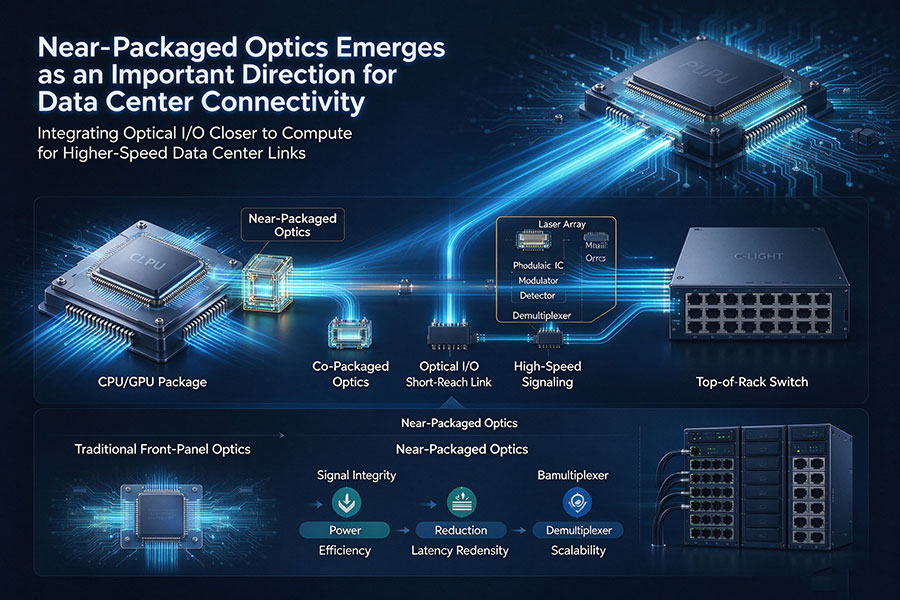
| Near-Packaged Optics (NPO) | Close to the host ASIC but outside its package | Short electrical paths while retaining a degree of modularity | Thermal design, optical connections, and serviceability |
| Co-Packaged Optics (CPO) | Integrated within the same package assembly as the host ASIC | Very short electrical connections and high integration density | Packaging yield, thermal management, testing, and repair |
4.1 Optical Engines in Pluggable Transceivers
In conventional pluggable optics, the optical engine's functions are implemented within a removable optical transceiver. The module connects to the host switch through an electrical interface and connects to the fiber network through its optical port.
This architecture offers practical advantages in deployment and maintenance. If an optical module fails or needs an upgrade, technicians can generally replace the module without replacing the entire switch.
For current data center deployments, products such as 800G QSFP-DD optical transceivers and 800G OSFP optical transceivers provide established pluggable connectivity options.
4.2 Optical Engines in Near-Packaged Optics
Near-packaged optics places optical engines close to the host ASIC while keeping them outside the ASIC package. This reduces the distance that high-speed electrical signals must travel before optical conversion.
NPO provides an intermediate integration approach between traditional pluggable optics and CPO. It can improve electrical channel conditions while retaining more separation between the switch chip and optical subsystem than a fully co-packaged design.
The approach is relevant to high-bandwidth switching systems that need improved optical density but still require practical optical engine access and system maintenance options.
4.3 Optical Engines in Co-Packaged Optics
CPO integrates optical engines within the same package assembly as a switch ASIC or another high-performance host chip. This arrangement significantly reduces the length of high-speed electrical connections between the electronic and photonic components.
By moving optical conversion closer to the switch silicon, CPO can support higher bandwidth density and potentially reduce the power associated with long electrical channels and some signal-conditioning functions.
However, CPO also introduces new engineering requirements. Optical engines, host chips, package substrates, fiber interfaces, and thermal solutions must operate together within a tightly integrated system. Component replacement and fault isolation can also be more complicated than with conventional pluggable modules.
For a related discussion of this architecture, see Why Is CPO Important for 1.6T Networks?
5. The Role of Silicon Photonics in Optical Engine Development
Silicon photonics is one of the key technologies supporting the development of compact, high-bandwidth optical engines. It uses silicon-based photonic integration to implement optical functions on a chip, reducing the need to assemble every optical component as a separate device.
A silicon photonics platform may integrate waveguides, modulators, photodetectors, and other optical structures. Electronic circuits and laser sources are then integrated or coupled through an appropriate packaging approach.
5.1 Photonic Integration
Traditional optical assemblies may use multiple discrete components connected through precise optical alignment. Silicon photonics can combine several optical functions on a single photonic integrated circuit, helping reduce component count and support more compact designs.
5.2 Modulation and Detection
Silicon photonics optical engines commonly use integrated modulators and photodetectors to transmit and receive high-speed data. Modulator design, driver performance, receiver sensitivity, and packaging losses all influence the final optical performance.
5.3 Laser Integration and External Laser Sources
Silicon is not an efficient light source by itself, so silicon photonics systems require a suitable laser source. Depending on the architecture, the laser may be integrated through hybrid or heterogeneous integration, or supplied externally.
External laser architectures can separate the light source from the optical engine. This may provide flexibility in laser placement and thermal management, but it also introduces additional optical interfaces and coupling considerations.
The choice between integrated and external laser arrangements depends on reliability requirements, optical power, packaging constraints, and system-level design.
6. Optical Engines and AI Data Center Connectivity
AI data centers place exceptional demands on network bandwidth because thousands of accelerators may need to exchange model parameters, training data, and intermediate results. Network performance increasingly depends on the efficiency of communication between compute nodes, not just the processing capability of individual GPUs.
Optical engines support this environment by enabling high-bandwidth links across different levels of the network.
6.1 GPU-to-GPU Communication
Large AI clusters rely on fast communication between GPUs and accelerator systems. Optical interconnects can support connections across longer distances than many high-speed copper alternatives, making them useful when the physical layout extends beyond a single server or tightly integrated system.
6.2 Switch-to-Switch Connectivity
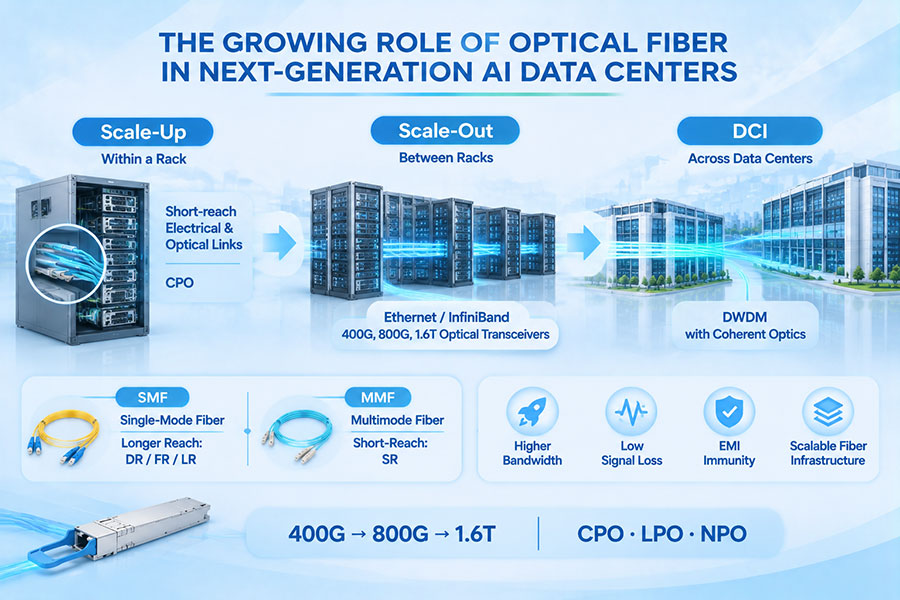
High-capacity Ethernet and InfiniBand networks require substantial bandwidth between switches. Optical engines help support high-density optical ports and connections across racks, rows, and data center zones.
6.3 Scaling to 800G and 1.6T Networks
As data center networks move toward higher aggregate bandwidth, optical engine designs must support faster electrical interfaces, more efficient optical modulation, and increasingly dense fiber connections.
For example, 800G optical transceivers and emerging 1.6T platforms represent important connectivity options for next-generation AI infrastructure. C-LIGHT provides product information for 800G QSFP-DD, 800G OSFP, and 1.6T OSFP-RHS optical modules.
These pluggable products and integrated optical engines serve different implementation approaches. They should be evaluated according to the host platform, link architecture, transmission distance, and system requirements rather than treated as interchangeable components.
7. Optical Engine Design Challenges
Although optical engines offer important advantages for high-speed connectivity, their development involves several technical challenges. Successful deployment requires more than increasing the data rate of an individual photonic component.
7.1 Thermal Management
Optical engines operate alongside high-performance electronic components that generate substantial heat. Temperature changes can affect laser output, modulator characteristics, wavelength stability, and receiver performance.
Thermal design must therefore account for the optical engine, host ASIC, package structure, cooling system, and surrounding components.
7.2 Optical Coupling and Fiber Management
Efficient optical coupling between the photonic chip and external fiber is essential. Alignment tolerances, connector design, insertion loss, and fiber routing all influence system performance.
As the number of optical channels increases, fiber management becomes more demanding. High-density optical connectors and carefully designed fiber routing are important for maintaining reliable connectivity.
7.3 Manufacturing Yield and Reliability
Optical engines combine photonic dies, electronic circuits, laser sources, and precision packaging. Each assembly and alignment step can affect manufacturing yield and long-term reliability.
Known-good-die testing, optical inspection, burn-in procedures, and system-level validation are important for identifying defects before deployment.
7.4 Serviceability and Replacement
Pluggable transceivers can generally be replaced independently of the host switch. NPO and CPO designs may involve more complex replacement procedures because optical engines are located closer to or integrated with the host electronics.
System designers must balance integration density and power efficiency against repair procedures, component accessibility, and the cost of servicing the complete platform.
7.5 Interoperability and Standardization
Optical engine performance depends on electrical interfaces, optical specifications, fiber connections, management functions, and packaging requirements. Consistent interfaces can help improve compatibility across components and suppliers.
However, compliance with an interface specification does not guarantee that every optical engine will work in every host system. Platform validation remains necessary to confirm electrical, optical, thermal, and management compatibility.
8. Optical Engine vs. Optical Transceiver
Optical engines and optical transceivers are closely related, but they are not the same type of product. An optical engine is generally a functional optoelectronic subsystem, while a complete optical transceiver is designed to provide a defined host interface and optical network connection.
| Comparison | Optical Engine | Optical Transceiver |
|---|---|---|
| Primary Function | Electrical-optical signal conversion within a system | Complete optical transmission and reception interface |
| Integration | May be integrated into NPO, CPO, or other assemblies | Typically housed in a pluggable module |
| Host Interface | Depends on the system architecture | Uses a defined electrical host interface |
| Optical Connection | May use internal or external fiber coupling | Usually provides an external optical connector |
| Replacement | Depends on the packaging and system design | Generally replaceable as an independent module |
| Typical Application | NPO, CPO, integrated optical I/O | Switch, router, server, and data center optical links |
A complete optical transceiver may contain an optical engine or equivalent optical and electronic subsystems, together with its housing, electrical connector, management interface, and other supporting components. The exact internal design varies by product generation and manufacturer.
9. What to Consider When Selecting an Optical Engine
Optical engine selection should begin with the requirements of the complete network platform. A high-bandwidth engine is not necessarily suitable for every switch or accelerator system.
Bandwidth and lane configuration: Confirm the aggregate bandwidth, per-lane data rate, lane count, and electrical interface requirements.
Transmission distance: Select an optical design appropriate for the required reach, fiber type, wavelength, and link budget.
Power consumption: Evaluate the complete optical subsystem, including drivers, receivers, laser sources, and cooling.
Integration architecture: Determine whether pluggable optics, OBO, NPO, or CPO is appropriate for the system.
Thermal requirements: Check operating temperature, heat dissipation, and cooling compatibility.
Optical interface: Verify fiber type, connector format, channel mapping, insertion loss, and optical coupling requirements.
Reliability and serviceability: Consider component lifetime, replacement procedures, test access, and fault isolation.
Interoperability: Validate the engine against the intended host platform and relevant interface specifications.
For optical connectivity projects that use conventional pluggable modules, testing remains an important part of deployment. The Optical Transceiver Testing and Validation Guide provides additional context on optical performance and compatibility verification.
10. The Future of Optical Engines in Data Centers
The development of optical engines is closely connected to the broader transition toward higher-bandwidth, more integrated data center networks. As AI infrastructure expands, optical connectivity is moving closer to the processors and switching devices that generate and handle network traffic.
Several technology directions will influence future optical engine development:
Higher per-lane data rates: Optical engines will need to support faster electrical and optical interfaces as network bandwidth increases.
Advanced silicon photonics: More integrated photonic functions may improve compactness and support higher channel density.
Near-packaged and co-packaged optics: NPO and CPO will continue to drive demand for optical engines designed for closer integration with host ASICs.
Improved laser architectures: Integrated and external laser solutions will continue to evolve to address power, reliability, and thermal requirements.
Advanced packaging: Better optical coupling, heterogeneous integration, and manufacturing processes will be important for improving yield and scalability.
System-level optical I/O: Optical connectivity may extend beyond switch ports toward processor and accelerator packages as optical I/O technologies mature.
These developments do not mean that one optical architecture will replace all others. Pluggable optics, NPO, and CPO address different combinations of bandwidth, reach, maintenance, cost, and integration requirements. Their coexistence is likely to remain important as data center infrastructure evolves.
Conclusion
Optical engines are becoming essential building blocks for next-generation data center connectivity. They provide the electrical-to-optical and optical-to-electrical conversion needed to move high-speed data through fiber, while enabling more compact and integrated optical architectures.
As AI clusters and high-capacity switching systems continue to scale, optical engines will play an increasingly important role in supporting bandwidth density, electrical signal integrity, and efficient system integration. Advances in silicon photonics, NPO, CPO, and optical packaging will further shape their development.
The long-term value of an optical engine depends not only on its optical performance but also on how effectively it integrates with the host ASIC, fiber infrastructure, thermal design, and network architecture. These system-level considerations will determine how optical engines support the next generation of data center networks.
 >

 >
 >
 >
 >
 >
 >
 >