C-LIGHT telephone TEL:+86 158 1857 3751    
Language
C-LIGHT search

OTU4 100G QSFP28 ZR4 vs ER4: Specifications, BER Performance and Telecom Applications

Posted on Jul-10-2026

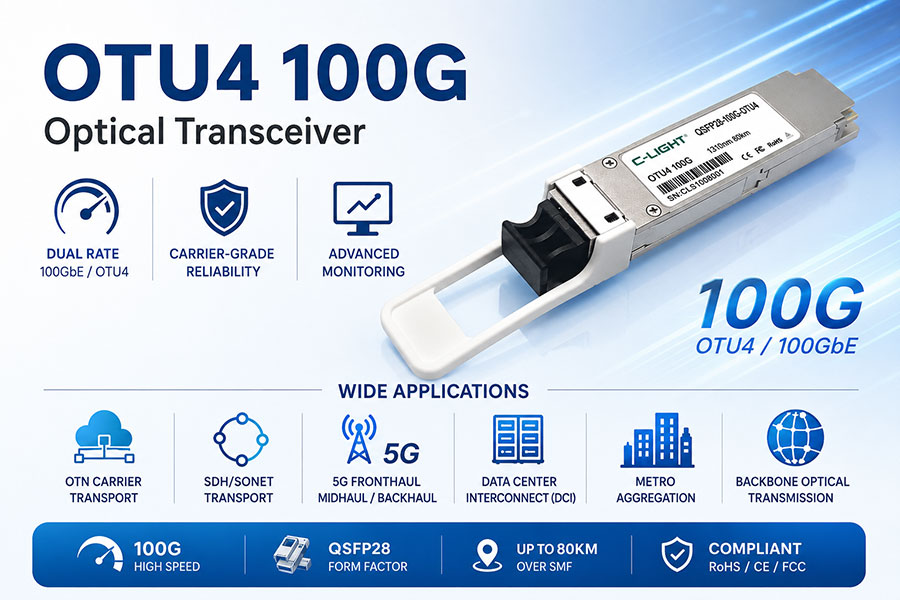
OTU4-100G-Optical-Transceiver.jpg

1. What Is an OTU4 100G Optical Transceiver?

OTU4 (Optical Transport Unit level 4) is the 100G optical transport encapsulation standard defined by ITU-T G.709 for Optical Transport Networks (OTN). Unlike standard 100GbE optical transceivers, OTU4 modules support both Ethernet services and carrier-grade transport applications while providing enhanced reliability, monitoring, and network management.

Typical deployment scenarios include:

  • OTN carrier transport networks

  • SDH/SONET transport

  • 5G fronthaul, midhaul, and backhaul

  • Data Center Interconnect (DCI)

  • Metro aggregation networks

  • Backbone optical transmission

Most OTU4 QSFP28 optical transceivers support Dual Rate operation, allowing seamless switching between 100GbE (103.125 Gb/s) and OTU4 line rate (111.809 Gb/s).

2. C-LIGHT OTU4 ER4 vs ZR4 Overview

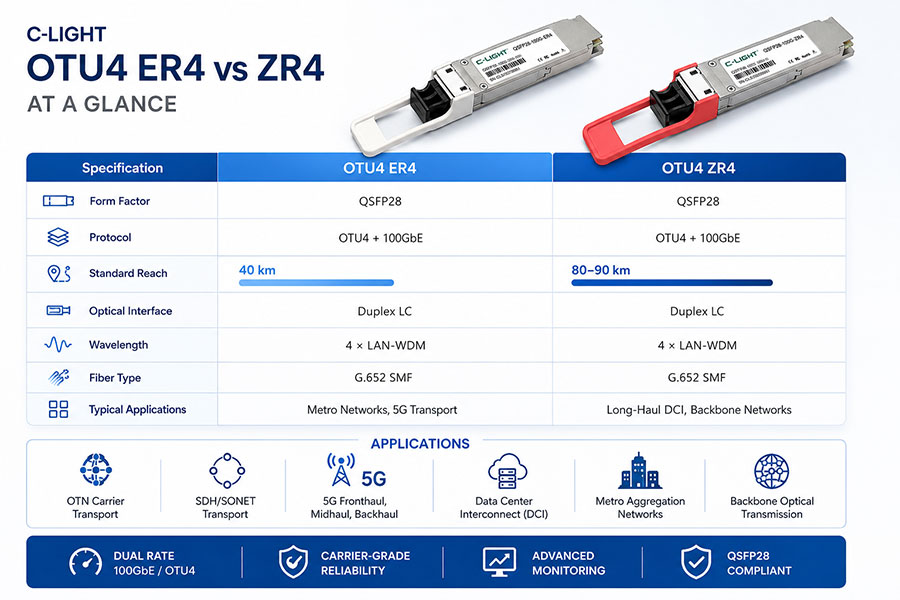
C-LIGHT-OTU4-ER4-vs-ZR4-Overview.jpg

SpecificationOTU4 ER4OTU4 ZR4
Form FactorQSFP28QSFP28
ProtocolOTU4 + 100GbEOTU4 + 100GbE
Standard Reach40 km80–90 km
Optical InterfaceDuplex LCDuplex LC
Wavelength4 × LAN-WDM4 × LAN-WDM
Fiber TypeG.652 SMFG.652 SMF
Typical ApplicationsMetro Networks, 5G TransportLong-Haul DCI, Backbone Networks

ER4 is designed for medium-distance transmission, while ZR4 provides significantly longer reach through higher transmit power, greater receiver sensitivity, and a larger optical link budget.

3. Detailed Technical Specifications

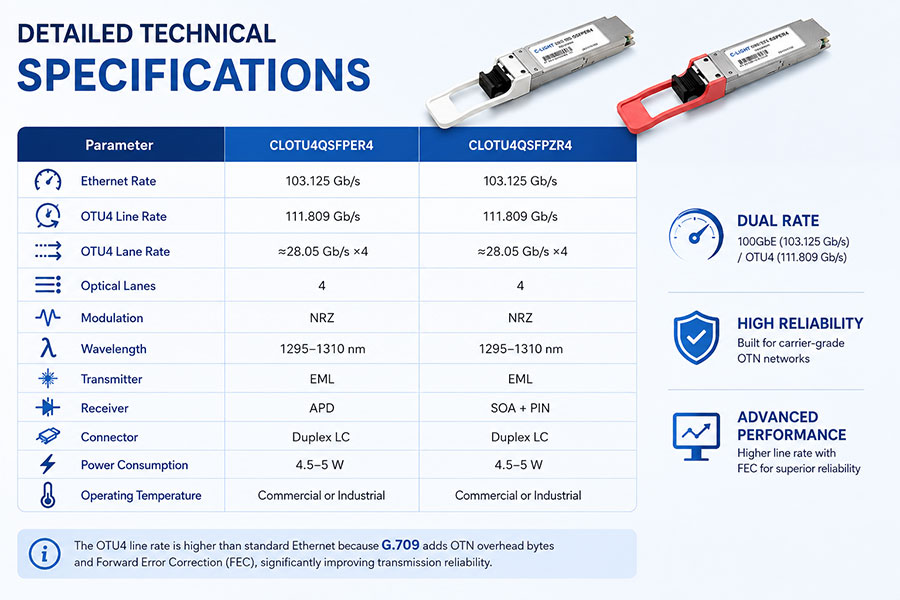
OUT4-ZR4-VS-ER4-Comparison.jpg

ParameterCLOTU4QSFPER4CLOTU4QSFPZR4
Ethernet Rate103.125 Gb/s103.125 Gb/s
OTU4 Line Rate111.809 Gb/s111.809 Gb/s
OTU4 Lane Rate≈28.05 Gb/s ×4≈28.05 Gb/s ×4
Optical Lanes44
ModulationNRZNRZ
Wavelength1295–1310 nm1295–1310 nm
TransmitterEMLEML
ReceiverAPDSOA + PIN
ConnectorDuplex LCDuplex LC
Power Consumption4.5–5 W4.5–5 W
Operating TemperatureCommercial or IndustrialCommercial or Industrial

The OTU4 line rate is higher than standard Ethernet because G.709 adds OTN overhead bytes and Forward Error Correction (FEC), significantly improving transmission reliability.

4. Optical Performance Comparison

Optical SpecificationCLOTU4QSFPER4CLOTU4QSFPZR4
Maximum Reach40 km80–90 km
Transmit Power0 to +5 dBm+2 to +6 dBm
Receiver Sensitivity-20 dBm @ BER 5E-5-28 dBm @ BER 5E-5
Optical Link Budget~20 dB~30 dB
Fiber Loss ToleranceMediumHigh
Dispersion ToleranceMediumMedium

With a larger link budget and higher receiver sensitivity, ZR4 supports longer metro and regional optical links than ER4.

5. BER Performance Comparison

Bit Error Rate (BER) is one of the most critical performance indicators in carrier optical networks.

BER PerformanceCLOTU4QSFPER4CLOTU4QSFPZR4
Pre-FEC BER @28.05Gb/s/Lane≤1×10⁻¹² @30 km≤1×10⁻¹⁰ @80 km
Post-FEC BER @28.05Gb/s/Lane≤1×10⁻¹⁵ @40 km≤1×10⁻¹⁵ @80 km
Pre-FEC BER @25.78Gb/s/Lane≤1×10⁻¹² @40 km≤1×10⁻¹² @80 km
Post-FEC BER @25.78Gb/s/Lane≤1×10⁻¹⁵ @40 km≤1×10⁻¹⁵ @80 km
Host FECOptionalRequired
Zero BER30 km @28.05 Gb/s; 40 km @25.78 Gb/s80 km after FEC @28.05 Gb/s; 80 km @25.78 Gb/s

ER4 typically achieves excellent BER performance within its rated distance. To support 80–90 km transmission, ZR4 relies on higher receiver sensitivity and host-side KP4 FEC to correct the higher raw BER and deliver carrier-grade link stability.

6. OTU4 vs Standard 100GbE

Feature100GbEOTU4
StandardIEEE 802.3ITU-T G.709
Target NetworkEnterprise & Data CenterCarrier OTN
Transmission CapabilityEthernet OnlyCarrier-Grade Transport
Multi-Service SupportLimitedExcellent
OAM & Performance MonitoringBasicComprehensive

Compared with standard Ethernet, OTU4 provides richer overhead bytes, OAM functions, alarms, performance monitoring, and maintenance capabilities required for telecom transport networks.

7. Why Is OTU4 Better for Carrier Networks?

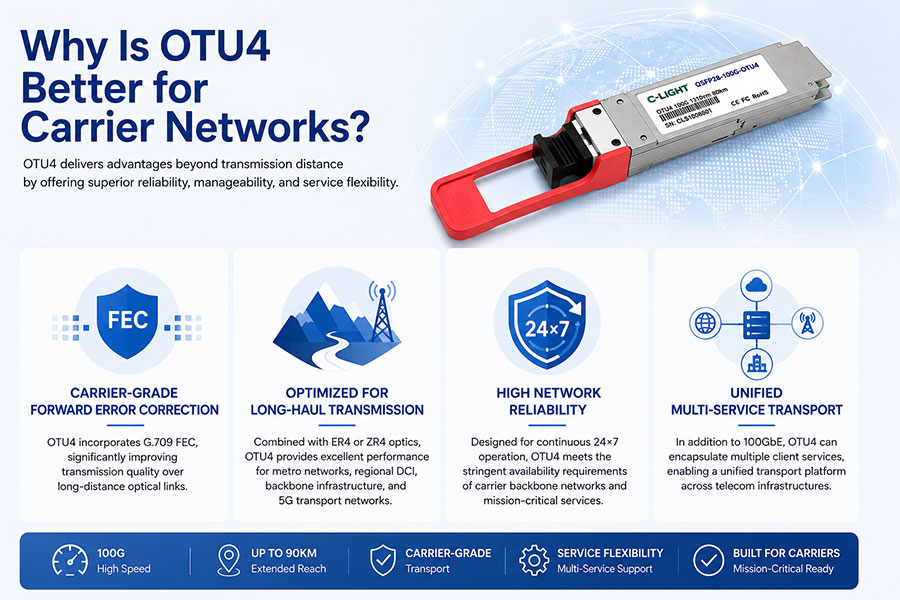
Why-Is-OTU4-Better-for-Carrier-Networks.jpg

OTU4 delivers advantages beyond transmission distance by offering superior reliability, manageability, and service flexibility.

Carrier-Grade Forward Error Correction

OTU4 incorporates G.709 FEC, significantly improving transmission quality over long-distance optical links.

Optimized for Long-Haul Transmission

Combined with ER4 or ZR4 optics, OTU4 provides excellent performance for metro networks, regional DCI, backbone infrastructure, and 5G transport networks.

High Network Reliability

Designed for continuous 24×7 operation, OTU4 meets the stringent availability requirements of carrier backbone networks and mission-critical services.

Unified Multi-Service Transport

In addition to 100GbE, OTU4 can encapsulate multiple client services, enabling a unified transport platform across telecom infrastructures.

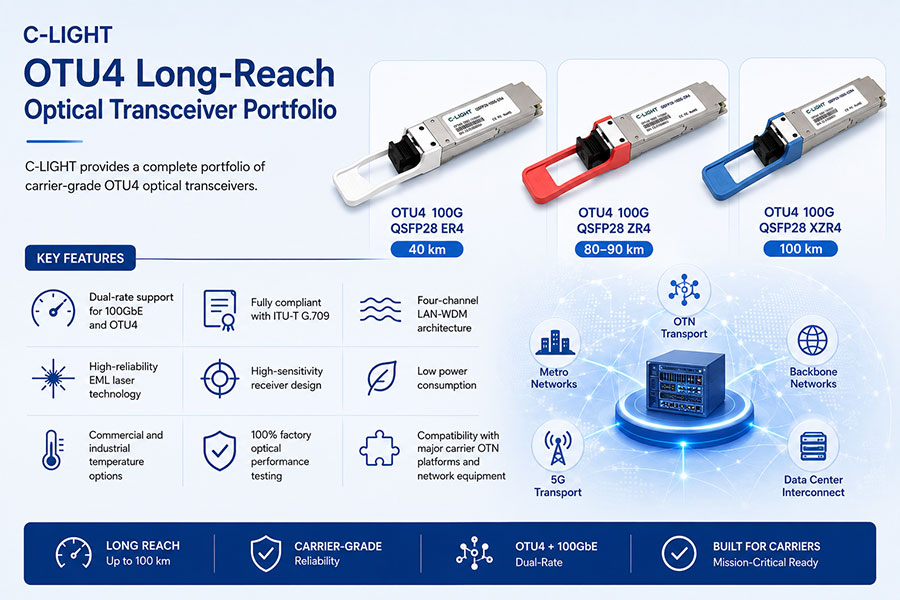
8. C-LIGHT OTU4 Long-Reach Optical Transceiver Portfolio

C-LIGHT-OTU4-Long-Reach-Optical-Transceiver-Portfolio.jpg

C-LIGHT provides a complete portfolio of carrier-grade OTU4 optical transceivers, including:

  • OTU4 100G QSFP28 ER4 (40 km)

  • OTU4 100G QSFP28 ZR4 (80–90 km)

  • OTU4 100G QSFP28 XZR4 (100 km)

Key Features

  • Dual-rate support for 100GbE and OTU4

  • Fully compliant with ITU-T G.709

  • Four-channel LAN-WDM architecture

  • High-reliability EML laser technology

  • High-sensitivity receiver design

  • Low power consumption

  • Commercial and industrial temperature options

  • 100% factory optical performance testing

  • Compatibility with major carrier OTN platforms and network equipment

9. Conclusion

For enterprise data centers, 100GbE ER4 is typically sufficient for links up to 40 km. However, carrier transport networks require higher reliability, comprehensive monitoring, and enhanced transmission capabilities.

OTU4 addresses these requirements through the G.709 standard, integrated OTN FEC, carrier-grade OAM, extensive performance monitoring, and superior long-distance transmission. As a result, OTU4 has become the preferred solution for 5G transport networks, metro networks, backbone infrastructures, and long-distance DCI applications.

When transmission distances exceed 40 km, the CLOTU4QSFPZR4 extends reach to 80–90 km, delivering stable carrier-grade performance when deployed with host-side KP4 FEC.

10、Frequently Asked Questions

Q1. What is the main difference between OTU4 and standard 100GbE?

Answer: OTU4 follows the ITU-T G.709 standard and supports OTN encapsulation, Forward Error Correction (FEC), OAM, and advanced performance monitoring, making it ideal for carrier transport networks. Standard 100GbE follows IEEE 802.3 and is primarily designed for enterprise and data center Ethernet networks.

Q2. How do I choose between ER4 and ZR4?

Answer: ER4 is recommended for optical links up to 40 km. For metro interconnects or regional DCI spanning 40–80/90 km, ZR4 is the better choice, provided sufficient optical link budget and host-side FEC are available.

Q3. Is OTU4 compatible with 100GbE?

Answer: Yes. Many carrier-grade QSFP28 OTU4 transceivers support dual-rate operation, allowing users to switch between 100GbE and OTU4 modes. Actual compatibility depends on the switch, transport equipment, and module specifications.

Q4. Why does 100G ZR4 require FEC?

Answer: To achieve transmission distances of up to 80–90 km, 100G ZR4 typically relies on host-side KP4 FEC to improve BER performance and maintain reliable long-distance optical links.

Q5. Which applications are best suited for OTU4?

Answer: OTU4 is ideal for OTN transport networks, carrier backbone infrastructure, metro optical networks, regional DCI, 5G transport networks, and other long-distance optical communication systems requiring carrier-grade reliability and performance.

For any questions, please contact us by email or WhatsApp.

Email: sales@c-light.com

WhatsApp: +86 158 1857 3751

Call
Top