TEL:+86 132 6656 7067




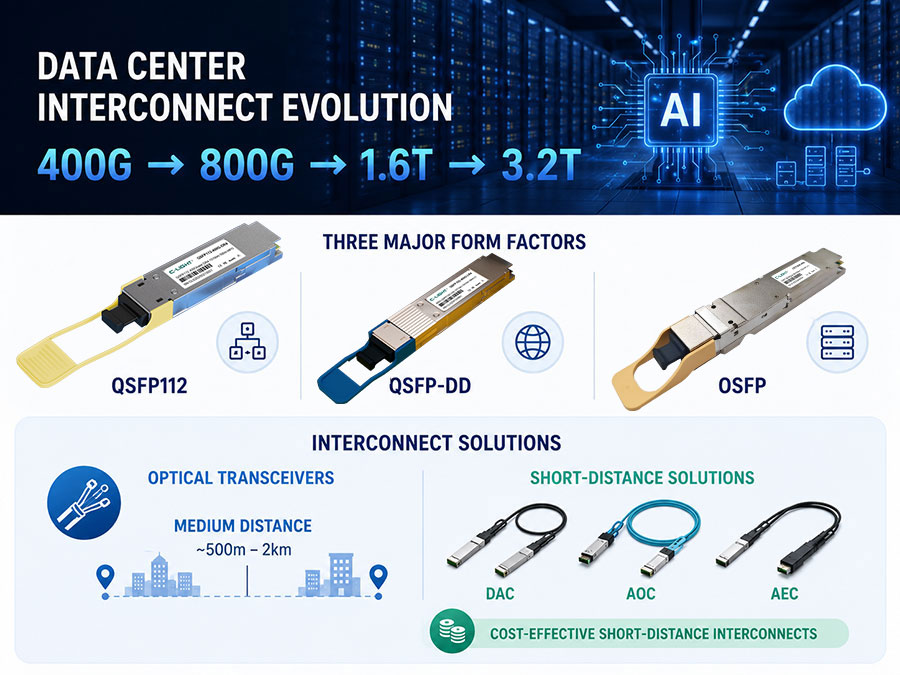
As AI computing, cloud infrastructure, and high-performance computing (HPC) continue to evolve, data center interconnect technologies are rapidly transitioning from 400G to 800G, 1.6T, and eventually 3.2T. Among the most widely adopted hardware form factors, QSFP112, QSFP-DD, and OSFP represent three distinct ecosystem strategies, each designed for different networking environments and performance requirements.
In modern AI data centers, optical transceivers are typically deployed for medium-distance links ranging from approximately 500 meters to 2 kilometers, while DAC (Direct Attach Cable), AOC (Active Optical Cable), and AEC (Active Electrical Cable) are primarily used for cost-effective short-distance interconnects.
1. Overview of QSFP112, QSFP-DD, and OSFP
QSFP-DD
800G QSFP DD SR8/DR8/FR4 optical transceiver丨C-LIGHT
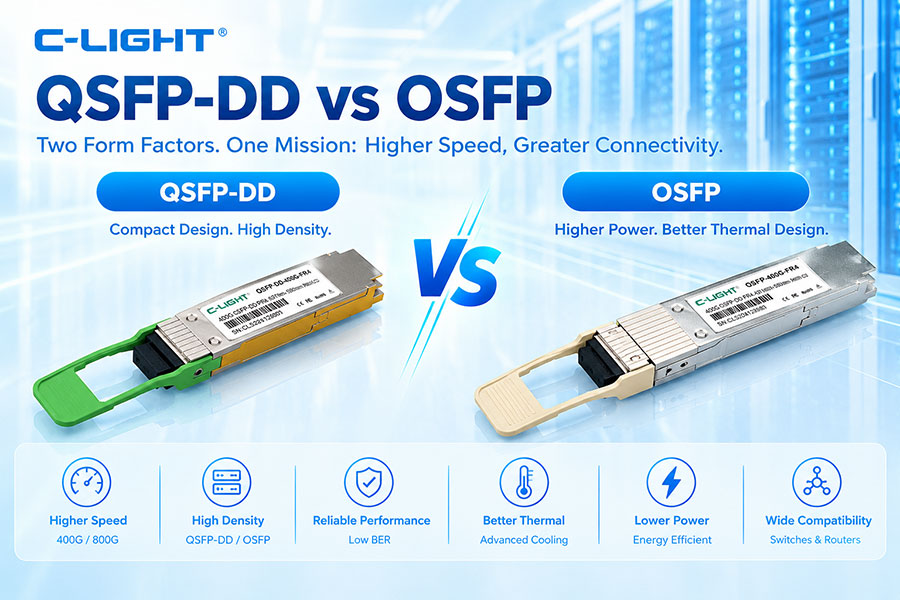
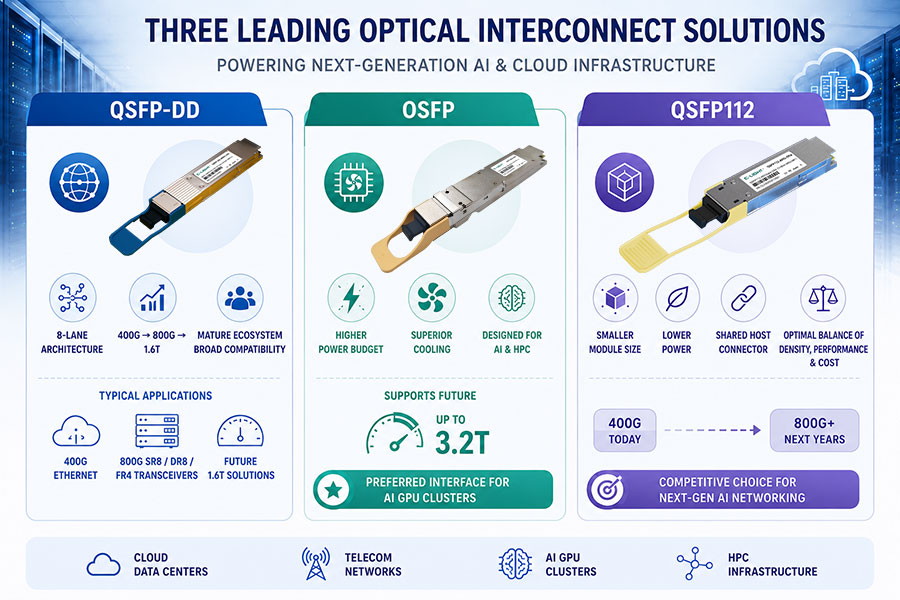
QSFP-DD (Quad Small Form-factor Pluggable Double Density) adopts an 8-lane electrical interface and has become one of the most mature standards for telecom and cloud networking.
Key features include:
Supports 8-lane electrical architecture
Scalable from 400G to 800G and 1.6T
Mature ecosystem with broad vendor compatibility
Commonly used in hyperscale cloud data centers and telecom networks
Typical applications include:
400G Ethernet
800G SR8, DR8, FR4 optical transceivers
Future 1.6T solutions
OSFP
800G OSFP MSA SR8/DR8/2FR4 Optical Transceiver丨C-LIGHT
OSFP (Octal Small Form-factor Pluggable) also utilizes an 8-lane electrical interface, but its larger physical size enables significantly better thermal performance.
Advantages include:
Higher power budget
Superior cooling capability
Designed specifically for AI and HPC networking
Supports future ultra-high-speed optical modules up to 3.2T
OSFP is increasingly becoming the preferred interface for AI GPU clusters due to its ability to accommodate higher-power optical engines.
QSFP112
400G QSFP112 LR4/FR4/DR4/SR4 Optical Transceiver丨C-LIGHT
QSFP112 represents the next-generation 4×112G PAM4 architecture.
Compared with QSFP-DD and OSFP, QSFP112 offers:
Smaller module size
Lower power consumption
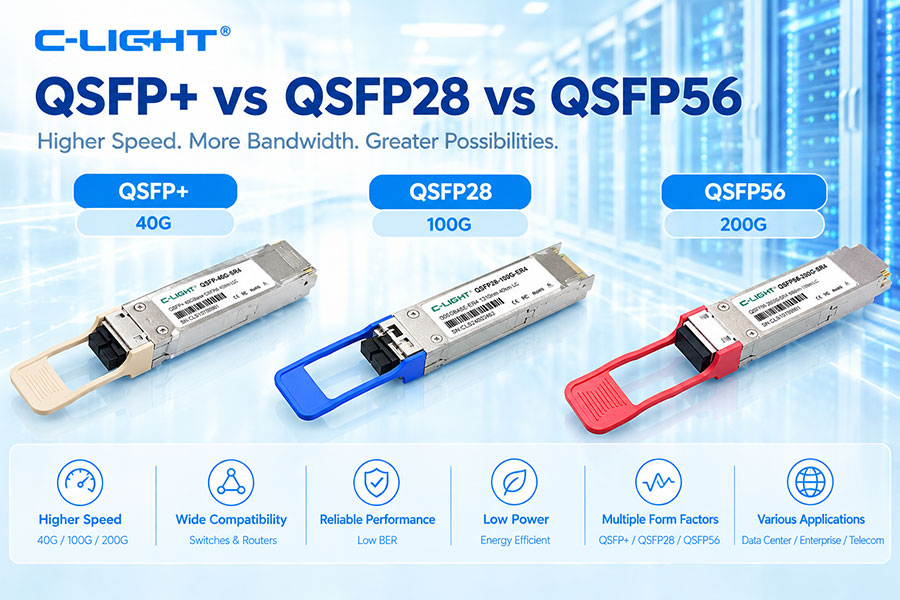
Shared host connector with QSFP56, QSFP28, and QSFP+
Excellent balance between density, performance, and deployment cost
Industry analysts expect QSFP112 to evolve from 400G today toward 800G over the next several years, making it one of the most competitive solutions for next-generation AI networking.
2. Technical Differences Between QSFP112, QSFP-DD, and OSFP
2.1 Lane Architecture
QSFP-DD
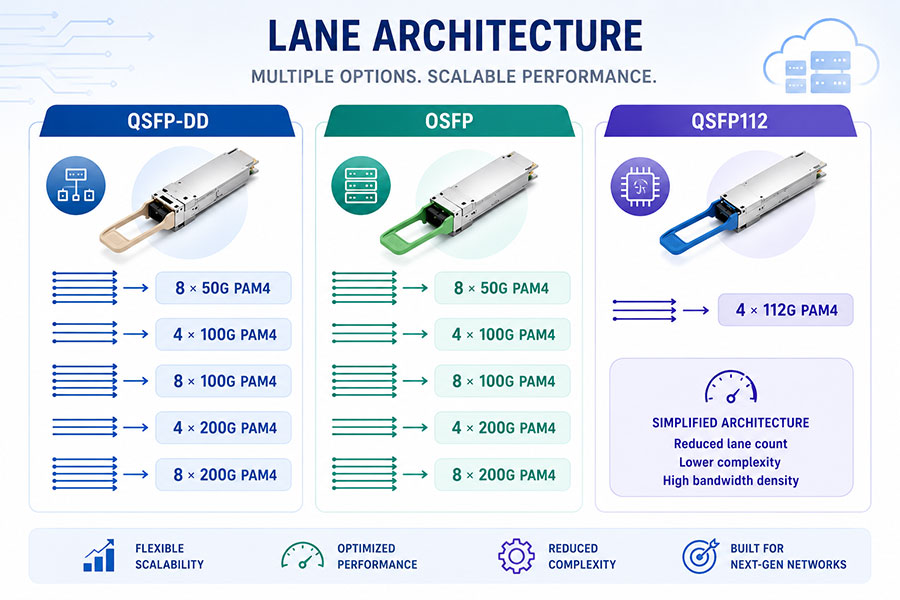
Supports multiple lane configurations, including:
8 × 50G PAM4
4 × 100G PAM4
8 × 100G PAM4
4 × 200G PAM4
8 × 200G PAM4
OSFP
Provides nearly identical electrical scalability:
8 × 50G PAM4
4 × 100G PAM4
8 × 100G PAM4
4 × 200G PAM4
8 × 200G PAM4
QSFP112
Uses a simplified architecture:
4 × 112G PAM4
The reduced lane count helps lower complexity while maintaining high bandwidth density.
2.2 Power Consumption and Thermal Performance
QSFP-DD
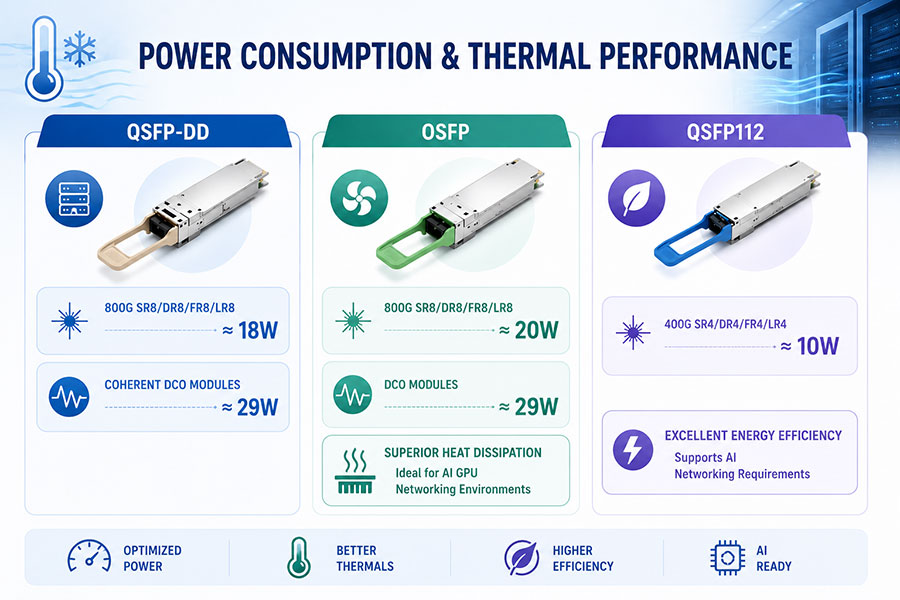
Typical power levels include:
800G SR8/DR8/FR8/LR8: approximately 18W
Coherent DCO modules: approximately 29W
OSFP
Typical specifications include:
800G SR8/DR8/FR8/LR8: approximately 20W
DCO modules: approximately 29W
Its larger housing delivers significantly improved heat dissipation, making it well suited for AI GPU networking environments.
QSFP112
Typical 400G modules such as SR4, DR4, FR4, and LR4 generally consume around 10W, offering excellent energy efficiency while supporting AI networking requirements.
2.3 DAC Compatibility
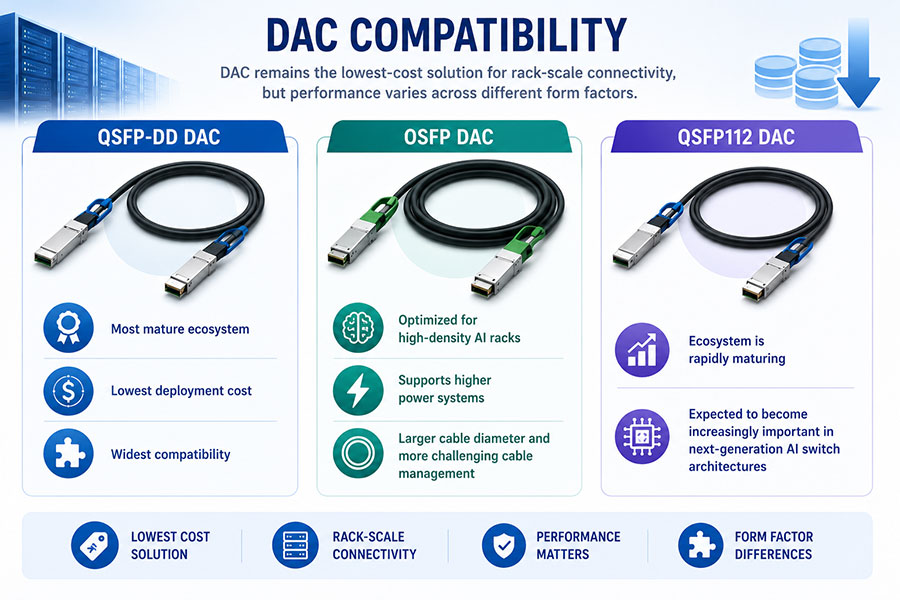
DAC remains the lowest-cost solution for rack-scale connectivity, but performance varies across different form factors.
QSFP-DD DAC
Most mature ecosystem
Lowest deployment cost
Widest compatibility
OSFP DAC
Optimized for high-density AI racks
Supports higher power systems
Larger cable diameter and more challenging cable management
QSFP112 DAC
Ecosystem is rapidly maturing
Expected to become increasingly important in next-generation AI switch architectures
3. AI Data Centers Are Reshaping High-Speed Interconnects
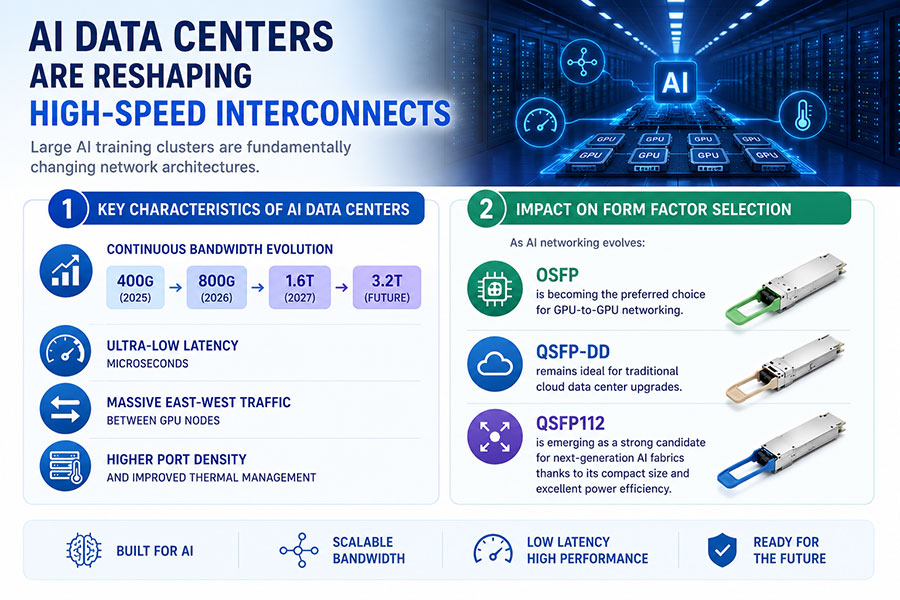
Large AI training clusters are fundamentally changing network architectures.
3.1 Key Characteristics of AI Data Centers
Modern AI infrastructure demands:
Continuous bandwidth evolution:
400G (2025)
800G (2026)
1.6T (2027)
3.2T (future)
Ultra-low latency measured in microseconds
Massive East-West traffic between GPU nodes
Higher port density and improved thermal management
3.2 Impact on Form Factor Selection
As AI networking evolves:
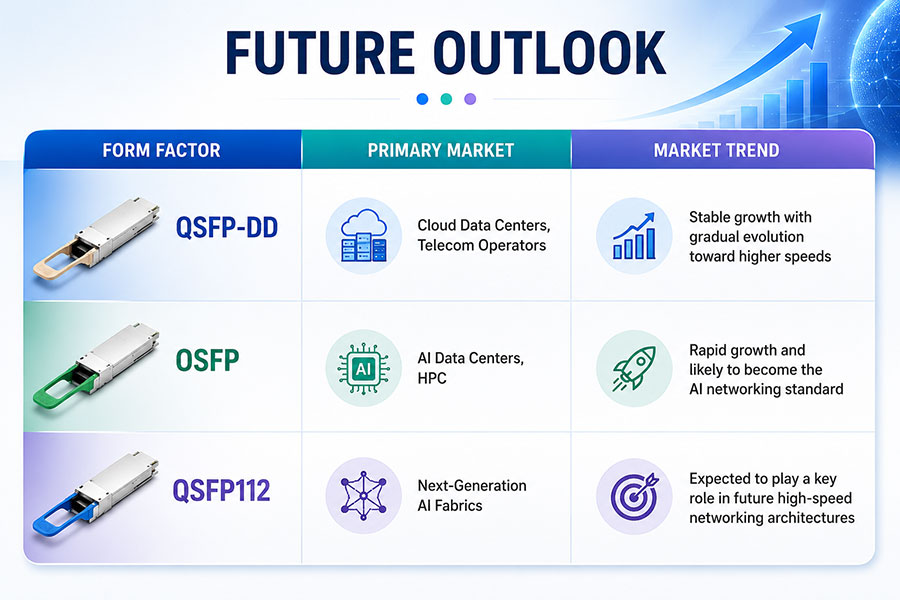
OSFP is becoming the preferred choice for GPU-to-GPU networking.
QSFP-DD remains ideal for traditional cloud data center upgrades.
QSFP112 is emerging as a strong candidate for next-generation AI fabrics thanks to its compact size and excellent power efficiency.
4. Deployment Strategy in Telecom Networks
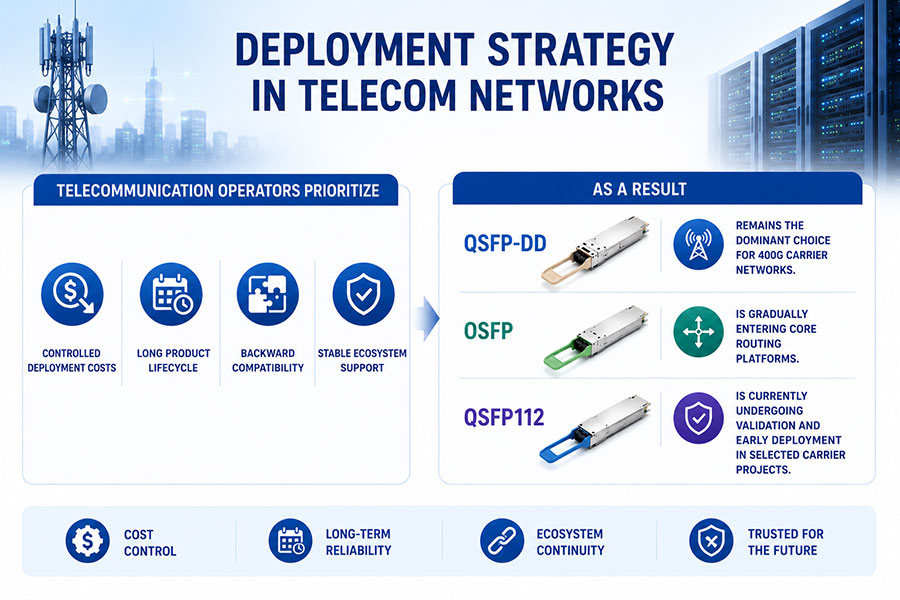
Telecommunication operators prioritize:
Controlled deployment costs
Long product lifecycle
Backward compatibility
Stable ecosystem support
As a result:
QSFP-DD remains the dominant choice for 400G carrier networks.
OSFP is gradually entering core routing platforms.
QSFP112 is currently undergoing validation and early deployment in selected carrier projects.
5. Market Outlook (2026–2030)
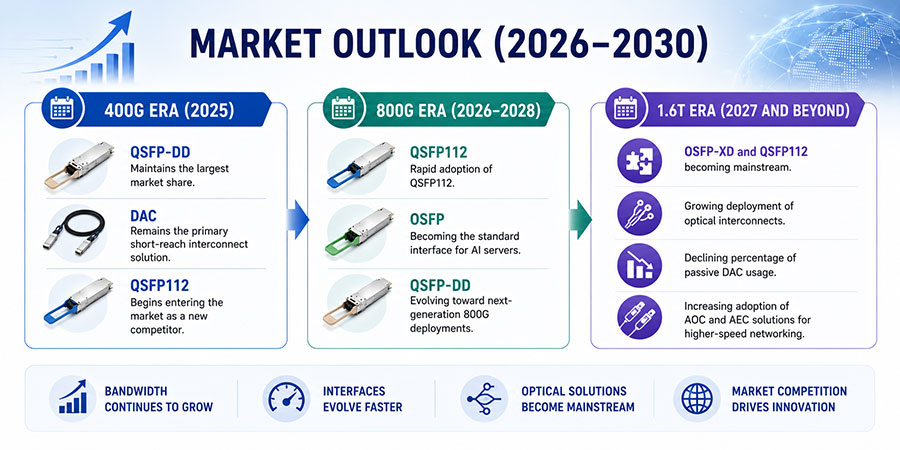
400G Era (2025)
Key trends include:
QSFP-DD maintains the largest market share.
DAC remains the primary short-reach interconnect solution.
QSFP112 begins entering the market as a new competitor.
800G Era (2026–2028)
Industry expectations include:
Rapid adoption of QSFP112.
OSFP becoming the standard interface for AI servers.
QSFP-DD evolving toward next-generation 800G deployments.
1.6T Era (2027 and Beyond)
Expected developments include:
OSFP-XD and QSFP112 becoming mainstream.
Growing deployment of optical interconnects.
Declining percentage of passive DAC usage.
Increasing adoption of AOC and AEC solutions for higher-speed networking.
6. Future Outlook
QSFP112 vs QSFP-DD vs OSFP FAQ
Q1. What is the difference between QSFP112, QSFP-DD, and OSFP optical modules?
Answer: QSFP112, QSFP-DD, and OSFP are three major form factors used for high-speed optical interconnects. QSFP-DD focuses on backward compatibility with existing QSFP ecosystems, while OSFP is designed for higher thermal capacity and future bandwidth upgrades. QSFP112 adopts a 4-channel 100G PAM4 electrical interface, providing a more direct path toward next-generation 400G and high-speed networking applications.
Q2. Why are QSFP112, QSFP-DD, and OSFP important for 400G and 800G networks?
Answer: As AI workloads and cloud computing continue to increase bandwidth requirements, traditional optical module form factors face challenges in signal integrity, power consumption, and thermal management. QSFP112, QSFP-DD, and OSFP provide different approaches to achieving high-speed connectivity for 400G, 800G, and future 1.6T data center networks.
Q3. What are the advantages of QSFP112 optical transceivers?
Answer: QSFP112 optical transceivers use four electrical lanes operating at 100G PAM4 per lane, enabling efficient 400G transmission with a compact QSFP-based design. Compared with traditional QSFP-DD architectures, QSFP112 reduces lane count requirements and supports higher-speed electrical interfaces, making it suitable for next-generation AI and high-performance networking applications.
Q4. What are the advantages of QSFP-DD optical modules?
Answer: The main advantage of QSFP-DD optical modules is backward compatibility. QSFP-DD ports can support existing QSFP+/QSFP28 modules, allowing network operators to upgrade bandwidth from previous generations while protecting existing infrastructure investments. This makes QSFP-DD attractive for enterprise networks, cloud data centers, and gradual network upgrades.
Q5. Why is OSFP preferred for 800G AI data centers?
Answer: OSFP is preferred for many 800G AI data center applications because of its larger physical size, improved thermal performance, and higher power handling capability. The additional thermal headroom enables higher-speed optical engines and supports future migration toward 1.6T optical interconnects, making OSFP suitable for GPU clusters, hyperscale data centers, and high-performance computing networks.
Q6. Should I choose QSFP112, QSFP-DD, or OSFP for AI data center deployments?
Answer: The choice depends on network architecture, compatibility requirements, and future scalability. QSFP-DD is suitable for environments that require compatibility with existing QSFP infrastructure. OSFP is ideal for new AI clusters and hyperscale deployments requiring higher thermal capacity and future bandwidth expansion. QSFP112 provides a compact high-speed solution for specific 400G applications using 100G PAM4 electrical interfaces.
Q7. Can QSFP112, QSFP-DD, and OSFP optical modules be used interchangeably?
Answer: No. Although QSFP112, QSFP-DD, and OSFP can support similar data rates, they use different mechanical designs, electrical interfaces, and host system requirements. Network switches, NICs, cables, and optical modules must be matched according to the supported form factor to ensure compatibility.
Q8. Will QSFP112 replace QSFP-DD and OSFP in future optical networks?
Answer: QSFP112 is an important evolution for high-speed optical connectivity, but it is unlikely to completely replace QSFP-DD or OSFP. Different form factors will continue to coexist based on application requirements. QSFP-DD remains valuable for compatibility-driven deployments, OSFP continues to support high-density AI networking, and QSFP112 provides another option for efficient 400G and next-generation interconnect designs.
 >
>

 >
>
 >
>
 >
>
 >
>
 >
>
 >
>
 >
>