TEL:+86 132 6656 7067




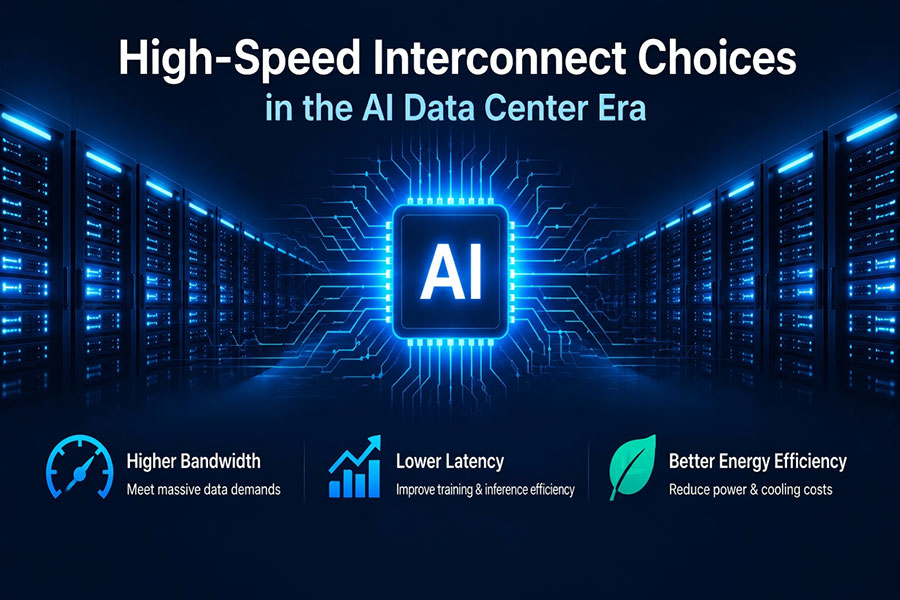
High-Speed Interconnect Technology Choices in the AI Data Center Era
With the rapid development of AI large-model training, HPC (High-Performance Computing), and hyperscale data centers, 800G high-speed interconnects have become a core infrastructure of next-generation networks.
Currently, 800G interconnect solutions in the market are mainly divided into two categories:
InfiniBand 800G
Non-InfiniBand 800G (primarily Ethernet 800G)
These two approaches differ significantly in protocol architecture, network latency, scalability, cost, and application scenarios. This article provides a comprehensive comparison between InfiniBand 800G and Ethernet 800G from both technical and application perspectives, and analyzes future trends in AI data centers.
1. What is InfiniBand 800G?
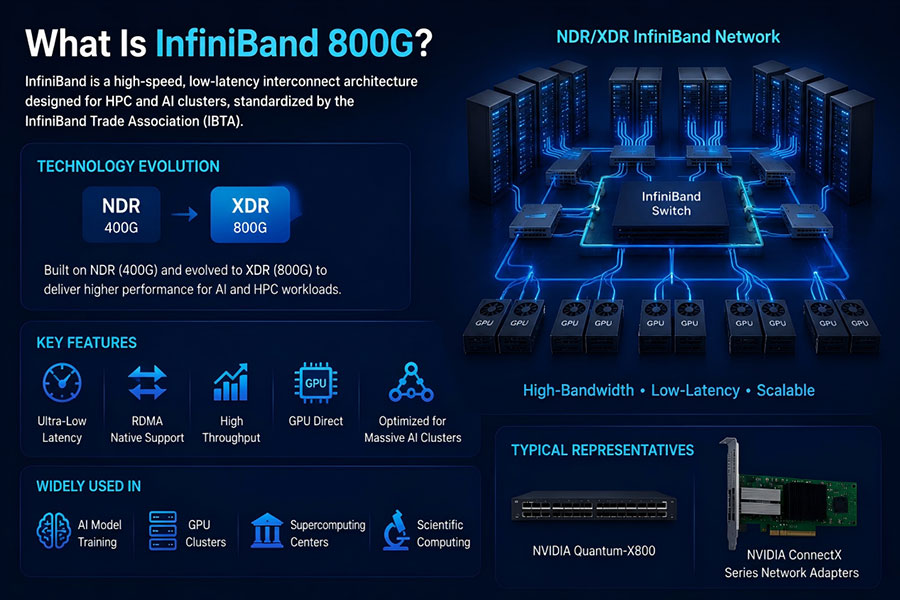
InfiniBand is a high-speed, low-latency interconnect architecture designed for HPC and AI clusters, standardized by the IBTA (InfiniBand Trade Association).
800G InfiniBand is typically evolved from:
NDR (400G)
XDR (800G)
Key features include:
Ultra-low latency
Native RDMA support
High throughput
GPU Direct
Optimized for large-scale AI clusters
Main applications:
AI large-model training
GPU clusters
Supercomputing centers
Scientific computing platforms
Typical ecosystem includes:
NVIDIA Quantum-X800
NVIDIA ConnectX series NICs
NDR/XDR InfiniBand networks
2. What is Non-InfiniBand 800G?
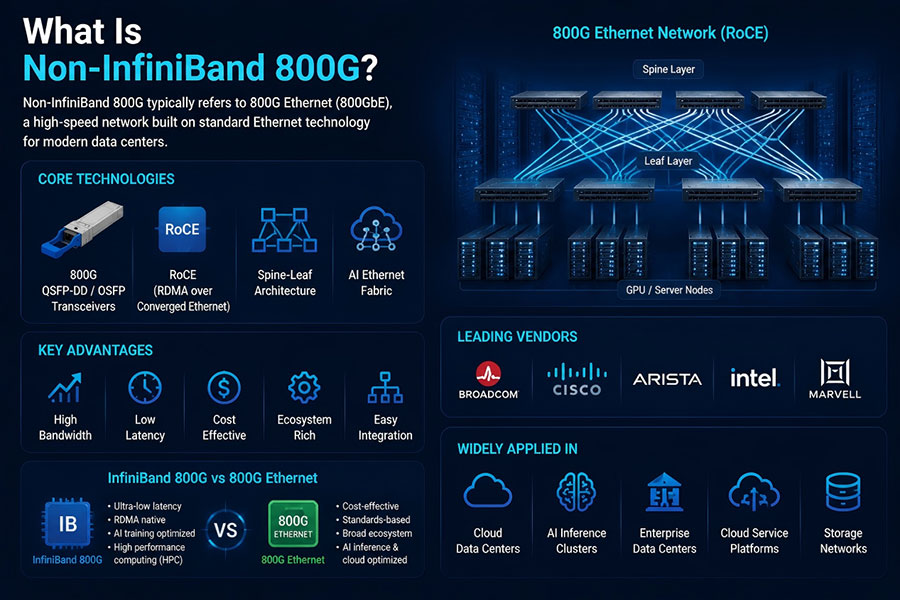
Non-InfiniBand 800G usually refers to 800G Ethernet (800GbE), a high-speed network based on standard Ethernet protocols.
Core technologies include:
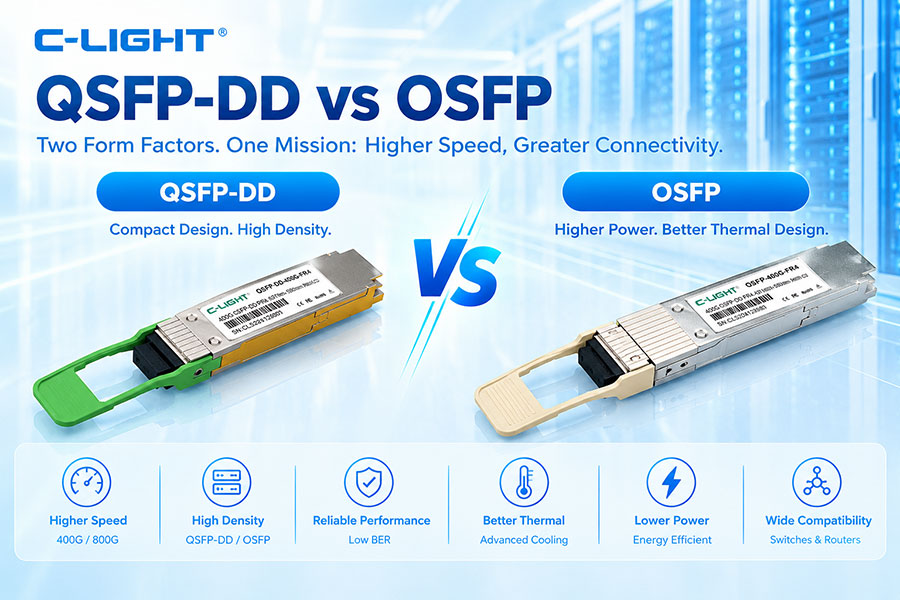
800G QSFP-DD / OSFP optical modules
RoCE (RDMA over Converged Ethernet)
Spine-Leaf architecture
AI Ethernet Fabric
Key vendors:
Broadcom
Cisco
Arista
Intel
Marvell
Main applications:
Cloud data centers
AI inference clusters
Enterprise data centers
Cloud service platforms
Storage networks
3. Key Comparison: InfiniBand 800G vs Ethernet 800G
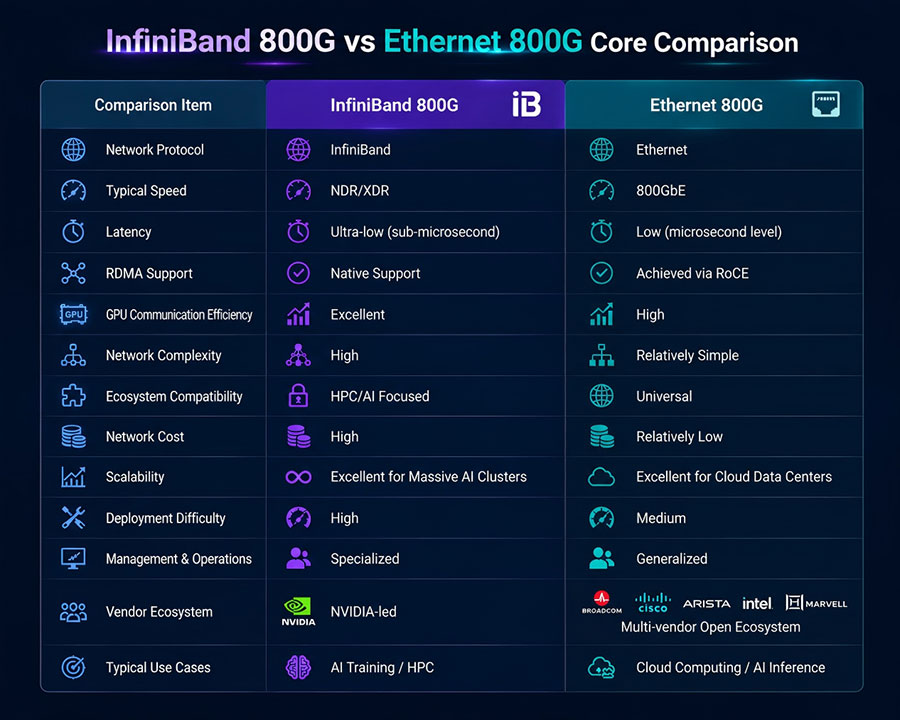
4. Technical Architecture Differences
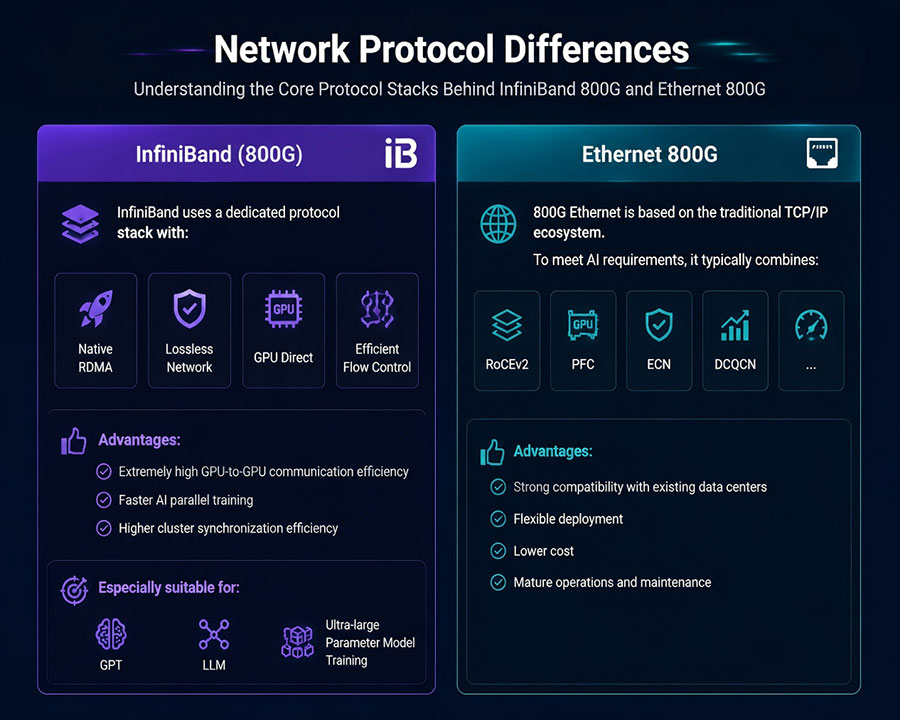
1) Protocol Differences
InfiniBand
InfiniBand uses a dedicated protocol stack with:
Native RDMA
Lossless networking
GPU Direct
Efficient flow control
Advantages:
Extremely efficient GPU-to-GPU communication
Faster AI training
Highly efficient cluster synchronization
Especially suitable for:
GPT
LLMs
Large-scale parameter models
Ethernet 800G
Based on traditional TCP/IP ecosystem, enhanced with:
RoCEv2
PFC
ECN
DCQCN
Advantages:
Strong compatibility with existing data centers
Flexible deployment
Lower cost
Mature operations ecosystem
5. Differences in AI Model Training
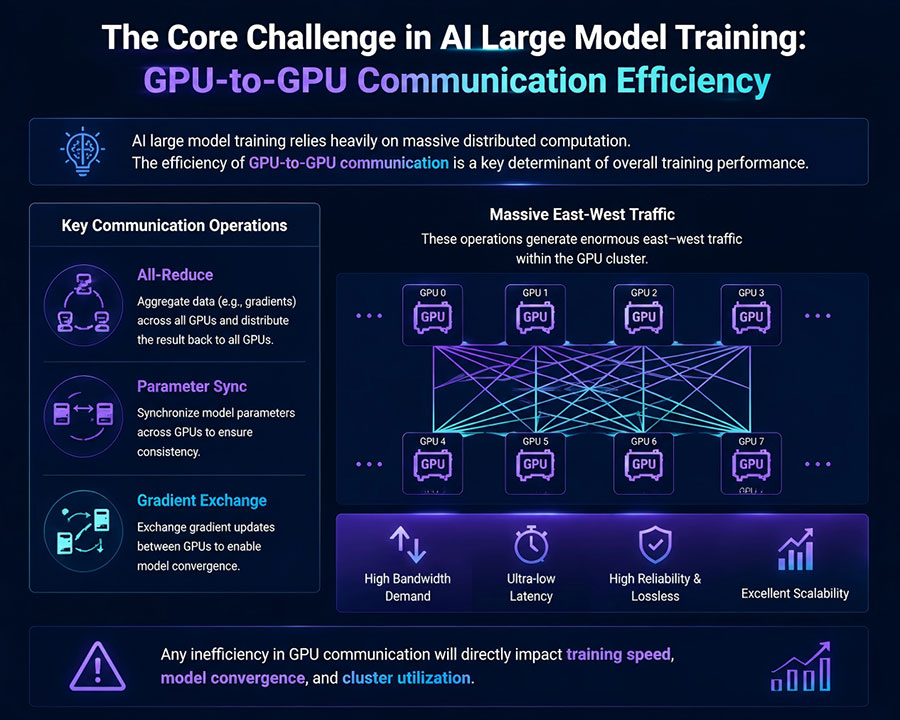
The core challenge in AI training is GPU-to-GPU communication efficiency, including:
All-Reduce
Parameter synchronization
Gradient exchange
These generate massive east-west traffic.
Advantages of InfiniBand:
In large GPU clusters:
Lower latency
Better congestion control
More efficient RDMA
More mature GPU Direct
Therefore:
Higher AI training efficiency
Especially in:
Thousand-GPU
Ten-thousand-GPU
Ultra-large clusters
Widely used in:
NVIDIA DGX SuperPOD
Supercomputing centers
Large-scale AI training clusters
Advantages of Ethernet:
With RoCE maturity:
800G Ethernet is rapidly expanding into AI networks.
Benefits:
Lower cost
More switch options
Open ecosystem
Compatible with traditional data centers
Well-suited for:
AI inference
Medium-scale training
Cloud platforms
Trend:
“AI Ethernet Fabric” is becoming increasingly important.
6. 800G Optical Modules vs High-Speed Cables
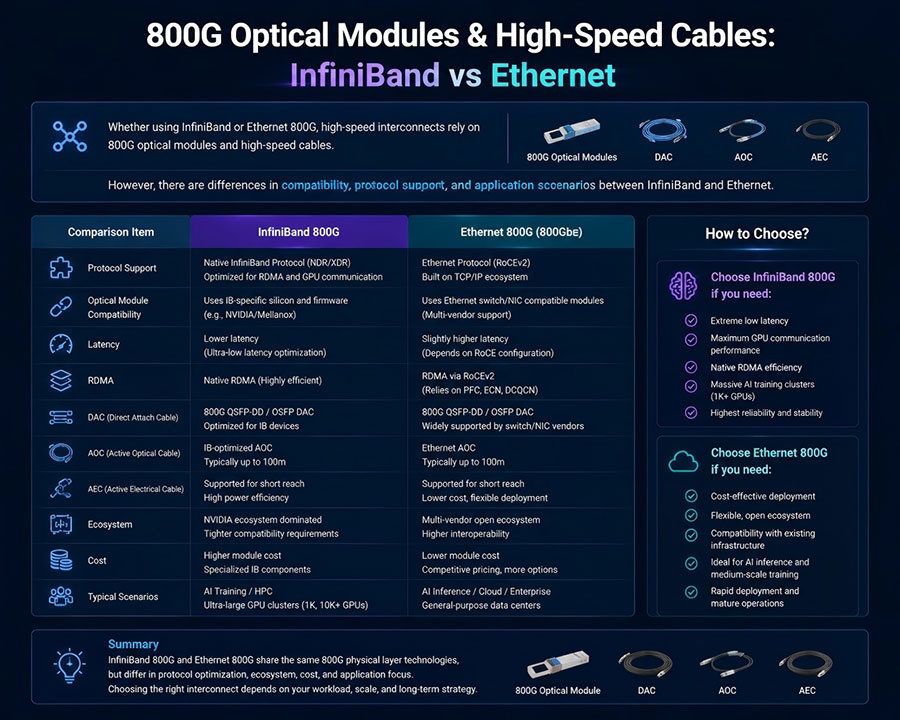
Both InfiniBand and Ethernet 800G rely on:
800G optical modules
DAC
AOC
AEC
InfiniBand common solutions
Optical modules:
800G OSFP NDR
2×400G breakout
Cables:
NDR DAC
NDR AOC
Features:
Optimized for ultra-low latency
Strict signal integrity requirements
Designed for GPU clusters
Ethernet common solutions
Optical modules:
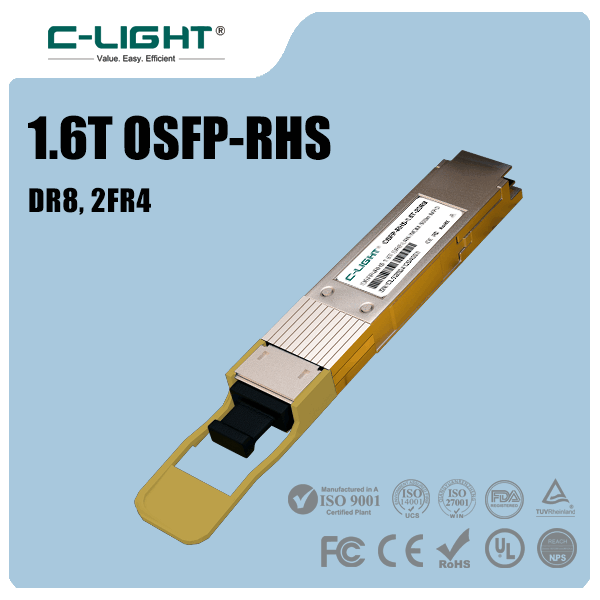
800G OSFP DR8
800G 2×FR4
800G SR8
Cables:
800G DAC
800G AOC
800G AEC
Features:
Broad compatibility
Suitable for Spine-Leaf networks
Flexible cloud deployment
7. Cost and Ecosystem Comparison
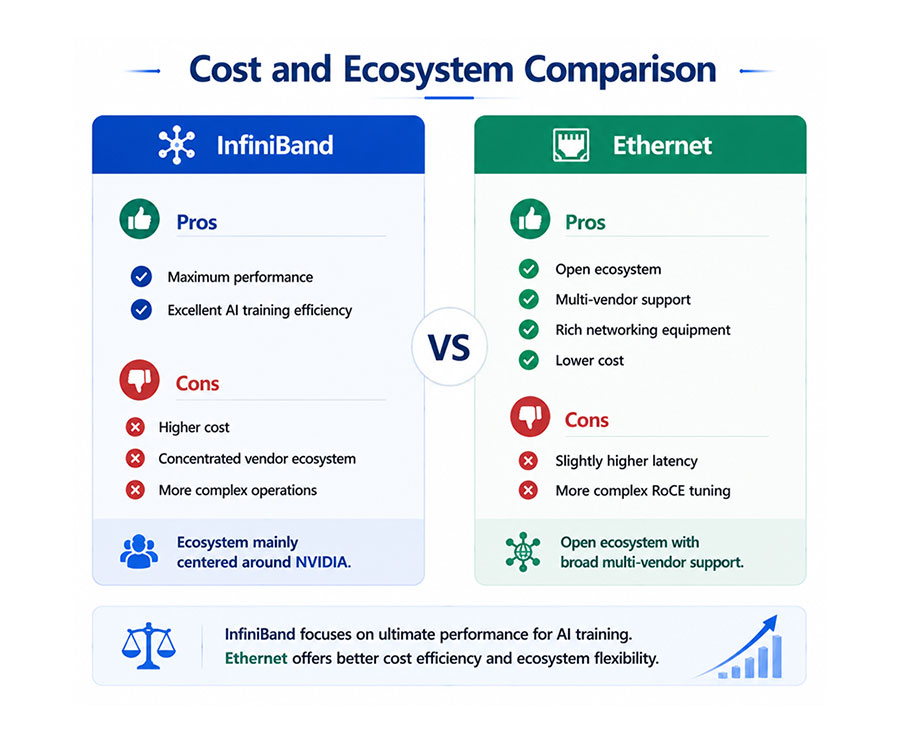
InfiniBand
Pros:
Maximum performance
Excellent AI training efficiency
Cons:
Higher cost
Concentrated vendor ecosystem
More complex operations
Ecosystem mainly centered around NVIDIA.
Ethernet
Pros:
Open ecosystem
Multi-vendor support
Rich networking equipment
Lower cost
Cons:
Slightly higher latency
More complex RoCE tuning
8. Future Trends
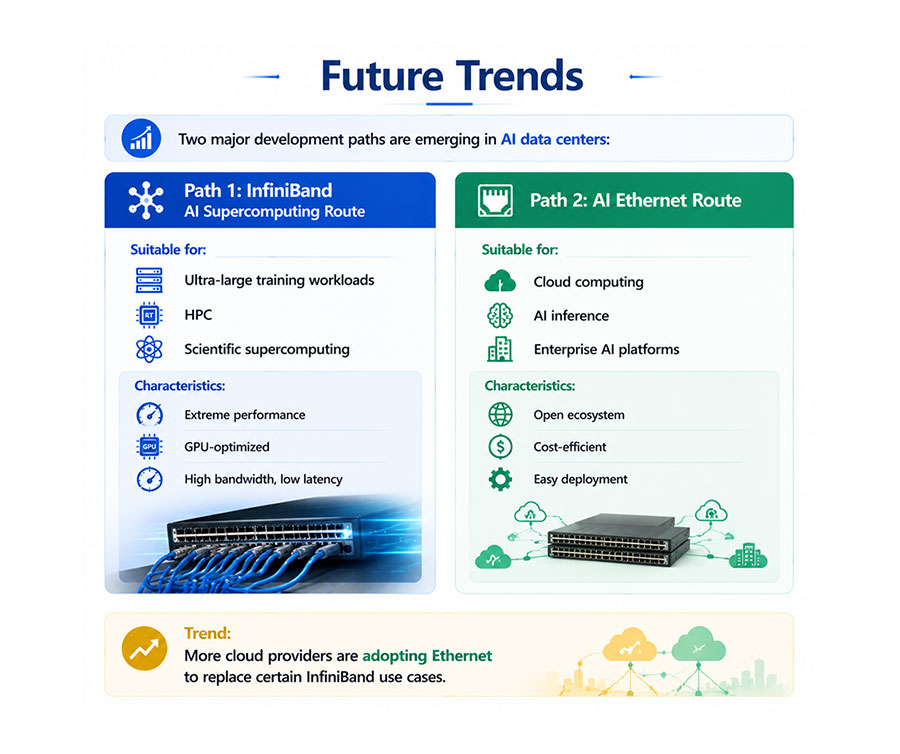
Two major development paths are emerging in AI data centers:
Path 1: InfiniBand AI Supercomputing Route
Suitable for:
Ultra-large training workloads
HPC
Scientific supercomputing
Characteristics:
Extreme performance
GPU-optimized
High bandwidth, low latency
Path 2: AI Ethernet Route
Suitable for:
Cloud computing
AI inference
Enterprise AI platforms
Characteristics:
Open ecosystem
Cost-efficient
Easy deployment
Trend:
More cloud providers are adopting Ethernet to replace certain InfiniBand use cases.
9. C-LIGHT Network 800G High-Speed Interconnect Solutions
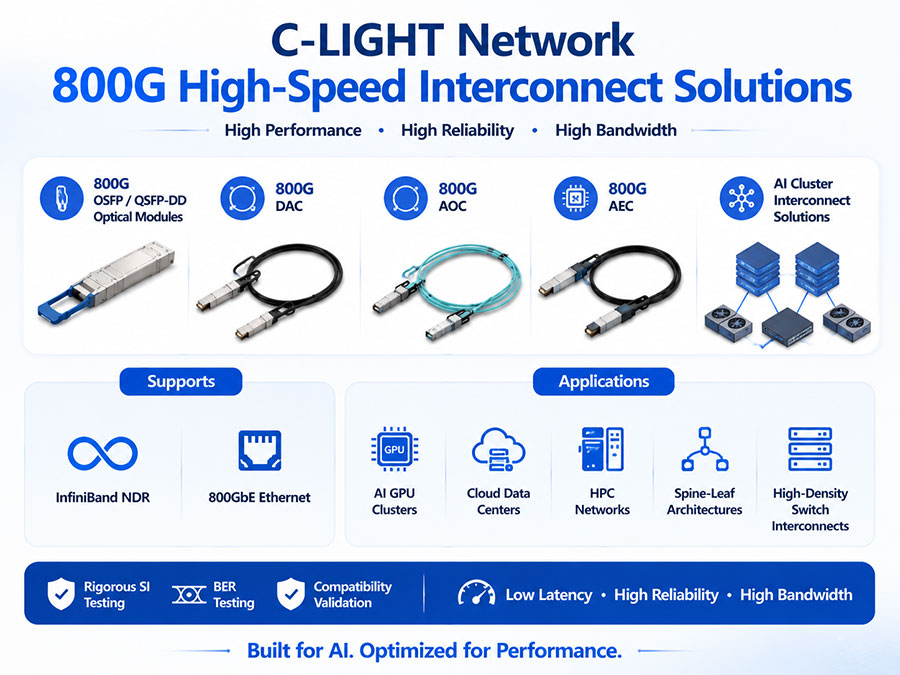
For AI data centers and HPC networks, C-LIGHT Network provides a complete 800G interconnect portfolio, including:
800G OSFP / QSFP-DD optical modules
800G DAC
800G AOC
800G AEC
AI cluster interconnect solutions
Supports:
InfiniBand NDR
800GbE Ethernet
Applications:
AI GPU clusters
Cloud data centers
HPC networks
Spine-Leaf architectures
High-density switch interconnects
Through rigorous signal integrity testing, BER testing, and compatibility validation, these solutions meet the AI data center requirements for low latency, high reliability, and high bandwidth.
10. Conclusion
In the 800G era, InfiniBand and Ethernet are not in a “replacement” relationship, but rather two technology paths for different scenarios.
If the priority is:
Extreme AI training performance
Ultra-low latency
Massive GPU clusters
➡ InfiniBand is more suitable
If the priority is:
Open ecosystem
Cost efficiency
Cloud deployment
Flexible scalability
➡ Ethernet 800G is more suitable
In the future, AI data centers will likely adopt a hybrid architecture:
“InfiniBand + Ethernet”
Together, they will support the evolving AI computing infrastructure.
10. Frequently Asked Questions (FAQ)
Q1. What is the difference between InfiniBand 800G and Non-InfiniBand 800G optical solutions?
Answer: The main difference between InfiniBand 800G and Non-InfiniBand 800G optical solutions is the network protocol and application ecosystem. InfiniBand 800G is designed for high-performance computing (HPC) and AI clusters requiring ultra-low latency and advanced RDMA capabilities. Non-InfiniBand 800G, mainly based on Ethernet, provides broader compatibility, flexible deployment, and scalability for cloud data centers and enterprise networks.
Q2. Why is 800G InfiniBand important for AI GPU clusters?
Answer: 800G InfiniBand is important for AI GPU clusters because large-scale AI training requires extremely high bandwidth and low-latency communication between GPUs. InfiniBand provides optimized RDMA networking, efficient GPU synchronization, and high-performance data exchange for applications such as large language model (LLM) training and HPC workloads.
Q3. What are the advantages of 800G Ethernet compared with 800G InfiniBand?
Answer: 800G Ethernet provides advantages in ecosystem compatibility, deployment flexibility, and cost scalability. It supports standard Ethernet architectures and integrates easily with existing data center networks, making it suitable for hyperscale cloud providers, enterprise AI infrastructure, and large-scale data center deployments.
Q4. Should I choose InfiniBand 800G or Ethernet 800G for an AI data center?
Answer: The choice depends on workload requirements and network architecture. InfiniBand 800G is ideal for dedicated AI supercomputing environments that prioritize maximum performance and ultra-low latency. Ethernet 800G is suitable for AI data centers requiring open standards, broader compatibility, and flexible network expansion.
Q5. What types of 800G optical transceivers are used in InfiniBand and Ethernet networks?
Answer: 800G optical transceivers are available in different form factors and configurations depending on the network protocol. Common solutions include 800G OSFP optical modules supporting applications such as InfiniBand NDR, 800GbE Ethernet, AI clusters, and hyperscale data centers. Transmission options include SR8 for short reach, DR8 for 500m links, and 2×FR4 for longer-distance connections.
Q6. Can InfiniBand 800G and Ethernet 800G optical modules be used interchangeably?
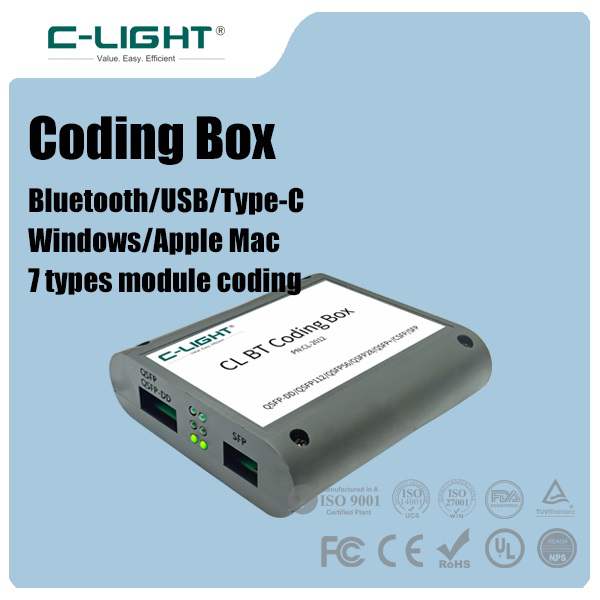
Answer: InfiniBand and Ethernet 800G solutions are based on different communication protocols, so optical modules are not always directly interchangeable. Network equipment, firmware, coding configuration, and protocol compatibility must be considered when selecting 800G optical solutions.
Q7. What are the typical applications of 800G InfiniBand and Non-InfiniBand solutions?
Answer: 800G InfiniBand solutions are mainly used in AI supercomputers, HPC clusters, and large-scale GPU training systems. Non-InfiniBand 800G Ethernet solutions are widely deployed in cloud data centers, hyperscale networks, enterprise AI infrastructure, and next-generation Ethernet-based AI fabrics.
Q8. Will Ethernet 800G replace InfiniBand 800G in future AI networks?
Answer: Ethernet 800G is expected to grow rapidly in AI networking, but it will not completely replace InfiniBand in all scenarios. InfiniBand remains valuable for specialized AI and HPC environments requiring maximum performance, while Ethernet continues to expand due to its open ecosystem, scalability, and operational advantages.
 >
>

 >
>
 >
>
 >
>
 >
>
 >
>
 >
>
 >
>