TEL:+86 132 6656 7067




In modern data centers and high-performance computing environments, optical transceivers serve as the critical bridge between electrical signals and optical transmission, enabling the massive data flows that power everything from cloud computing to artificial intelligence workloads. As network speeds have evolved from 10G to 40G, 100G, and now 400G and beyond, the optical module form factors that support these speeds have undergone a parallel evolution.
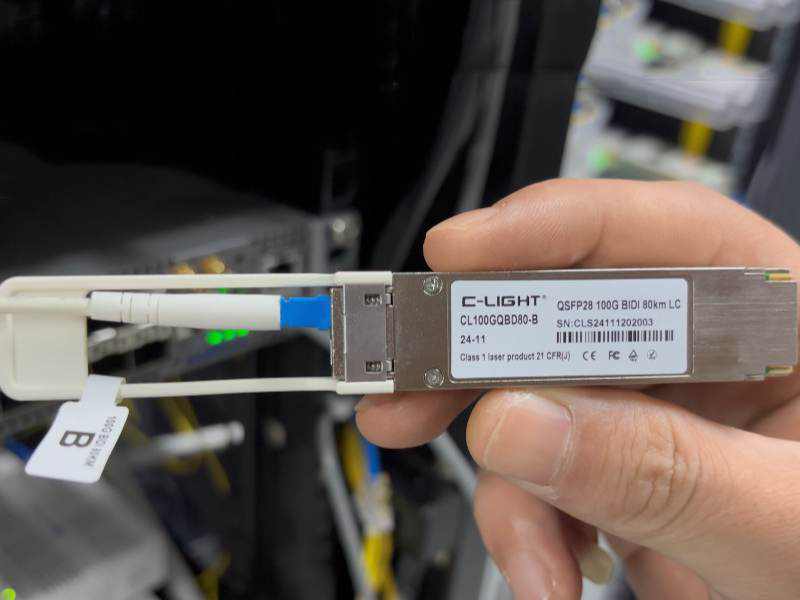
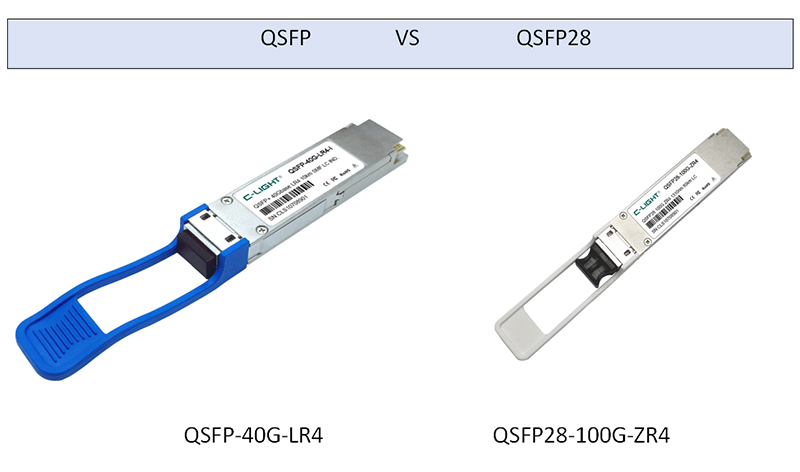
Two of the most widely deployed high-density optical transceiver form factors in today's networking landscape are QSFP+ (Quad Small Form-factor Pluggable Plus) and QSFP28 (Quad Small Form-Factor Pluggable 28). While both share the same physical dimensions and belong to the QSFP family, they serve different speed tiers and are optimized for distinct network architectures. This article provides a comprehensive comparison of QSFP+ and QSFP28, examining their technical specifications, key differences, practical applications, and how network operators can choose the right solution for their specific requirements. The article also includes an overview of C-LIGHT’s QSFP+ and QSFP28 product offerings for enterprise and telecom networks.
The QSFP Family: A Brief Evolution
The QSFP form factor was first introduced as a high-density alternative to the SFP (Small Form-factor Pluggable) standard, designed to support four parallel data channels within a single compact module. This quad-channel architecture has remained the defining characteristic of the QSFP family throughout its evolution.
QSFP+ (40G): As the successor to the original QSFP, the QSFP+ standard increased the per-channel data rate to 10 Gbps, enabling an aggregate bandwidth of 40 Gbps. It integrates four independent transmit and receive channels within a single interface, each operating at 10 Gbps, making it the workhorse for 40G Ethernet deployments and data center spine-leaf architectures. Notably, QSFP+ and the original QSFP share identical physical dimensions, and the industry is gradually transitioning from QSFP to QSFp+.
QSFP28 (100G): The QSFP28 represents the next major leap in the QSFP family, increasing per-lane speed to 25 Gbps (or up to 28 Gbps in certain applications). By combining four lanes of 25 Gbps electrical signals, QSFP28 delivers a total data rate of up to 100 Gbps, making it the industry standard for 100G Ethernet connectivity. The “28” designation refers to the maximum speed of each electrical lane (up to 28 Gbps), though in 100G Ethernet applications, the lanes typically operate at 25 Gbps.
The QSFP28 module maintains the same compact form factor as QSFP+—approximately 18.35 mm wide and 72.4 mm long—enabling high-density deployments in switches and routers while maximizing port utilization.
Technical Comparison: QSFP+ vs QSFP28
The following table provides a side-by-side technical comparison of QSFP+ and QSFP28 across key parameters:
| Feature | QSFP+ | QSFP28 |
| Form Factor | Quad Small Form-Factor Pluggable Plus | Quad Small Form-Factor Pluggable 28 |
| Data Rate | 40 Gbps aggregate (4×10 Gbps) | 100 Gbps aggregate (4×25 Gbps) |
| Per-Lane Speed | 10 Gbps | 25 Gbps (up to 28 Gbps) |
| Number of Electrical Lanes | 4 channels | 4 channels |
| Modulation Technology | NRZ (Non-Return-to-Zero) | NRZ (Non-Return-to-Zero) |
| Key Standards | IEEE 802.3ba, QSFP MSA | IEEE 802.3bm, IEEE 802.3ba, QSFP28 MSA, SFF-8636 |
| Common Variants | SR4, LR4, CWDM4, BiDi, ER4 | SR4, LR4, CWDM4, ER4, PSM4, BiDi |
| Maximum Distance (Typical) | 100 m (SR4) to 80+ km (ER4) | 100 m (SR4) to 40+ km (ER4) |
| Power Consumption | 1.5–3.5 W | 3.5–5 W |
| Connector Types | MPO/MTP (SR4), LC Duplex (LR4) | MPO/MTP (SR4, PSM4), LC Duplex (LR4, CWDM4, ER4) |
| Backward Compatibility | Compatible with QSFP ports | Compatible with QSFP+ ports |
| Typical Applications | 40G Ethernet, enterprise aggregation, storage networks | 100G Ethernet, data center spine-leaf, DCI, HPC, telecom backhaul |
Key Differences Explained
1. Data Rate and Channel Architecture
The most significant difference lies in the per-lane data rate. QSFP+ utilizes four 10 Gbps lanes to achieve 40 Gbps aggregate throughput, while QSFP28 employs four 25 Gbps lanes to deliver 100 Gbps total bandwidth. Both form factors use NRZ modulation, but QSFP28 achieves 2.5× the bandwidth density per lane.
2. Physical and Electrical Compatibility
QSFP28 modules are designed with backward compatibility in mind: a QSFP28 port can typically accept QSFP+ modules and operate at 40 Gbps, enabling gradual network migration without wholesale hardware replacement. Both form factors share identical mechanical dimensions and cage specifications, ensuring seamless integration into existing chassis designs.
3. Power Consumption and Thermal Considerations
QSFP28 modules generally consume more power than their QSFP+ counterparts—typically in the 3.5 W to 5 W range compared to 1.5 W to 3.5 W for QSFP+. This higher power draw must be factored into switch and router thermal design, particularly in high-density 100G deployments.
4. Standards Compliance
QSFP28 modules comply with a broader set of industry standards, including SFF-8636 for enhanced digital diagnostic monitoring capabilities and IEEE 802.3bm for 100GBASE-SR4 specifications. QSFP+ modules are primarily governed by IEEE 802.3ba and the original QSFP MSA.
Applications and Use Cases
QSFP+ (40G) Applications
QSFP+ remains widely deployed in scenarios where 40G bandwidth is sufficient and cost optimization is a priority:
Enterprise Network Aggregation: Connecting distribution-layer switches to core switches in medium-to-large enterprise campuses.
Data Center Top-of-Rack (ToR) Deployments: Providing 40G uplinks from access switches to aggregation layers.
Storage Area Networks (SAN): Supporting 16G/32G Fibre Channel connectivity for high-performance storage systems.
40G to 4×10G Breakout Applications: QSFP+ modules can be split into four independent 10G connections using breakout cables, maximizing port utilization in mixed-speed environments.
Telecom Aggregation: Providing cost-effective 40G transport in metro and regional networks.
QSFP28 (100G) Applications
QSFP28 has become the de facto standard for 100G connectivity, particularly in high-bandwidth, low-latency environments:
Data Center Spine-Leaf Architectures: 100G interconnects between spine and leaf switches form the backbone of modern data center networks.
Data Center Interconnect (DCI): Connecting geographically distributed data centers across metro distances using CWDM4 or LR4 optics.
High-Performance Computing (HPC) Clusters: Providing the high-bandwidth, low-latency connectivity required for scientific computing, AI training, and big data analytics.
100G Ethernet Switching and Routing: Enterprise core networks and service provider edge routing.
Telecom Backhaul: Aggregating 5G and broadband traffic for transport to core networks.
InfiniBand EDR/FDR Networks: Supporting high-speed interconnect fabrics for specialized computing environments.
QSFP28 Variants and Distance Options
QSFP28 is not a single product type but a family of optical modules optimized for different reaches and fiber types:
| Variant | Data Rate | Fiber Type | Max Distance | Connector | Typical Use Case |
| SR4 | 100G | MMF(OM3/OM4) | 100 m (OM4) | MPO/MTP-12 | Short-reach data center interconnects |
| LR4 | 100G | SMF | 10 km | LC Duplex | Campus and metro DCI |
| CWDM4 | 100G | SMF | 2 km | LC Duplex | Data center interconnect over existing fiber |
| ER4 | 100G | SMF | 40 km | LC Duplex | Metro and regional network links |
| PSM4 | 100G | SMF | 2 km | MPO/MTP | Parallel single-mode applications |
| BiDi | 100G | SMF | 10–40 km | LC Duplex | Single-fiber bidirectional transmission |
SR4 is the most cost-effective solution for short-reach connections within a single data center, using multimode fiber and VCSEL lasers. LR4 employs LAN-WDM technology to multiplex four wavelengths onto a single fiber pair, enabling 10 km reach suitable for campus and metro applications. ER4 extends this reach to 40 km for regional network links. CWDM4 offers an economical 2 km reach using standard CWDM wavelengths, ideal for data center interconnect applications.
OSFP vs QSFP-DD Frequently Asked Questions (FAQ)
Q1. What is the difference between OSFP and QSFP-DD optical transceivers?
Answer: The main difference between OSFP and QSFP-DD optical transceivers is their design philosophy and application focus. QSFP-DD emphasizes backward compatibility and smooth network upgrades, while OSFP is designed for higher bandwidth scalability, improved thermal performance, and future 800G/1.6T applications. Both support high-speed Ethernet and AI data center networks, but they target different infrastructure requirements.
Q2. Why are OSFP and QSFP-DD important for 800G optical networks?
Answer: OSFP and QSFP-DD are two major optical transceiver form factors developed to support the transition from 400G to 800G networking. They provide eight electrical lanes using PAM4 modulation to achieve higher bandwidth, making them suitable for hyperscale data centers, AI clusters, cloud computing, and high-performance computing (HPC) networks.
Q3. Is QSFP-DD backward compatible with QSFP28 optical modules?
Answer: Yes. One of the biggest advantages of QSFP-DD is backward compatibility. QSFP-DD ports can support existing QSFP+ and QSFP28 modules, allowing data center operators to upgrade network bandwidth gradually without replacing the entire optical infrastructure.
Q4. Why does OSFP provide better thermal performance than QSFP-DD?
Answer: OSFP provides better thermal performance because it features a larger physical size and more space for heat dissipation. The larger module design allows the integration of larger heatsinks and supports higher-power optical components, making OSFP suitable for high-bandwidth 800G and future 1.6T optical transceivers.
Q5. Should I choose OSFP or QSFP-DD for 800G AI data center applications?
Answer: The choice depends on network architecture and upgrade requirements. OSFP is often preferred for AI clusters and hyperscale data centers that require higher thermal capacity and a clear migration path toward 1.6T. QSFP-DD is suitable for cloud, telecom, and enterprise networks where compatibility with existing QSFP-based systems is important.
Q6. Can OSFP and QSFP-DD optical modules be used in the same network?
Answer: Yes. OSFP and QSFP-DD modules can coexist in the same network architecture when compatible switches, cables, and optical solutions are deployed. However, the two form factors use different mechanical interfaces, so they are not directly interchangeable between ports.
Q7. What are the main applications of OSFP optical transceivers?
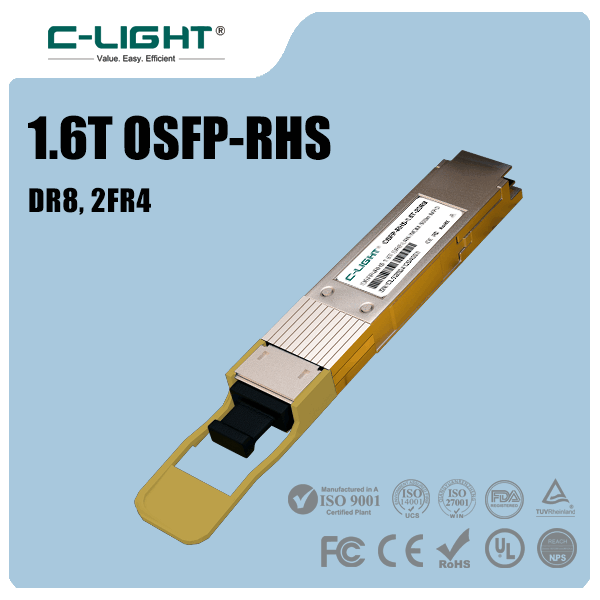
Answer: OSFP optical transceivers are mainly used in high-performance networking scenarios, including AI GPU clusters, hyperscale data centers, HPC systems, cloud infrastructure, and next-generation 800G/1.6T Ethernet networks. Their high thermal capability and scalability make them suitable for bandwidth-intensive applications.
Q8. Will OSFP replace QSFP-DD in future optical networks?
Answer: No. OSFP and QSFP-DD are expected to coexist in future optical networks. OSFP offers advantages for high-density AI infrastructure and future bandwidth upgrades, while QSFP-DD continues to provide strong value through ecosystem maturity and backward compatibility. The optimal choice depends on application requirements, power constraints, and long-term network planning.
 >
>

 >
>
 >
>
 >
>
 >
>
 >
>
 >
>
 >
>