TEL:+86 132 6656 7067




1. Evolution of Optical Interconnect Architectures
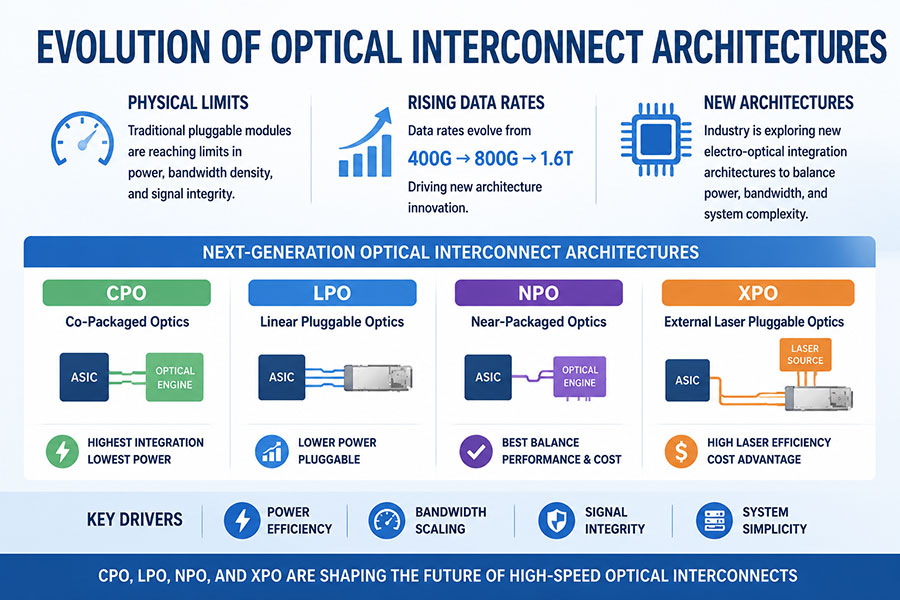
With the rapid development of AI computing, cloud computing, and hyperscale data centers, traditional pluggable optical modules are approaching physical limits in terms of power consumption, bandwidth density, and signal integrity.
As data rates evolve from 400G to 800G and further toward 1.6T, the industry is actively exploring new electro-optical integration architectures to balance power efficiency, bandwidth scaling, and system complexity.
Against this background, CPO, LPO, NPO, and XPO have become the key architectural directions for next-generation optical interconnect technologies.
2. What Are CPO, LPO, NPO, and XPO?
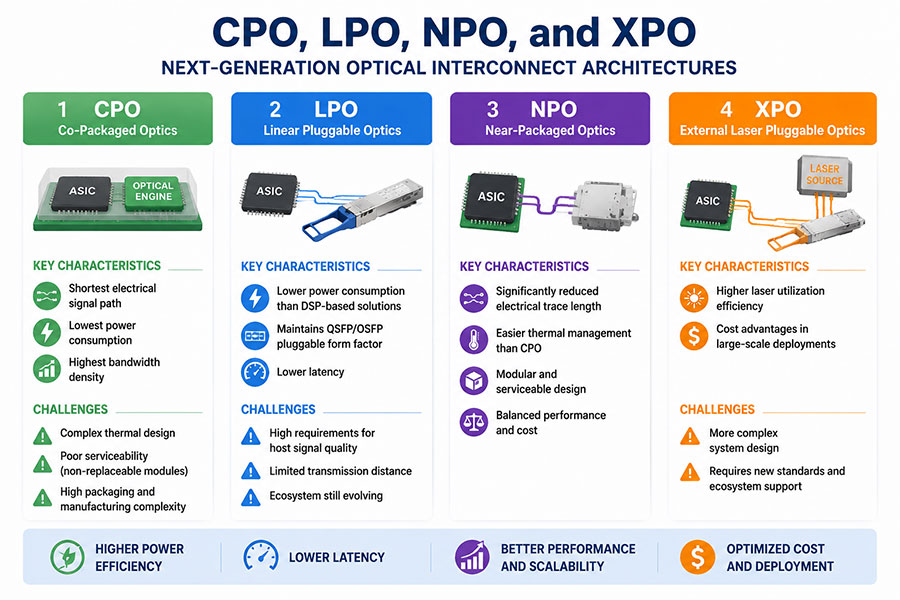
2.1 CPO (Co-Packaged Optics)
CPO integrates the optical engine directly with the switch ASIC within the same package.
Key characteristics:
Shortest electrical signal path
Lowest power consumption
Highest bandwidth density
Challenges:
Complex thermal design
Poor serviceability (non-replaceable modules)
High packaging and manufacturing complexity
2.2 LPO (Linear Pluggable Optics)
LPO removes the DSP chip from traditional optical modules and enables direct linear drive from the host ASIC.
Key characteristics:
Lower power consumption than DSP-based solutions
Maintains QSFP/OSFP pluggable form factor
Lower latency
Challenges:
High requirements for host signal quality
Limited transmission distance
Ecosystem still evolving
2.3 NPO (Near-Packaged Optics)
NPO places the optical engine close to the ASIC without fully integrating it into the same package.
Key characteristics:
Significantly reduced electrical trace length
Easier thermal management than CPO
Modular and serviceable design
Balanced performance and cost
2.4 XPO (External Laser Pluggable Optics)
XPO separates the laser source from the optical module and uses a centralized external laser supply.
Key characteristics:
Higher laser utilization efficiency
Cost advantages in large-scale deployments
Challenges:
More complex system design
Requires new standards and ecosystem support
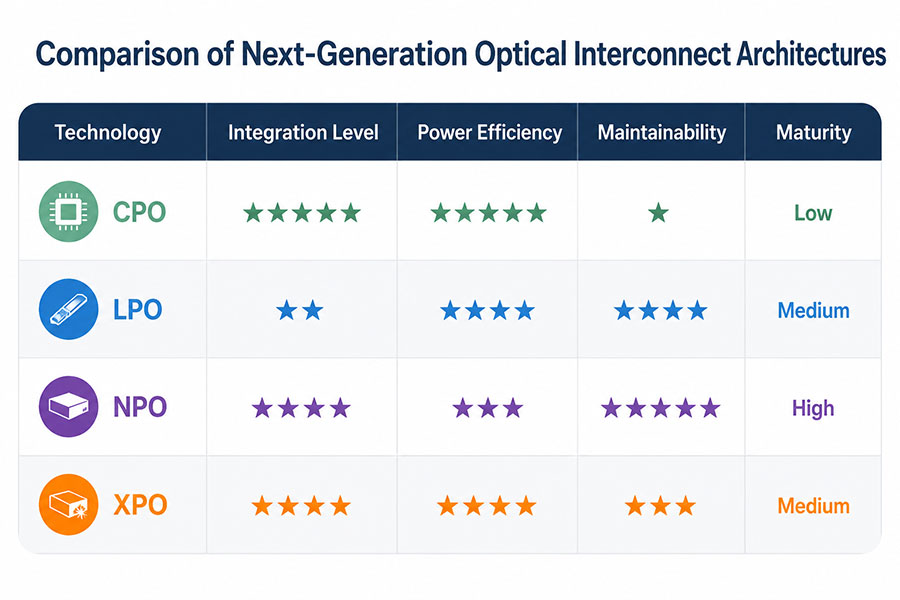
3. Architecture Comparison
4. Why Is NPO Preferred in 2026?
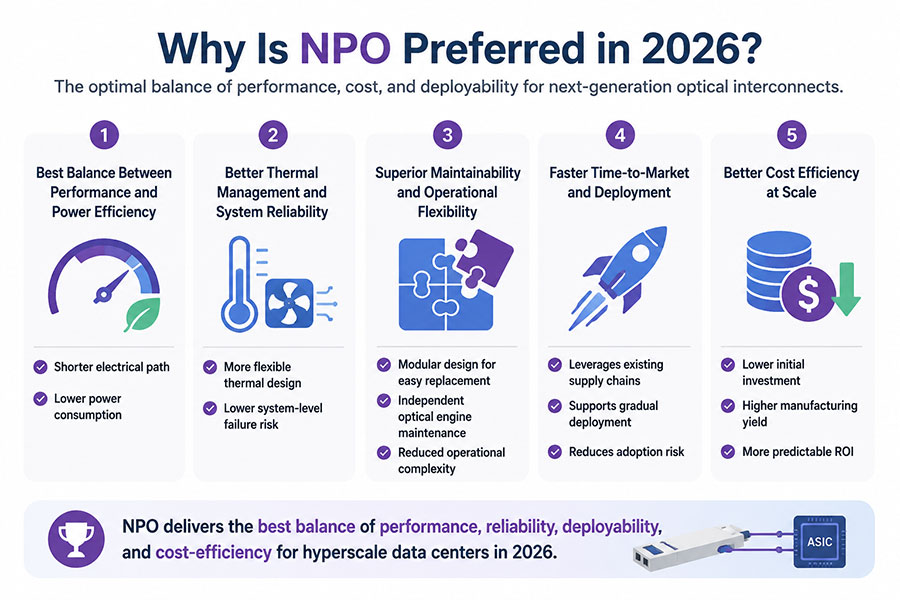
At the current stage, the industry is no longer focused solely on maximum integration, but increasingly on the balance between performance, cost, and deployability. This is where NPO stands out.
4.1 Best Balance Between Performance and Power Efficiency
NPO reduces electrical path length, effectively lowering power consumption while avoiding the extreme packaging complexity of CPO.
4.2 Better Thermal Management and System Reliability
Compared with tightly coupled CPO architectures, NPO offers:
More flexible thermal design
Lower system-level failure risk
4.3 Superior Maintainability and Operational Flexibility
For hyperscale data centers, serviceability is critical:
Modular design enables easy replacement
Optical engines can be maintained independently
Reduced operational complexity
4.4 Faster Time-to-Market and Deployment
Unlike CPO, which requires a full ecosystem redesign, NPO:
Leverages existing supply chains
Supports gradual, incremental deployment
Reduces adoption risk
4.5 Better Cost Efficiency at Scale
Compared with CPO, NPO provides:
Lower initial investment
Higher manufacturing yield
More predictable ROI
5. Typical Application Scenarios
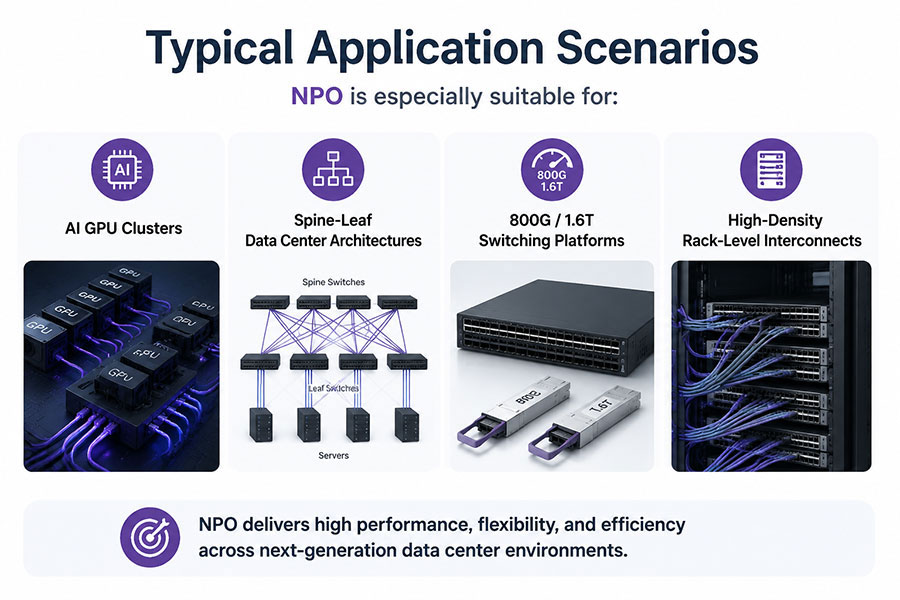
NPO is especially suitable for:
AI GPU clusters
Spine-Leaf data center architectures
800G / 1.6T switching platforms
High-density rack-level interconnects
6. Future Trend: Long-Term Coexistence of Multiple Architectures
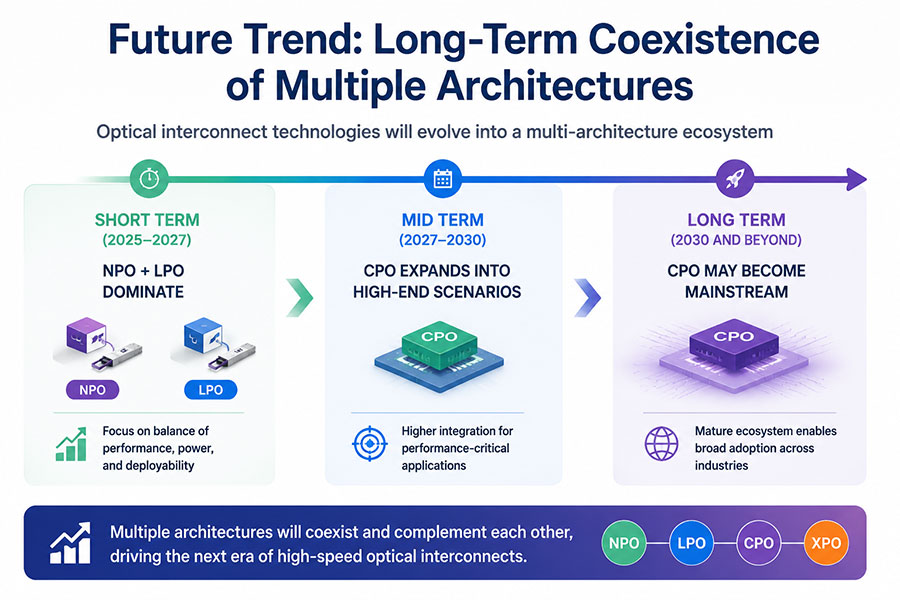
Optical interconnect technologies will evolve into a multi-architecture ecosystem:
Short term (2025–2027): NPO + LPO dominate
Mid term (2027–2030): CPO expands into high-end scenarios
Long term: CPO may become mainstream as technology matures
7. C-LIGHT Network Perspective
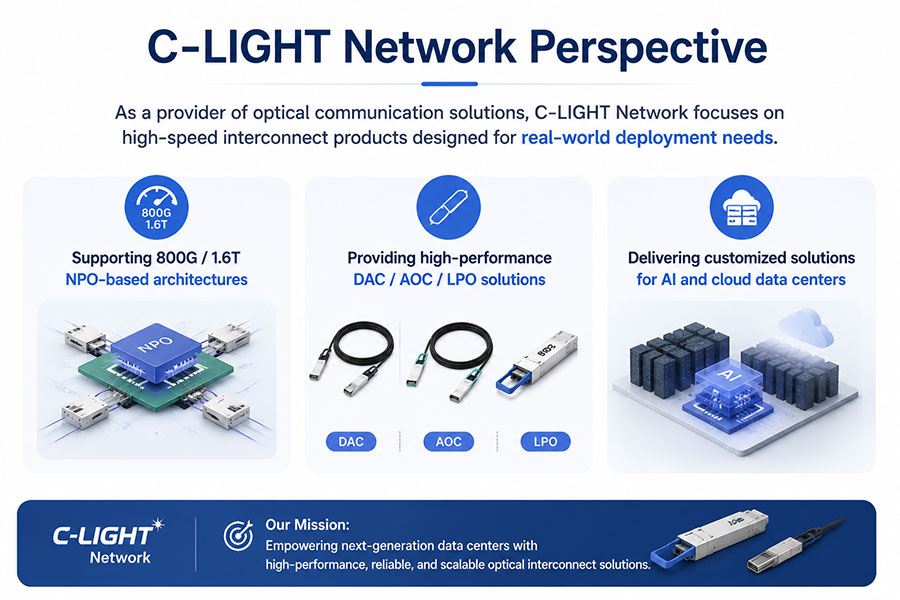
As a provider of optical communication solutions, C-LIGHT Network focuses on high-speed interconnect products designed for real-world deployment needs:
Supporting 800G / 1.6T NPO-based architectures
Providing high-performance DAC / AOC / LPO solutions
Delivering customized solutions for AI and cloud data centers
8. Conclusion
Although CPO represents the highest level of integration in optical interconnect evolution, its ecosystem maturity still requires time.
In 2026, NPO emerges as the most practical and optimal solution, offering the best balance of performance, cost, and deployability.
For customers seeking rapid deployment of high-performance interconnect solutions, NPO is currently the most effective path forward.
9. CPO vs LPO vs NPO vs XPO FAQ
Q1. What is the difference between CPO, LPO, NPO, and XPO optical architectures?
Answer: CPO, LPO, NPO, and XPO are next-generation optical interconnect architectures designed to overcome the power consumption, bandwidth density, and signal integrity challenges of traditional pluggable optics. CPO integrates optical engines directly with the switch ASIC, LPO removes DSP processing for lower power consumption, NPO places optical engines close to the ASIC with improved serviceability, and XPO separates laser sources from optical modules for enhanced scalability.
Q2. Why are CPO, LPO, and NPO technologies important for AI data centers?
Answer: AI workloads such as large language model (LLM) training and GPU clusters require massive bandwidth with lower power consumption. As network speeds evolve from 400G to 800G and 1.6T, traditional optical modules face increasing challenges in power efficiency and signal integrity. New architectures such as CPO, LPO, and NPO help improve bandwidth density, reduce electrical loss, and support future AI networking requirements.
Q3. What are the advantages of CPO optical interconnects?
Answer: CPO (Co-Packaged Optics) provides the shortest electrical signal path by integrating optical engines directly with switch ASICs. Its main advantages include lower power consumption, improved signal integrity, reduced latency, and higher bandwidth density. However, CPO requires advanced packaging technology and faces challenges related to thermal management, maintenance, and ecosystem maturity.
Q4. How does LPO differ from traditional optical modules?
Answer: LPO (Linear Pluggable Optics) removes the DSP chip from traditional optical modules and enables direct linear driving from the host ASIC. Compared with DSP-based solutions, LPO offers lower power consumption, lower latency, and maintains the flexibility of pluggable optical modules. However, it requires high-quality electrical signals and is generally more suitable for shorter-distance applications.
Q5. Why is NPO considered a practical solution for 800G and 1.6T optical networks?
Answer: NPO (Near-Packaged Optics) places optical engines close to the ASIC without fully integrating them into the same package. It provides a balance between performance, power efficiency, thermal management, and maintainability. Compared with CPO, NPO offers easier deployment, better serviceability, and lower adoption risk, making it suitable for AI GPU clusters and high-density data center networks.
Q6. Should AI data centers choose CPO, LPO, or NPO optical solutions?
Answer: The choice depends on network requirements and deployment strategy. LPO is suitable for low-power pluggable optical solutions with shorter reach requirements. NPO provides a balanced approach for large-scale AI clusters requiring high performance and operational flexibility. CPO is designed for future ultra-high-density switching platforms where maximum integration and power efficiency are priorities.
Q7. What are the typical applications of CPO, LPO, NPO, and XPO?
Answer: These optical architectures target different next-generation networking scenarios. LPO is suitable for high-speed pluggable optical connections, NPO is designed for AI GPU clusters, spine-leaf architectures, and 800G/1.6T switching platforms, CPO targets future hyperscale AI networks, and XPO focuses on large-scale deployments requiring centralized laser sources and improved optical efficiency.
Q8. Will CPO replace LPO and NPO in future AI optical networks?
Answer: CPO is unlikely to completely replace LPO and NPO in the near term. Different architectures will coexist based on application requirements. LPO and NPO provide practical deployment advantages for current 800G and early 1.6T networks, while CPO may become more important in future ultra-high-bandwidth AI infrastructure as technology and ecosystem maturity improve.
 >
>

 >
>
 >
>
 >
>
 >
>
 >
>
 >
>
 >
>