TEL:+86 132 6656 7067





Global data center investment is creating a broader demand cycle for optical connectivity. New facilities require fiber infrastructure, high-speed transceivers, switching systems, and interconnection networks, while upgrades to existing sites increase the need for higher bandwidth and denser optical links. As AI workloads expand, optical connectivity is becoming a core part of data center capital planning rather than a secondary networking consideration.
1. Global Data Center Investment Is Entering a New Expansion Cycle
Cloud computing, generative AI, enterprise digitalization, and large-scale data processing are changing the economics of data center infrastructure. Operators are investing in new facilities while expanding existing campuses to accommodate growing requirements for compute capacity, storage, networking, and power.
The investment cycle includes several distinct spending categories: land and buildings, electrical infrastructure, cooling systems, servers, accelerators, storage, network switches, optical equipment, and external connectivity. Optical networking is directly affected by both facility construction and the installation of information technology equipment.
JLL's 2026 Global Data Center Market Outlook estimates that global data center capacity could increase by approximately 97 GW between 2025 and 2030. Its analysis indicates that the expansion will require substantial investment in both data center real estate and tenant equipment. The scale of network spending therefore needs to be considered alongside the construction of new facilities.
Investment is also becoming more geographically distributed. North America remains a major data center market, while Europe, the Middle East, and Asia-Pacific are attracting new projects driven by cloud adoption, AI infrastructure programs, enterprise demand, and regional data-sovereignty requirements.
2. AI Infrastructure Is Increasing the Optical Content of Data Centers
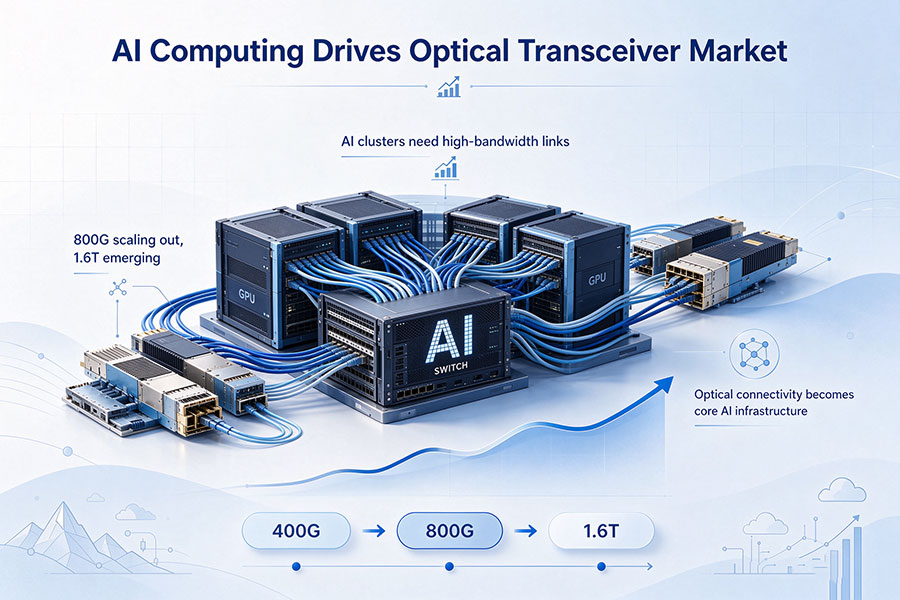
AI infrastructure has different networking requirements from many conventional enterprise data centers. Large GPU clusters exchange substantial volumes of information during distributed training, model synchronization, and inference. These communication patterns increase traffic between accelerators, servers, switches, and storage systems.
As deployments scale across multiple racks and data halls, operators need high-bandwidth network fabrics with predictable performance. Optical connections are increasingly used where copper links face practical constraints related to distance, signal integrity, cable density, and power consumption.
This shift affects both the number and the capabilities of optical connections. A new AI facility may require large quantities of high-speed transceivers, fiber trunks, breakout assemblies, connectors, and optical transport equipment. Existing facilities may also need network upgrades as accelerator density and switching capacity increase.
The optical content of a data center is therefore influenced not only by its total floor space or power capacity, but also by its compute architecture, rack density, switch design, network topology, and the distance between connected systems.
3. Capital Expenditure Is Flowing Into Network Infrastructure
Data center investment is often discussed in terms of buildings, electricity, and GPUs, but networking infrastructure represents another important part of the total capital requirement. Servers and accelerators need high-speed connections to communicate with one another, access storage, and connect to external networks.
JLL's 2026 outlook estimates that approximately US$3 trillion of investment may be required by 2030 to support around 100 GW of new global data center capacity. Its estimate includes data center real estate investment and an additional US$1 trillion to US$2 trillion in tenant spending on IT equipment. These figures are projections, not confirmed future expenditure.
Network investment extends across several layers:
Server and accelerator connectivity: Network interface cards, high-speed electrical links, optical transceivers, and active optical cables.
Switching infrastructure: Leaf-spine switches, high-capacity switching ASICs, optical uplinks, and network interface equipment.
Structured cabling: Fiber trunks, patch panels, MPO/MTP connectors, LC patch cords, and high-density distribution systems.
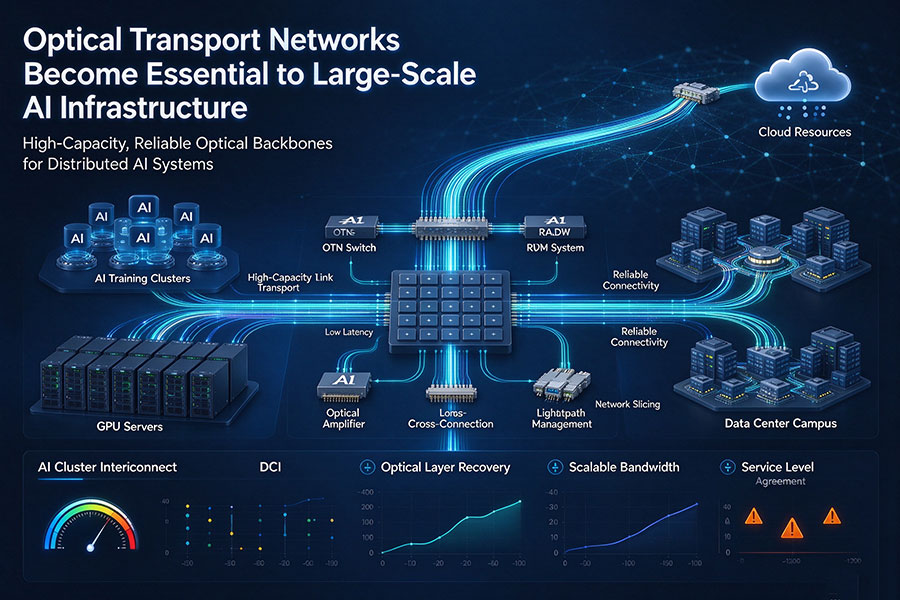
Data center interconnect: Coherent optical equipment, DWDM systems, amplifiers, and long-distance fiber infrastructure.
Network management and testing: Optical monitoring, link qualification, performance validation, and operational tools.
As new facilities become larger and more interconnected, network infrastructure planning needs to be integrated into early project design. Retrofitting fiber routes, equipment rooms, or optical distribution capacity after construction can increase cost and complicate deployment schedules.
4. Higher Network Speeds Are Accelerating Optical Transceiver Upgrades
Growing data center investment is supporting the transition toward higher-speed optical interfaces. As switch capacity and server bandwidth increase, operators need optical transceivers that can support higher aggregate throughput while fitting within equipment power and thermal limits.
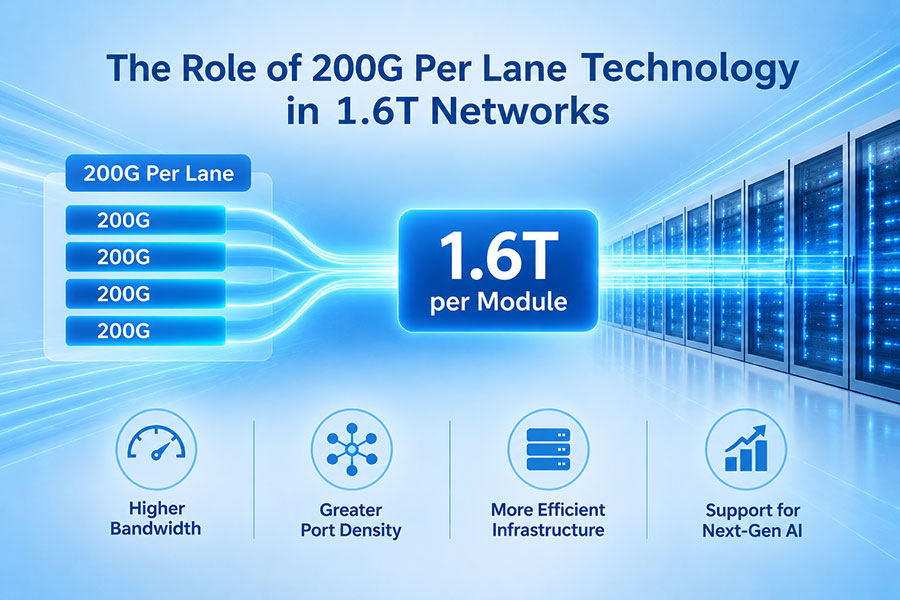
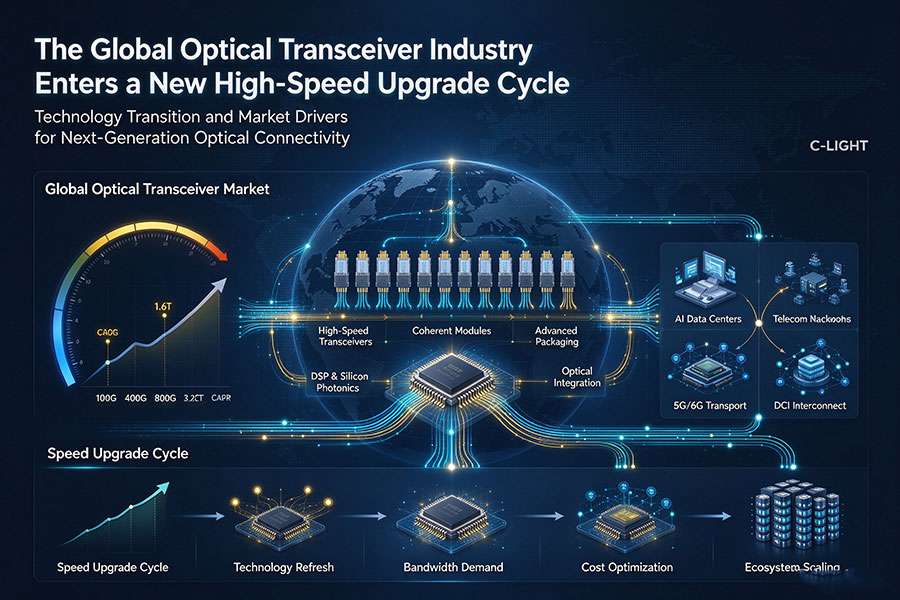
400G products remain relevant across many networks, while 800G connectivity is becoming increasingly important in large AI and cloud deployments. 1.6T interfaces are emerging as the next bandwidth step, with adoption depending on switch platforms, host electrical interfaces, optical reach requirements, and ecosystem maturity.
| Interface generation | Typical application direction | Optical infrastructure implications |
|---|---|---|
| 100G / 200G | Established data center links, aggregation, and selected enterprise or service-provider networks | Continued demand for compatible transceivers, patching, and fiber infrastructure |
| 400G | High-capacity switching and data center uplinks | Higher port density, parallel optics, and duplex WDM options |
| 800G | Large-scale cloud and AI cluster networking | Higher-speed optical engines, advanced DSPs, and increased fiber connectivity |
| 1.6T | Emerging next-generation switching and AI network platforms | 200G-class electrical lane development, photonic integration, and tighter thermal requirements |
These generations do not replace one another simultaneously. Data centers typically operate multiple network generations during phased upgrades. Product selection must match the switch port, electrical lane configuration, optical reach, fiber type, connector, and supported management functions.
5. Fiber Infrastructure Is Becoming a Strategic Investment
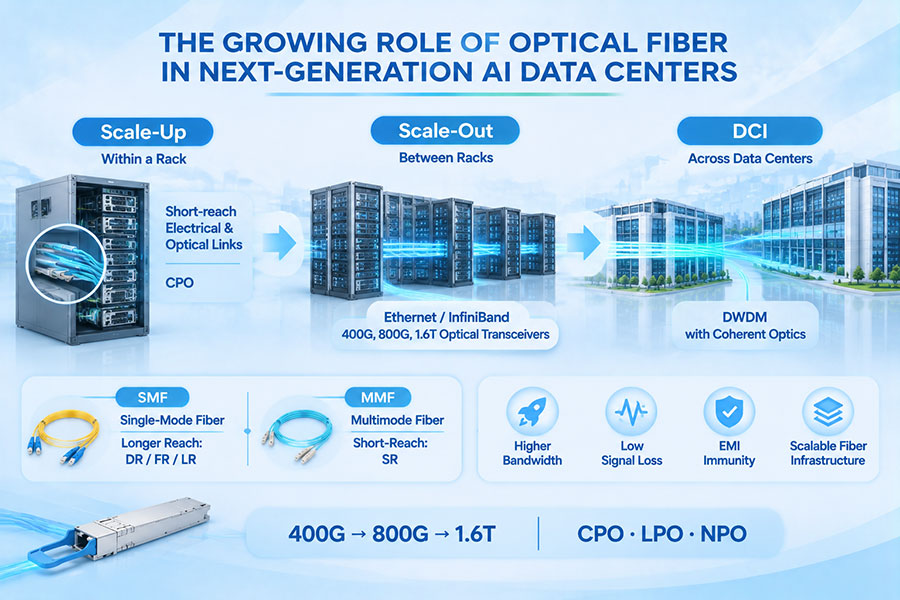
Every optical connection requires a physical fiber path. As data center campuses expand, fiber infrastructure must support connections within racks, between racks, across data halls, and between separate buildings. Large facilities also require external fiber routes to connect with cloud regions, carrier networks, internet exchanges, and other data centers.
Higher port density increases the amount of fiber required in equipment rooms and cable pathways. AI clusters can use extensive parallel-fiber connections, while high-speed WDM interfaces can carry multiple wavelengths over duplex fiber pairs. The actual fiber requirement depends on the optical architecture, port count, topology, redundancy design, and deployment scale.
TrendForce reported in October 2026 that AI data centers, data center interconnects, and high-capacity backbone deployments were contributing to tighter global optical fiber supply. Its research projected a 2026 supply shortfall of 180 million fiber-kilometers and indicated that supply constraints could persist through 2028. These are industry estimates and projections rather than finalized production figures.
The development highlights the importance of securing fiber capacity early in large infrastructure projects. Fiber availability, cable manufacturing lead times, route diversity, and installation resources can influence the schedule of a data center expansion just as power availability and equipment delivery can.
6. Data Center Interconnect Is Extending Optical Investment Beyond Individual Facilities
Large cloud and AI operators increasingly distribute computing resources across multiple buildings, campuses, and metropolitan areas. This creates demand for data center interconnect, or DCI, which provides high-capacity communication between geographically separated facilities.
DCI links may carry storage replication, cloud traffic, distributed computing workloads, backup data, and connections between AI infrastructure sites. Their requirements differ from short-reach connections inside a data hall because transmission distance, fiber loss, optical amplification, and available spectrum become more important.
Coherent optical technology is widely used in higher-capacity DCI systems. Coherent transceivers encode information using optical amplitude and phase, allowing advanced receivers and digital signal processing to recover signals over longer distances and support high spectral efficiency.
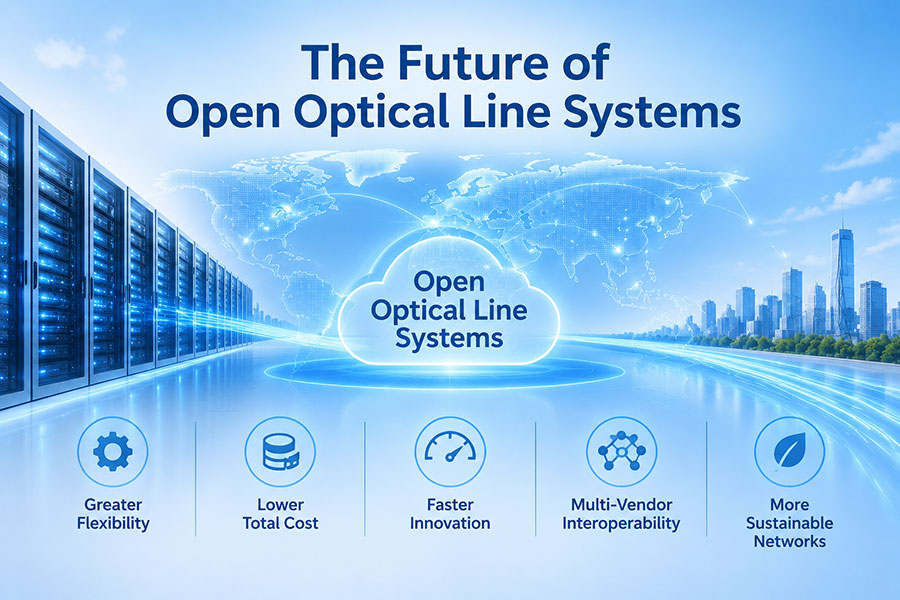
DWDM systems increase the capacity of existing fiber routes by carrying multiple wavelengths over the same fiber. Depending on distance and network design, these systems may use optical amplifiers, wavelength management, and open optical line systems to support scalable capacity.
RCR Wireless reported in June 2026, citing Dell'Oro Group, that DCI optical equipment spending increased by 40% in 2025 and was expected to rise by a further 40% in 2026. The report also described hyperscale cloud providers as an increasingly important source of optical networking demand.
7. Hyperscale and Colocation Models Create Different Connectivity Requirements
Global data center investment is not concentrated in a single operating model. Hyperscale providers build and operate large facilities for their own cloud and AI platforms, while colocation providers supply space, power, and connectivity to multiple customers. Enterprise facilities and edge data centers serve additional requirements.
These models create different optical deployment patterns.
| Data center model | Connectivity priorities | Common optical infrastructure needs |
|---|---|---|
| Hyperscale | Large-scale compute fabrics, high port counts, and rapid capacity expansion | 800G and emerging 1.6T optics, high-density fiber, optical switching, and DCI |
| Colocation | Multi-tenant connectivity, carrier access, and flexible cross-connects | Fiber distribution, patch panels, transceivers, and diverse external routes |
| Enterprise | Business applications, storage, security, and campus connectivity | 10G to 400G optical links depending on network scale and upgrade requirements |
| Edge | Regional access, low-latency services, and distributed workloads | Compact optical equipment, access fiber, and aggregation links |
Hyperscale facilities often place greater emphasis on standardized network architectures and large-volume procurement. Colocation facilities need flexible fiber distribution and clear demarcation between tenants. Enterprise and edge deployments may prioritize compatibility with existing infrastructure and gradual capacity upgrades.
8. Regional Investment Is Reshaping Optical Network Geography
Data center construction is influenced by access to electricity, fiber routes, land, cooling resources, customers, and regulatory conditions. These factors are shaping investment decisions across North America, Europe, and Asia-Pacific.
North America remains a major center for hyperscale and AI infrastructure. Large cloud providers are expanding existing campuses and developing new locations, while network operators invest in fiber routes and DCI capacity to connect facilities.
Europe's data center market is influenced by cloud adoption, enterprise digitalization, data residency, and interconnection demand. Established hubs and emerging regional markets require connectivity between facilities, cloud platforms, and international network routes.
Asia-Pacific is experiencing investment from cloud providers, telecommunications companies, and regional technology firms. Market development varies significantly by country because power availability, regulation, connectivity, and local demand differ.
Regional expansion also changes the supply chain. Optical transceiver manufacturers, fiber suppliers, connector producers, semiconductor companies, and system integrators must coordinate production and delivery across multiple markets.
9. Higher Fiber Density Is Changing Data Center Cabling Design
As optical port counts increase, the physical organization of fiber becomes a major engineering concern. A large AI facility may contain extensive connections between accelerator servers, leaf switches, spine switches, storage systems, and external network equipment. Poorly planned cable routing can make installation, maintenance, and future expansion more difficult.
High-density structured cabling provides a more organized approach. Trunk cables can connect distribution areas, while breakout harnesses and patch cords provide the required interfaces at equipment racks.
MPO/MTP connectivity is widely used in parallel-optics applications, while duplex LC interfaces remain common for many single-mode and WDM transceivers. The correct connector and fiber arrangement depend on the transceiver specification and the network's polarity plan.
Important design considerations include:
Fiber count and available cable-tray capacity.
Connector type, gender, keying, and polarity mapping.
Insertion-loss budgets across connectors, splices, and fiber routes.
Minimum bend radius and mechanical protection.
Labeling, documentation, and access for maintenance.
Spare fiber capacity and provision for future network upgrades.
Structured cabling should be designed around the logical network topology as well as the physical layout. This is particularly important in AI clusters where multiple network planes or accelerator rails may require consistent and clearly separated fiber paths.
10. Power and Cooling Constraints Influence Optical Architecture
Network equipment is part of the wider data center power and thermal budget. Higher-speed transceivers, switch ASICs, retimers, and optical engines all contribute to equipment power consumption. As port density increases, the combined thermal load can influence rack design and cooling requirements.
Operators therefore evaluate optical technologies not only by bandwidth and reach, but also by power per bit, thermal performance, serviceability, and deployment cost.
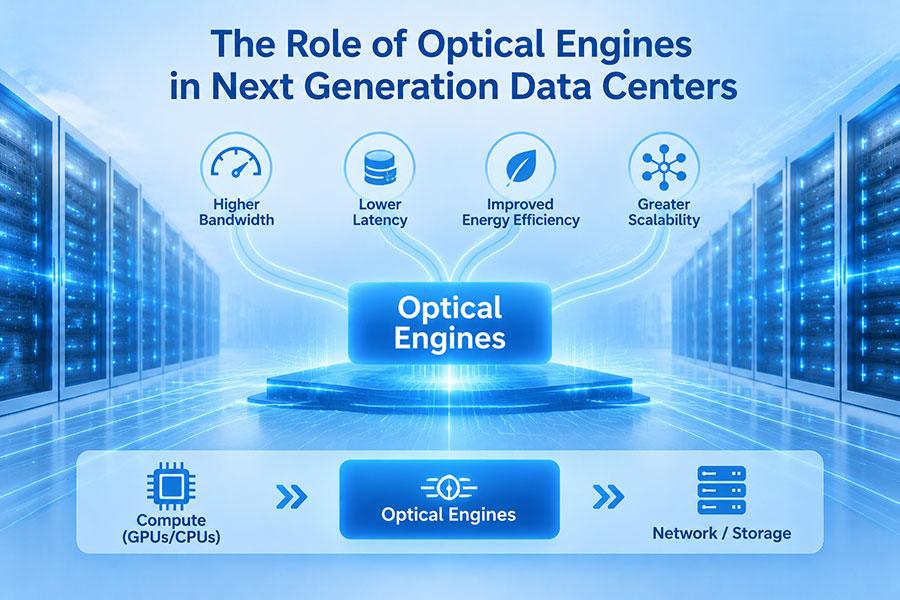
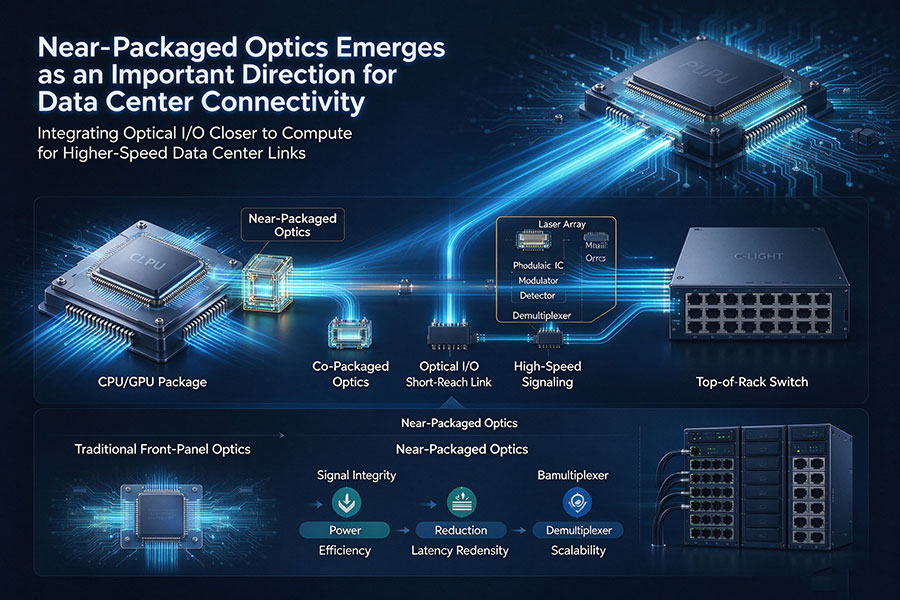
Pluggable transceivers provide modularity and allow individual modules to be replaced without redesigning the switch package. Linear pluggable optics can reduce selected module-side signal-processing functions in compatible systems. Near-packaged optics and co-packaged optics move optical engines closer to switching ASICs to shorten high-speed electrical paths.
These architectures involve different engineering trade-offs. Closer integration can improve electrical efficiency and bandwidth density, but may affect repair procedures, packaging complexity, and long-term service models. The appropriate choice depends on system requirements and operational priorities.
11. Optical Component Supply Chains Are Becoming More Important
Large infrastructure investment creates demand for complete optical products and for the components used to manufacture them. These include laser diodes, photodetectors, silicon photonics devices, optical DSPs, drivers, transimpedance amplifiers, fiber arrays, connectors, and optical packaging materials.
Higher-speed products can require more advanced manufacturing processes and tighter control of optical and electrical characteristics. A shortage in one specialized component can affect the delivery of complete transceiver products even when other parts of the production line have sufficient capacity.
Supply-chain planning is therefore becoming a strategic consideration for optical manufacturers and data center operators. Long-term procurement agreements, qualified alternative suppliers, production-capacity planning, and component lifecycle management can help reduce exposure to supply disruptions.
For manufacturers, the ability to maintain consistent performance at higher production volumes is as important as achieving strong results in initial product samples. Optical alignment, thermal stability, reliability testing, and manufacturing yield all affect commercial scalability.
12. Interoperability and Qualification Matter During Network Expansion
Large data center projects often combine equipment from multiple suppliers. Switches, network interface cards, optical transceivers, fiber assemblies, and monitoring systems must work together within the intended network architecture.
Compatibility involves more than mechanical form factor. The optical module must match the host port's data rate, electrical lane configuration, modulation format, wavelength, reach, fiber type, connector, and supported management interface. Firmware behavior and FEC settings can also affect link establishment and error performance.
Before large-scale deployment, operators and equipment suppliers typically validate optical power, receiver sensitivity, link stability, error rates, thermal behavior, and interoperability with target platforms. Testing should reflect the actual operating environment rather than relying only on individual component specifications.
For phased network upgrades, qualification is especially important because new optical modules may need to coexist with earlier generations of switches, cables, and network management systems.
13. Investment Planning Will Need to Include Long-Term Optical Capacity
Data center construction decisions have long-term consequences for network capacity. A facility designed only around its initial server and switch deployment may face expensive upgrades if fiber pathways, distribution areas, and external routes lack sufficient expansion capacity.
Infrastructure planning should consider expected changes in accelerator density, switch bandwidth, rack power, fiber count, and inter-facility traffic. It should also account for the possibility that different network segments will migrate to higher data rates at different times.
Several planning priorities are becoming increasingly important:
Scalable fiber pathways: Provide sufficient capacity for future trunks, patching, and additional network planes.
Flexible optical architecture: Support different reach requirements and transceiver generations without unnecessary redesign.
Supply-chain resilience: Evaluate component availability, manufacturing capacity, and procurement lead times.
Energy-aware network design: Assess power consumption and cooling requirements across the complete optical link.
Interoperability validation: Qualify equipment combinations before large-scale deployment.
External route diversity: Plan resilient fiber connectivity between facilities and carrier networks.
The objective is not simply to install the highest-speed optics available at the time of construction. It is to build an infrastructure foundation that can accommodate changing bandwidth requirements and evolving network architectures over the facility's operating life.
14. Conclusion
Global data center investment is reshaping optical connectivity across both internal network infrastructure and external interconnection networks. AI workloads are increasing the need for high-bandwidth links, while cloud expansion and distributed computing are driving demand for fiber routes and DCI capacity.
The effects extend throughout the optical supply chain. Higher-speed transceivers, advanced laser sources, photonic integration, fiber assemblies, connectors, and precision packaging are becoming increasingly important to the development of modern data centers.
As investment continues, optical connectivity will need to evolve alongside compute capacity, switching performance, power infrastructure, and cooling systems. Data center operators and equipment suppliers that plan for scalable fiber capacity, reliable component supply, and system-level compatibility will be better positioned to support the next generation of digital infrastructure.
Reliable optical connectivity is essential to scalable data center infrastructure. C-LIGHT provides optical transceiver solutions for different network speeds and application requirements. View the optical transceiver product range or Contact C-LIGHT for further information.
 >

 >
 >
 >
 >
 >
 >
 >