TEL:+86 132 6656 7067





Wavelength selection is a major consideration when designing DWDM optical networks. Every wavelength channel must match the optical multiplexer, demultiplexer, transmission path, and receiving equipment. The choice between fixed-wavelength and tunable lasers affects not only the optical transmitter but also equipment inventory, network provisioning, maintenance, and deployment flexibility.
A fixed-wavelength laser operates around one designated optical channel. A tunable laser can be configured to operate at different wavelengths within its supported tuning range. Both approaches can deliver reliable optical transmission, but they serve different operational requirements. Fixed-wavelength solutions are attractive for predictable channel assignments and lower initial costs, while tunable solutions offer greater flexibility across multi-channel DWDM networks.
1. What Is a Fixed-Wavelength Laser?
A Fixed-Wavelength Laser is a semiconductor laser designed to operate at a specified nominal wavelength. In optical communication, this wavelength normally corresponds to an assigned channel in an optical wavelength plan, such as an ITU-T DWDM grid.
Common fixed-wavelength telecom laser technologies include Distributed Feedback (DFB) lasers and other wavelength-specific semiconductor laser structures. The grating design, cavity characteristics, and operating conditions determine the nominal emission wavelength.
For example, a fixed-wavelength DWDM transceiver may be manufactured for one designated C-band channel. Its laser is designed to transmit on that channel rather than being configured for a different channel during normal operation.
Typical characteristics include:
Single designated channel: The transmitter is designed for a specific nominal wavelength.
Stable operation: Temperature control and laser-drive management help maintain the specified wavelength.
Simpler configuration: No user-selectable wavelength tuning is normally required.
Channel-specific product variants: Different wavelength assignments may require different product part numbers.
Established architecture: Fixed-wavelength transmitters are widely used in conventional optical communication networks.
Temperature stabilization remains important even when the wavelength is fixed. Semiconductor laser emission can shift as temperature changes, so the transmitter must maintain the wavelength within the applicable specification.
2. What Is a Tunable Laser?
A Tunable Laser is a laser source whose output wavelength can be intentionally selected or adjusted within a defined tuning range. Instead of being restricted to one designated channel, the same laser product can support multiple wavelength assignments.
In DWDM systems, a tunable transmitter can be configured for a required ITU channel during installation or network provisioning. The selected wavelength must match the network's channel plan and the optical filtering characteristics of the transmission system.
Common tunable laser architectures include:
Tunable DFB array: Uses multiple DFB cavities designed for different wavelength regions.
DBR laser: Uses separately controlled gain and reflector sections to adjust the lasing wavelength.
Sampled-Grating DBR (SG-DBR): Uses wavelength-selective reflector structures to achieve a wider tuning range.
External Cavity Laser (ECL): Uses an external wavelength-selective element to control the optical output.
The tuning range and performance depend on the laser architecture. Some devices cover a limited group of adjacent channels, while others support a wider portion of the C-band.
Tunable transceivers may require wavelength configuration through a switch operating system, management interface, or external tuning tool. Support depends on the module and host platform.
3. Fixed-Wavelength vs Tunable Laser: Core Differences
The primary distinction is whether the optical transmitter is restricted to one designated channel or can be configured for multiple supported channels.
| Technical Factor | Fixed-Wavelength Laser | Tunable Laser |
|---|---|---|
| Wavelength operation | One designated nominal wavelength | Multiple selectable wavelengths within a defined range |
| Channel assignment | Established during product selection or manufacturing | Configured during installation or network operation |
| Laser architecture | Commonly fixed DFB or other wavelength-specific laser | May use DFB arrays, DBR, SG-DBR, or external-cavity structures |
| Wavelength control | Maintains the designated operating wavelength | Selects and stabilizes the configured wavelength |
| Product variants | Different channels may require different part numbers | One product can support multiple channel assignments |
| Initial purchase cost | Generally lower | Generally higher |
| Inventory management | May require channel-specific spare units | Can reduce the number of wavelength-specific spare models |
| Configuration complexity | Usually simpler | Requires supported tuning and wavelength configuration functions |
| Network flexibility | Best suited to predetermined channel assignments | Supports wavelength reassignment within the tuning range |
| Typical applications | Fixed-channel optical links and DWDM deployments | Flexible DWDM, ROADM, and wavelength-reconfigurable networks |
4. Wavelength Selection and DWDM Channel Grid
DWDM increases fiber capacity by transmitting multiple optical wavelengths through a shared fiber. Each channel occupies a designated position on the wavelength or frequency grid. The transmitter must operate within the permitted channel frequency and wavelength tolerance so that the signal passes through the intended optical filters.
In a fixed-wavelength architecture, the laser is designed for one channel. For example, a transmitter may be assigned to a particular 100 GHz or 50 GHz ITU channel. A different channel generally requires a different fixed-wavelength transmitter.
In a tunable architecture, the transmitter can be configured for different supported channels. This is particularly useful when equipment is deployed across multiple network locations that do not all use the same wavelength assignment.
| Parameter | Fixed-Wavelength System | Tunable System |
|---|---|---|
| Channel selection | Determined by the selected transceiver variant | Selected from the supported channel list |
| ITU grid compatibility | Manufactured for the specified channel grid | Must support the required grid and channel spacing |
| Channel reassignment | Normally requires replacing the wavelength-specific transmitter | Can be performed through supported wavelength configuration |
| Optical filtering | Must match the fixed channel | Must pass the newly selected channel |
| Network planning | Requires channel-specific product allocation | Provides more flexibility in product allocation |
For example, a C-band DWDM system may use a 50 GHz channel grid. A tunable transceiver designed for that grid can be configured for supported channel frequencies within its specified tuning range. It cannot automatically operate on every possible optical frequency: the tuning range, channel grid, frequency accuracy, and host support must all be verified.
5. Optical Performance: Output Power, Linewidth, and Stability
Fixed-wavelength and tunable lasers can both deliver high-quality optical signals. Their performance should be assessed through the actual laser and transceiver specifications rather than assuming that one category always provides better optical quality.
Important parameters include:
Output power: The optical power available at the transmitter output.
Wavelength accuracy: How closely the output matches the assigned or selected channel.
Wavelength stability: How consistently the laser maintains its operating wavelength over temperature and time.
Linewidth: The spectral width of the optical carrier, particularly important in coherent transmission.
Side-mode suppression ratio (SMSR): The suppression of unwanted longitudinal modes.
Relative intensity noise (RIN): Optical intensity fluctuations that can affect signal quality.
A fixed DFB laser can provide stable single-mode output for a designated channel. A tunable laser must maintain acceptable optical characteristics throughout its supported tuning range. Its linewidth, power, and stability may vary depending on the selected wavelength and architecture.
For coherent optical systems, laser linewidth and frequency stability are particularly important because phase information is used to recover the transmitted data. A tunable laser intended for coherent transmission must satisfy the relevant frequency and phase-noise requirements.
6. Power Consumption and Temperature Control
Power consumption depends on the laser structure, operating wavelength, output power, temperature-control method, and the electronics surrounding the optical source.
Fixed-wavelength transmitters generally have a simpler wavelength-control requirement. They may still use thermoelectric cooling or other temperature-control mechanisms to maintain the specified operating point.
Tunable transmitters may require additional control functions for wavelength selection, calibration, and stabilization. Some architectures use multiple laser sections or active tuning elements, which can increase control complexity and power requirements.
However, it is not accurate to assume that every tunable laser consumes more power than every fixed-wavelength laser. Actual power depends on the implementation and must be checked in the product datasheet.
| Evaluation Factor | Fixed-Wavelength | Tunable |
|---|---|---|
| Wavelength stabilization | Maintains one target wavelength | Maintains the currently selected wavelength |
| Control functions | Generally simpler | May include wavelength selection and calibration |
| Thermal management | Depends on laser design and operating conditions | Depends on tuning architecture and selected wavelength |
| Power consumption | Product-specific | Product-specific; additional tuning functions may affect the total |
| Operational behavior | Maintains its preset channel | Must complete wavelength configuration and stabilization after a channel change |
7. Tuning Speed and Network Reconfiguration
One important difference is the ability to change the operating wavelength. A fixed-wavelength transmitter does not normally provide a user-selectable channel change. A tunable transmitter can select another supported channel, but the time required depends on the laser architecture and control system.
Wavelength reconfiguration typically involves more than changing a control value. The laser may need to adjust its internal tuning sections, stabilize its temperature, acquire the target frequency, and confirm that the output meets the required wavelength tolerance.
For network deployments, tuning and settling time should be considered alongside the network's restoration requirements. A tunable transmitter is useful for provisioning or wavelength reassignment, but it should not automatically be treated as a replacement for fast protection switching.
Engineers should verify:
Supported wavelength switching method
Channel-to-channel tuning time
Frequency acquisition and settling time
Wavelength locking and stabilization behavior
Management interface and software support
Traffic interruption during wavelength changes
8. DWDM Applications and Network Deployment
Fixed-wavelength and tunable transmitters can both be used in DWDM networks. Their suitability depends on how the network is planned and how frequently wavelength assignments are expected to change.
Fixed-wavelength applications:
Point-to-point DWDM links with predetermined channel assignments
Metro and long-haul systems with stable wavelength plans
Deployments where channel-specific equipment is acceptable
Networks prioritizing lower initial transceiver costs
Tunable applications:
DWDM networks with multiple wavelength assignments
ROADM systems requiring wavelength flexibility
Network deployments using standardized transceiver inventory
Service-provider networks with distributed equipment locations
Coherent optical systems requiring a selectable carrier frequency
In a reconfigurable optical network, wavelength flexibility can simplify channel provisioning and help operators assign available wavelengths to different routes. However, tunability at the transmitter does not by itself make the entire optical network reconfigurable. ROADMs, optical filters, control systems, and network management must also support the required configuration.
9. Cost, Inventory, and Total Cost of Ownership
Purchase price is only one part of the cost difference between fixed-wavelength and tunable transceivers. The number of channels in the network, spare inventory requirements, deployment frequency, and compatibility with host equipment all influence the total cost of ownership.
Fixed-wavelength transceivers usually have a lower initial unit price. However, a network using many wavelength channels may need to stock separate spare transceivers for each channel.
Tunable transceivers generally have a higher purchase price but can reduce the number of wavelength-specific spare models. One supported tunable model may cover multiple channel assignments, simplifying logistics and field replacement.
| Cost Factor | Fixed-Wavelength Transceiver | Tunable Transceiver |
|---|---|---|
| Unit purchase cost | Generally lower | Generally higher |
| Product variants | May require separate SKUs for different channels | One SKU may cover several supported channels |
| Spare inventory | Channel-specific spares may be required | Potentially fewer spare models |
| Deployment flexibility | Requires correct channel selection before installation | Can be configured for the required supported channel |
| Operational training | Usually simpler | Requires wavelength provisioning knowledge |
| Long-term cost | Can be economical for stable channel plans | May be advantageous when inventory and reconfiguration savings are significant |
The financial advantage depends on the deployment scale. A small point-to-point network with only a few channels may benefit from fixed-wavelength optics. A large network with many channel assignments and distributed spare requirements may gain more value from tunable products.
10. Compatibility and Installation Considerations
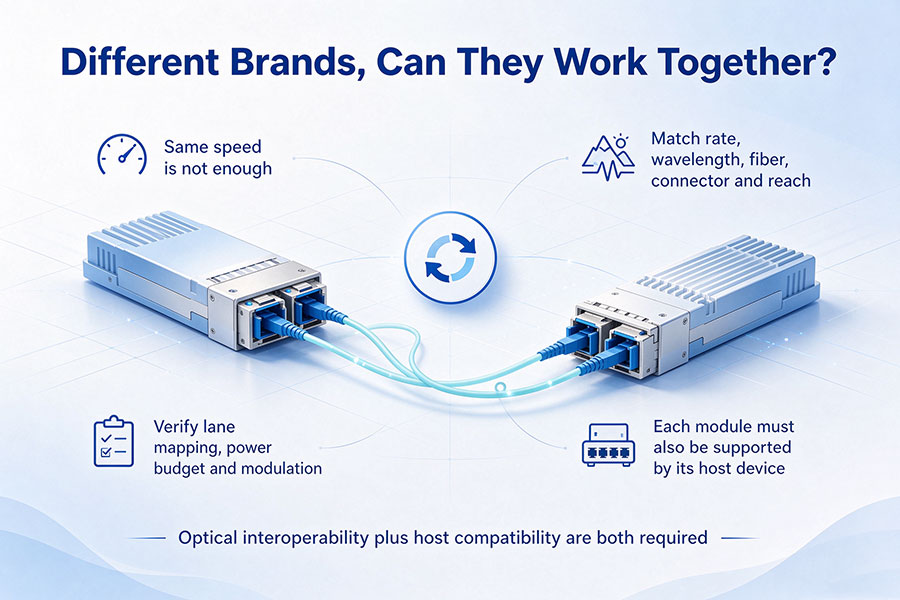
Wavelength tunability does not guarantee compatibility with every switch, router, or DWDM line system. The host platform must recognize the transceiver and support its wavelength configuration method.
Before deployment, engineers should check the following:
Host equipment: Confirm that the switch or router supports the exact tunable transceiver model.
Management interface: Verify that wavelength selection is available through the platform's operating system, CLI, or management software.
Channel grid: Confirm that the tunable range and supported channel spacing match the DWDM system.
Optical line system: Check compatibility with muxes, demuxes, ROADMs, and optical amplifiers.
Transmission distance: Confirm the optical budget, receiver sensitivity, and supported reach.
Wavelength monitoring: Check that the module provides the required monitoring and diagnostic information.
Firmware and coding: Verify the vendor-specific compatibility requirements and software support.
Some platforms allow tunable wavelength configuration directly through their management interface. Others may require a separate tuning tool or supported external configuration process. A transceiver that physically fits a port is not necessarily supported for wavelength tuning by that platform.
11. How to Choose the Right Laser for Your Network
The best choice depends on the network's channel plan, equipment compatibility, deployment scale, and operational requirements.
Choose fixed-wavelength optics when:
The wavelength assignment is predetermined and unlikely to change.
The network uses a limited number of optical channels.
Lower initial transceiver cost is a priority.
Channel-specific inventory is manageable.
The host platform does not support tunable wavelength configuration.
Choose tunable optics when:
The network uses multiple DWDM channels across different locations.
Wavelength reassignment is part of normal network operations.
Reducing channel-specific spare inventory is important.
The host equipment supports the tunable module and its management functions.
ROADM or other reconfigurable optical network functions are required.
Before finalizing the product selection, evaluate the following specifications:
Wavelength range and supported ITU channel grid
Channel spacing, such as 100 GHz or 50 GHz
Output power and receiver sensitivity
Optical reach and link budget
Laser linewidth and wavelength stability
Power consumption and temperature range
Tuning method and settling time
Form factor and host equipment compatibility
For optical connectivity requirements, the C-LIGHT optical transceiver portfolio provides a starting point for evaluating available transceiver categories. Exact fixed-wavelength and tunable capabilities should be verified against the individual product specifications.
12. Conclusion
Fixed-Wavelength Laser and Tunable Laser technologies serve different operational needs in optical communication. Fixed-wavelength transmitters provide a designated channel with a relatively simple configuration and generally lower initial cost. Tunable transmitters provide wavelength flexibility, allowing one supported product to operate on multiple channels within its specified tuning range.
For stable point-to-point DWDM links, fixed-wavelength optics can be an economical and straightforward solution. For large networks with many channel assignments, distributed equipment, or frequent wavelength reconfiguration, tunable optics can simplify inventory and improve deployment flexibility.
The final decision should consider not only laser performance and purchase price, but also channel planning, host compatibility, optical line-system support, maintenance, and total cost of ownership. A mixed deployment using fixed and tunable transceivers may be the most practical approach for networks with different operational requirements.
Planning a DWDM or high-speed optical connectivity deployment?
C-LIGHT supports optical connectivity requirements across data center, telecommunications, and networking applications. Share your target wavelength, channel spacing, transmission distance, data rate, and equipment model to discuss a suitable transceiver solution.
 >

 >
 >
 >
 >
 >
 >
 >