TEL:+86 132 6656 7067





As optical interconnects evolve toward higher bandwidth and greater integration density, semiconductor modulators are becoming critical components in data center transceivers, AI computing networks, and silicon photonic systems. Electro-Absorption Modulators (EAMs) and microring modulators (MRMs) are two compact technologies designed to convert electrical signals into optical intensity variations. Although both can support high-speed optical communication, they rely on fundamentally different physical mechanisms.
An EAM directly changes the absorption of light inside a semiconductor waveguide by applying an electric field. A ring modulator changes the optical resonance of a small ring-shaped cavity, shifting its transmission response relative to the incoming laser wavelength. This difference affects optical bandwidth, wavelength sensitivity, thermal management, modulation efficiency, and transmitter integration.
EAM technology is attractive for compact, high-speed optical transmitters with relatively broad operating wavelength ranges, while ring modulators offer extremely small footprints and resonance-enhanced modulation. The appropriate choice depends on the complete optical link rather than device size or data rate alone.
1. Device Structure and Modulation Mechanism
Electro-Absorption Modulator (EAM)
An EAM is a semiconductor optical modulator that controls light transmission by changing the absorption coefficient of its active region. When an electrical field is applied, the semiconductor's optical absorption characteristics change, allowing different optical power levels to represent digital data.
Two important physical mechanisms are used in EAM designs:
Quantum-Confined Stark Effect (QCSE): Commonly used in semiconductor quantum-well structures. An applied electric field changes the absorption spectrum of the quantum wells.
Franz-Keldysh Effect (FKE): Occurs in bulk semiconductor materials, where an electric field modifies the absorption behavior near the material's band edge.
GeSi and Ge-based EAMs can be integrated with silicon photonics, while InP-based EAMs are widely used in semiconductor laser and EML architectures.
Ring Modulator (MRM)
A microring modulator consists of a circular or racetrack-shaped optical waveguide placed close to a straight bus waveguide. Light couples into the ring when its wavelength satisfies the resonator's phase-matching condition.
In a typical silicon microring modulator, an electrically controlled PN junction changes the carrier concentration in the waveguide. This modifies the effective refractive index and shifts the resonant wavelength. The resulting change in resonance relative to the input laser wavelength alters the optical transmission.
Unlike an EAM, which directly changes optical absorption, a conventional silicon ring modulator primarily uses the plasma dispersion effect to change the refractive index and shift the resonance.
2. Electro-Absorption Modulator vs Ring Modulator: Key Differences
| Technical Aspect | Electro-Absorption Modulator (EAM) | Ring Modulator (MRM) |
|---|---|---|
| Full name | Electro-Absorption Modulator | Microring Modulator |
| Modulation mechanism | Electric-field-controlled optical absorption | Resonance shift and optical transmission change |
| Primary physical effect | QCSE or Franz-Keldysh effect, depending on material | Usually plasma dispersion in silicon PN junctions |
| Optical structure | Semiconductor absorption waveguide | Ring or racetrack resonator coupled to a bus waveguide |
| Typical footprint | Compact; often tens to hundreds of micrometers in active length | Extremely compact; ring radii commonly several micrometers |
| Optical operating bandwidth | Generally broader than a high-Q ring resonance, but material and band-edge dependent | Limited by resonance linewidth and operating wavelength alignment |
| Wavelength sensitivity | Depends on material absorption spectrum and operating wavelength | High sensitivity to resonance alignment |
| Thermal management | Temperature affects absorption and operating characteristics | Resonance wavelength requires careful thermal control |
| Electrical drive | Often compact lumped-electrode drive | Often compact lumped-electrode drive |
| Modulation efficiency | Direct absorption modulation can provide strong extinction with short devices | Resonance enhancement can produce substantial modulation with small refractive-index changes |
| Insertion loss | Includes absorption and waveguide losses | Depends on coupling, propagation loss, and resonator design |
| Optical power handling | Absorbed optical power can generate photocurrent and heat | Limited by resonator nonlinearities, heating, and optical power buildup |
| Control requirements | Bias and operating-point control | Resonance alignment and wavelength stabilization |
| Typical applications | EML transmitters and compact high-speed optical links | Dense WDM silicon photonics and compact optical engines |
These are general engineering tendencies, not universal specifications. Different semiconductor materials, junction structures, resonator quality factors, and electrode designs can produce significantly different performance.
3. EAM Operating Principle: Electric-Field-Controlled Absorption
An EAM changes optical intensity by controlling how much light is absorbed as it propagates through a semiconductor waveguide.
When the electrical bias changes, the electric field inside the active region modifies the material's absorption spectrum. At the selected operating wavelength, this produces a change in optical transmission.
The main characteristics of EAM technology include:
Direct intensity modulation: The electrical signal changes optical absorption without requiring a two-arm interferometer or resonant cavity.
Compact active region: EAMs can achieve substantial modulation in relatively short waveguide sections.
Low electrical capacitance: Compact junction structures can support high-speed operation with suitable driver design.
Material-dependent wavelength range: The absorption edge determines the useful operating region.
Absorption-related loss: The same physical mechanism that creates modulation also introduces optical loss.
GeSi EAMs are particularly relevant to silicon photonics because germanium-rich semiconductor structures can provide electro-absorption functionality that is difficult to achieve using pure silicon alone.
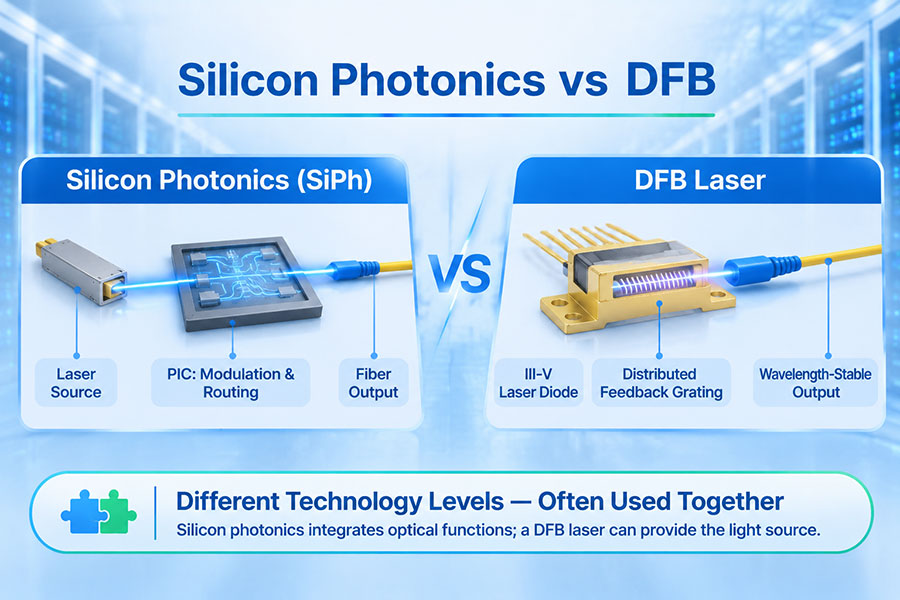
InP-based EAMs are also important in high-speed optical transmitters. When an EAM is integrated with a DFB laser, the resulting device is commonly called an Electro-Absorption Modulated Laser (EML).
In an EML architecture, the DFB laser generates the optical carrier while the EAM performs the data modulation. This separates laser generation from modulation and supports compact transmitter integration.
4. Ring Modulator Operating Principle: Resonance-Based Modulation
A ring modulator uses an optical resonator to change the transmission of a signal around a selected wavelength.
A simplified resonance condition is:
Where:
m: Integer resonance order.
λ: Resonant wavelength.
neff: Effective refractive index.
L: Optical round-trip path length of the ring.
When an electrical signal changes the carrier concentration in the ring waveguide, the effective refractive index changes. This shifts the resonance wavelength relative to the incoming optical carrier.
As the resonance moves, the optical power at the through port or drop port changes. This transmission variation encodes the electrical data.
Important characteristics include:
Very small footprint: A ring resonator can occupy a compact area, supporting dense photonic integration.
Resonance enhancement: Optical energy circulates inside the cavity, increasing the interaction between light and the active waveguide.
Low junction capacitance: Compact PN junctions can reduce electrical RC limitations.
Wavelength selectivity: Each ring operates around a designed resonance wavelength.
Thermal sensitivity: Temperature changes can shift the resonance and alter the operating point.
The resonator quality factor (Q) is an important design parameter. A higher Q generally produces a narrower resonance and stronger resonant enhancement, but also increases sensitivity to wavelength and temperature changes.
Designers must balance resonance strength, optical bandwidth, modulation speed, and wavelength stability when selecting the ring structure.
5. Optical Bandwidth and Data Transmission Performance
Optical bandwidth is one of the most important differences between EAM and ring modulator architectures.
EAM optical bandwidth
An EAM's useful optical operating range depends on its semiconductor absorption spectrum and the selected operating wavelength. GeSi EAMs based on the Franz-Keldysh effect can support relatively broad operating regions within suitable telecom wavelength bands.
However, EAMs are not wavelength-independent. Their absorption edge and modulation efficiency vary with wavelength, and the useful operating range depends on material composition and device design.
Its electrical modulation bandwidth is influenced by:
Junction capacitance and resistance.
Electrode and package parasitics.
Electrical driver bandwidth.
Carrier dynamics and device structure.
Impedance matching and signal integrity.
Ring modulator bandwidth
A ring modulator has a resonant optical response. Its usable wavelength range is influenced by resonance linewidth, free spectral range (FSR), quality factor, and the operating detuning between the laser and the resonator.
Its high-speed electrical response is mainly affected by two factors:
Electrical RC bandwidth: Determined by junction capacitance, resistance, contacts, and electrical parasitics.
Photon lifetime: Determined by the optical energy storage and loss characteristics of the resonator.
A smaller ring can reduce junction capacitance and photon lifetime, potentially supporting higher intrinsic bandwidth. However, a compact resonator does not automatically guarantee a higher system data rate. Laser alignment, driver performance, receiver bandwidth, and signal quality remain important.
In general, an EAM provides a broader wavelength operating region than a high-Q microring resonance, while the ring offers wavelength-selective modulation and resonance enhancement.
6. Insertion Loss, Extinction Ratio, and Optical Power
Insertion loss and extinction ratio are important parameters for evaluating the transmitter optical power budget.
Insertion loss
An EAM intentionally absorbs part of the optical signal. This absorption creates the modulation effect but also contributes to insertion loss. The optical source must provide sufficient power to compensate for this loss and meet the required transmitter output.
A ring modulator does not rely primarily on absorption to produce modulation. Its insertion loss depends on waveguide propagation loss, resonator coupling, junction absorption, and the selected operating point.
Extinction ratio
For an EAM, extinction ratio depends on the difference between the absorption levels associated with the logical high and low states. Bias voltage, drive amplitude, material structure, and wavelength influence the result.
For a ring modulator, extinction ratio depends on resonance depth, coupling condition, resonance detuning, and electrical drive. The operating point must be selected carefully to balance modulation depth, linearity, and bandwidth.
Optical power handling
Because an EAM absorbs optical energy, absorbed power can generate photocurrent and heat. This can influence device temperature and operating stability under high optical input conditions.
Ring modulators also have optical power limitations. Resonant energy buildup can increase local optical intensity, making nonlinear effects and thermal shifts important at higher power levels.
7. Power Consumption and Integration Density
Both EAM and ring modulators are attractive for integrated photonic circuits because their structures can be much smaller than conventional long-arm MZM implementations.
EAMs use compact semiconductor absorption regions and can operate with relatively low-capacitance electrical structures. Ring modulators use resonance enhancement to obtain substantial modulation from a small refractive-index change.
| Design Consideration | EAM | Ring Modulator |
|---|---|---|
| Photonic footprint | Compact active waveguide | Extremely compact resonator |
| Electrical capacitance | Often low due to short junction structure | Often low due to compact ring junction |
| Dynamic modulation energy | Can be low with efficient junction and driver design | Can be low due to compact capacitance and resonance enhancement |
| Static control power | Bias control may be required | May require continuous resonance tuning and locking |
| Thermal control | Operating characteristics are temperature-dependent | Resonance stabilization can be a major requirement |
| Optical power considerations | Absorbed power can generate photocurrent and heat | Resonant optical intensity can increase local nonlinear and thermal effects |
| Integration density | Supports compact multi-channel integration | Supports very dense resonator integration |
| System power evaluation | Include driver and optical absorption effects | Include driver, heater, monitoring, and control circuitry |
A fair power comparison must distinguish dynamic energy per bit from total operating power. A ring modulator may have low switching energy but require additional thermal tuning. An EAM may avoid narrow resonance locking but still require careful bias, temperature, and optical power management.
8. Wavelength Sensitivity and Thermal Management
Wavelength stability is a particularly important consideration for ring modulators.
The resonance wavelength of a silicon ring changes with temperature because the refractive index of silicon is temperature-dependent. A shift in resonance can move the device away from its optimum operating point, reducing extinction ratio or changing the optical modulation response.
Common ring stabilization approaches include:
Integrated microheaters for resonance adjustment.
Temperature sensors for monitoring local conditions.
Optical monitoring circuits for resonance detection.
Feedback control to maintain the target operating point.
Laser wavelength coordination across WDM channels.
EAMs also experience temperature-dependent changes in absorption spectrum, operating voltage, and modulation performance. However, a conventional EAM does not require alignment to a narrow optical cavity resonance. Its thermal management strategy is therefore different from that of a high-Q ring modulator.
For dense WDM systems, this distinction can affect system architecture. Multiple ring modulators may require coordinated resonance control, whereas EAM-based channels are primarily designed around their semiconductor absorption characteristics and laser wavelength specifications.
9. Applications in Data Centers and Optical Networks
EAM-based optical transmitters
EAM technology is widely used in compact high-speed optical transmitter designs. InP-based EMLs combine a DFB laser and EAM, while GeSi EAMs provide another integration option for silicon photonic systems.
Common application areas include:
High-speed single-mode optical transceivers.
Data center interconnect links.
Telecommunications and metro optical networks.
Compact silicon photonic optical transmitters.
High-speed intensity-modulated optical communication.
Ring modulator-based optical systems
Ring modulators are attractive when compact size, wavelength selectivity, and dense photonic integration are important.
Typical application areas include:
Silicon photonic optical engines.
Dense wavelength-division multiplexing systems.
Compact optical interconnects for AI data centers.
Multi-channel photonic integrated circuits.
Wavelength-selective optical transmitters and receivers.
In AI data centers, increasing optical I/O density while controlling energy consumption is an important design objective. Ring modulators offer a potential route to integrating multiple optical channels within a small photonic chip area. Their practical deployment depends on resonance stabilization, thermal control, and the complete laser-to-modulator architecture.
10. EAM vs Ring Modulator: Selection Guide
The appropriate technology depends on the optical link requirements, material platform, integration density, and thermal environment.
| Application Requirement | Potentially Suitable Technology | Engineering Reason |
|---|---|---|
| Broad optical operating range | EAM | Does not depend on a narrow ring resonance, although its absorption spectrum remains wavelength-dependent |
| Extremely compact photonic structure | Ring modulator | Micrometer-scale resonator supports dense integration |
| Integrated DFB laser transmitter | EAM | Commonly used in EML architectures |
| Wavelength-selective modulation | Ring modulator | Resonance provides selective operation around a target wavelength |
| Reduced resonance-control requirements | EAM | Does not require continuous narrow-resonance alignment |
| Dense multi-channel silicon photonics | Ring modulator | Small footprint supports high photonic integration density |
| Direct absorption-based intensity modulation | EAM | Electrical field directly changes optical absorption |
| Low dynamic modulation energy | Both | Actual energy depends on junction capacitance, drive voltage, and architecture |
| High-speed optical interconnect | Both | Selection depends on bandwidth, wavelength control, optical power, and link requirements |
Before selecting an EAM or ring modulator, engineers should evaluate:
Data rate and modulation format.
Operating wavelength and wavelength tolerance.
Electro-optic bandwidth and electrical drive capability.
Insertion loss and extinction ratio.
Optical modulation amplitude (OMA).
Temperature range and wavelength stability.
Dynamic energy per bit and total operating power.
Optical input power and device thermal limits.
Receiver sensitivity and complete optical link budget.
Host platform compatibility and FEC requirements.
11. Integration with Silicon Photonics and Optical Transceivers
EAM and ring modulators are both relevant to silicon photonics, but their integration approaches are different.
GeSi and Ge-based EAMs can be integrated with silicon waveguides through suitable semiconductor processing or heterogeneous integration. InP-based EAMs are commonly integrated with semiconductor lasers to create EML devices.
Silicon ring modulators can be fabricated using standard silicon photonic waveguides and PN junction structures. Their compact geometry allows multiple resonators and wavelength-selective functions to be integrated on the same photonic chip.
In a complete optical transceiver, the modulator operates alongside the laser source, driver IC, photonic integrated circuit, optical coupling interface, receiver photodiodes, transimpedance amplifiers, and DSP where applicable.
Consequently, the choice of EAM or ring modulation should be evaluated at both the photonic-chip level and the complete transceiver level. Data rate and form factor alone do not identify the internal modulator architecture.
C-LIGHT provides a range of optical transceiver solutions for different optical networking applications. Specific EAM or ring modulator implementations should be confirmed against the relevant product datasheet rather than assumed from the module's transmission rate or physical form factor.
12. Conclusion
Electro-Absorption Modulators and ring modulators use different physical mechanisms to control optical intensity. An EAM changes the absorption characteristics of a semiconductor waveguide through an applied electric field. A ring modulator shifts the resonance of a compact optical cavity to change transmission at a selected wavelength.
EAMs are attractive for compact high-speed transmitters, particularly EML architectures and GeSi-based silicon photonic integration. Ring modulators offer extremely small footprints, resonance enhancement, and strong potential for dense WDM photonic integration, but require careful wavelength and thermal stabilization.
For AI data centers and next-generation optical interconnects, both technologies offer important advantages. EAM selection emphasizes absorption efficiency, operating wavelength, optical power handling, and transmitter integration. Ring modulator selection emphasizes resonance control, thermal stability, channel density, and dynamic modulation energy.
The final decision should be based on complete system performance, including optical bandwidth, modulation quality, link budget, thermal requirements, and total power consumption.
For optical transceiver requirements, compatibility evaluation, or application-specific technical support, Contact C-LIGHT.
 >

 >
 >
 >
 >
 >
 >
 >