TEL:+86 132 6656 7067





Wavelength flexibility is an important design consideration in modern optical communication networks. Fixed-wavelength transmitters are often sufficient for conventional point-to-point links, but DWDM systems, reconfigurable optical networks, and coherent transmission platforms may require a source that can operate on different wavelength channels.
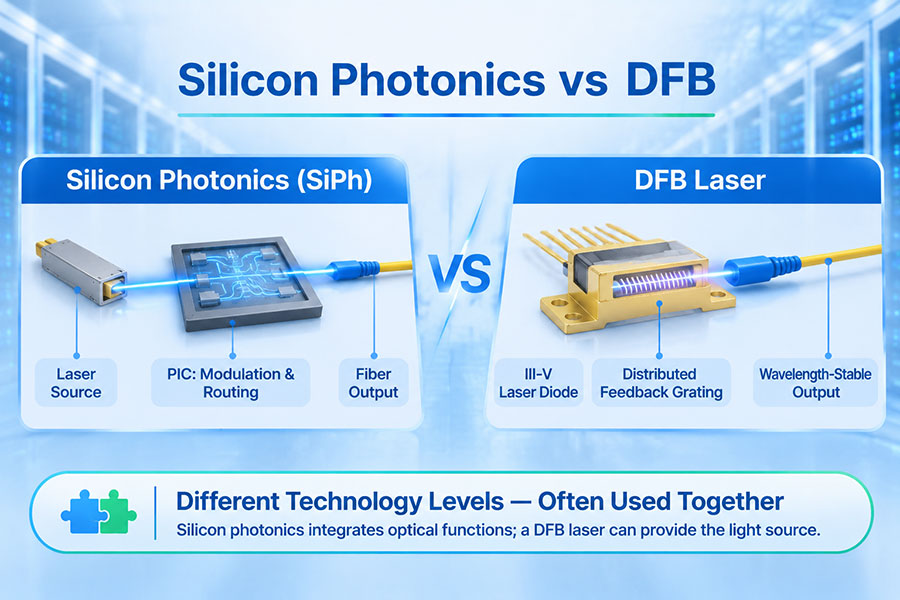
Distributed Feedback (DFB) lasers are widely used in optical transceivers because of their stable single-mode output, compact structure, and established manufacturing processes. Tunable lasers provide a different capability: their output wavelength can be deliberately selected or adjusted within a specified tuning range. The distinction is not absolute, however. A DFB laser can be one of the building blocks of a tunable laser, particularly in DFB arrays and multi-section laser designs.
1. What Is a DFB Laser?
A Distributed Feedback (DFB) laser is a semiconductor laser that incorporates a periodic diffraction grating into its optical cavity. The grating provides wavelength-selective feedback, favoring a specific resonant wavelength and supporting stable single-longitudinal-mode operation.
Unlike a conventional Fabry-Pérot laser, which can support multiple longitudinal modes, a DFB laser is designed to suppress unwanted modes and provide a relatively narrow optical spectrum. This makes it suitable for single-mode fiber communication, where spectral stability and controlled wavelength operation are important.
Most telecom DFB lasers are based on III-V semiconductor materials, particularly InP for common 1310 nm and 1550 nm communication applications.
Typical DFB laser characteristics include:
Wavelength selection: An integrated Bragg grating determines the preferred lasing wavelength.
Single-mode output: Designed to provide stable single-longitudinal-mode operation.
Wavelength stability: Temperature control and appropriate drive conditions help maintain the target wavelength.
Compact structure: The grating is integrated into the semiconductor laser chip.
Telecom applications: Commonly used in fixed-wavelength optical transmitters and as light sources for photonic integrated circuits.
A conventional fixed-channel DFB laser is manufactured for a specified wavelength. Its actual emission wavelength can shift with temperature and operating current, so optical modules may use temperature-control circuitry to maintain the required operating point.
2. What Is a Tunable Laser?
A Tunable Laser is a laser source whose output wavelength can be intentionally changed within a defined tuning range. Instead of being restricted to one nominal operating channel, it can be configured to operate at different wavelengths according to network requirements.
In optical communication, tunable lasers are especially useful in DWDM systems. A single tunable source can be configured for different wavelength channels, reducing the need to maintain separate fixed-wavelength laser variants for every supported channel.
Common tunable laser architectures include:
Tunable DFB array: Multiple DFB laser cavities are fabricated on one chip. Different cavities provide different wavelength regions, with selection and temperature control used to set the output channel.
DBR laser: A Distributed Bragg Reflector laser uses a grating section separate from the gain region. Independent control of the gain, phase, and reflector sections enables wavelength tuning.
Sampled-Grating DBR (SG-DBR): Uses specially designed reflector gratings and the Vernier effect to achieve a wider tuning range.
External Cavity Laser (ECL): Uses an external wavelength-selective element, such as a tunable filter or grating, to select the operating wavelength.
Other integrated tunable designs: Different combinations of gain sections, filters, and optical feedback structures can provide wavelength selection across a specified range.
The actual tuning range, speed, linewidth, and output power depend on the laser architecture. Not every tunable laser covers the entire C-band, and not every tunable laser is suitable for coherent transmission.
3. DFB Laser vs Tunable Laser: Core Differences
The most important difference is that DFB identifies a laser structure, while tunable identifies a wavelength-control capability. A fixed-wavelength DFB laser and a widely tunable laser may use different architectures, but a tunable DFB array can combine both concepts.
| Technical Factor | Conventional Fixed-Wavelength DFB | Tunable Laser |
|---|---|---|
| Technology category | Specific semiconductor laser structure | Functional category covering multiple laser architectures |
| Wavelength operation | Designed for a specified nominal wavelength | Can be deliberately set to different wavelengths within its tuning range |
| Wavelength selection | Primarily determined by the grating design | Determined by selectable cavities, tunable reflectors, filters, or other mechanisms |
| Tuning range | Usually limited to a relatively narrow range around its nominal wavelength | Ranges from a few nanometers to much wider ranges, depending on architecture |
| Wavelength control | Often uses temperature stabilization | May use thermal, electrical, mechanical, or combined control |
| Optical output | Stable single-mode output in a properly designed device | Depends on the selected laser structure and operating wavelength |
| Control complexity | Generally simpler for a fixed-channel implementation | Usually requires wavelength selection and calibration functions |
| Network flexibility | Requires a suitable fixed-wavelength transmitter for each channel | One device can support multiple channels within its specified tuning range |
| Typical applications | Fixed-channel optical transceivers and optical links | DWDM, ROADM, coherent systems, and wavelength-reconfigurable networks |
4. Wavelength Tuning Range and Channel Selection
Wavelength tuning range determines how many optical channels a tunable laser can support. In DWDM systems, channel spacing is defined by the relevant wavelength or frequency grid. The laser must be able to reach the required channel accurately and remain stable during operation.
Conventional fixed-wavelength DFB lasers are designed around a target channel. Temperature control compensates for operating-condition changes and helps keep the emission wavelength within the required tolerance.
Tunable lasers provide a wider selection range. Depending on their architecture, they can cover several adjacent channels or a substantial portion of a telecommunications band.
| Parameter | Fixed DFB Laser | Tunable Laser |
|---|---|---|
| Nominal wavelength | One specified channel | Selectable within a defined range |
| Channel switching | Normally requires a different wavelength source | Can select another supported channel electronically or through its control system |
| Temperature compensation | Used to maintain the specified operating wavelength | May be combined with active wavelength selection and stabilization |
| Wavelength coverage | Limited around the design wavelength | Determined by the architecture and specified tuning band |
| Network configuration | Fixed optical channel assignment | Supports wavelength reassignment within the supported range |
For example, a DWDM network may use a set of channels distributed across the C-band. A fixed DFB transmitter is designed for one assigned channel, while a tunable transmitter may be configured to operate on several supported channels. The exact channel range and spacing must match the transceiver specification and the network's wavelength plan.
5. How Does a Tunable DFB Laser Work?
A conventional DFB laser uses a grating designed for a particular wavelength. Temperature changes can shift its emission wavelength by changing the refractive index of the semiconductor structure. However, the tuning range of a single DFB cavity is generally limited.
To support a wider selection of wavelengths, manufacturers can integrate multiple DFB cavities with different grating periods onto one chip. Each cavity is designed for a different wavelength region. Control electronics select the required cavity and may fine-tune its wavelength through temperature adjustment.
This arrangement is known as a tunable DFB array.
Another approach is to use multiple laser sections and wavelength-selective structures within a common device. These can provide a broader tuning range than a conventional single-cavity DFB laser.
The main engineering considerations include:
Number of available laser cavities or wavelength regions
Channel spacing and wavelength coverage
Mode stability during channel selection
Optical power after wavelength selection and combining
Temperature stabilization and wavelength calibration
Switching time and control accuracy
One important trade-off in DFB arrays is optical combining loss. When several laser outputs are connected through an optical coupler, the combining architecture can reduce the power delivered to the output. The final design must account for this loss and any amplification required.
6. Fixed DFB vs DBR vs External Cavity Tunable Laser
Different tunable laser structures use different wavelength-selection mechanisms. Understanding these differences is useful when selecting a laser for a DWDM transmitter or coherent optical module.
| Laser Architecture | Wavelength Selection Mechanism | Key Characteristics | Typical Application |
|---|---|---|---|
| Fixed DFB | Integrated grating in the gain region | Stable single-mode output and relatively simple control | Fixed-wavelength optical transmitters |
| Tunable DFB Array | Selection among multiple DFB cavities | Multiple wavelength choices on an integrated chip | Wavelength-selectable transmitters |
| DBR | Separate gain and reflector sections | Independent wavelength control through section tuning | Tunable optical sources |
| SG-DBR | Two sampled gratings using Vernier selection | Wide tuning capability in a compact semiconductor device | DWDM and tunable telecom sources |
| External Cavity Laser | External grating or tunable optical filter | Can support broad wavelength tuning, depending on design | Optical instrumentation and selected communication systems |
These architectures do not have identical performance. Tuning range, linewidth, output power, mode-hop behavior, tuning speed, and long-term stability must all be evaluated using the specific device datasheet.
7. Linewidth, Spectral Stability, and Optical Performance
Laser linewidth and wavelength stability are important parameters in optical communication. Linewidth describes the spectral width of the emitted optical carrier, while wavelength stability describes how consistently the source maintains its intended operating wavelength over time and under changing conditions.
Conventional DFB lasers provide stable single-mode output suitable for many intensity-modulated optical links. Their performance depends on cavity design, temperature control, drive conditions, and device quality.
Tunable lasers must maintain acceptable optical performance across their specified tuning range. Some designs prioritize wide wavelength coverage, while others prioritize narrow linewidth and frequency stability for coherent transmission.
Engineers should evaluate:
Linewidth: Particularly important for coherent optical transmission and phase-sensitive applications.
Side-mode suppression ratio (SMSR): Indicates how effectively unwanted optical modes are suppressed.
Relative intensity noise (RIN): Describes fluctuations in optical output intensity.
Wavelength accuracy: Determines how closely the output matches the selected channel.
Wavelength repeatability: Indicates whether the laser returns reliably to the same channel after retuning.
Mode-hop behavior: Relevant when changing wavelength or operating near tuning boundaries.
A tunable laser is not automatically narrower-linewidth or more stable than a fixed DFB laser. The correct choice depends on the optical modulation format and the performance specifications of the complete transmitter.
8. Power Consumption and Tuning Speed
Fixed-wavelength DFB implementations generally have a simpler control architecture because they do not need to select among a wide range of wavelengths. Temperature stabilization may still require a thermoelectric cooler and associated control circuitry.
Tunable lasers can require additional control functions, such as wavelength selection, tuning-section current control, calibration, and temperature compensation. The resulting power consumption varies significantly across architectures.
Tuning speed is another important difference. A fixed DFB laser normally operates at its assigned wavelength without channel switching. A tunable laser must reach the selected wavelength and settle to a stable operating point before carrying traffic.
| Factor | Fixed DFB | Tunable Laser |
|---|---|---|
| Wavelength control | Primarily stabilization around one target | Selection and stabilization across multiple wavelengths |
| Control circuitry | Generally simpler | Usually more sophisticated |
| Power requirements | Depends on laser drive and thermal control | Depends on laser architecture, tuning method, and thermal control |
| Channel switching | Not normally supported as an operating function | Supported within the specified tuning range |
| Settling behavior | Maintains its designated operating point | Must stabilize after a wavelength change |
For network applications, the relevant metric is not simply the time needed to change the laser wavelength. The complete transmitter must also complete calibration, wavelength locking, and any required network configuration before normal transmission resumes.
9. Applications in DWDM, ROADM, and Coherent Optical Networks
Wavelength flexibility is particularly valuable in networks that use multiple optical channels over a shared fiber. DWDM systems assign individual wavelengths to different data channels, allowing high aggregate capacity without requiring a separate fiber for every channel.
Fixed DFB lasers are suitable when the optical channel assignment is predetermined and does not need to change during normal operation. Tunable lasers provide greater flexibility when equipment may be deployed on different channels or reconfigured as network capacity changes.
Typical application differences include:
Fixed DWDM links: Fixed-wavelength DFB transmitters can be used when the channel plan is known and stable.
Reconfigurable optical networks: Tunable transmitters can support wavelength reassignment without replacing the entire laser source.
ROADM networks: Tunable sources can help network operators deploy and reconfigure optical channels across different routes.
Coherent optical transmission: Tunable lasers can provide selectable carrier frequencies, with linewidth and frequency stability requirements determined by the coherent modulation format.
Optical testing: Tunable sources are useful for wavelength sweeps, component characterization, and optical network testing.
For coherent systems, the laser specification is especially important. Narrow linewidth, frequency stability, and phase noise can influence the performance of the coherent receiver's carrier-recovery process.
10. Cost, Inventory, and Network Deployment
Fixed-wavelength DFB lasers are often attractive for high-volume applications with predictable channel assignments. Each transmitter can be optimized for one wavelength, and the control architecture is generally less complex than that of a widely tunable product.
Tunable lasers can simplify inventory and deployment in networks that use multiple wavelength channels. Instead of stocking a separate transmitter for every channel, an operator may use one tunable product across several supported channels.
| Evaluation Factor | Fixed DFB Transceiver | Tunable Transceiver |
|---|---|---|
| Initial product complexity | Generally lower | Generally higher |
| Channel flexibility | Limited to its specified wavelength | Supports multiple configured channels |
| Inventory strategy | May require separate products for different channels | Can reduce the number of channel-specific product variants |
| Network deployment | Suitable for fixed wavelength assignments | Useful for flexible channel planning and reconfiguration |
| Control and maintenance | Usually simpler wavelength management | Requires tuning configuration and wavelength verification |
| Total cost | Depends on volume, channel count, and product specification | Depends on tuning architecture, inventory savings, and operational requirements |
A tunable transceiver may have a higher unit price, but its operational value can be significant when multiple wavelength options are needed. Conversely, a fixed DFB solution can be more economical when the network uses a small number of stable, predetermined channels.
11. How to Select Between DFB and Tunable Lasers
The selection process should begin with the network's wavelength plan and operational requirements. A fixed-wavelength laser is often sufficient for a stable optical link. A tunable laser becomes more valuable when wavelength flexibility is part of the network design.
Consider a fixed DFB laser when:
The optical channel is predetermined.
The link does not require wavelength reassignment.
A simpler transmitter architecture is preferred.
The required wavelength and optical performance are available in a fixed-channel product.
High-volume deployment and predictable inventory are priorities.
Consider a tunable laser when:
The network uses multiple DWDM channels.
Wavelength reassignment is required during deployment or maintenance.
Equipment needs to support different channel assignments at different locations.
ROADM or other reconfigurable optical network functions are part of the design.
A coherent optical system requires a selectable carrier frequency.
Before selecting an optical transceiver, verify these parameters:
Supported wavelength range and channel grid
Channel spacing and wavelength accuracy
Laser linewidth and side-mode suppression ratio
Output power and receiver sensitivity
Wavelength tuning and settling time
Temperature range and wavelength stabilization method
Modulation format and transmission distance
Host equipment compatibility and management support
For optical connectivity requirements, the C-LIGHT optical transceiver portfolio provides a starting point for evaluating available transceiver categories. The exact wavelength and tuning capabilities should always be confirmed against the individual product specification.
12. Conclusion
DFB Laser and Tunable Laser describe different aspects of laser technology. DFB identifies a semiconductor laser structure that uses a distributed grating to provide wavelength-selective feedback and stable single-mode output. Tunable Laser describes a source that can intentionally operate at different wavelengths within a defined range.
Fixed-wavelength DFB lasers are suitable for stable, predetermined optical channels and many conventional telecom transceivers. Tunable lasers provide greater flexibility for DWDM, ROADM, coherent transmission, and wavelength-reconfigurable networks. DFB arrays and other multi-section designs also demonstrate that DFB technology can be incorporated into tunable laser architectures.
The right choice depends on wavelength flexibility, linewidth, tuning range, optical power, control complexity, network topology, and total deployment cost. Selecting the laser based on the complete optical link specification is more important than relying on the laser category alone.
Need support with optical transceiver selection?
C-LIGHT provides optical connectivity solutions for data center, telecommunications, and networking applications. Share your target wavelength, transmission distance, data rate, and equipment model to discuss a suitable optical solution.
 >

 >
 >
 >
 >
 >
 >
 >