TEL:+86 132 6656 7067




As 100G, 200G, 400G, and 800G high-speed networks become the mainstream in modern data centers, high-density cabling has made cable management increasingly complex.
Although DAC (Direct Attach Copper) cables share a similar physical structure, more customers are requesting custom cable jacket colors and pull tab colors to simplify deployment and maintenance.
Color coding is more than an aesthetic choice—it is a mature cable management practice that significantly improves operational efficiency while reducing the risk of human error.
1. Why Do DAC Cables Use Different Cable Colors?
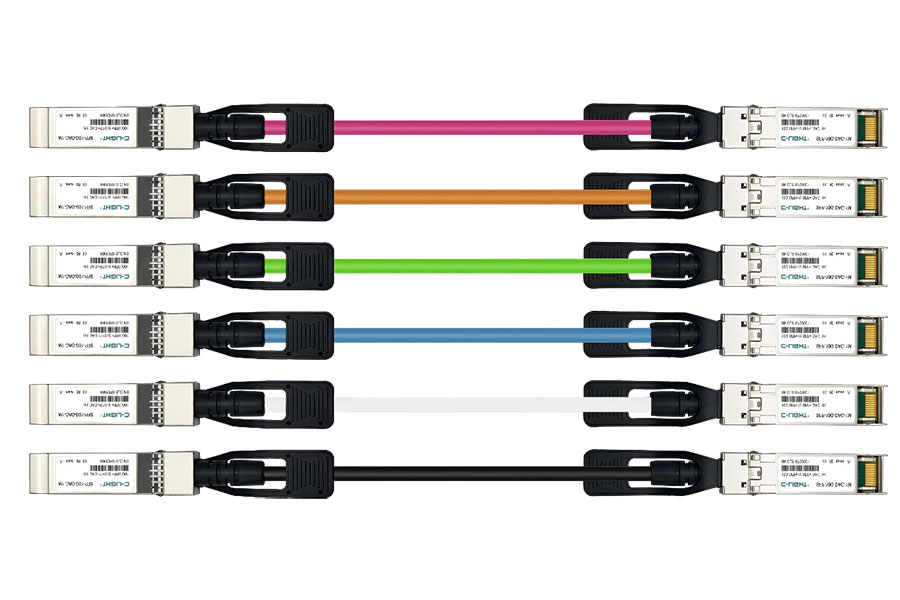
A single rack in a large-scale data center may contain hundreds or even thousands of DAC cables. Relying solely on labels for identification can be inefficient, while color-coded cables allow technicians to recognize connections instantly through visual inspection.
Common applications include identifying:
Different business networks
Different systems
Different data center zones
Different customer projects
Different network architectures
Different transmission speeds
For example:
| Cable Color | Typical Application |
|---|---|
| Black | Standard Ethernet connections |
| Blue | Storage networks |
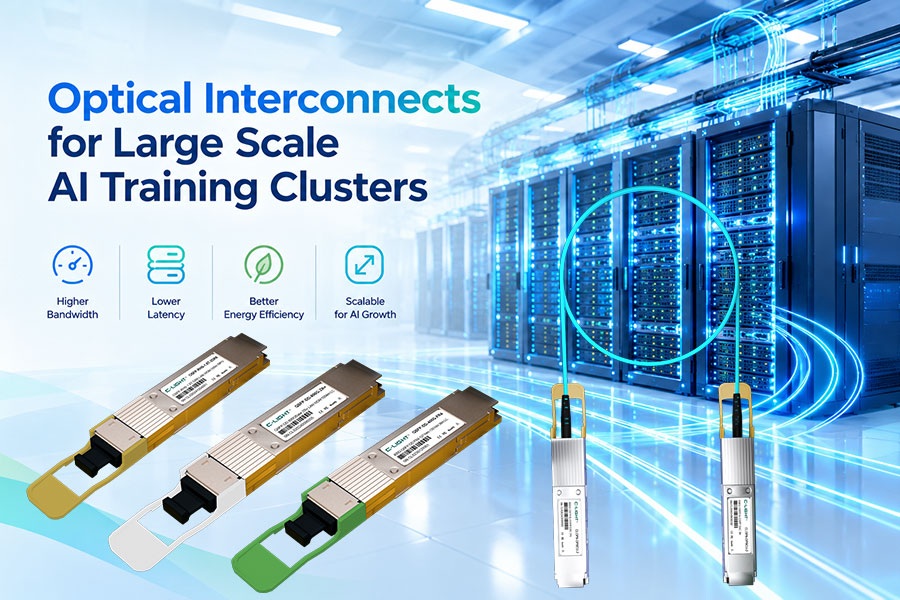
| Yellow | AI computing networks |
| Red | Core business links |
| Green | Management networks |
| Orange | Dedicated customer networks |
In practice, color definitions are usually established according to each customer's own cabling standards.
2. Why Are DAC Pull Tabs Also Color-Coded?
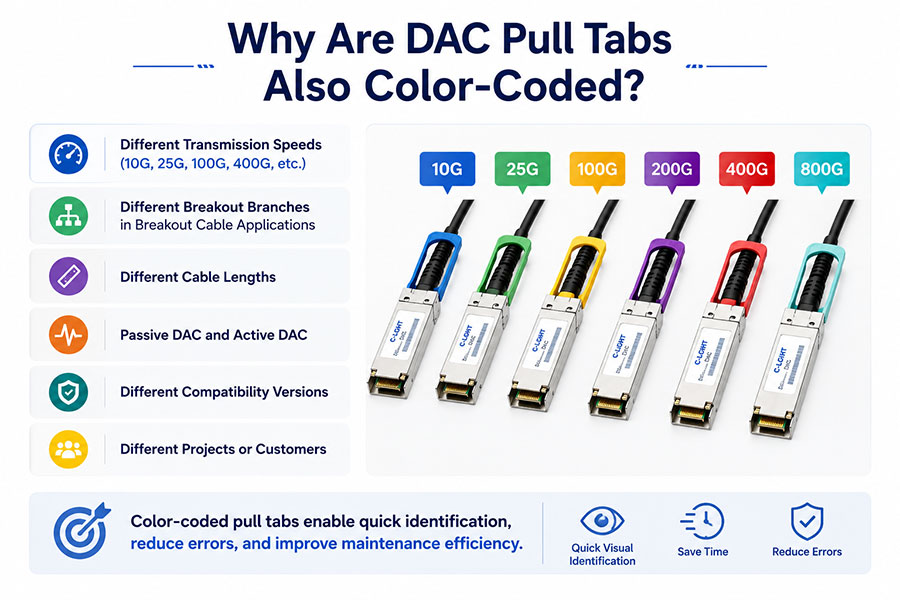
The pull tab on a DAC module is primarily used for insertion and removal. However, an increasing number of customers also use pull tab colors for quick visual identification.
Different pull tab colors are commonly used to distinguish:
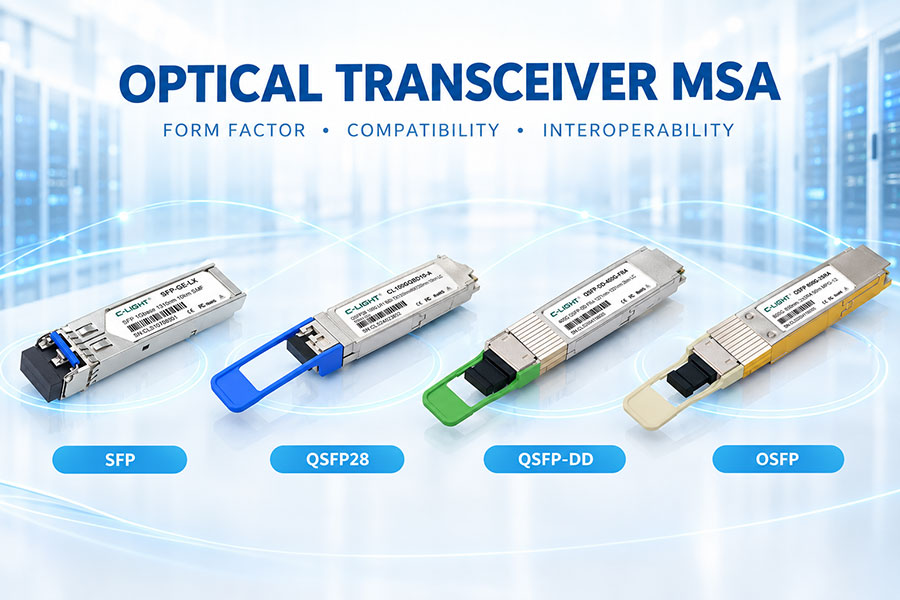
Different transmission speeds (10G, 25G, 100G, 400G, etc.)
Different breakout branches in breakout cable applications
Different cable lengths
Passive DAC and Active DAC
Different compatibility versions
Different projects or customers
With color-coded pull tabs, technicians can quickly locate the correct cable without checking labels, greatly improving maintenance efficiency.
3. How Color Coding Improves Data Center Operations
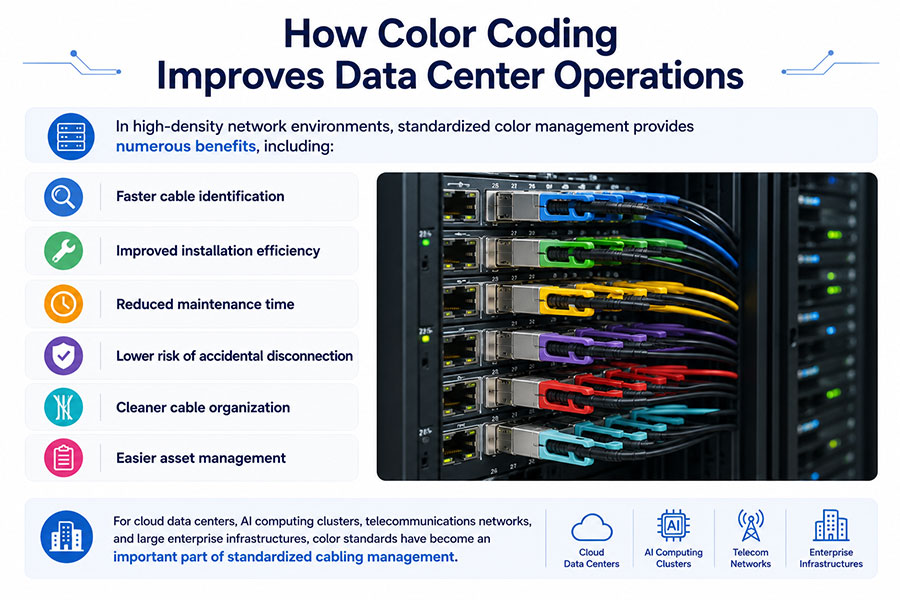
In high-density network environments, standardized color management provides numerous benefits, including:
Faster cable identification
Improved installation efficiency
Reduced maintenance time
Lower risk of accidental disconnection
Cleaner cable organization
Easier asset management
For cloud data centers, AI computing clusters, telecommunications networks, and large enterprise infrastructures, color standards have become an important part of standardized cabling management.
4. Cable Colors Do Not Affect DAC Performance
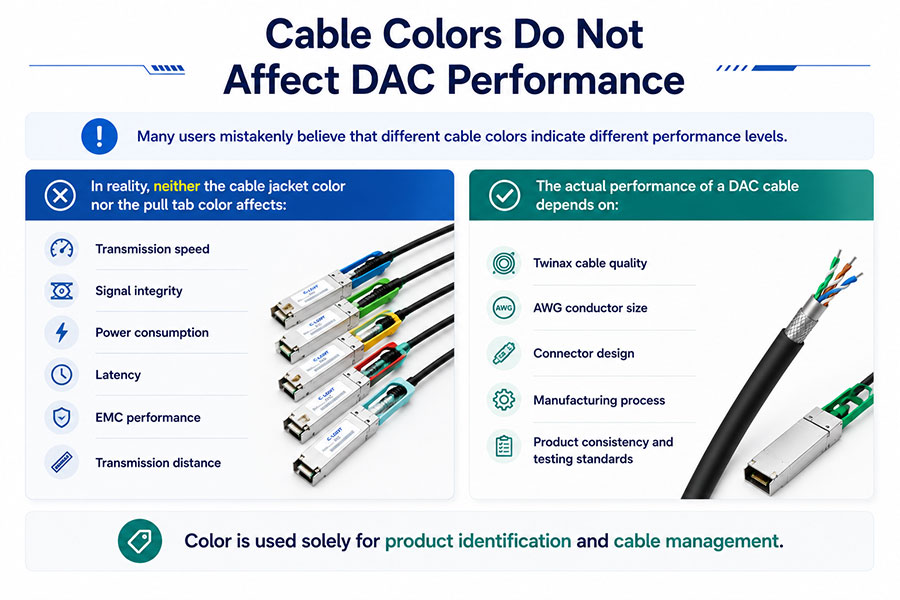
Many users mistakenly believe that different cable colors indicate different performance levels.
In reality, neither the cable jacket color nor the pull tab color affects:
Transmission speed
Signal integrity
Power consumption
Latency
EMC performance
Transmission distance
The actual performance of a DAC cable depends on:
Twinax cable quality
AWG conductor size
Connector design
Manufacturing process
Product consistency and testing standards
Color is used solely for product identification and cable management.
5. Can DAC Cable Colors Be Customized?
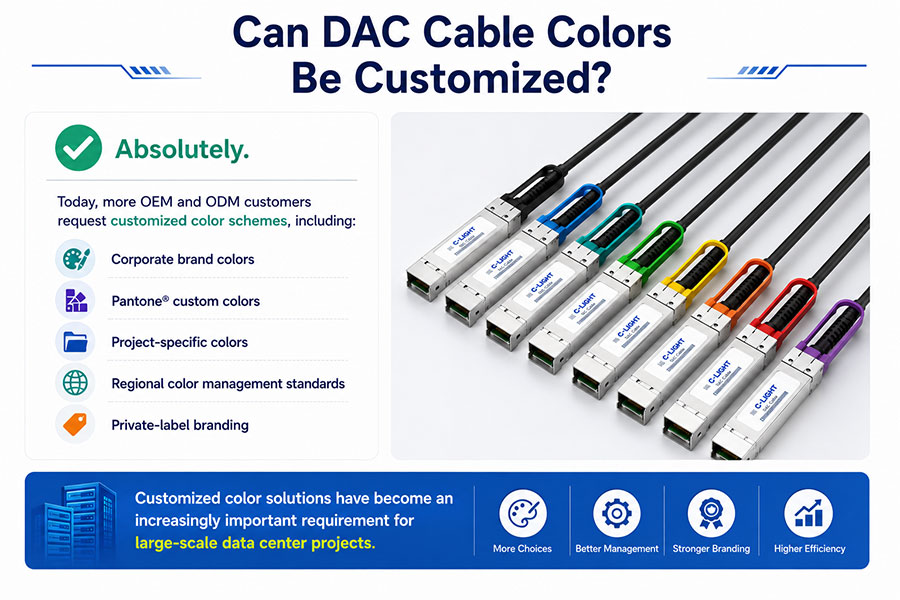
Absolutely.
Today, more OEM and ODM customers request customized color schemes, including:
Corporate brand colors
Pantone® custom colors
Project-specific colors
Regional color management standards
Private-label branding
Customized color solutions have become an increasingly important requirement for large-scale data center projects.
6. C-LIGHT DAC Color Customization Solutions
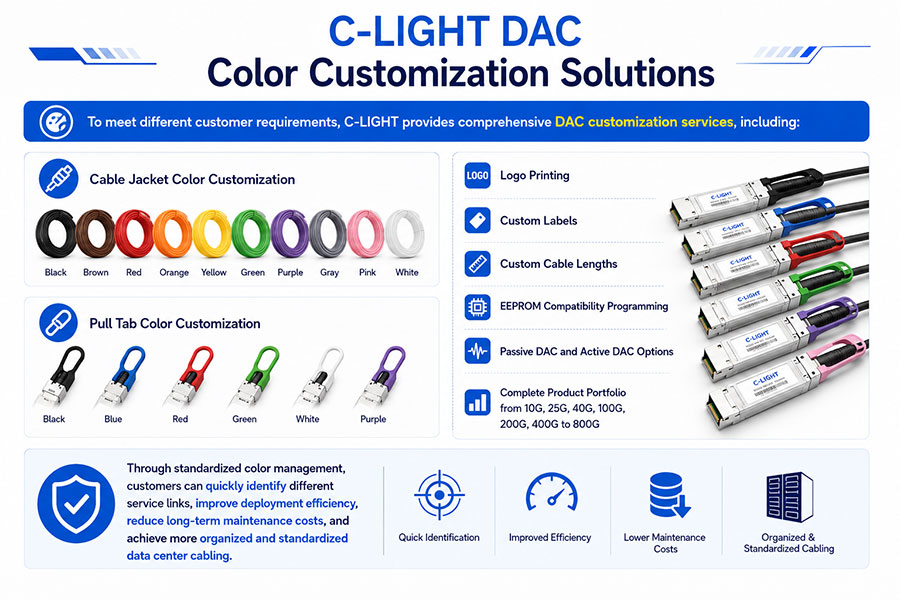
To meet different customer requirements, C-LIGHT provides comprehensive DAC customization services, including:
800G DAC QSFP-DD/OSFP112 Cable丨C-LIGHT
Cable jacket color customization (Black, Brown, Red, Orange, Yellow, Green, Purple, Gray, Pink, White)
Pull tab color customization (Black, Blue, Red, Green, White, Purple)
Logo printing
Custom labels
Custom cable lengths
EEPROM compatibility programming
Passive DAC and Active DAC options
Complete product portfolio from 10G, 25G, 40G, 100G, 200G, 400G to 800G
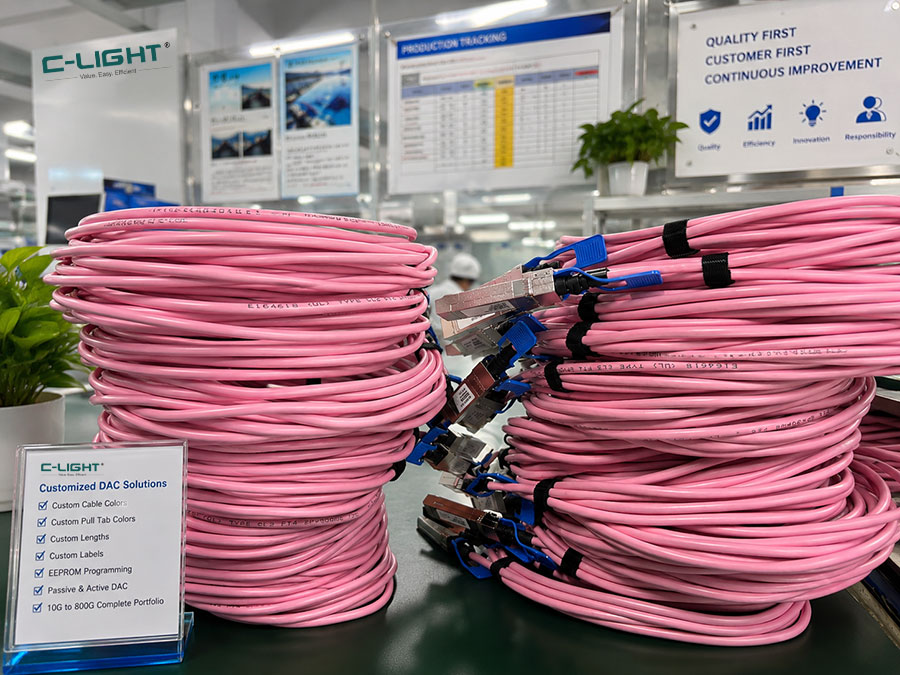
Through standardized color management, customers can quickly identify different service links, improve deployment efficiency, reduce long-term maintenance costs, and achieve more organized and standardized data center cabling.
7. Frequently Asked Questions (FAQ)
Q1. Does the color of a DAC cable affect transmission performance?
Answer: No. Cable colors are used only for identification and management. They do not affect transmission speed, distance, or signal quality.
Q2. Can different colors represent different cable lengths?
Answer: Yes. Many customers use different colors to distinguish 1 m, 2 m, 3 m, and other cable lengths for faster on-site identification.
Q3. Why are DAC pull tabs available in different colors?
Answer: Pull tab colors help quickly distinguish transmission speeds, cable lengths, customer projects, compatibility versions, or product categories, improving operational efficiency.
Q4. Can both cable jacket colors and pull tab colors be customized?
Answer: Yes. C-LIGHT supports customization of cable jacket colors, pull tab colors, logos, labels, packaging, and other OEM/ODM requirements.
Q5. Is color-coded cable management recommended for AI data centers?
Answer: Yes. AI clusters typically contain a large number of high-speed interconnects. A standardized color-coding system significantly improves deployment efficiency, accelerates fault identification, and simplifies long-term operations and maintenance.
 >
>

 >
>
 >
>
 >
>
 >
>
 >
>
 >
>
 >
>