TEL:+86 132 6656 7067




1. AI Models Propel the Rapid Growth of Hyperscale GPU Clusters
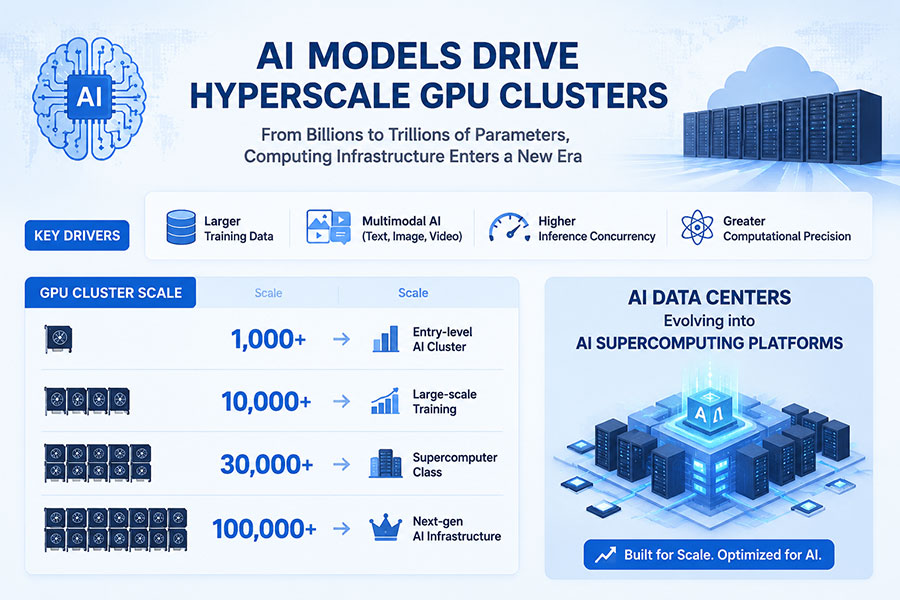
Generative AI, large language models (LLMs), autonomous driving, AI agents, multimodal systems, and scientific AI are driving a massive expansion in global compute infrastructure.
As model complexity escalates, parameter counts have grown from millions and billions to tens of billions, hundreds of billions, and even trillions.
Key demands include:
LLMs require larger training datasets
Multimodal AI processes text, images, and video simultaneously
AI inference demands higher concurrency
Scientific AI requires greater computational precision
These requirements mean traditional single-server or small-scale GPU clusters can no longer meet training efficiency goals.
Leading tech companies are now building:
| Cluster Size | Scale |
| 1,000+ GPUs | Entry-level AI cluster |
| 10,000+ GPUs | Large-scale training |
| 30,000+ GPUs | Supercomputer-class |
| 100,000+ GPUs | Next-gen AI infrastructure |
AI data centers are rapidly transforming from conventional cloud facilities into supercomputing platforms optimized for AI workloads.
2. GPU Clusters: From Server Stacks to AI Supercomputing Systems
Traditional data centers were designed around CPU compute, storage, and user access.
The paradigm shift in AI data centers is clear: high-speed, large-scale communication between GPUs is now the decisive factor in training efficiency.
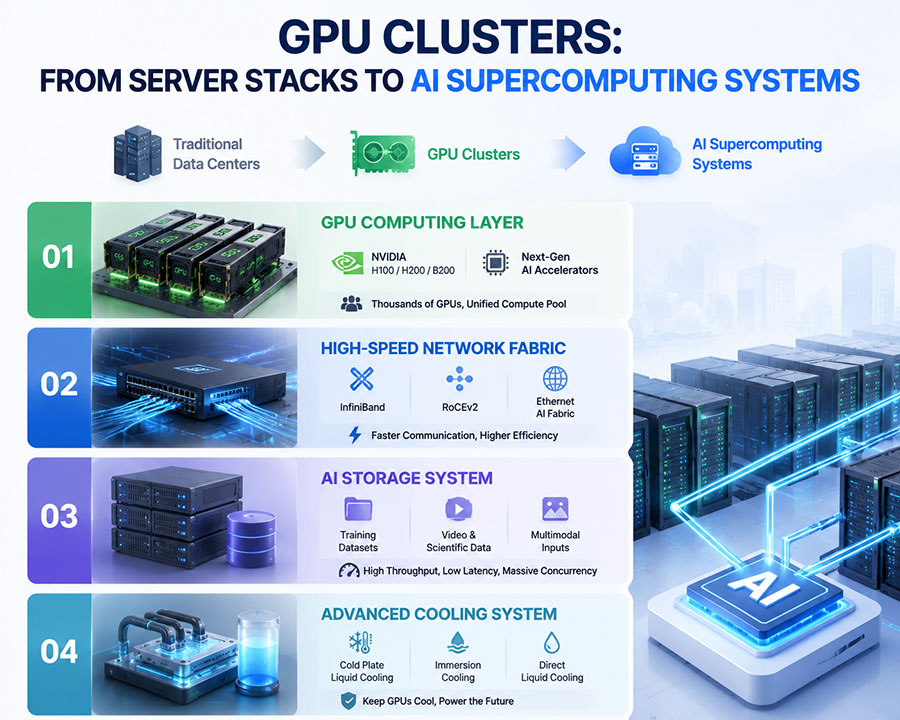
Modern hyperscale GPU clusters are no longer simple server aggregates—they are complex systems comprising:
GPU Computing Layer
Handles model training and inference. Key accelerators include:
NVIDIA H100 / H200 / B200
Next-generation AI accelerators
Thousands of GPUs are interconnected via high-speed networks into unified compute resource pools.
High-Speed Network Fabric
Enables GPU-to-GPU data exchange. Primary technologies:
InfiniBand
RoCEv2
Ethernet AI Fabric
Network performance directly impacts training time, GPU utilization, and cluster efficiency.
AI Storage System
AI training demands massive throughput for:
Training datasets
Video and scientific data
Multimodal inputs
Storage must deliver high throughput, low latency, and concurrent access.
Advanced Cooling System
Rising GPU power densities make air cooling insufficient. Next-gen data centers are adopting:
Cold plate liquid cooling
Immersion cooling
Direct liquid cooling
3. Why Hyperscale GPU Clusters Are Becoming the Norm
3.1 AI Model Scales Keep Growing
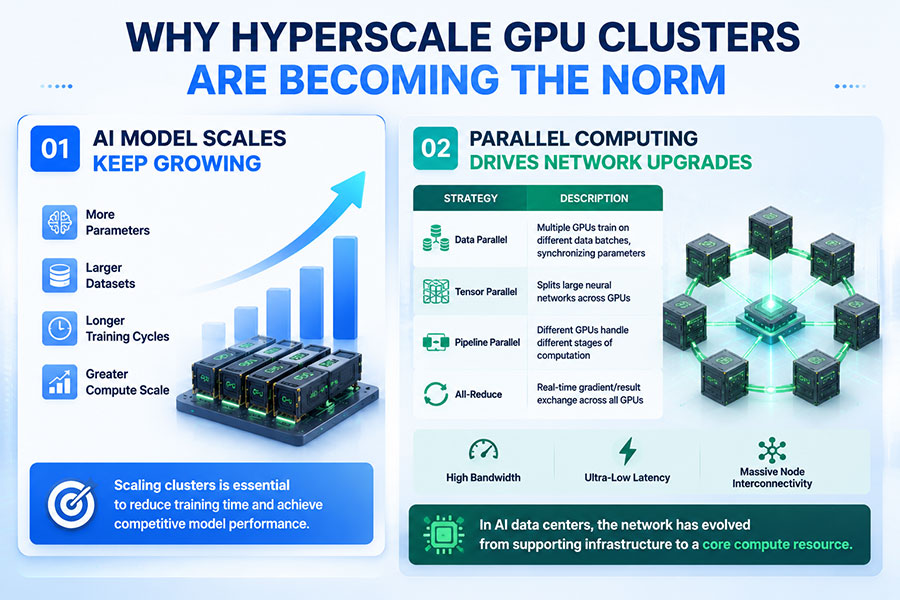
AI capability improvement depends on:
More parameters
Larger datasets
Longer training cycles
Greater compute scale
Early models ran on dozens of GPUs. Today's foundation models require thousands to tens of thousands of GPUs, running for weeks or months.
Scaling clusters is essential to reduce training time and achieve competitive model performance.
3.2 Parallel Computing Drives Network Upgrades
AI training relies on multiple parallel strategies:
| Strategy | Description |
| Data Parallel | Multiple GPUs train on different data batches, synchronizing parameters |
| Tensor Parallel | Splits large neural networks across GPUs |
| Pipeline Parallel | Different GPUs handle different stages of computation |
| All-Reduce | Real-time gradient/result exchange across all GPUs |
These patterns demand:
High bandwidth
Ultra-low latency
Massive node interconnectivity
In AI data centers, the network has evolved from supporting infrastructure to a core compute resource.
4. Evolution of 10,000+ GPU Cluster Architecture
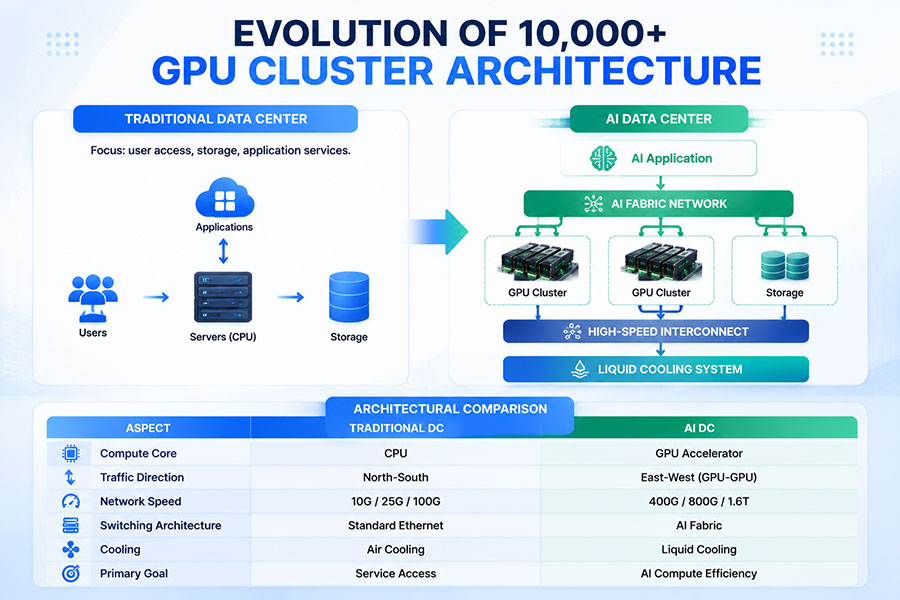
Traditional Data Center
Focus: user access, storage, application services.
AI Data Center
        AI Application
             |
        AI Fabric Network
      /         |          \
GPU Cluster  GPU Cluster  Storage
      \         |          /
   High-Speed Interconnect
             |
    Liquid Cooling System
Architectural Comparison
| Aspect | Traditional DC | AI DC |
| Compute Core | CPU | GPU Accelerator |
| Traffic Direction | North-South | East-West (GPU-GPU) |
| Network Speed | 10G/25G/100G | 400G/800G/1.6T |
| Switching Architecture | Standard Ethernet | AI Fabric |
| Cooling | Air Cooling | Liquid Cooling |
| Primary Goal | Service Access | AI Compute Efficiency |
5. AI Data Centers Enter the High-Speed Optical Interconnect Era
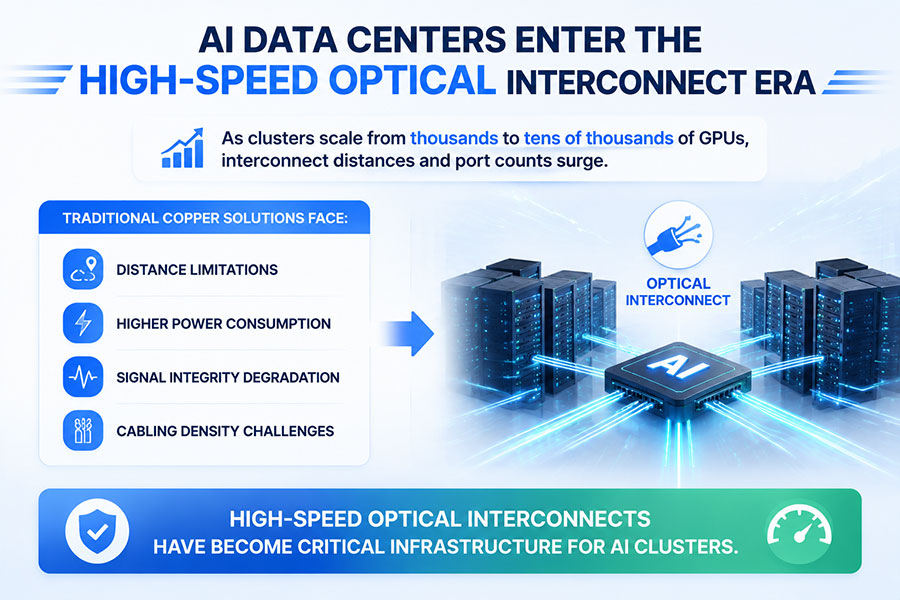
As clusters scale from thousands to tens of thousands of GPUs, interconnect distances and port counts surge.
Traditional copper solutions face:
Distance limitations
Higher power consumption
Signal integrity degradation
Cabling density challenges
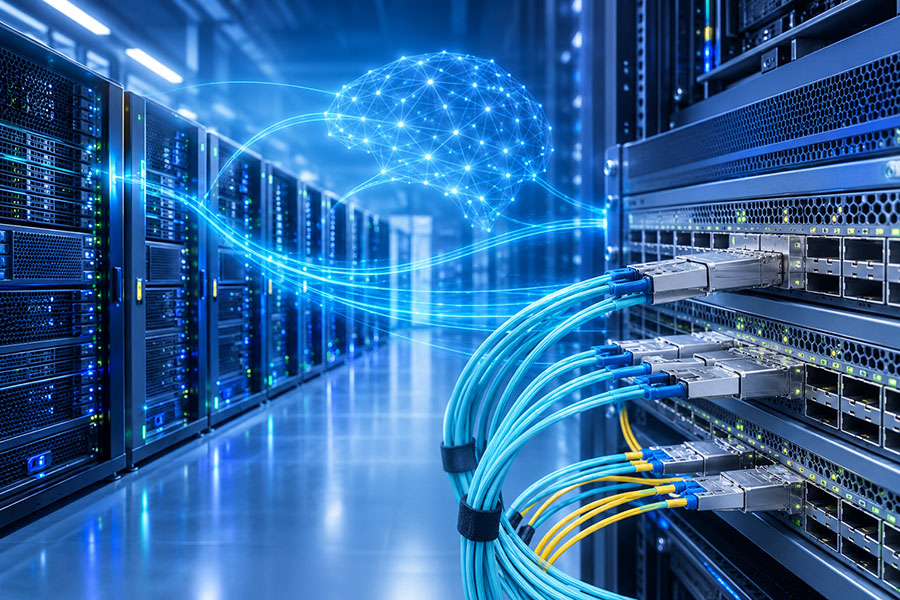
High-speed optical interconnects have become critical infrastructure for AI clusters.
6. AI Fabric: The Core Network Foundation
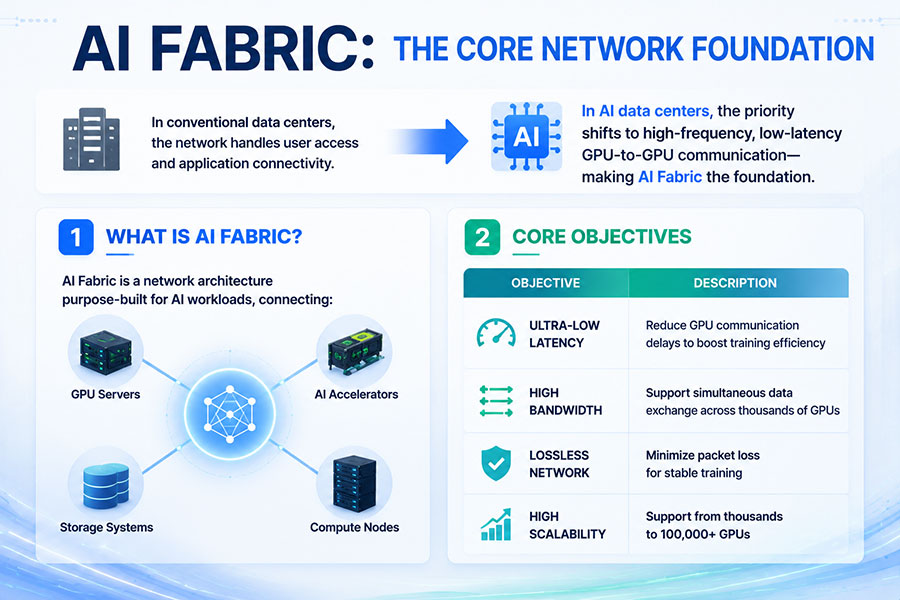
In conventional data centers, the network handles user access and application connectivity.
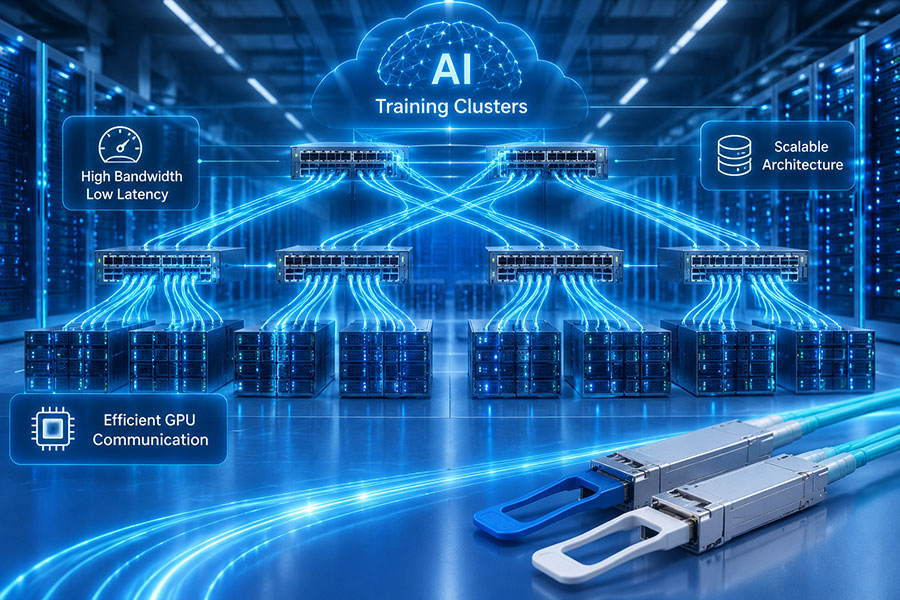
In AI data centers, the priority shifts to high-frequency, low-latency GPU-to-GPU communication—making AI Fabric the foundational infrastructure.
6.1 What Is AI Fabric?
AI Fabric is a network architecture purpose-built for AI workloads, connecting:
GPU servers
AI accelerators
Storage systems
Compute nodes
6.2 Core Objectives
| Objective | Description |
| Ultra-Low Latency | Reduce GPU communication delays to boost training efficiency |
| High Bandwidth | Support simultaneous data exchange across thousands of GPUs |
| Lossless Network | Minimize packet loss for stable training |
| High Scalability | Support from thousands to 100,000+ GPUs |
7. InfiniBand, RoCEv2, and Ethernet AI Fabric
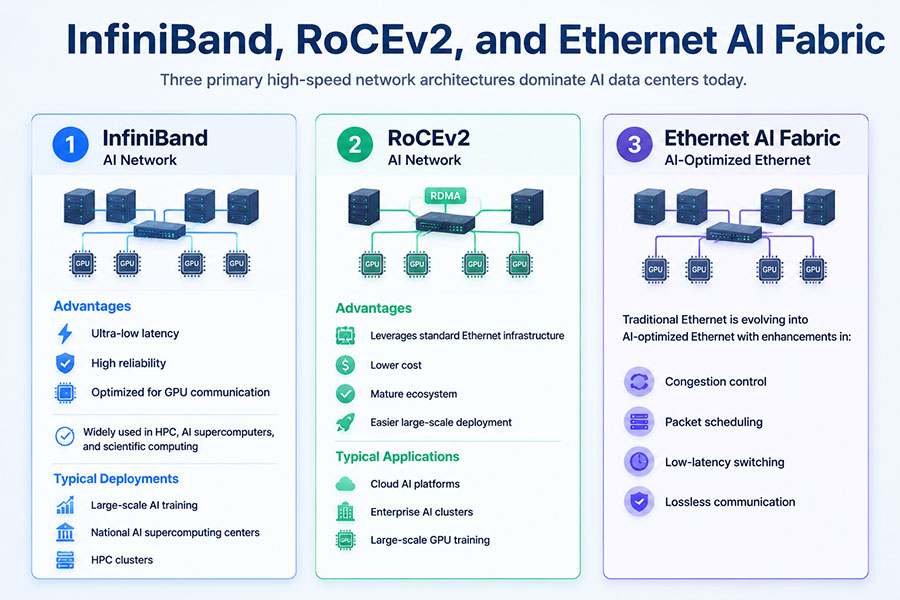
Three primary high-speed network architectures dominate AI data centers today.
7.1 InfiniBand AI Network
Widely used in HPC, AI supercomputers, and scientific computing.
Advantages:
Ultra-low latency
High reliability
Optimized for GPU communication
Commonly deployed in NVIDIA AI computing platforms for large-scale training.
Typical Architecture:
Large-scale AI training
National AI supercomputing centers
HPC clusters
7.2 RoCEv2 AI Network
RoCE (RDMA over Converged Ethernet) enables RDMA on standard Ethernet.
Advantages:
Leverages standard Ethernet infrastructure
Lower cost
Mature ecosystem
Easier large-scale deployment
Typical Applications:
Cloud AI platforms
Enterprise AI clusters
Large-scale GPU training
7.3 Ethernet AI Fabric
Traditional Ethernet is evolving into AI-optimized Ethernet with enhancements in:
Congestion control
Packet scheduling
Low-latency switching
Lossless communication
8. High-Speed Optical Transceivers: Core Components of AI Clusters
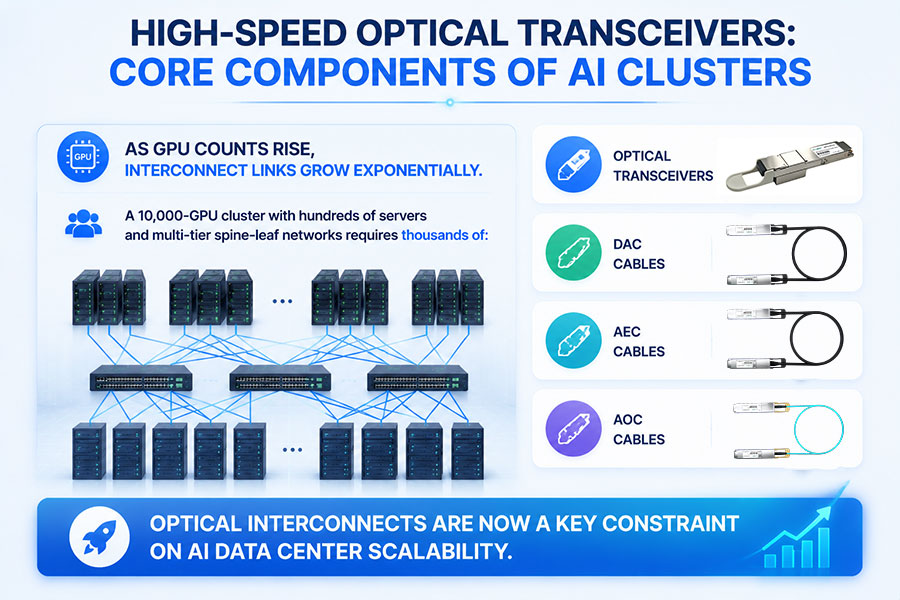
As GPU counts rise, interconnect links grow exponentially.
A 10,000-GPU cluster with hundreds of servers and multi-tier spine-leaf networks requires thousands of:
Optical transceivers
Optical interconnects are now a key constraint on AI data center scalability.
9. 400G, 800G, and 1.6T Optical Interconnect Trends
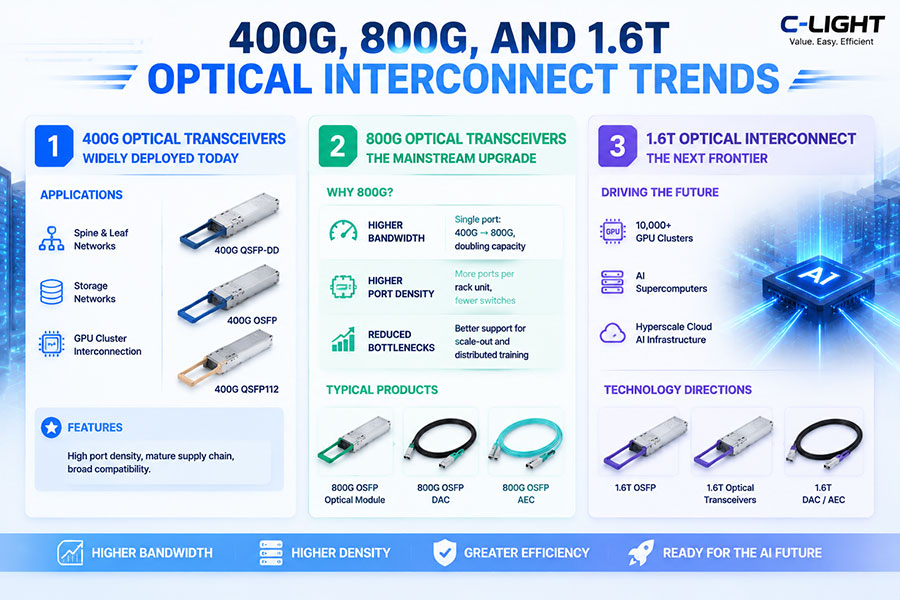
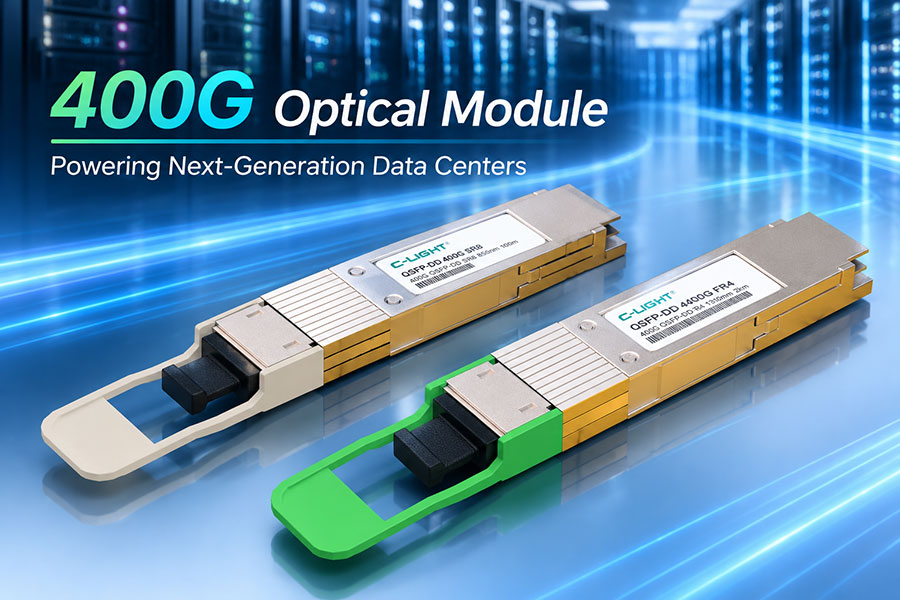
9.1 400G Optical Transceivers
Currently widely deployed across AI data centers.
Applications:
Spine and leaf networks
Storage networks
GPU cluster interconnection
Common Form Factors:
Features: High port density, mature supply chain, broad compatibility.
9.2 800G Optical Transceivers: The Mainstream Upgrade
With NVIDIA H100/H200/B200 platforms scaling, 800G is rapidly becoming the standard AI Fabric interface.
Advantages:
| Aspect | Benefit |
| Higher Bandwidth | Single port: 400G → 800G, doubling capacity |
| Higher Port Density | More ports per rack unit, fewer switches |
| Reduced Bottlenecks | Better support for scale-out and distributed training |
Typical Products:
9.3 1.6T Optical Interconnect: The Next Frontier
As AI models continue to grow, 800G will eventually become insufficient for ultra-large-scale AI fabrics.
1.6T optical interconnect is emerging as the next-generation direction for:
10,000+ GPU clusters
AI supercomputers
Hyperscale cloud AI infrastructure
Technology Directions:
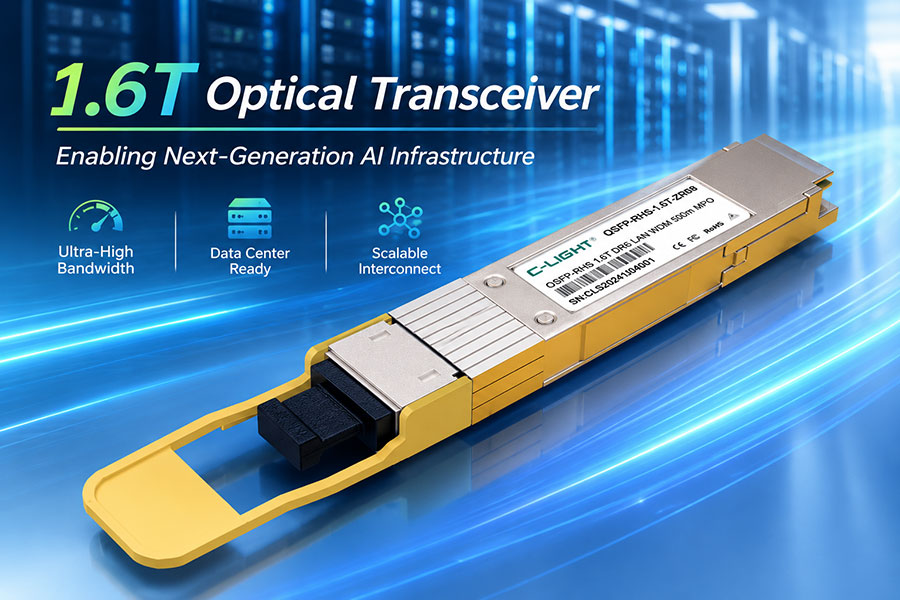
1.6T optical transceivers
1.6T DAC/AEC
10. DAC, AEC, and Optical Transceivers: Application Differences
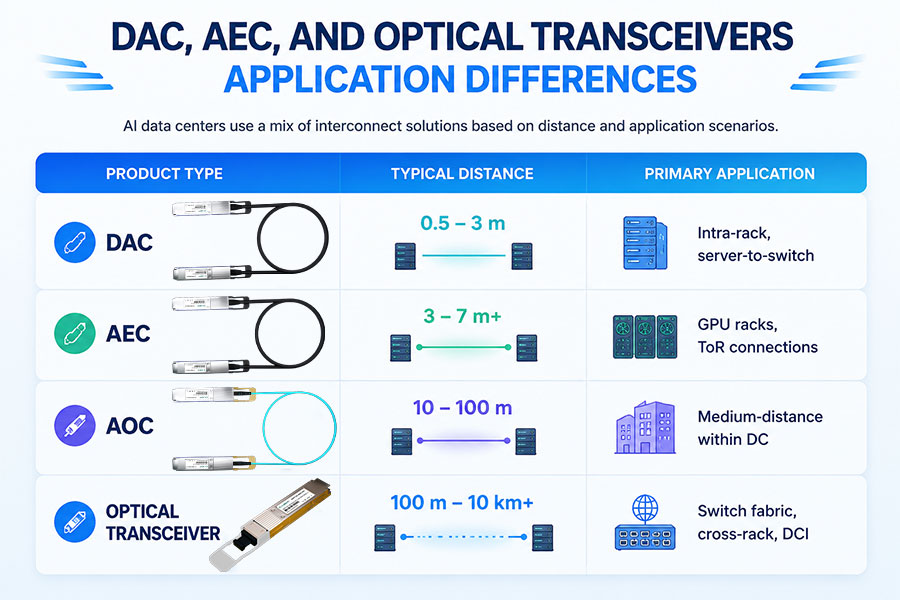
AI data centers use a mix of interconnect solutions based on distance and application scenarios.
| Product Type | Typical Distance | Primary Application |
| DAC | 0.5–3 m | Intra-rack, server-to-switch |
| AEC | 3–7 m+ | GPU racks, ToR connections |
| AOC | 10–100 m | Medium-distance within DC |
| Optical Transceiver | 100 m – 10 km+ | Switch fabric, cross-rack, DCI |
10.1 DAC (Direct Attach Copper)
Cost-effective, short-reach solution.
Advantages:
Low cost and power
High reliability
Easy plug-and-play
Best for:
GPU server to switch
Rack-internal connections
C-LIGHT Offerings:
400G QSFP-DD / OSFP / QSFP112 DAC
1.6T OSFP DAC
10.2 AEC (Active Electrical Cable)
A fast-growing interconnect type for AI data centers.
Enhancements over DAC:
Retimer chips
Signal conditioning
Active electronics
Advantages:
Longer reach
Better signal integrity
Supports higher data rates
Best for:
GPU racks
AI pods
Spine-leaf connections
C-LIGHT Offerings:
400G / 800G / 1.6T AEC
10.3 Optical Transceivers
Required for longer-distance connections.
Typical Products:
400G QSFP-DD ER4
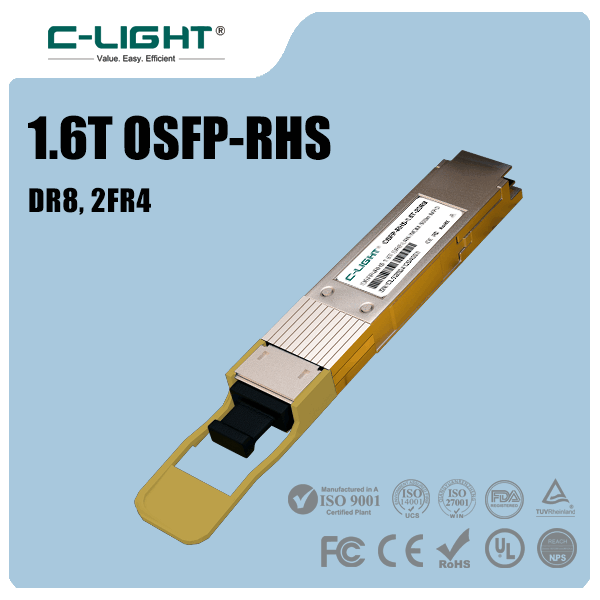
800G / 1.6T optical modules
Advantages:
Long reach
High bandwidth
Low loss
Best for:
Data center fabric
Inter-building connections
DCI
11. Liquid Cooling: A Standard Feature in AI Data Centers
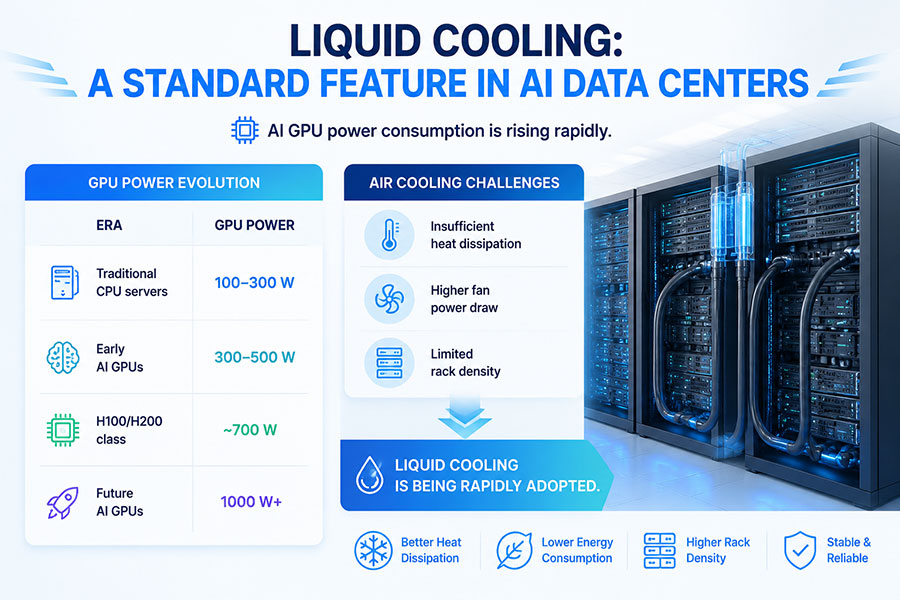
AI GPU power consumption is rising rapidly.
| Era | GPU Power |
| Traditional CPU servers | 100–300 W |
| Early AI GPUs | 300–500 W |
| H100/H200 class | ~700 W |
| Future AI GPUs | 1000 W+ |
Air cooling faces challenges:
Insufficient heat dissipation
Higher fan power draw
Limited rack density
Liquid cooling is being rapidly adopted.
11.1 Cold Plate Liquid Cooling
Most commercially mature.
Features:
Direct contact with GPU cold plates
High heat-transfer efficiency
Easy maintenance
Applications: AI servers, GPU racks, HPC clusters.
11.2 Immersion Cooling
Servers are fully submerged in dielectric coolant.
Advantages:
Extremely high cooling capacity
Supports ultra-high-density computing
Best for: Future AI supercomputers, 100K GPU clusters.
11.3 Impact on Optical Interconnects
Liquid cooling affects:
Optical module packaging
Cable routing
Rack architecture
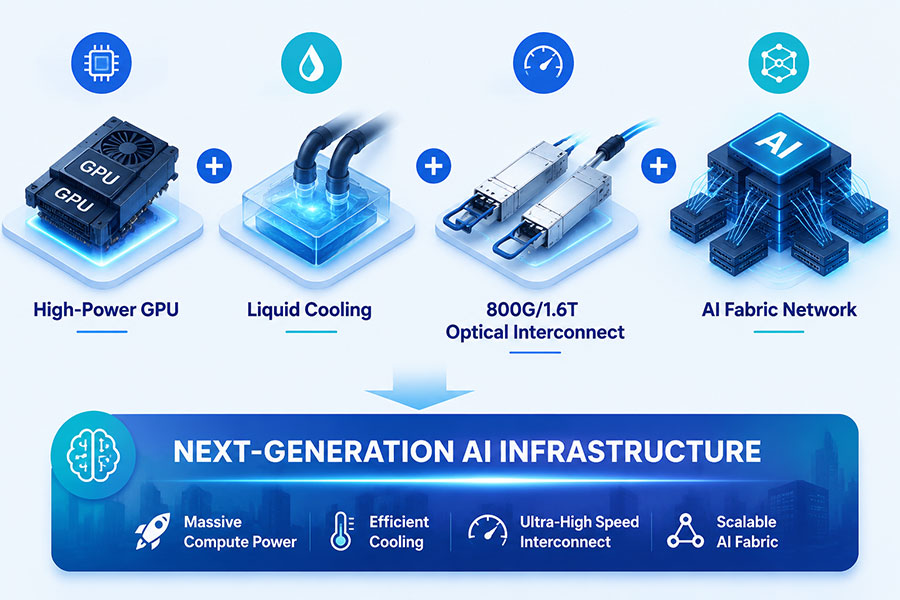
Next-Gen AI Rack Formula:
12. C-LIGHT's Commitment to High-Speed Interconnects for AI Clusters
As AI training scales from thousands to tens of thousands of GPUs, high-speed interconnects have become a critical pillar of AI infrastructure.
Future AI cluster competitiveness depends not just on GPU count, but on:
GPU communication efficiency
Network bandwidth
Optical interconnect capability
Power efficiency
System reliability
As a high-speed optical communications solution provider, C-LIGHT is dedicated to addressing the interconnect needs of AI data centers, HPC, and hyperscale computing environments.
13. C-LIGHT AI Data Center Interconnect Product Portfolio
13.1 1.6T OSFP DAC / AEC
As clusters scale to 10,000+ GPUs, 1.6T interconnects are becoming the next critical technology.
Target Applications:
Next-gen AI fabric
Hyperscale GPU clusters
AI supercomputers
High-density rack interconnects
Key Advantages:
Ultra-high bandwidth
Low latency
High signal integrity
High-density connectivity
13.2 800G OSFP DAC / AEC
800G is rapidly becoming the mainstream high-speed interconnect for AI data centers.
Applications:
NVIDIA AI infrastructure
GPU cluster networks
AI spine-leaf fabrics
HPC environments
Advantages:
Supports 800 Gbps transmission
Optimized for short-reach AI cluster connectivity
Reduces intra-rack complexity
Improves port utilization
13.3 400G DAC / AEC Series
400G remains a key deployment solution for many AI data centers.
C-LIGHT Offerings:
400G QSFP-DD DAC
400G OSFP DAC
400G QSFP112 DAC
400G AEC
Applications:
GPU server connections
ToR switch connections
Storage networks
Data center fabrics
13.4 High-Speed Optical Transceiver Solutions
For long-reach interconnect requirements.
400G QSFP-DD ER4
Applications: DCI, metro networks, long-reach AI fabrics
Features: High-performance optical transmission, long reach, high reliability
400G QSFP-DD DCO High Power
Applications: DCI, AI data center interconnect, coherent optical networks
Features: High output power, long-distance transmission, complex network environment support
13.5 Liquid Immersion Optical Transceivers
Optimized for liquid-cooled AI data centers.
C-LIGHT Offerings:
100G liquid immersion transceiver
25G liquid immersion transceiver
Applications: Liquid-cooled AI data centers, HPC systems, high-density computing platforms
Advantages: Liquid-cooling compatible, enhanced system stability, future-proof for high-power computing
14. C-LIGHT High-Speed Interconnect Testing & Reliability Verification
Hyperscale GPU clusters demand exceptional network stability. Any link failure can cause:
Training interruptions
Wasted compute resources
Extended recovery time
C-LIGHT maintains comprehensive testing systems, including:
14.1 BER Testing
Bit error rate performance
PRBS31 pattern testing
Long-duration stability verification
Ensures low error rates and stable transmission.
14.2 Signal Integrity Testing
Focus areas for 800G/1.6T:
Eye diagram analysis
Insertion loss / return loss
Crosstalk and jitter
Guarantees high-speed signal quality.
14.3 Optical Performance Testing
Includes optical power, receiver sensitivity, OMA, and TDECQ—ensuring long-term reliability.
14.4 Environmental Reliability Testing
High-temperature aging
Thermal cycling
Full-load operation
Hot-plug testing
Qualified for data center, AI cluster, and HPC environments.
14.5 Compatibility Testing
Verification across:
NVIDIA platforms
Broadcom switches
Intel / AMD accelerators
Major network equipment
15. Future Trends: Toward the 100,000-GPU Era
AI infrastructure will continue to expand in the coming years.
15.1 GPU Cluster Scale Growth
1,000 GPU → 10,000 GPU → 100,000 GPU → AI Supercomputer
15.2 Network Speed Evolution
| Phase | Speed |
| Current Mainstream | 400G |
| Rapid Deployment | 800G |
| Next Phase | 1.6T |
| Future Research | 3.2T |
15.3 AI Fabric as the Core Competitive Advantage
Future competition is not just about GPU counts, but comprehensive capabilities in:
Network efficiency
Communication latency
Cooling capability
Power efficiency
15.4 Optical Interconnect Demand Continues to Grow
Different solutions will coexist based on distance:
| Distance | Solution |
| Intra-rack | DAC / AEC |
| Row-level | AOC |
| Data center fabric | Optical transceivers |
| DCI | Coherent optics |
16. Conclusion
The rise of hyperscale GPU clusters marks a new infrastructure era for AI data centers.
From thousand-GPU clusters to 10,000- and 100,000-GPU AI supercomputing platforms, data center architecture is undergoing profound transformation:
GPU becomes the compute core
AI Fabric becomes the network core
Liquid cooling becomes the thermal foundation
800G/1.6T high-speed interconnects become essential technologies
Tomorrow's AI data centers will demand not just greater compute power, but also:
Higher-speed networking
Lower-latency data exchange
More reliable high-speed interconnects
High-speed optical modules, DAC, AEC, and next-gen AI Fabric networks will form the backbone of global AI development.
C-LIGHT remains committed to delivering high-speed interconnect solutions for AI data centers, HPC, and hyperscale computing—powering the next generation of AI infrastructure.
17. Frequently Asked Questions (FAQ)
Q1. What is a Hyperscale GPU Cluster?
Answer: A hyperscale GPU cluster is a large-scale computing system with thousands to hundreds of thousands of GPUs interconnected via high-speed networks, designed for AI training, large language models (LLMs), and HPC workloads.
Q2. Why do AI data centers require thousands of GPUs?
Answer: Large AI models demand enormous compute resources. More GPUs enable parallel processing, reducing training time and improving model performance.
Q3. Why is AI Fabric important for GPU clusters?
Answer: AI Fabric enables high-bandwidth, low-latency GPU-to-GPU communication, which directly impacts training efficiency and cluster utilization.
Q4. What is the difference between InfiniBand and RoCE?
Answer: InfiniBand is a specialized high-performance networking technology widely used in HPC and AI supercomputers. RoCE (RDMA over Converged Ethernet) provides RDMA over standard Ethernet with broader ecosystem compatibility.
Q5. Why are 800G optical modules becoming popular in AI data centers?
Answer: They deliver higher bandwidth, greater port density, and improved scalability, making them ideal for next-generation AI Fabric networks.
Q6. What role do DAC and AEC cables play in AI GPU clusters?
Answer: DAC (Direct Attach Copper) and AEC (Active Electrical Cable) are used for short-distance, high-speed connections inside racks and between GPU servers and switches, offering low latency and cost-effective connectivity.
Q7. Why does AI data center infrastructure need liquid cooling?
Answer: Modern AI GPUs generate significantly more heat than traditional servers. Liquid cooling improves thermal management, supports higher rack density, and reduces energy consumption.
Q8. What products does C-LIGHT provide for AI data centers?
Answer: C-LIGHT offers a comprehensive high-speed interconnect portfolio:
1.6T OSFP DAC/AEC
800G OSFP DAC/AEC
400G DAC/AEC
400G QSFP-DD ER4
400G QSFP-DD DCO
Liquid immersion optical transceivers
These products support AI GPU clusters, HPC networks, and hyperscale data centers.
Q9. Will 1.6T optical interconnect replace 800G?
Answer: No. 800G will remain widely deployed, while 1.6T will gradually be adopted in next-generation AI clusters requiring higher bandwidth.
Q10. What is the future of AI data center networking?
Answer: Future AI data centers will evolve toward:
1.6T / 3.2T networking
Larger GPU clusters
Advanced AI Fabric
Liquid cooling
High-density optical interconnects
High-speed interconnect technology will be a key competitive advantage in future AI compute infrastructure.
 >
>

 >
>
 >
>
 >
>
 >
>
 >
>
 >
>
 >
>