TEL:+86 132 6656 7067




1. Introduction
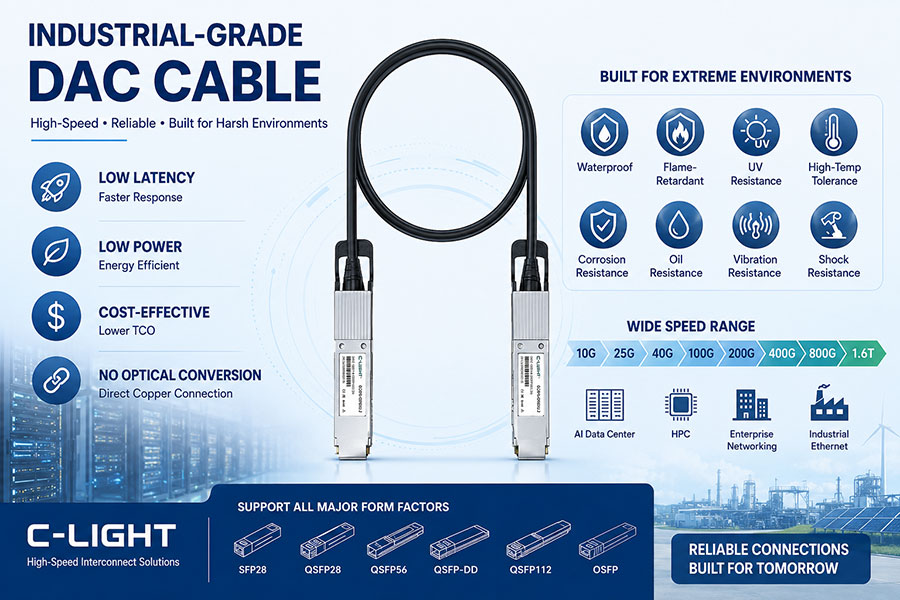
Direct Attach Copper (DAC) cables have become one of the most cost-effective and reliable solutions for short-reach high-speed interconnects. Offering low latency, low power consumption, reduced cost, and no optical-electrical conversion, DAC cables are widely deployed in 10G, 25G, 40G, 100G, 200G, 400G, 800G, and emerging 1.6T Ethernet networks.
Traditional DAC cables were primarily designed for climate-controlled data centers with stable temperature and humidity. However, the rapid growth of Industrial Internet, AI edge computing, 5G communications, railway transportation, smart manufacturing, renewable energy, and outdoor networking has created increasing demand for high-speed interconnects that can operate reliably in much harsher environments.
Modern industrial-grade DAC cables must provide not only outstanding signal integrity and transmission performance but also enhanced environmental protection, including:
Waterproof construction
Flame-retardant materials
UV resistance
High-temperature tolerance
Corrosion resistance
Oil resistance
Vibration and shock resistance
These features ensure long-term network reliability under demanding operating conditions.
C-LIGHT has been dedicated to developing high-speed interconnect solutions for many years, offering a comprehensive portfolio of 10G, 25G, 40G, 100G, 200G, 400G, and 800G DAC cables. Supporting mainstream form factors including SFP28, QSFP28, QSFP56, QSFP-DD, QSFP112, and OSFP, C-LIGHT products are designed for AI data centers, High-Performance Computing (HPC), enterprise networking, and industrial Ethernet applications.
800G 400G 200G 100G AOC/DAC/AEC/ACC Cable丨C-LIGHT
C-LIGHT High-Speed DAC Cable Portfolio
| Product | Speed | Interface | Typical Applications |
|---|---|---|---|
| C-LIGHT CLC25GSFP-x SFP28 DAC | 25G | SFP28 | Industrial Ethernet, Edge Computing |
| C-LIGHT CLQ1-Q1CU-x QSFP28 DAC | 100G | QSFP28 | Enterprise Networks, AI Servers |
| C-LIGHT CLQ2-Q2CU-x QSFP56 DAC | 200G | QSFP56 | HPC Clusters |
| C-LIGHT CLQD4-4Q1CU-x QSFP-DD DAC | 400G | QSFP-DD | AI Data Centers |
| C-LIGHT CLO56-O56CU-x OSFP DAC | 400G | OSFP | NVIDIA AI Fabric |
| C-LIGHT CLQD8-QD8CU-x QSFP-DD 800G DAC | 800G | QSFP-DD800 | AI Clusters |
| C-LIGHT CLOP8-OP8CU-x OSFP 800G DAC | 800G | OSFP | GPU Networking |
2. Why Do Industrial Environments Demand More from DAC Cables?
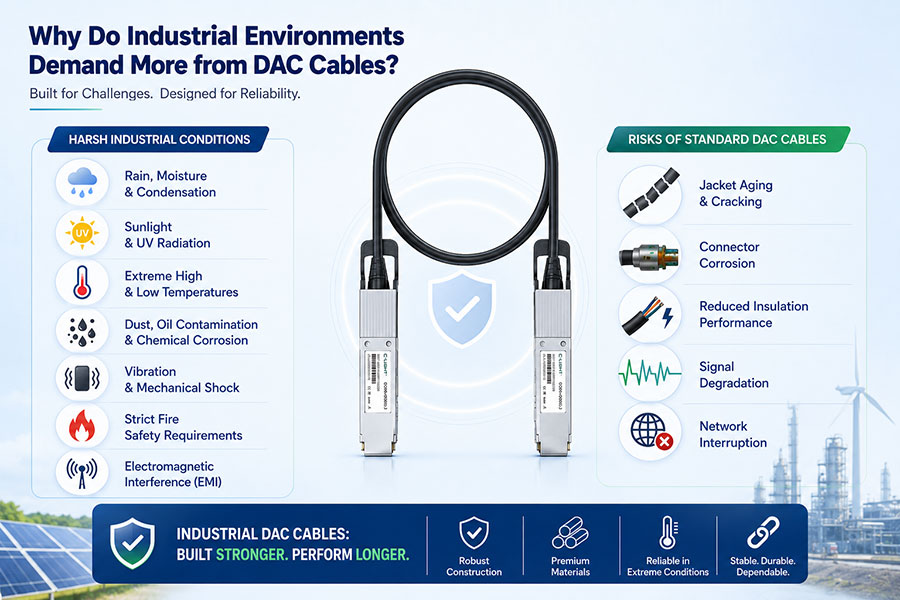
Compared with traditional data centers, industrial and outdoor environments present significantly greater challenges for high-speed copper interconnects.
Industrial DAC cables may be exposed to:
Rain, moisture, and condensation
Continuous sunlight and UV radiation
Extreme high and low temperatures
Dust, oil contamination, and chemical corrosion
Constant vibration and mechanical shock
Strict fire safety requirements
Electromagnetic interference (EMI)
Standard data center DAC cables are generally not designed for these conditions. Long-term exposure can lead to:
Jacket aging and cracking
Connector corrosion
Reduced insulation performance
Signal degradation
Network interruption
To ensure reliable operation, industrial DAC cables require more robust mechanical structures and higher-grade materials.
3. Waterproof Design: Ensuring Reliable Operation in Wet and Outdoor Environments
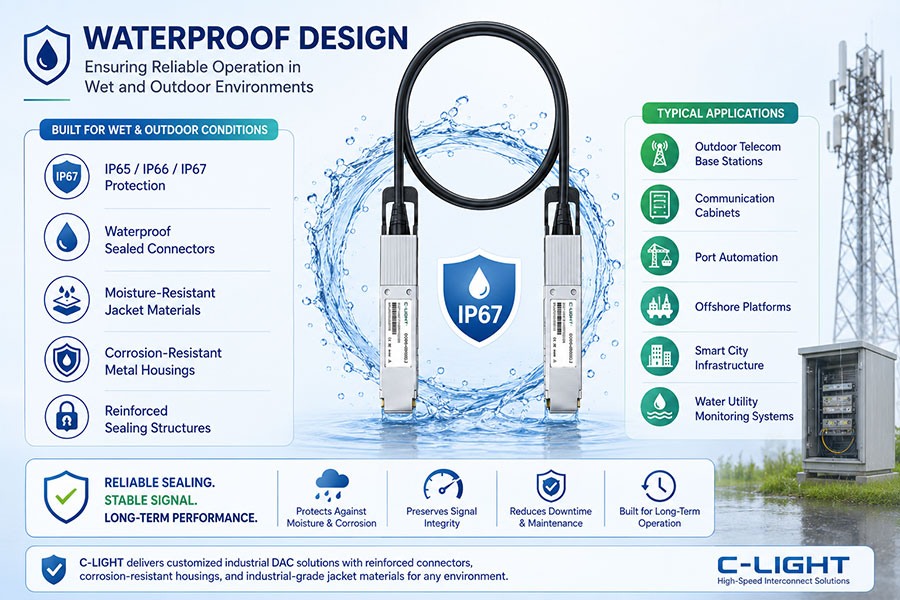
For installations in outdoor telecom cabinets, industrial control systems, railway infrastructure, ports, and marine environments, waterproof performance is essential.
Industrial-grade DAC cables typically incorporate:
IP65, IP66, or IP67 protection ratings
Waterproof sealed connectors
Moisture-resistant jacket materials
Corrosion-resistant metal housings
Reinforced sealing structures
These design features effectively prevent moisture from entering connectors and cable assemblies, reducing the risk of oxidation, poor electrical contact, and high-speed signal attenuation.
Typical Applications
Outdoor telecom base stations
Communication cabinets
Port automation
Offshore platforms
Smart city infrastructure
Water utility monitoring systems
Reliable sealing not only protects the physical cable assembly but also preserves signal integrity over long-term operation.
For deployments in outdoor communication cabinets, industrial edge computing nodes, and smart city infrastructure, high-speed interconnect solutions must combine excellent environmental sealing with stable high-speed electrical performance.
C-LIGHT provides customized industrial DAC solutions that support reinforced connector structures, corrosion-resistant metal housings, and multiple industrial-grade jacket materials to meet diverse deployment requirements.
4. Fire-Resistant Design: Meeting Data Center and Building Safety Standards
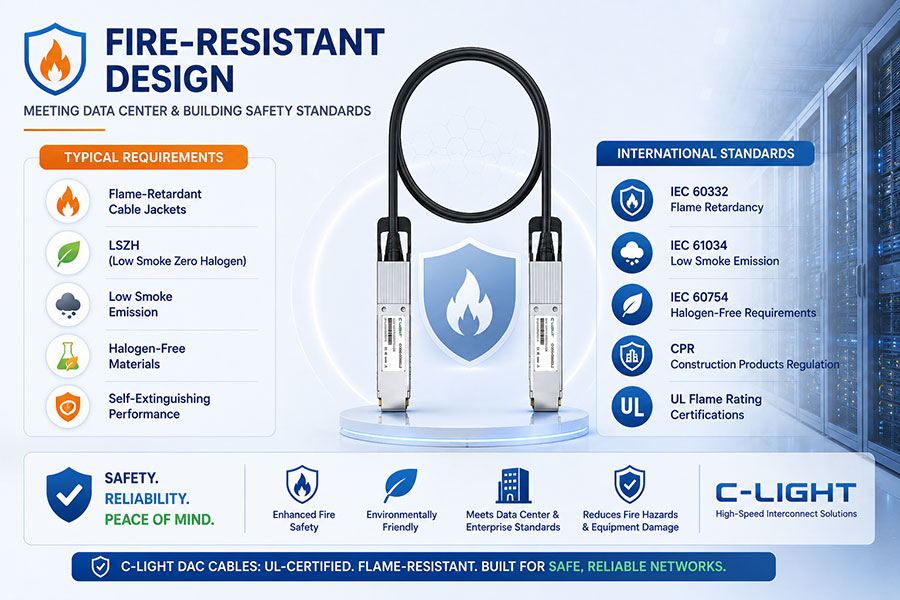
As modern data centers continue to increase in size and power density, fire protection has become a critical requirement for network infrastructure.
Many projects require DAC cables to comply with internationally recognized flame-retardant standards.
Typical requirements include:
Flame-retardant cable jackets
LSZH (Low Smoke Zero Halogen)
Low smoke emission
Halogen-free materials
Self-extinguishing performance
Relevant international standards include:
IEC 60332 – Flame Retardancy
IEC 61034 – Low Smoke Emission
IEC 60754 – Halogen-Free Requirements
CPR (Construction Products Regulation)
UL Flame Rating Certifications
C-LIGHT's full range of data center DAC cables utilizes UL-certified cable jackets as standard, meeting modern data center and enterprise cabling requirements for enhanced fire safety and environmentally friendly installations while reducing fire hazards and equipment damage.
5. UV Resistance: Protecting Cables from Long-Term Sunlight Exposure
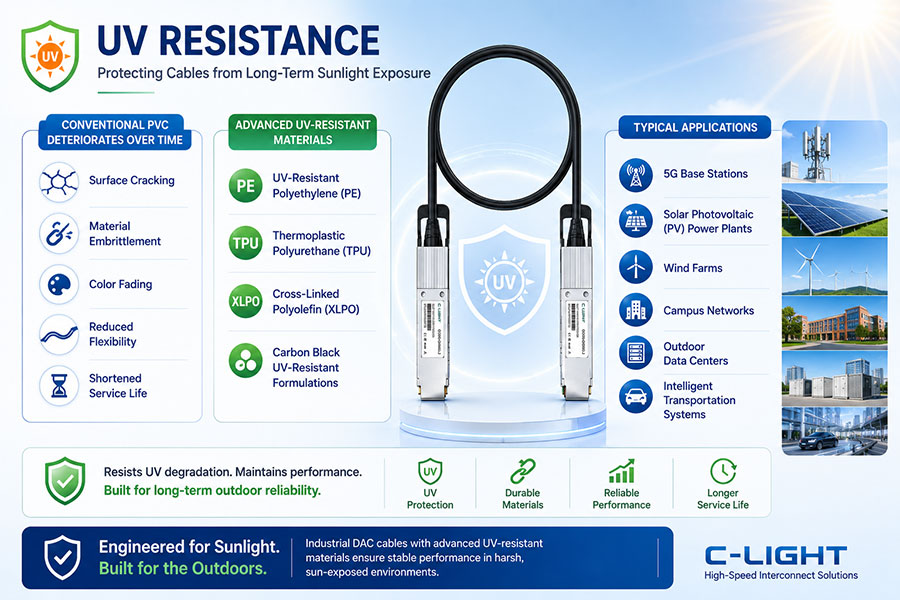
Conventional PVC cable jackets deteriorate after prolonged exposure to sunlight, often resulting in:
Surface cracking
Material embrittlement
Color fading
Reduced flexibility
Shortened service life
Industrial DAC cables typically utilize advanced materials such as:
UV-resistant polyethylene (PE)
Thermoplastic polyurethane (TPU)
Cross-linked polyolefin (XLPO)
Carbon black UV-resistant formulations
These materials effectively resist ultraviolet degradation while maintaining excellent mechanical strength and electrical performance throughout extended outdoor service.
For renewable energy facilities, 5G base stations, intelligent transportation systems, and other installations exposed to continuous sunlight, industrial DAC cables with dedicated UV-resistant materials are strongly recommended.
Typical Applications
5G base stations
Solar photovoltaic (PV) power plants
Wind farms
Campus networks
Outdoor data centers
Intelligent transportation systems
6. High-Temperature Resistance: Designed for Harsh Industrial Environments
Unlike climate-controlled data centers, industrial facilities and outdoor communication cabinets often operate under much higher ambient temperatures.
Typical operating environments include:
| Application Environment | Typical Ambient Temperature |
|---|---|
| Data Centers | 18°C to 27°C |
| Outdoor Telecom Cabinets | Up to 70°C |
| Solar Power Plants | Above 75°C |
| Steel Mills | Above 80°C |
| Industrial Automation | Above 85°C |
To ensure long-term reliability, industrial-grade DAC cables are commonly designed with:
High-temperature insulation layers
Heat-resistant cable jacket materials
High-temperature connectors
Reinforced shielding structures
Typical operating temperature ratings include:
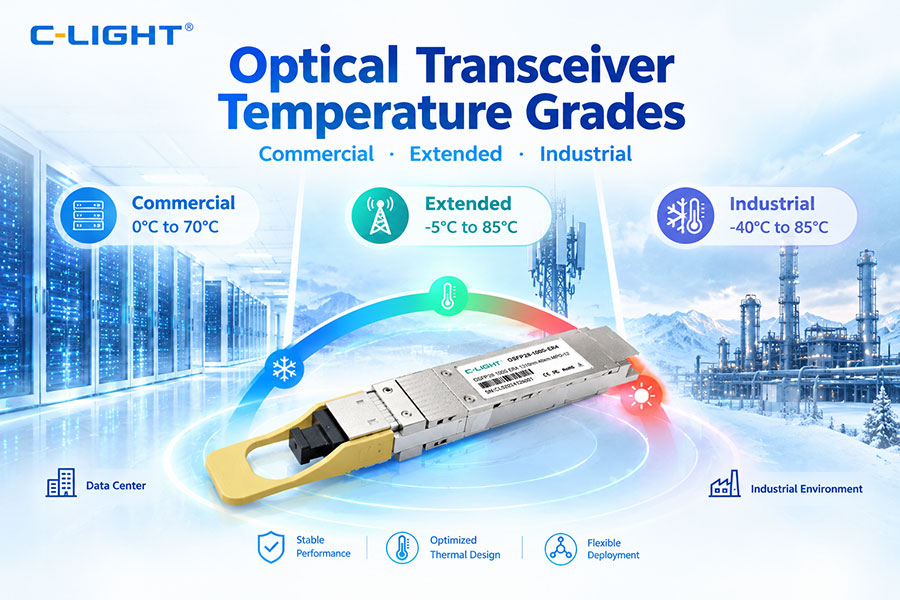
-40°C to +85°C
-40°C to +90°C
Industrial-grade wide-temperature designs
These features help maintain excellent signal integrity (SI) and stable high-speed transmission even under elevated temperatures.
C-LIGHT high-speed DAC cables undergo comprehensive reliability testing, including:
High- and low-temperature cycling tests
Long-term aging tests
Connector insertion and extraction life tests
Signal Integrity (SI) verification
Industrial wide-temperature versions are available upon request to satisfy demanding deployment requirements across harsh industrial environments.
7. Additional Features of Industrial-Grade DAC Cables
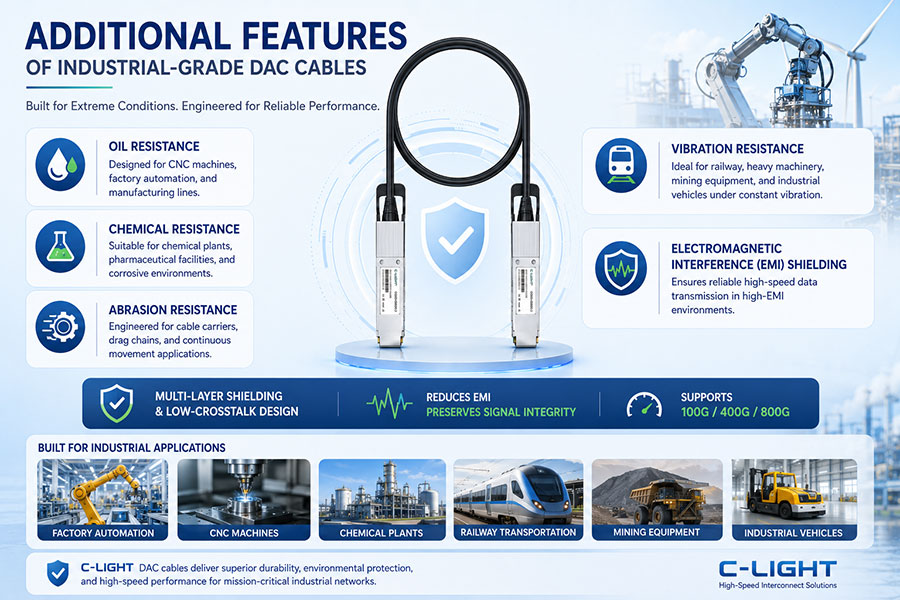
Beyond waterproofing, flame resistance, UV protection, and high-temperature performance, industrial DAC cables often incorporate several additional enhancements.
Oil Resistance
Designed for CNC machines, factory automation equipment, and manufacturing production lines where oil exposure is common.
Chemical Resistance
Suitable for chemical processing plants, pharmaceutical facilities, and laboratory environments exposed to corrosive substances.
Abrasion Resistance
Engineered for robotic cable carriers, drag chains, and applications involving continuous movement.
Vibration Resistance
Ideal for railway transportation, heavy machinery, mining equipment, and industrial vehicles operating under constant vibration.
Electromagnetic Interference (EMI) Shielding
Provides reliable high-speed data transmission in environments with strong electromagnetic interference.
In addition, C-LIGHT DAC cables feature multi-layer shielding structures and low-crosstalk designs, significantly reducing EMI while maintaining outstanding Signal Integrity (SI) across 100G, 400G, and 800G Ethernet links.
8. Typical Industrial Applications
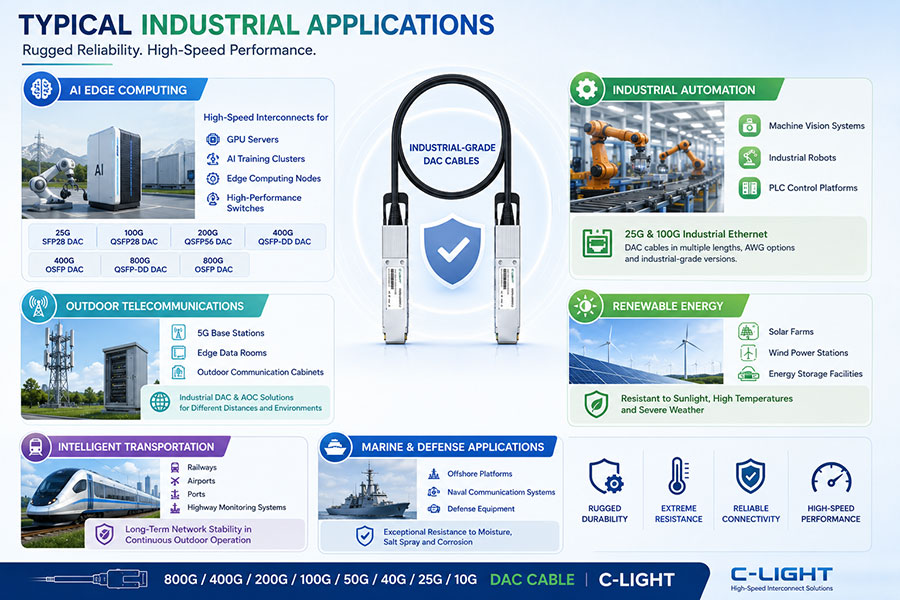
AI Edge Computing
AI edge servers are increasingly deployed in factories, outdoor facilities, and distributed computing sites where environmental conditions are much harsher than traditional data centers.
For low-latency, short-reach interconnects between AI servers, C-LIGHT offers:
These products provide reliable high-speed connectivity for:
GPU servers
AI training clusters
Edge computing nodes
High-performance Ethernet switches
800G/400G/200G/100G/50G/40G/25G/10G DAC Cable丨C-LIGHT
Industrial Automation
Machine vision systems, industrial robots, and PLC control platforms are increasingly adopting 25G and 100G Industrial Ethernet.
C-LIGHT offers DAC cables in various lengths, AWG options, and industrial-grade versions to support automated production lines and intelligent manufacturing equipment.
Outdoor Telecommunications
5G base stations, edge data rooms, and outdoor communication cabinets require highly reliable high-speed interconnects.
For telecom operators and edge networking applications, C-LIGHT provides both industrial DAC and AOC solutions to accommodate different transmission distances and deployment environments.
Renewable Energy
Solar farms, wind power stations, and energy storage facilities frequently operate under intense sunlight, high temperatures, and severe weather conditions, making industrial-grade DAC cables an ideal solution.
Intelligent Transportation
Railways, airports, ports, and highway monitoring systems demand long-term network stability under continuous outdoor operation.
Marine and Defense Applications
Offshore platforms, naval communication systems, and defense equipment require exceptional resistance to moisture, salt spray, and corrosion, making ruggedized DAC cables essential.
9. How to Choose an Industrial-Grade DAC Cable
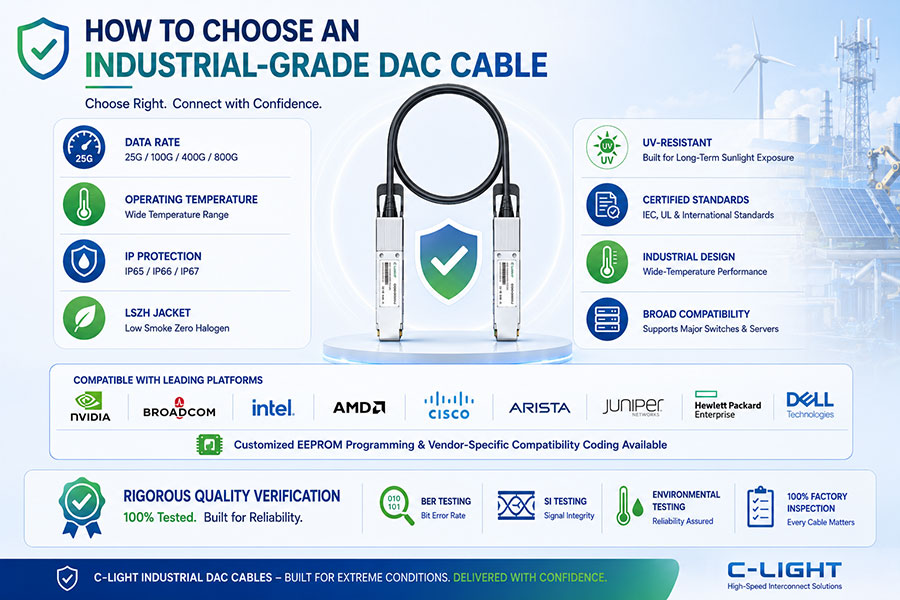
When selecting an industrial DAC cable, consider the following factors carefully:
Required data rate (25G, 100G, 400G, or 800G)
Operating temperature range
IP protection rating
LSZH (Low Smoke Zero Halogen) cable jacket
UV-resistant construction
Compliance with IEC, UL, and other international standards
Wide-temperature industrial design
Compatibility with target switches and servers
Evaluating these specifications helps improve long-term network reliability while minimizing maintenance costs.
C-LIGHT DAC cables are fully compatible with leading networking platforms from NVIDIA, Broadcom, Intel, AMD, Cisco, Arista, Juniper, HPE, and Dell. Customized EEPROM programming and vendor-specific compatibility coding are also available.
Every cable undergoes rigorous quality verification, including:
BER (Bit Error Rate) testing
Signal Integrity (SI) testing
Environmental reliability testing
100% factory inspection
10. Future Trends of Industrial DAC Cables
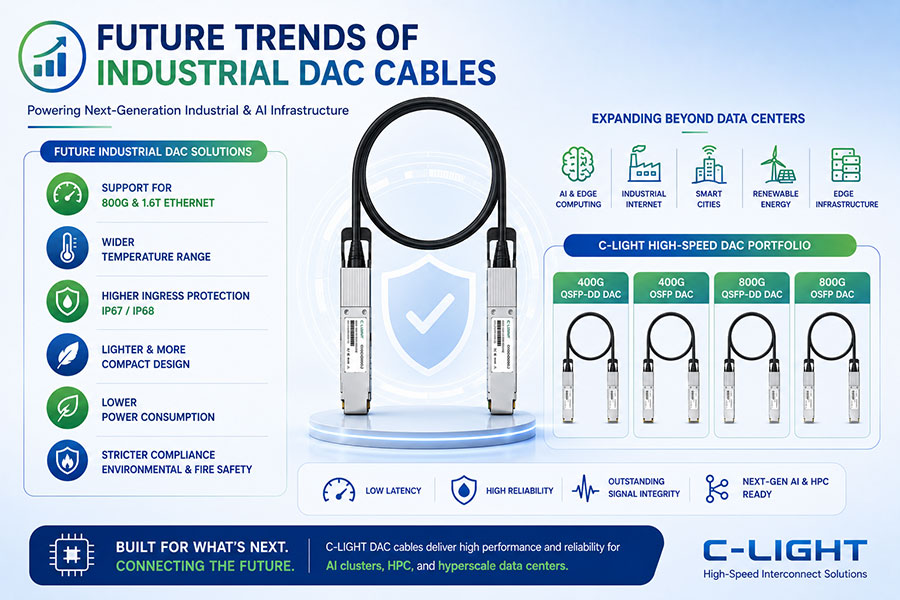
As AI, Industrial Internet, smart cities, renewable energy, and edge computing continue to expand, high-speed DAC technology is rapidly moving beyond traditional data centers into increasingly demanding environments.
Future industrial DAC solutions are expected to feature:
Support for 800G and 1.6T Ethernet
Wider operating temperature ranges
Higher ingress protection ratings (IP67/IP68)
Lighter and more compact cable designs
Lower power consumption
Stricter environmental and fire safety compliance
These advancements will further accelerate the deployment of next-generation industrial networking and edge AI infrastructure.
As AI networking evolves from 400G toward 800G and eventually 1.6T, C-LIGHT has introduced a complete portfolio of high-speed copper interconnects, including:
400G QSFP-DD DAC
400G OSFP DAC
800G QSFP-DD DAC
800G OSFP DAC
These solutions deliver low latency, high reliability, and outstanding signal integrity, providing an ideal interconnect platform for next-generation AI clusters, high-performance computing (HPC), and hyperscale data centers.
11. Conclusion
Traditional Direct Attach Copper (DAC) cables were primarily designed for controlled data center environments. However, the rapid expansion of the Industrial Internet, AI edge computing, smart manufacturing, renewable energy, and outdoor communications has significantly broadened the range of DAC applications.
Industrial-grade DAC cables featuring waterproof, flame-retardant, UV-resistant, and high-temperature-resistant designs provide the durability required for harsh operating environments. These enhanced cables improve network reliability, extend equipment lifespan, reduce maintenance costs, and ensure stable high-speed connectivity under challenging conditions.
Looking ahead, as networking technologies evolve from 400G to 800G and eventually 1.6T Ethernet, industrial-grade DAC cables will become an essential infrastructure component for industries such as intelligent manufacturing, AI edge computing, renewable energy, smart transportation, and industrial automation.
As a professional provider of high-speed interconnect solutions, C-LIGHT continues to expand its portfolio of 10G to 800G DAC cables for both data center and industrial applications. In addition to DAC solutions, C-LIGHT offers a comprehensive range of AOC (Active Optical Cables), AEC (Active Electrical Cables), and high-speed optical transceivers, enabling customers to build reliable, high-performance, and future-ready network infrastructures.
12.Frequently Asked Questions (FAQ)
Q1. What is the difference between a standard DAC cable and an industrial-grade DAC cable?
Answer: Industrial-grade DAC cables feature enhanced materials, rugged mechanical structures, and higher reliability designs to withstand moisture, extreme temperatures, UV exposure, oil contamination, vibration, and other harsh environmental conditions. Standard DAC cables are primarily intended for climate-controlled indoor data centers.
Q2. Can waterproof DAC cables be permanently installed outdoors?
Answer: Yes. For long-term outdoor deployment, choose DAC cables with IP65, IP66, or IP67 ingress protection ratings, UV-resistant cable jackets, and corrosion-resistant connectors. These features help ensure reliable operation in outdoor communication cabinets, industrial facilities, and other exposed environments.
Q3. Why are LSZH DAC cables recommended for data centers?
Answer: LSZH (Low Smoke Zero Halogen) cable jackets produce significantly less smoke and do not release corrosive halogen gases during a fire. This improves personnel safety during evacuation while reducing potential damage to servers, switches, and other critical IT equipment. As a result, LSZH has become the preferred cabling material for modern data centers.
Q4. What operating temperature range is typically supported by industrial DAC cables?
Answer: Most industrial-grade DAC cables support operating temperatures ranging from -40°C to +85°C. Specialized versions may support +90°C or even higher, making them suitable for demanding environments such as steel mills, renewable energy facilities, industrial automation systems, and outdoor telecommunications.
Q5. Which industries benefit most from industrial-grade DAC cables?
Answer: Industrial-grade DAC cables are ideal for applications requiring enhanced environmental durability, including:
Industrial automation
AI edge computing
5G telecommunications
Renewable energy (solar and wind farms)
Railway and intelligent transportation systems
Ports and marine infrastructure
Smart city deployments
Offshore platforms
Defense and military communication systems
Their rugged construction and reliable high-speed performance make them well suited for environments where conventional data center cables cannot provide long-term stability.
 >
>

 >
>
 >
>
 >
>
 >
>
 >
>
 >
>
 >
>