TEL:+86 132 6656 7067





Optical receiver design for long-distance fiber transmission involves more than choosing a photodiode with higher sensitivity. An avalanche photodiode (APD) improves direct-detection performance through internal carrier multiplication, while a coherent receiver uses a local optical reference to recover the signal's amplitude, phase, and polarization information. These approaches address different limitations in optical communication systems and are built around fundamentally different receiver architectures.
1. APD vs Coherent Receiver: Fundamental Difference
An APD is a semiconductor photodetector. It converts incoming optical power into an electrical current and uses avalanche multiplication to increase the current generated by incident light. It normally operates in an intensity-modulation direct-detection (IM/DD) receiver.
A coherent receiver is a complete optical detection architecture. It combines the incoming optical signal with a local oscillator (LO) laser, then uses optical mixing and photodetection to recover the information carried by the optical field. Its photodetectors are commonly arranged as balanced pairs, with subsequent digital signal processing (DSP) recovering the transmitted data.
| Feature | APD Receiver | Coherent Receiver |
|---|---|---|
| Architecture | Direct detection | Coherent detection |
| Core technology | Avalanche photodiode | Local oscillator, optical hybrid, balanced photodetectors and DSP |
| Detection principle | Optical power converted into photocurrent with internal gain | Received optical field mixed with a reference optical field |
| Signal information | Primarily intensity | Amplitude, phase and polarization |
| Internal detector gain | Yes, through avalanche multiplication | Usually PIN-based balanced photodetection; sensitivity also benefits from LO mixing |
| Optical reference | Not required | Local oscillator laser required |
| Signal processing | Typically TIA and CDR, with architecture-dependent equalization | High-performance DSP for field recovery and impairment compensation |
| Implementation complexity | Moderate | Higher |
| Typical applications | Selected long-reach direct-detection links and access systems | Metro, long-haul, submarine and high-capacity DWDM systems |
2. How an APD Receiver Works
An APD operates under a relatively high reverse-bias voltage. When an incoming photon generates an electron-hole pair in the semiconductor, the carriers accelerate in the strong electric field. Impact ionization creates additional carriers, producing avalanche multiplication.
The resulting photocurrent can be represented approximately as:
Here, M represents the avalanche multiplication factor, R is the unity-gain responsivity, and Popt is the incident optical power. The multiplication factor increases the electrical signal before subsequent amplification.
This internal gain can improve receiver sensitivity when electronic noise is a major limitation. However, avalanche multiplication is statistical, so it also introduces excess noise. APD gain is affected by operating voltage and temperature, making bias control and thermal management important parts of the receiver design.
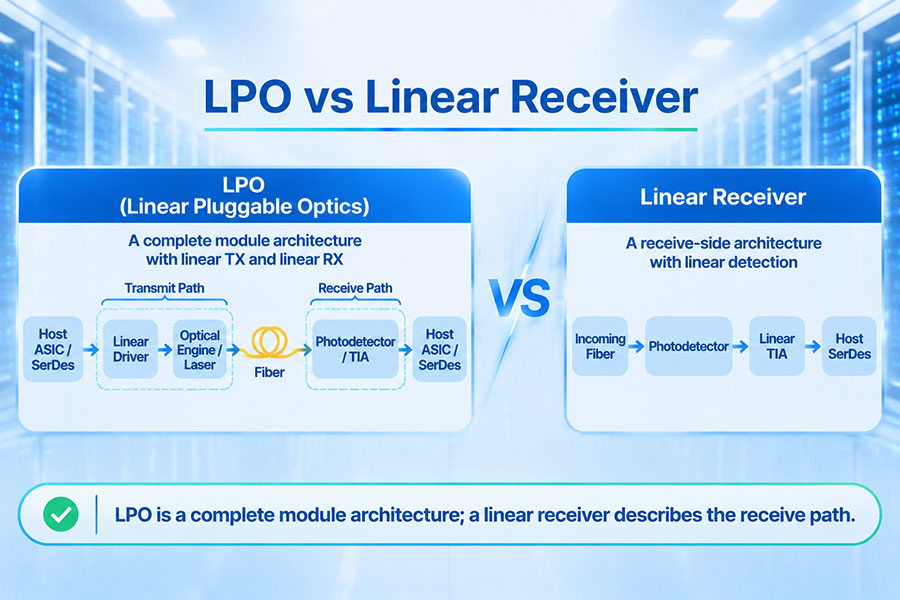
Typical APD receiver signal path
The APD detects optical intensity. The TIA converts its current into a voltage signal, and subsequent electronics recover the transmitted data.
APD receivers are useful when the optical link budget is constrained and direct detection remains suitable. They do not, however, recover the optical carrier phase or polarization in the way a coherent receiver does.
3. How a Coherent Receiver Works
A coherent receiver uses an optical local oscillator as a reference. The received signal and LO are combined in an optical hybrid. The resulting optical outputs are detected by balanced photodetectors, generating electrical signals that contain information about the relative phase and amplitude of the two optical fields.
A polarization-diverse coherent receiver typically separates or processes two orthogonal polarization components. In-phase (I) and quadrature (Q) signals are produced for each polarization, giving four electrical signal paths for a conventional dual-polarization coherent architecture.
The LO provides a strong optical reference, while the balanced detection and DSP stages enable recovery of complex modulation formats.
Because the receiver recovers the complex optical field, coherent systems can support modulation formats such as QPSK and higher-order QAM. DSP can compensate for chromatic dispersion, polarization-mode dispersion, polarization rotation and other transmission impairments within the limits of the system design.
Coherent detection is therefore not simply an APD with greater sensitivity. It changes how the optical signal is detected and what information can be recovered.
4. Sensitivity and Optical Link Budget
Both architectures can support weak-signal reception, but their sensitivity mechanisms are different.
An APD increases the detected photocurrent through avalanche gain. This is particularly useful when the receiver's performance is limited by the noise of its electrical front end. The improvement is constrained by avalanche excess noise, detector bandwidth, operating conditions and the characteristics of the TIA.
A coherent receiver uses the LO to mix with the incoming optical field. The resulting electrical beat signal can provide strong detection sensitivity and efficient recovery of spectrally efficient modulation formats. Its performance depends on LO power and linewidth, optical hybrid characteristics, balanced detector noise, DSP implementation, modulation format and transmission conditions.
Consequently, sensitivity values from APD and coherent datasheets should not be compared without checking the measurement conditions. Bit rate, modulation format, FEC threshold, reference bandwidth, pre-FEC BER and required OSNR can all affect the stated receiver performance.
5. Noise Characteristics and Signal Recovery
| Noise or impairment | APD direct detection | Coherent detection |
|---|---|---|
| Thermal noise | Important when the received signal is weak and electrical amplifier noise dominates | Contributes through the balanced photodetectors and electrical front end |
| Shot noise | Associated with photocurrent and dark current | Includes contributions from signal and LO-related photocurrents |
| Multiplication noise | Introduced by stochastic avalanche gain | Not inherent to conventional PIN-based balanced detection |
| Laser phase noise | Usually not recovered as data in basic intensity detection | Important because the signal is measured relative to the LO phase |
| Chromatic dispersion | Can limit direct-detection performance and may require separate compensation | Can be compensated electronically by coherent DSP |
| Polarization effects | Generally not recovered as separate complex polarization channels | Polarization-diverse designs recover both polarization components |
Balanced detection also helps reject common-mode components, including some LO intensity noise, when the optical paths and detector pair are sufficiently well matched. It does not eliminate every source of noise, and coherent performance still depends on the quality of the optical and electrical front ends.
6. Bandwidth, Modulation and DSP Requirements
APD receiver bandwidth is influenced by the detector structure, carrier transit time, capacitance, avalanche buildup time and the electrical front end. Increasing avalanche gain can create a trade-off with bandwidth, so the detector must be optimized for the target data rate.
Coherent receiver bandwidth is determined by the optical front end, balanced photodetectors, analog electrical bandwidth, ADC sampling and DSP capability. Its advantage is not that every coherent receiver has a wider analog bandwidth than every APD receiver. Rather, coherent detection preserves the complex field information needed for advanced modulation and digital compensation.
For example, a conventional APD-based IM/DD receiver is designed to recover intensity-modulated data. A dual-polarization coherent receiver can recover I/Q information on two polarizations, supporting higher spectral efficiency when the optical channel and DSP are designed accordingly.
7. Power Consumption, Cost and Integration
An APD receiver requires a high-voltage bias supply and may need gain stabilization or temperature compensation. Its overall architecture can remain relatively compact because it does not require a local oscillator, optical hybrid and high-performance coherent DSP chain.
A coherent receiver requires more optical and electronic functions. The LO laser, optical hybrid, balanced detector arrays, high-speed ADCs and DSP increase component count, power consumption and integration complexity. These requirements are justified in applications where spectral efficiency, reach and transmission capacity are important.
Power and cost comparisons must use complete receiver or transceiver specifications. Detector-level power figures alone do not represent the total system requirements.
8. Typical Applications in Fiber Optic Networks
| Application | APD-based receiver | Coherent receiver |
|---|---|---|
| PON access networks | Used in selected receiver designs where direct-detection sensitivity is required | Not the conventional architecture for mainstream access optics |
| Short-reach data center links | Possible in selected designs, although PIN is common in many short-reach modules | Used where coherent technology is justified by reach or capacity requirements |
| Metro optical transport | Suitable for some direct-detection systems | Widely used for high-capacity wavelength channels |
| Long-haul DWDM | Limited where phase recovery and advanced modulation are required | A major receiver architecture for high-capacity transmission |
| Submarine networks | Not the typical choice for modern high-capacity coherent channels | Widely used for high spectral efficiency and long-distance transmission |
For optical transceiver selection, the receiver architecture should match the transmission system. C-LIGHT's optical transceiver portfolio provides a starting point for evaluating optical connectivity by data rate, wavelength, reach and form factor. The exact receiver technology should be confirmed against the relevant product specification.
9. APD vs Coherent Receiver: Selection Considerations
APD and coherent detection solve different engineering problems. The appropriate choice depends on whether the link needs improved direct-detection sensitivity or recovery of the full complex optical field.
Choose an APD-based design when direct detection is appropriate, the link budget is constrained, and internal avalanche gain can improve the receiver's noise-limited performance.
Choose coherent detection when the system requires phase and polarization recovery, advanced modulation formats, high spectral efficiency or digital compensation of transmission impairments.
Evaluate the complete link by checking transmitter power, fiber attenuation, connector and splice losses, receiver sensitivity, OSNR, modulation format and FEC requirements.
Check implementation constraints including power consumption, thermal design, module form factor, host interface and network equipment compatibility.
10. Conclusion
APD and coherent receivers represent two distinct approaches to optical signal detection. An APD uses avalanche multiplication to increase photocurrent in a direct-detection architecture, offering a practical sensitivity improvement for suitable intensity-modulated links. A coherent receiver combines the incoming signal with a local oscillator and uses balanced detection and DSP to recover amplitude, phase and polarization information.
APD technology is primarily a photodetector-level solution, while coherent detection is a complete receiver architecture. Their performance should therefore be evaluated against different system requirements rather than treated as interchangeable detector options. For access and direct-detection links, APD can be valuable when optical margin is limited. For high-capacity metro, long-haul and submarine transmission, coherent technology provides the signal recovery and spectral efficiency required by advanced optical transport systems.
For optical transceiver selection, compatibility evaluation or application-specific connectivity requirements, Contact C-LIGHT.
 >

 >
 >
 >
 >
 >
 >
 >