TEL:+86 132 6656 7067




AI computing is changing the architecture of modern data centers. Traditional cloud workloads were mainly limited by processor performance, storage capacity, and server efficiency. However, large-scale AI models introduce a different challenge: thousands of GPUs must exchange massive amounts of data with extremely low latency.
As GPU clusters continue scaling from hundreds to thousands or even tens of thousands of accelerators, the network connecting these computing resources becomes a critical factor. The industry has already increased GPU computing capability dramatically, but the interconnect technology that moves data between processors is becoming the next constraint.
Optical interconnect has historically been used for long-distance communication between data center racks and facilities. Today, it is moving closer to the computing layer because electrical connections cannot efficiently support the bandwidth, distance, and power requirements of next-generation AI systems.
The challenge is no longer simply increasing GPU performance. The challenge is moving data between GPUs fast enough to keep those processors fully utilized. This shift is making optical interconnect one of the most important technologies in AI data center infrastructure.
1. Why AI Workloads Are Changing Data Center Networking
AI training and inference workloads operate differently from traditional applications. Large language models and generative AI systems require continuous communication between many GPUs during computation.
In distributed AI training, GPUs exchange intermediate results through high-speed networking technologies. The efficiency of this communication directly affects training time, power consumption, and overall system utilization.
1.1 GPU Scaling Creates Massive Bandwidth Demand
A single AI accelerator can generate enormous amounts of data traffic. When thousands of GPUs operate together, the aggregate communication requirement grows exponentially.
Modern AI clusters require high-speed connections in two major areas:
Scale-up networking: Communication between GPUs inside the same computing domain, requiring extremely high bandwidth and very low latency.
Scale-out networking: Communication between servers, racks, and data center zones using Ethernet or InfiniBand networks.
Both architectures depend on optical connectivity as electrical signaling reaches its physical limitations.
1.2 Network Performance Becomes a Limiting Factor
When network communication cannot keep pace with GPU processing capability, GPUs spend more time waiting for data instead of performing computation. This reduces cluster efficiency and increases the cost of AI infrastructure.
The result is a fundamental shift: the bottleneck is moving from computing power to data movement.
2. Why Electrical Interconnects Are Facing Physical Limits
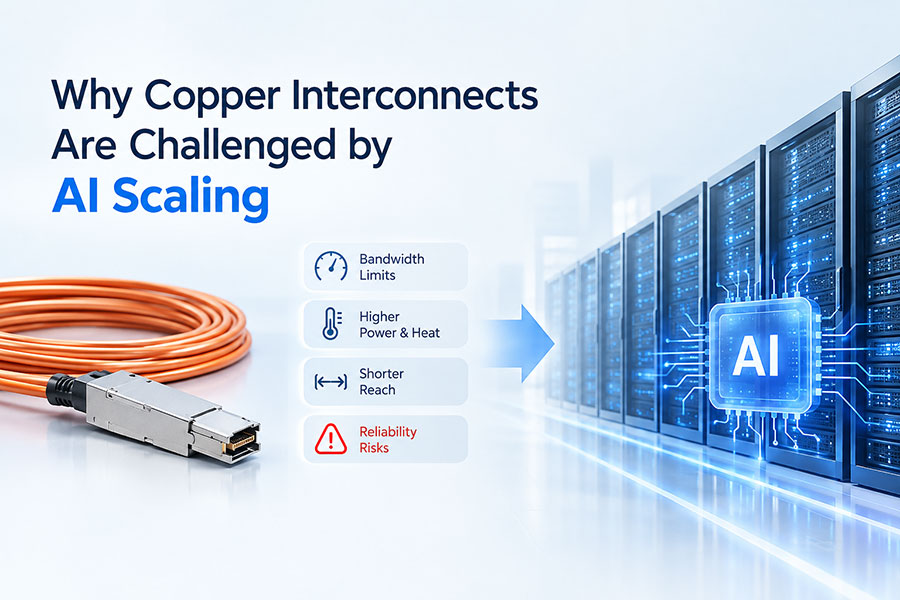
Electrical interconnects have powered data centers for decades because they are cost-effective and efficient over short distances. However, AI clusters require significantly higher bandwidth over longer paths, creating challenges for copper-based solutions.
2.1 Increasing Speed Creates Signal Integrity Challenges
As Ethernet speeds move from 100G to 400G, 800G, and beyond, electrical signals become increasingly difficult to transmit over copper connections.
Higher-speed electrical transmission faces several limitations:
Signal attenuation: Electrical signals lose strength as distance increases.
Insertion loss: Higher frequencies experience greater transmission loss.
Power consumption: Electrical equalization and signal processing require additional power.
Reach limitations: Copper solutions become shorter as bandwidth increases.
2.2 Copper Scaling Becomes Increasingly Difficult
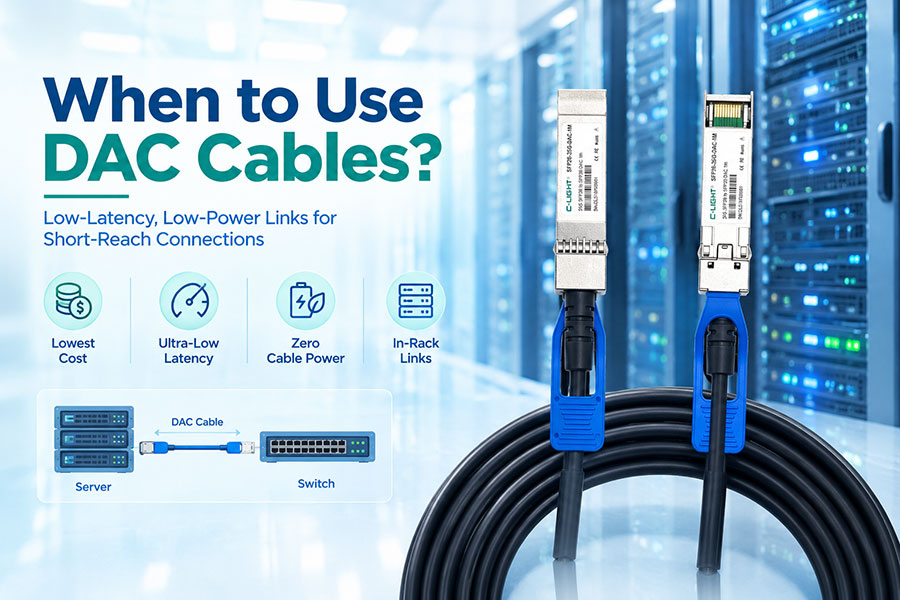
Direct Attach Copper (DAC) cables remain popular for short connections because of their low cost and simplicity. However, they are primarily suitable for short-reach applications.
| Technology | Typical Application | Main Limitation |
|---|---|---|
| Copper DAC | Short rack connections | Limited reach and increasing power at higher speeds |
| Active Copper | Medium-distance electrical links | More electronics and thermal challenges |
| Optical Interconnect | Rack-to-rack and data center-scale networks | Higher cost and optical complexity |
3. Optical Interconnect Moves Closer to AI Computing
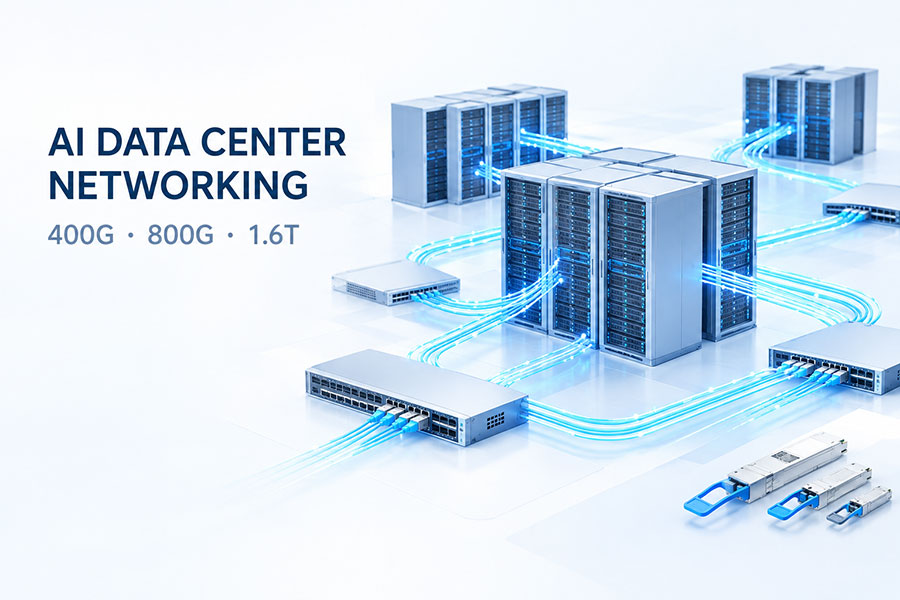
In traditional data centers, optical modules mainly connected switches and long-distance network links. AI infrastructure changes this model by pushing optical connectivity closer to GPU systems.
The reason is simple: optical communication provides significantly higher bandwidth density and longer reach with lower signal degradation compared with electrical alternatives.
3.1 From Data Center Networking to AI Fabric
AI clusters require a high-performance communication fabric connecting thousands of computing nodes. This fabric depends on optical transceivers, optical cables, and switching systems to maintain continuous data exchange.
Modern AI networking commonly uses:
400G optical transceivers for existing large-scale deployments.
800G optical modules for next-generation AI clusters.
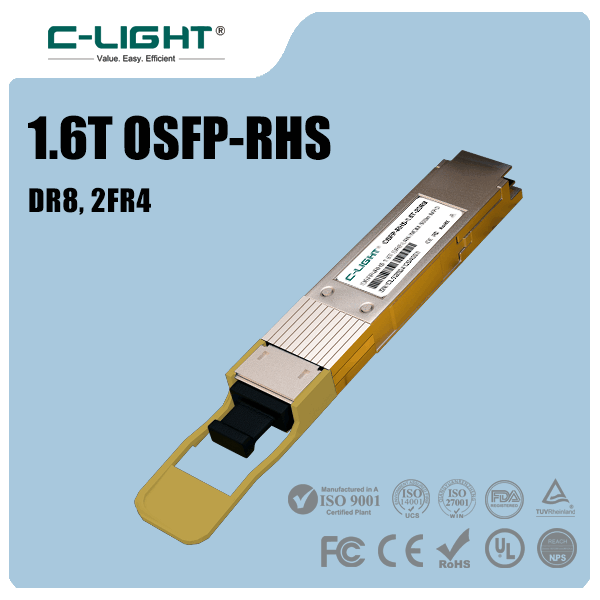
1.6T optical solutions for future high-density systems.
Co-packaged optics and silicon photonics for reducing electrical distance.
3.2 Optical Links Become a Critical System Component
In AI data centers, optical modules are no longer simple connectivity accessories. They directly influence:
GPU utilization efficiency.
Network scalability.
System power consumption.
AI training performance.
Overall data center operating cost.
4. 800G and 1.6T Optical Interconnects for AI Infrastructure
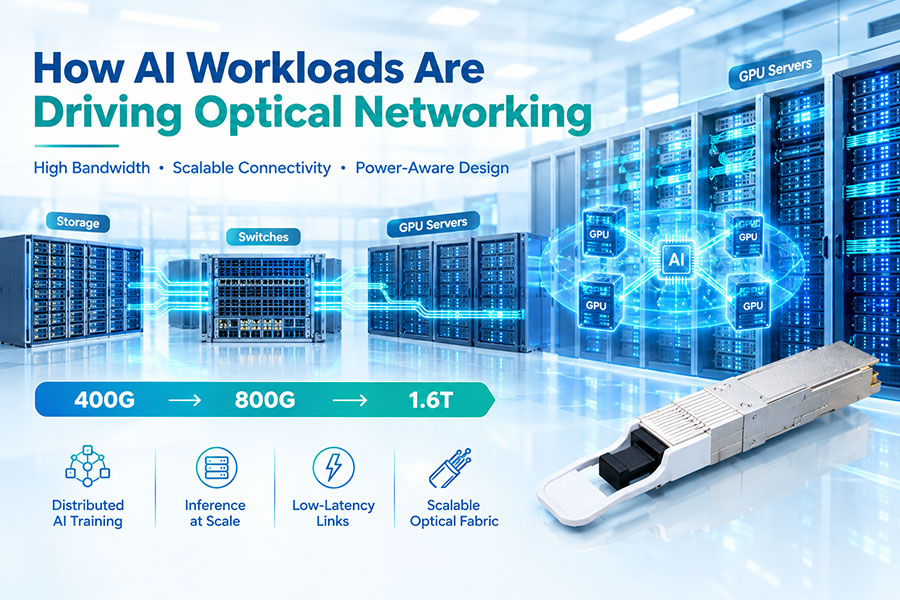
The rapid growth of AI clusters is accelerating the transition from 400G optical connectivity to 800G and 1.6T solutions. Higher-speed optical modules are required because the traditional network architecture cannot provide sufficient bandwidth density for large-scale GPU systems.
An AI data center may contain thousands of GPUs connected through multiple layers of switching infrastructure. Each layer requires higher bandwidth to prevent communication congestion. As a result, optical transceivers must continuously increase throughput while maintaining power efficiency and reliability.
4.1 800G Becomes the New Standard for AI Networks
800G optical modules have become a key technology for next-generation AI data centers. Compared with 400G solutions, 800G doubles the bandwidth while supporting higher-density network architectures.
Typical 800G optical solutions include:
800G OSFP: Designed for high-density AI and Ethernet switching applications.
800G QSFP-DD: Compatible with existing network platforms and widely adopted in data center environments.
800G DR8 / 2×FR4: Supporting different reach requirements from short data center connections to longer interconnect links.
4.2 Why 1.6T Optical Is Becoming Necessary
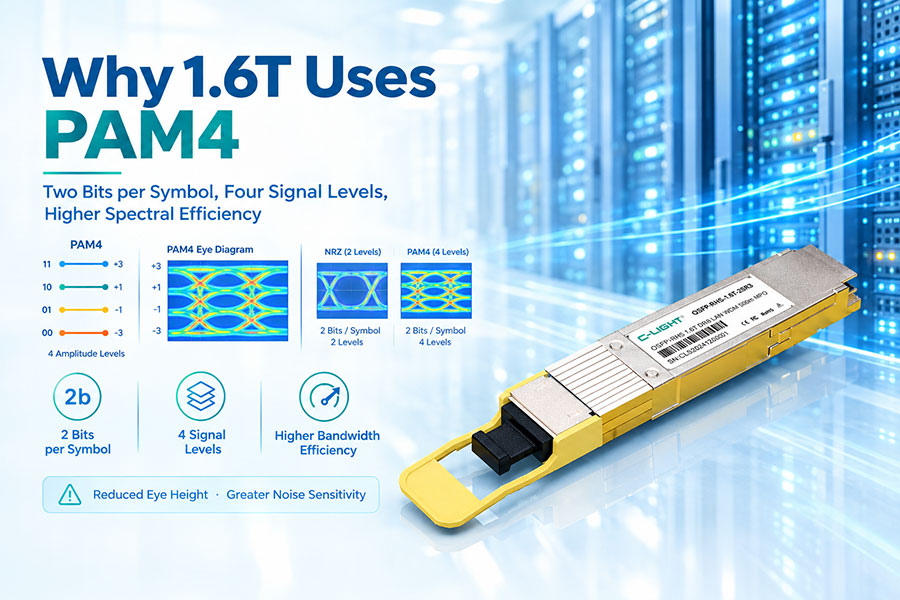
Although 800G provides significant bandwidth improvement, AI workloads continue to grow faster than traditional networking evolution. Larger GPU clusters and higher-performance accelerators are driving demand for 1.6T optical interconnect solutions.
| Generation | Network Requirement | Optical Solution |
|---|---|---|
| 100G / 200G | Traditional cloud and enterprise networking | QSFP28 / QSFP56 optical modules |
| 400G | Large-scale data center expansion | 400G DR4, FR4, LR4 optics |
| 800G | AI clusters and high-performance computing | 800G OSFP, QSFP-DD optics |
| 1.6T | Future AI superclusters | 1.6T OSFP-XD and advanced optical engines |
5. Optical Interconnect Challenges in AI Data Centers
Although optical technology solves many bandwidth limitations, AI networking introduces new challenges. Optical suppliers must improve performance, power efficiency, integration, and manufacturing scalability.
5.1 Power Consumption of Optical Modules
As optical speeds increase, module power consumption becomes a major concern. A large AI cluster may contain hundreds of thousands of optical connections, making every watt important.
Reducing optical module power consumption is one of the main reasons why technologies such as Linear-drive Pluggable Optics (LPO), Near Package Optics (NPO), and Co-Packaged Optics (CPO) are attracting attention.
5.2 Thermal Management
AI data centers already operate with extremely high power density. Optical modules installed near high-performance switches must maintain stable operation under significant thermal pressure.
Future optical interconnect designs must balance:
High bandwidth density.
Low optical module power.
Efficient heat dissipation.
Long-term reliability.
5.3 Manufacturing Complexity
Advanced optical modules combine lasers, photonic components, drivers, receivers, DSPs, and high-speed electrical interfaces. Manufacturing yield and testing complexity become increasingly important as speeds move beyond 800G.
6. CPO, LPO, and Silicon Photonics: The Next Evolution
The future of AI optical interconnect is moving toward tighter integration between optical components and computing systems. Traditional pluggable optics separate optical modules from switching ASICs, but future architectures aim to shorten electrical paths.
6.1 Linear-drive Pluggable Optics (LPO)
LPO reduces power consumption by removing or simplifying DSP functions inside optical modules. The switch ASIC directly drives optical components through high-speed electrical signals.
| Technology | Main Advantage | Challenge |
|---|---|---|
| LPO | Lower power consumption and simpler optical modules | Requires high-quality signal integrity |
| CPO | Shortest electrical connection distance | Complex packaging and maintenance |
| Silicon Photonics | Large-scale photonic integration | Manufacturing maturity |
6.2 Co-Packaged Optics (CPO)
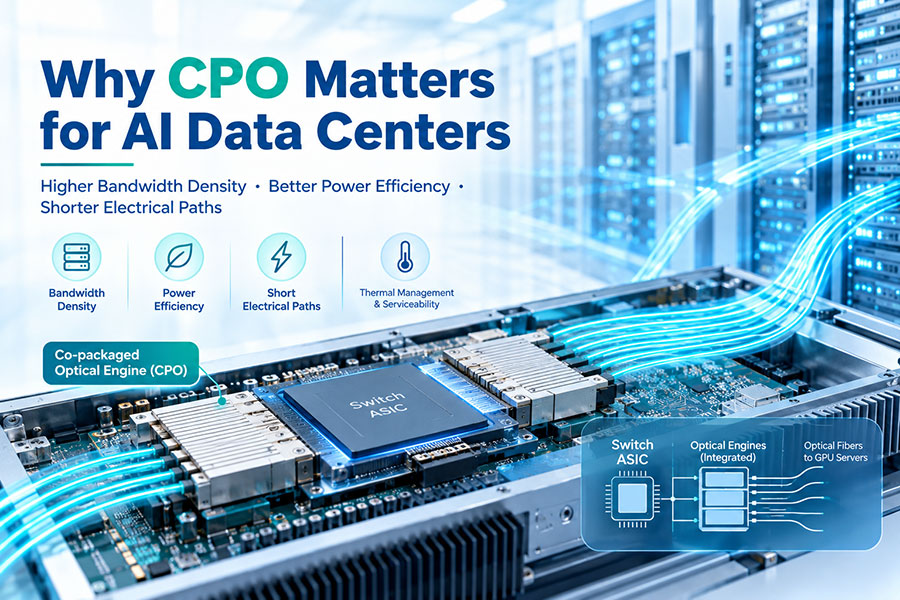
CPO integrates optical engines closer to the switching ASIC. By reducing electrical trace length, CPO can significantly improve bandwidth density and energy efficiency.
For future AI clusters requiring extremely high-speed communication, CPO may become an important architecture for overcoming electrical interconnect limitations.
7. Optical Interconnect vs Electrical Interconnect in AI Networks
| Parameter | Electrical Interconnect | Optical Interconnect |
|---|---|---|
| Bandwidth Scaling | Limited by electrical loss | Supports higher-speed evolution |
| Transmission Distance | Short reach | Longer reach with lower loss |
| Power Efficiency | Power increases rapidly with speed | Better efficiency for high bandwidth |
| Signal Integrity | More sensitive to attenuation | Strong immunity to electromagnetic interference |
| AI Cluster Suitability | Limited for large-scale clusters | Preferred for large AI networks |
8. How Optical Interconnect Supports Future AI Scaling
The future of AI depends not only on faster processors but also on faster communication between processors. Optical interconnect provides the foundation required for scaling AI systems beyond current limitations.
Several trends will continue driving optical adoption:
Larger GPU clusters:AI training systems require more computing nodes and higher bandwidth communication.
Higher accelerator performance:Faster GPUs require faster network connections to avoid idle time.
AI infrastructure expansion:Cloud providers and enterprises are building dedicated AI data centers.
Energy efficiency requirements:Optical solutions help reduce power consumption per transmitted bit.
9. Comparison Summary
| Dimension | Traditional Electrical Interconnect | Optical Interconnect |
|---|---|---|
| Primary Limitation | Signal loss and power consumption | Cost and optical complexity |
| AI Cluster Role | Short-distance connections | Large-scale GPU networking |
| Bandwidth Growth | Increasing difficulty | Continuous evolution to 1.6T and beyond |
| Future Direction | Limited scaling | CPO, LPO, silicon photonics |
10. Summary
AI workloads are transforming data center architecture. As GPU clusters continue expanding, the ability to move data efficiently between processors becomes just as important as computing performance itself.
Optical interconnect is becoming the new bottleneck because traditional electrical solutions cannot efficiently support the bandwidth, distance, and power requirements of future AI systems.
800G and 1.6T optical modules, together with LPO, CPO, and silicon photonics technologies, are becoming essential solutions for next-generation AI infrastructure. Optical communication is no longer only a networking technology; it is becoming a fundamental component of AI computing systems.
 >
>

 >
>
 >
>
 >
>
 >
>
 >
>
 >
>
 >
>