TEL:+86 132 6656 7067




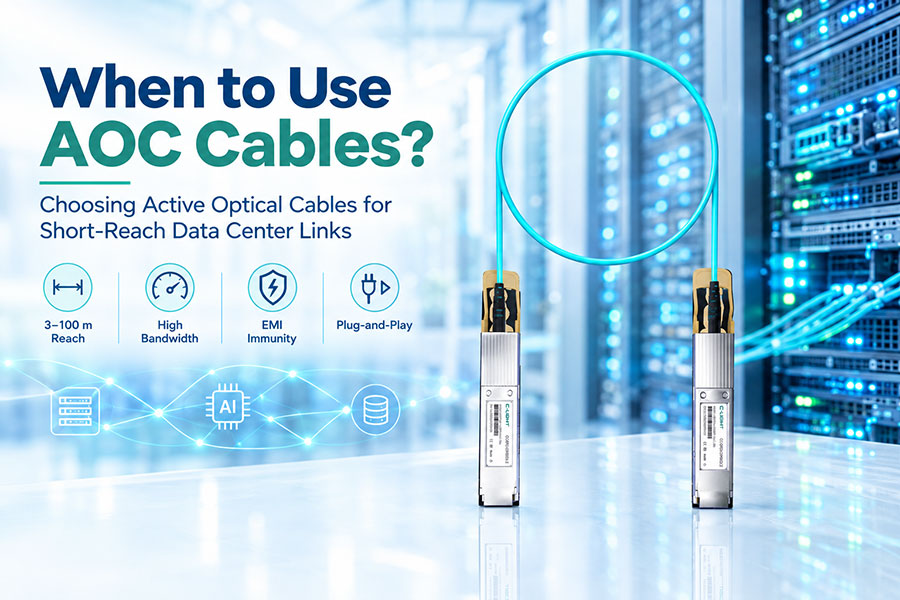
Active Optical Cables (AOC) occupy a critical position in the data center interconnect spectrum. They bridge the gap between copper DAC, which is limited to very short distances, and discrete optical modules, which offer maximum flexibility but at higher cost and complexity. An AOC integrates optical transceivers and fiber into a single factory-terminated assembly, delivering the reach of fiber optics with the plug-and-play simplicity of a copper cable.
For AI data centers, where GPU clusters, leaf-spine fabrics, and storage networks demand reliable high-bandwidth connectivity across distances that copper cannot span, AOC has become the interconnect of choice for the 3–100 meter range. It is lightweight, immune to electromagnetic interference, and eliminates the optical port contamination risks that plague discrete module deployments.
But AOC is not the answer for every link. It costs more than DAC, consumes more power than copper, and offers less flexibility than separate optical modules and patch cords. Understanding when AOC is the right choice—and when DAC, AEC, or discrete optics are better—requires a clear view of the trade-offs across distance, power, cost, and operational requirements.
1. What Is an AOC Cable?
An Active Optical Cable is a factory-terminated assembly that integrates optical transceivers and fiber into a single unit. Each end of the cable contains the essential optical components: a VCSEL (Vertical-Cavity Surface-Emitting Laser) or tuned laser, a driver, a photodiode, and a transimpedance amplifier. Some AOC designs also include a retimer or clock-and-data-recovery (CDR) chip to enhance signal integrity.
The cable itself is multimode fiber, typically OM3 or OM4, permanently spliced to the optical engines at each end. Because the optics are factory-aligned and sealed within the connector housing, an AOC behaves electrically like a standard transceiver but eliminates the need for users to handle or clean optical connectors. There are no LC ferrules to clean, no patch-fiber polarity to get wrong, and no optical port contamination to worry about.
AOC cables are available in all standard form factors—SFP+, SFP28, QSFP+, QSFP28, QSFP56, QSFP-DD, OSFP, and OSFP-XD—and support data rates from 10G through 800G and beyond. C-LIGHT, for example, offers a comprehensive AOC portfolio spanning 10G to 800G, with products compliant with IEEE 802.3 series standards and MSAs including SFF-8431, SFF-8636, and CMIS4.0.
The key distinction between AOC and discrete optical modules is that AOC is a fixed-length, non-detachable solution. The fiber length is determined at the factory and cannot be changed in the field. If a link fails, the entire cable assembly is replaced. This trade-off is acceptable for most data center links, where distances are planned and stable, but it does sacrifice the flexibility of separate module-and-patch-cord deployments.
2. AOC vs. DAC: The Fundamental Trade-Off
The choice between AOC and DAC is the most common interconnect decision in short-reach data center networking. Both support the same Ethernet and InfiniBand speeds and use compatible connector form factors. The differences lie in medium, reach, power, and cost.
| Characteristic | DAC (Copper Twinax) | AOC (Active Optical Cable) |
|---|---|---|
| Medium | Copper twinax | Multimode fiber |
| Typical Reach (25G–100G) | Passive: ≤5–7 m; Active: ≤15 m | 25–100 m |
| Typical Reach (400G/800G) | Passive: ≤3 m; Active: ≤5–7 m | 30–100 m |
| EMI Immunity | Good (shielded twinax) | Excellent (fiber is dielectric) |
| Power Consumption | Passive: ~0 W; Active:<1 w=""> | ~1 W per module (both ends) |
| Latency | Extremely low | Very low, slightly higher than DAC |
| Cable Size & Weight | Thick, heavy, less flexible | Thin, lightweight, flexible |
| Cost per Link | Lowest | Higher |
| Best For | In-rack, adjacent-rack, latency-critical | Cross-rack, high-EMI, cable-dense |
The decision rule is straightforward: use DAC for distances under 3 meters at high speeds (400G+), or under 7 meters at lower speeds (25G–100G), when cost and latency are priorities. Switch to AOC when distance exceeds DAC reach, when cable management is a constraint, or when the environment demands complete EMI immunity.
According to C-Light's estimates, the comprehensive cost of a 400G DAC solution can be 60% lower compared to a 400G AOC solution for very short reaches[reference:1]. This cost differential makes DAC the clear winner for in-rack connections, while AOC becomes economically justified when the link distance exceeds copper's practical reach.
3. When AOC Cables Are the Right Choice
AOC cables are the correct choice in a well-defined set of scenarios. The common thread is a distance that exceeds copper's reach but does not require the full flexibility of discrete optical modules.
3.1 Cross-Rack and Inter-Row Connections
The most common AOC deployment is connecting switches across adjacent racks or within a row. Distances in these scenarios typically range from 3 to 30 meters, which is beyond the reach of passive DAC at high speeds but well within AOC's capability. AOC handles 30–100 m with ease, making it the standard choice for End-of-Row (EoR) and Middle-of-Row (MoR) architectures.
In a leaf-spine fabric, AOC connects leaf switches to spine switches across rows, providing the bandwidth density and reach required for modern AI networks. C-LIGHT's AOC portfolio, spanning 10G to 800G, supports these cross-rack and inter-row connections with reach up to 30 meters and compatibility with over 100 switch brands.
3.2 Environments with High EMI
Optical fiber is inherently immune to electromagnetic interference. In environments where cables run near power distribution units, industrial machinery, or other sources of electrical noise, AOC eliminates the signal corruption risks that can affect copper cables. This makes AOC the preferred choice for links that cross or run parallel to power cabling in data centers.
3.3 Cable-Dense, High-Density Deployments
AOC cables are significantly thinner and lighter than copper DAC cables. A typical AOC has a cable diameter of approximately 3 mm and a minimum bend radius of around 30 mm, compared to the larger bend radius and heavier construction of copper cables. In high-density deployments where cable management and airflow are constrained—such as GPU clusters with hundreds of high-speed links—AOC's smaller form factor reduces cable congestion and improves thermal performance.
For racks like the GB200 NVL72, where dense cabling is a major engineering challenge, AEC and AOC have overwhelming advantages in cable management due to their smaller diameters and greater flexibility.
3.4 Storage Fabrics and HPC Clusters
Storage area networks and high-performance computing clusters require stable multi-lane throughput over distances that may exceed copper's reach. AOC provides the necessary reach with the reliability and signal integrity required for these demanding applications. AOC cables are commonly used for connecting storage arrays to compute nodes and for interconnecting HPC cluster nodes.
3.5 Breakout Applications
AOC breakout cables allow a single high-speed port to be split into multiple lower-speed ports. For example, a 400G QSFP-DD port can break out to four 100G ports, or an 800G OSFP port to two 400G ports. C-LIGHT offers breakout configurations including 100G QSFP28 to 4x25G SFP28 and 400G QSFP-DD to 4xQSFP, facilitating flexible port mapping in high-density environments.
4. When AOC Cables Are Not the Right Choice
AOC's limitations are equally well-defined. Recognizing when AOC is not the right choice prevents over-spending on links that could be served by copper and avoids performance issues in applications that demand maximum flexibility.
4.1 Very Short In-Rack Links
For connections under 3 meters—server-to-switch links within a rack, GPU-to-switch connections in the same cabinet—passive DAC offers the lowest cost, lowest latency, and zero power consumption. According to C-Light's selection strategy, very short distance (<3m)>
4.2 Links Requiring Future Flexibility
AOC is a fixed-length, non-detachable solution. The transmission distance is fixed before shipment, and the entire unit must be replaced if damaged or if the link distance needs to change[reference:8]. When a deployment requires the ability to change fiber lengths, swap modules independently, or upgrade to different optical standards without replacing the entire cable, discrete optical modules with patch cords offer superior flexibility.
4.3 Ultra-Long Reach Beyond 100 Meters
While AOC supports distances up to 100 meters for most data rates, links that exceed this range require discrete optical modules with single-mode or extended-reach multimode fiber. Data center interconnects (DCI) spanning hundreds of meters or kilometers are outside AOC's design scope.
4.4 Cost-Sensitive, High-Volume Deployments
In deployments with hundreds or thousands of short links, the cost premium of AOC over DAC compounds rapidly. When distances permit, DAC remains the most cost-effective solution. AOC becomes economically justified only when copper cannot span the required distance.
5. AOC in the Interconnect Spectrum: DAC, AEC, AOC, and Optics
AOC does not exist in isolation. It is one of four major interconnect technologies, each optimized for a specific range of distances, power budgets, and cost targets. Understanding where AOC fits in this spectrum is essential for making the right selection.
| Characteristic | DAC (Passive) | ACC/AEC (Active Copper) | AOC | Discrete Optics |
|---|---|---|---|---|
| Medium | Copper | Copper | Fiber | Fiber |
| Signal Processing | None | Linear EQ (ACC) / Retimer (AEC) | Optical transceivers | Full DSP |
| Typical Reach (400G) | ≤3 m | 3–7 m (AEC up to 9 m at 800G) | 3–100 m | 100 m–10 km+ |
| Typical Reach (800G) | ≤2 m | 5–7 m | 30–100 m | 500 m–10 km+ |
| Power Consumption | ~0 W | 1–3 W | ~1 W per module | 5–20 W |
| EMI Immunity | Good | Good | Excellent | Excellent |
| Cable Management | Thick, heavy | Moderate | Thin, lightweight | Thin, requires fiber management |
| Flexibility | Fixed assembly | Fixed assembly | Fixed assembly | High (modules + patch cords) |
| Best For | In-rack,<3 m=""> | Adjacent rack, 3–7 m | Cross-rack, 3–100 m | Long reach, flexible deployment |
The interconnect spectrum is organized by distance. DAC dominates the shortest links, where cost and power are paramount. AEC extends copper's reach to adjacent racks, bridging the gap between passive DAC and optical solutions. AOC takes over for cross-rack and inter-row connections, where copper's reach and weight become prohibitive. Discrete optics serve the longest reaches and the most flexible deployments.
C-LIGHT's product portfolio reflects this spectrum: the company offers DAC, AEC, and AOC solutions across 10G to 800G, enabling network designers to select the right technology for each link in the network[reference:9].
6. AOC Reach and Power by Data Rate
AOC performance varies by data rate. As lane rates increase, the optical components must operate at higher speeds, affecting both reach and power consumption. Understanding these parameters is essential for planning deployments.
| Data Rate | Form Factor | Typical Reach | Typical Power | Typical Application |
|---|---|---|---|---|
| 10G | SFP+ | 0.5–30 m | < 1 w per end | Server connectivity, enterprise networking |
| 25G | SFP28 | 0.5–30 m | < 1 w per end | Cloud data centers, 5G fronthaul |
| 50G | SFP56/QSFP+ | 0.5–30 m | < 1.5 w per end | Next-gen server interconnects |
| 100G | QSFP28 | 0.5–30 m | < 2 w per end | ToR to leaf/spine, storage networks |
| 200G | QSFP56/OSFP | 1–30 m | < 3 w per end | High-density data center links |
| 400G | QSFP-DD/OSFP | 1–30 m | < 5 w per end | Hyperscale DC, AI/ML clusters |
| 800G | QSFP-DD/OSFP | 1–30 m (up to 70 m for some designs) | < 10 w per end | AI clusters, spine-leaf backbones |
For 800G AOC, C-LIGHT's CLQD8-QD8AOC delivers full-duplex 800Gbps over 1–30 meters of OM3 multimode fiber using 850nm VCSEL technology. The design achieves ≤3 pJ/bit power efficiency with total power under 10W, and the QSFP-DD form factor is backward compatible with QSFP56 and QSFP28, doubling port density versus traditional QSFP.
At the higher end, 1.6T AOC solutions are emerging to support next-generation AI cluster requirements. These designs leverage 200G per lane technology and are designed for 51.2T and 102.4T switching fabrics, maintaining the ultra-low latency required for GPU-to-GPU communication.
7. AOC in AI Data Centers: Specific Considerations
AI workloads place unique demands on interconnect infrastructure. GPU clusters generate massive east-west traffic, training jobs are sensitive to latency and jitter, and the sheer number of links magnifies the impact of every cable decision.
7.1 GPU Cluster Interconnects
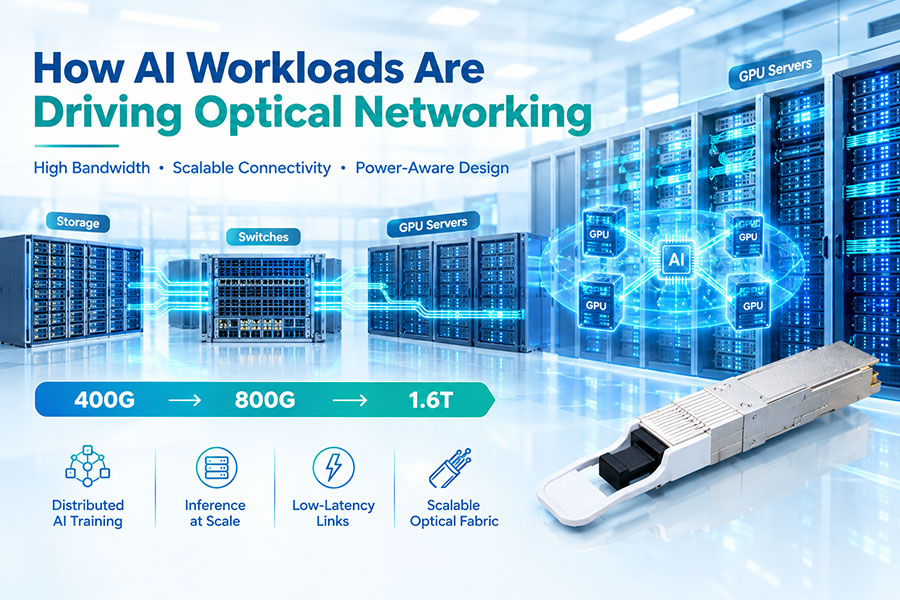
In AI clusters, GPU nodes connect to Top-of-Rack switches, and ToR switches connect to leaf and spine switches. While GPU-to-ToR connections within a rack often use DAC, the cross-rack connections between ToR and leaf switches—typically spanning 3–30 meters—are where AOC becomes essential. AOC's reach, EMI immunity, and cable management advantages make it the standard choice for these links.
C-LIGHT's 800G AOC is designed for AI/GPU cluster interconnect, enabling lossless 800G transmission for thousand-chip LLM training and minimizing communication bottlenecks[reference:12]. The product supports spine-leaf backbone bandwidth of 25.6Tbps between switches for east-west traffic.
7.2 Latency Considerations
AOC introduces some latency due to the electrical-to-optical and optical-to-electrical conversions at each end, as well as any retimer or CDR processing. This latency is small—typically in the nanosecond range—but it is higher than the near-zero latency of passive DAC. For AI training workloads where every nanosecond of collective communication latency matters, DAC remains the preferred choice for in-rack links. AOC's latency is acceptable for cross-rack links, where the distance advantage outweighs the small latency penalty.
7.3 Reliability and Diagnostics
AOC integrates the optical interface into the cable assembly, eliminating the exposed optical ports that can be contaminated in discrete module deployments. This reduces a common source of link failures and simplifies field maintenance. C-LIGHT's 800G AOC achieves MTBF greater than 5 million hours and is Telcordia GR-468-CORE certified for 24/7 operation.
Modern AOC assemblies also support Digital Diagnostic Monitoring (DDM), providing real-time visibility into optical power, temperature, and voltage. This enables proactive monitoring and faster fault isolation compared to copper cables, which offer limited telemetry.
7.4 Thermal Management
AOC's lower power consumption compared to discrete optical modules translates directly to reduced thermal load. The thin, lightweight cable design also improves airflow compared to bulky copper cables, which is important in dense GPU racks where thermal headroom is constrained. C-LIGHT's 800G AOC uses passive cooling with an aluminum housing and airflow optimization suited to hot/cold aisle layouts.
8. Evaluating AOC for a Specific Deployment
Selecting the right interconnect for a given link requires a structured evaluation of requirements against available options.
| Evaluation Factor | What to Confirm |
|---|---|
| Link Distance | Physical cable path length, including service loops and slack |
| Data Rate per Lane | 25G, 50G, 100G, or 200G PAM4; determines optical component selection |
| Connector Form Factor | SFP28, QSFP28, QSFP-DD, OSFP; must match host ports |
| Breakout Requirement | Whether one high-speed port needs to split to multiple lower-speed ports |
| Cable Management Space | Bend radius, tray capacity, airflow path interference |
| EMI Environment | Proximity to power cables, motors, RF sources |
| Latency Budget | Whether O-E-O conversion latency is acceptable |
| Power Budget | Whether active cable power is acceptable at scale |
| Cost per Link | Capital cost and total cost of ownership over deployment lifetime |
A disciplined evaluation compares DAC, AEC, AOC, and discrete optical module options for each link category in the network. In most data center designs, the optimal architecture uses a mix: passive DAC for the shortest in-rack links, AEC for adjacent-rack connections that exceed passive DAC reach, and AOC for everything from cross-rack links to inter-row connections up to 100 meters.
C-LIGHT's selection framework reflects this layered approach: DAC for very short distance and cost-sensitive links, AEC for medium-short distance (3–7m), and AOC for longer fiber links where reach exceeds copper's capability.
9. The Future of AOC in Higher-Speed Networks
As Ethernet advances toward 1.6T and eventually 3.2T, AOC continues to evolve. At 800G, AOC supports reaches up to 30 meters for standard designs and up to 70 meters for optimized designs. At 1.6T, AOC solutions are in development using 200G per lane technology, targeting the short-reach interconnect needs of next-generation AI clusters.
The key challenges for higher-speed AOC are power consumption and thermal management. As lane rates increase, the optical engines must operate faster, consuming more power and generating more heat. Innovations in VCSEL technology, silicon photonics, and low-power DSP architectures are addressing these challenges.
MicroLED-based AOC is one emerging approach that could reduce power consumption by up to 50% for AI cluster cross-rack interconnects. This technology targets 800G and 1.6T speeds for in-rack interconnects under 100 meters.
For the 400G, 800G, and 1.6T generations that dominate current and near-future AI data center deployments, AOC remains the most practical interconnect for the 3–100 meter range. Its combination of reach, signal integrity, cable management advantages, and operational simplicity makes it indispensable for cross-rack and inter-row connectivity. The key is recognizing where AOC's benefits justify its cost premium over copper, and where discrete optics remain necessary for longer reaches or greater flexibility.
10.Conclusion
AOC cables are the right choice for data center interconnects when the required distance exceeds copper's practical reach—typically 3 meters at 400G and above—but does not require the full flexibility of discrete optical modules. They bridge the gap between DAC and optics, delivering fiber-optic reach with plug-and-play simplicity.
The key scenarios for AOC are cross-rack and inter-row connections, high-EMI environments, cable-dense deployments where copper's bulk is a liability, and storage or HPC fabrics requiring stable multi-lane throughput over moderate distances. AOC's advantages in EMI immunity, cable management, and simplified maintenance make it the standard choice for these applications.
When links are short enough for copper, DAC remains the most cost-effective and lowest-power option. When distances exceed 100 meters or maximum flexibility is required, discrete optical modules become necessary. But for the 3–100 meter range that characterizes the majority of cross-rack links in modern AI data centers, AOC delivers the best balance of performance, reliability, and operational simplicity.
 >
>

 >
>
 >
>
 >
>
 >
>
 >
>
 >
>
 >
>