TEL:+86 132 6656 7067




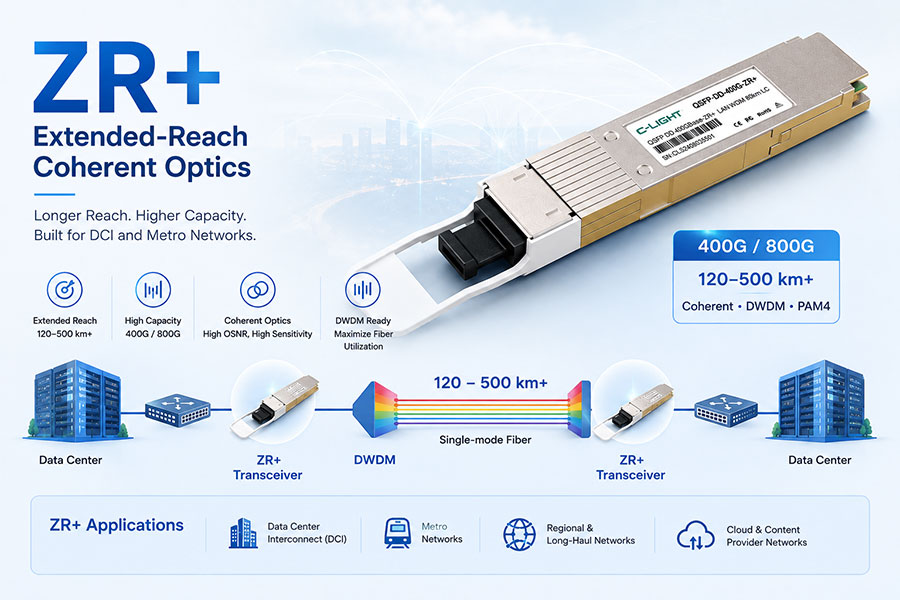
ZR+ is a high-performance coherent optical technology designed to extend high-speed transmission beyond the typical reach of standard ZR solutions. It is mainly used for data center interconnect (DCI), metropolitan networks, regional networks, and other applications that require high bandwidth over longer distances.
Unlike traditional short-reach optical transceivers, ZR+ solutions use coherent optical technology, advanced modulation, and forward error correction (FEC) to achieve long-distance transmission while maintaining a compact pluggable form factor.
C-LIGHT provides DWDM ZR+ coherent optical solutions for 400G and 800G applications, with options covering distances from around 120 km to several hundred kilometers and beyond, depending on the product configuration.
1. What Does ZR+ Mean?
ZR+ generally refers to an extended-reach coherent optical solution based on the concept of ZR, or extended-reach optical transmission.
The term ZR+ does not represent one single fixed optical specification. Different vendors and industry groups may use ZR+ to describe different combinations of modulation, FEC, baud rate, optical performance, and transmission distance.
For example, some 400G ZR+ implementations are designed for approximately 120 km to 500 km or more, depending on the fiber link, amplification, optical budget, and module configuration.
Key Characteristics of ZR+
Coherent transmission: Uses coherent optical technology to improve long-distance transmission performance.
High bandwidth: Supports high-speed services such as 400G and next-generation 800G transmission.
Longer reach: Extends transmission beyond conventional data center optical modules.
Pluggable form factor: Enables coherent technology to be integrated into compact modules such as QSFP-DD and OSFP.
DWDM support: ZR+ modules are commonly used with tunable DWDM wavelengths for efficient fiber utilization.
2. How Does ZR+ Work?
ZR+ optical transceivers use coherent optical technology to transmit high-speed signals over single-mode fiber.
A typical ZR+ module integrates a tunable laser, coherent transmitter and receiver components, digital signal processing (DSP), and advanced FEC into a pluggable optical module.
The transmitter converts electrical data into a coherent optical signal. The signal is then transmitted through a DWDM network, while the receiver uses coherent detection and DSP to recover the original data.
This architecture allows ZR+ to achieve significantly longer transmission distances than many conventional direct-detection optical modules.
3. What Is the Difference Between ZR and ZR+?
ZR and ZR+ are closely related, but they are generally designed for different reach and network requirements.
400G ZR
400ZR is a standardized coherent optical solution developed primarily for high-capacity point-to-point data center interconnect applications. It is optimized for interoperability, power efficiency, and a target reach around the traditional DCI environment.
ZR+
ZR+ extends the concept of 400ZR by supporting additional performance levels and longer distances. Depending on the implementation, ZR+ can support links extending from approximately 120 km to several hundred kilometers.
ZR+ is therefore more suitable when a network requires longer reach or a larger optical margin than a conventional 400ZR solution.
4. ZR vs. ZR+ Comparison
| Feature | ZR | ZR+ |
|---|---|---|
| Technology | Coherent optics | Advanced coherent optics |
| Typical Application | DCI and point-to-point links | DCI, metro, regional and long-distance networks |
| Reach | Typically around 80 km class | Typically 120 km to 500 km+, depending on implementation |
| DWDM | Supported | Widely used |
| Modulation | Typically DP-16QAM | DP-16QAM and other optimized coherent formats |
| FEC | Standard ZR FEC | Enhanced or proprietary FEC options may be available |
| Network Reach | Short-to-medium DCI | Longer DCI, metro and regional transmission |
The exact specifications vary by vendor and product generation. Therefore, ZR+ should always be evaluated based on the actual module specifications rather than the ZR+ name alone.
5. Why Is DWDM Important for ZR+?
DWDM, or Dense Wavelength Division Multiplexing, allows multiple optical wavelengths to share the same fiber.
ZR+ coherent modules are commonly deployed on DWDM networks because a single optical fiber can carry multiple high-capacity wavelengths, improving fiber utilization.
C-LIGHT's DWDM 400G ZR+ products use tunable C-band wavelengths and are designed for high-speed long-distance transmission in DCI and metropolitan network applications.
Typical DWDM ZR+ Architecture
Router → ZR+ Transceiver → DWDM MUX → Optical Fiber → DWDM DEMUX → ZR+ Transceiver → Router
In larger optical networks, amplifiers, ROADMs, dispersion management, and other optical components may also be used depending on the transmission distance and link design.
6. What Is 400G ZR+?
400G ZR+ is one of the most widely discussed ZR+ solutions. It provides a 400Gbps client-side interface combined with coherent optical transmission for extended-reach networking.
400G ZR+ modules can be used for DCI and metro applications where standard 400ZR reach is insufficient.
C-LIGHT provides 400G ZR+ coherent solutions in QSFP-DD form factors, with product options supporting different transmission distances. Its product portfolio currently includes 120 km, 300 km, and approximately 450–500 km-class solutions, depending on the module configuration.
Typical 400G ZR+ Applications
Data Center Interconnect
Metro data center networks
Cloud infrastructure
Telecommunications networks
OTN networks
Regional backbone connectivity
7. What Is 800G ZR+?
As data center bandwidth requirements continue to increase, ZR+ technology is expanding from 400G to 800G.
800G ZR+ uses higher-speed coherent optical transmission to provide greater capacity while maintaining a pluggable module architecture.
C-LIGHT lists 800G ZR+ solutions in OSFP and QSFP-DD form factors, including configurations supporting approximately 120 km, 340 km, and 500 km reach depending on the optical implementation.
800G ZR+ is particularly relevant to next-generation AI data centers, hyperscale networks, high-capacity DCI, and regional optical networks.
8. ZR+ for Data Center Interconnect
Data Center Interconnect is one of the most important applications for ZR+ technology.
Cloud providers and enterprises increasingly operate multiple data centers across a metropolitan or regional area. These facilities need to exchange large volumes of data with high bandwidth and predictable latency.
Traditional short-reach optical modules may not provide sufficient reach, while traditional telecom transport equipment can introduce higher cost and complexity.
ZR+ provides an intermediate solution by bringing coherent optical transmission into compact pluggable modules.
Typical DCI Architecture
Data Center A → Router/Switch → ZR+ → DWDM → Fiber → DWDM → ZR+ → Router/Switch → Data Center B
This architecture can significantly simplify long-distance high-speed interconnect deployment.
9. ZR+ for AI Data Centers
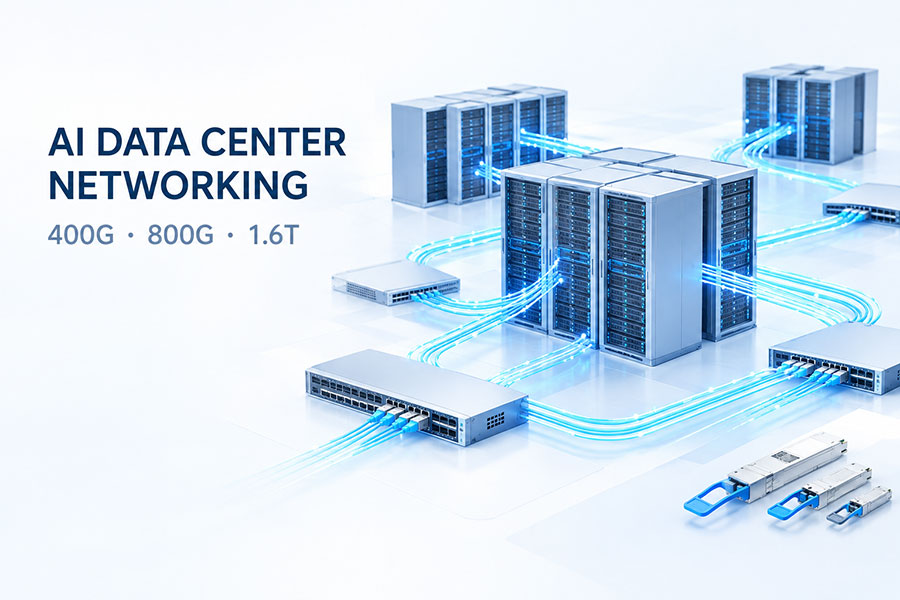
AI workloads are driving rapid growth in data center bandwidth requirements. GPU clusters generate large volumes of east-west traffic during distributed training, model synchronization, and high-speed data movement.
As AI infrastructure expands across multiple facilities, optical networks must provide higher bandwidth and longer reach.
ZR+ can be used as an optical layer between geographically separated data centers, complementing short-distance 400G and 800G DAC, AOC, SR, DR, and FR connections within the data center.
A typical architecture may include:
GPU Server → 800G DAC/AOC → ToR Switch
ToR → 800G/400G Optical → Leaf/Spine
Data Center → 400G ZR+ / 800G ZR+ → DWDM → Remote Data Center
This allows different optical technologies to be selected according to the required distance and network layer.
10. What Are the Advantages of ZR+?
Longer Transmission Distance
ZR+ supports substantially longer distances than conventional data center optical modules and can reach hundreds of kilometers in suitable network configurations.
High Bandwidth
400G and 800G ZR+ solutions provide high-capacity connectivity for modern DCI, cloud, AI, and telecom networks.
Compact Pluggable Design
Coherent technology can be deployed in compact pluggable form factors such as QSFP-DD and OSFP, reducing the dependence on dedicated transport equipment.
Better Fiber Utilization
When combined with DWDM technology, multiple high-speed wavelengths can share a single fiber infrastructure.
Flexible Network Deployment
ZR+ modules can be deployed directly in compatible routers, switches, and optical networking platforms, depending on the host equipment and interoperability requirements.
11. C-LIGHT ZR+ Optical Solutions
C-LIGHT provides a range of coherent ZR+ optical modules designed for high-speed and long-distance optical networks.
400G QSFP-DD ZR+
C-LIGHT's 400G QSFP-DD ZR+ portfolio includes different distance options and tunable C-band configurations. These products are designed for DCI, metro networks, cloud infrastructure, telecommunications, and AI-related optical connectivity.
400G ZR+ High Power
C-LIGHT also provides a high-power 400G ZR+ QSFP-DD solution with up to 0 dBm launch power. The design integrates EDFA and tunable optical filtering functions and supports amplified and unamplified transmission configurations.
800G ZR+
C-LIGHT's 800G ZR+ solutions support high-capacity coherent transmission with different reach options, including approximately 120 km, 340 km, and 500 km configurations depending on the selected implementation.
12. ZR+ vs. Traditional Optical Modules
Conventional SR, DR, FR, and LR modules typically use direct-detection optical technology and are optimized for specific data center transmission distances.
ZR+ uses coherent technology and is designed for significantly longer optical transmission.
| Solution | Typical Application | Technology | Reach Category |
|---|---|---|---|
| 400G SR4/DR4 | Data Center | Direct Detection | Short |
| 400G FR4 | Data Center / DCI | Direct Detection | Medium |
| 400G LR4 | Data Center / Metro | Direct Detection | Longer |
| 400ZR | DCI | Coherent | ~80 km class |
| 400G ZR+ | DCI / Metro / Regional | Coherent | 120 km–500 km+ |
The actual transmission distance depends on the module, fiber loss, optical components, FEC, amplification, and network design.
13. How to Choose the Right ZR+ Module?
Check the Required Distance
Determine whether the link is 80 km, 120 km, 300 km, 500 km, or longer before selecting a module.
Check the Host Interface
Confirm whether the networking platform supports QSFP-DD, OSFP, or another compatible form factor.
Check the Optical Architecture
Determine whether the network uses point-to-point DWDM, amplified DWDM, ROADM, or another optical architecture.
Check the Required Data Rate
400G ZR+ is widely used today, while 800G ZR+ provides a higher-capacity option for next-generation networks.
Check Interoperability
ZR+ products can have different implementations. Always verify MSA compatibility, host support, modulation, FEC, wavelength tuning range, and optical performance before deployment.
14. Conclusion
ZR+ is an extended-reach coherent optical technology designed to bridge the gap between conventional data center optical modules and long-distance optical transport systems.
It is particularly useful for 400G and 800G DCI, metro networks, cloud infrastructure, AI data centers, and regional optical networks where high bandwidth and long transmission distance are required.
For networks that need more reach than standard 400ZR, ZR+ provides a flexible approach using coherent optics, DWDM, advanced FEC, and compact pluggable modules.
C-LIGHT provides 400G and 800G ZR+ optical solutions with different transmission distances and form factors, supporting modern data center, AI, telecom, and DCI applications.
15.ZR+ in Optical Networking Q&A
Q1. What is ZR+?
ZR+ is an extended-reach coherent optical technology designed for high-speed transmission over longer distances than conventional ZR solutions. It is commonly used for DCI, metro, regional, and long-distance optical networks.
Q2. What does ZR+ stand for?
ZR+ generally describes an enhanced or extended-reach implementation of ZR coherent optics. It is not a single fixed optical standard, so its exact specifications depend on the vendor and implementation.
Q3. What is the difference between 400ZR and 400G ZR+?
400ZR is primarily optimized for standardized high-capacity DCI applications, while 400G ZR+ generally extends reach and optical performance for longer-distance applications such as metro and regional networking.
Q4. How far can ZR+ transmit?
ZR+ transmission distance depends on the module design and optical network. Many 400G ZR+ solutions support approximately 120 km to 500 km or more, while specific systems may support longer distances.
Q5. Is ZR+ a DWDM technology?
ZR+ is a coherent optical technology rather than simply a DWDM technology. However, ZR+ modules are commonly deployed over DWDM systems and often use tunable C-band wavelengths.
Q6. What is 400G ZR+ used for?
400G ZR+ is mainly used for data center interconnect, metro networks, cloud infrastructure, telecom networks, and other applications that require 400Gbps transmission over extended distances.
Q7. What is 800G ZR+?
800G ZR+ is a next-generation coherent optical solution that supports 800Gbps-class transmission with extended optical reach. It is designed for high-capacity DCI, AI infrastructure, hyperscale data centers, and advanced optical networks.
Q8. What form factors are available for ZR+?
ZR+ coherent modules are available in pluggable form factors such as QSFP-DD and OSFP, depending on the data rate, optical architecture, and vendor implementation.
Q9. Can ZR+ be used in AI data centers?
Yes. ZR+ is suitable for interconnecting geographically separated AI data centers, especially when high bandwidth is required over distances beyond the reach of standard data center optical modules.
Q10. Does ZR+ require an optical amplifier?
Not always. The requirement for an optical amplifier depends on transmission distance, fiber loss, connector loss, optical margin, and the specific ZR+ module. Some high-power solutions can support longer unamplified or simplified links.
Q11. What is the difference between ZR+ and LR4?
LR4 is typically a direct-detection optical solution designed for relatively long data center links, while ZR+ uses coherent technology and is designed for much longer distances, including DCI and metro applications.
Q12. Does C-LIGHT provide ZR+ optical modules?
Yes. C-LIGHT provides 400G and 800G ZR+ coherent optical solutions, including QSFP-DD and OSFP options with different transmission distances for DCI, metro, AI, cloud, and telecom applications.
Q13. Why is ZR+ important for modern data center networks?
ZR+ enables high-bandwidth optical connectivity over longer distances while using compact pluggable modules. This makes it useful for scaling DCI, cloud infrastructure, AI data centers, and metro optical networks.
 >
>

 >
>
 >
>
 >
>
 >
>
 >
>
 >
>
 >
>