TEL:+86 132 6656 7067




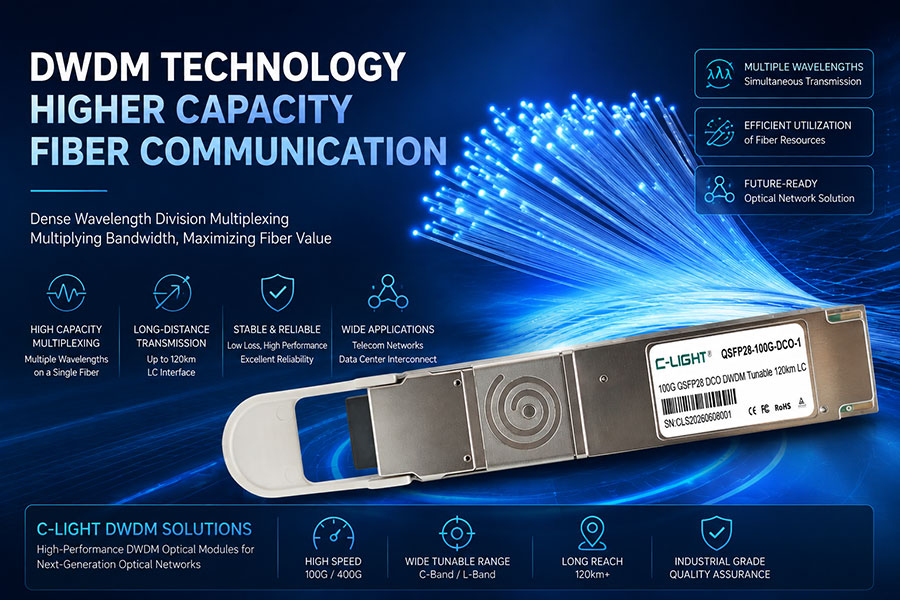
Dense Wavelength Division Multiplexing (DWDM) is a high-capacity optical communication technology that enables multiple optical signals to be transmitted simultaneously over a single fiber by using different wavelengths of light. By combining many closely spaced wavelengths into one fiber, DWDM greatly increases network bandwidth and improves fiber utilization.
DWDM is widely used in telecom backbone networks, data center interconnect (DCI), cloud computing infrastructure, enterprise networks, and long-distance optical transmission systems. It provides a scalable solution for networks that require high bandwidth, low latency, and reliable connectivity.
1. How Does Dense Wavelength Division Multiplexing Work?
The working principle of DWDM is based on wavelength multiplexing technology. Each optical signal is assigned to a specific wavelength channel, and multiple wavelengths are transmitted together through the same optical fiber.
1.1 DWDM Transmission Process
1. Optical Signal Generation: Each data channel uses a laser transmitter operating at a specific DWDM wavelength.
2. Wavelength Multiplexing: A DWDM multiplexer (MUX) combines multiple optical wavelengths into a single fiber.
3. Fiber Transmission: Multiple optical channels travel simultaneously through the same single-mode fiber.
4. Wavelength Separation: A DWDM demultiplexer (DEMUX) separates each wavelength and sends individual signals to the corresponding receivers.
2. Key Advantages of DWDM Technology
2.1 High Network Capacity
The biggest advantage of DWDM is its ability to significantly increase fiber capacity. Instead of using one fiber for one signal, DWDM allows multiple independent channels to share the same fiber infrastructure.
A single DWDM system can support multiple wavelengths, enabling terabit-level transmission capacity for modern communication networks.
2.2 Long-Distance Optical Transmission
DWDM is designed for long-haul optical communication. When combined with optical amplifiers such as EDFA (Erbium-Doped Fiber Amplifier), DWDM systems can transmit data over hundreds or thousands of kilometers.
2.3 Efficient Fiber Resource Utilization
Fiber deployment costs can be high, especially in metropolitan and backbone networks. DWDM helps operators maximize existing fiber resources by carrying multiple services over a single fiber pair.
2.4 Support for Multiple Protocols
DWDM works at the optical layer and is protocol transparent. It can support various communication technologies, including Ethernet, Fibre Channel, OTN, SONET/SDH, and other optical transport protocols.
3. DWDM Wavelength Channels and Technology
DWDM systems typically operate in the C-band (1530nm–1565nm) and L-band regions because optical fiber has low transmission loss and excellent performance in these wavelength ranges.
DWDM follows ITU-T wavelength grid standards, including common channel spacing options such as 100GHz, 50GHz, and narrower spacing technologies. Smaller channel spacing allows more wavelengths to be deployed within the available optical spectrum.
3.1 Common DWDM Components
A complete DWDM system usually includes the following components:
1. DWDM MUX: Combines multiple wavelengths into one optical fiber.
2. DWDM DEMUX: Separates combined wavelengths at the receiving side.
3. DWDM Optical Modules: Convert electrical signals into optical signals using specific wavelengths.
4. Optical Amplifiers: Extend transmission distance by compensating optical loss.
4. DWDM vs CWDM: What Is the Difference?
DWDM and CWDM are both wavelength division multiplexing technologies, but they are designed for different network requirements.
| Feature | DWDM | CWDM |
|---|---|---|
| Channel Spacing | Narrow wavelength spacing (100GHz, 50GHz, etc.) | Wide wavelength spacing (20nm) |
| Number of Channels | Higher channel density | Up to 18 wavelengths |
| Transmission Distance | Long-distance transmission | Short and medium distance |
| Main Applications | Backbone networks, DCI, telecom | Enterprise and access networks |
| Cost | Higher system cost | Lower deployment cost |
5. Main Applications of DWDM
5.1 Telecom Backbone Networks
Telecom operators use DWDM technology to build high-capacity backbone networks supporting internet traffic, mobile communication, and large-scale cloud services.
5.2 Data Center Interconnect (DCI)
Modern data centers generate massive amounts of data traffic. DWDM provides high-bandwidth optical connectivity between geographically distributed data centers while reducing fiber requirements.
5.3 Enterprise Storage Networks
DWDM is commonly used in SAN extension, disaster recovery, and enterprise storage networks where high reliability and long-distance transmission are required.
5.4 AI Data Center Networks
The rapid growth of artificial intelligence workloads has created higher bandwidth requirements between computing facilities. DWDM helps support high-capacity optical connections for AI clusters, cloud platforms, and large-scale data processing systems.
6. C-LIGHT DWDM Optical Solutions
C-LIGHT provides advanced DWDM optical solutions for telecom, data center, and enterprise network applications.
C-LIGHT DWDM solutions include:
1. DWDM MUX/DEMUX modules for wavelength management
2. DWDM optical transceivers for high-speed transmission
3. Custom wavelength solutions for different network architectures
4. High-performance optical connectivity solutions for DCI and backbone networks
With reliable optical design and strict quality testing, C-LIGHT helps customers build scalable, high-capacity, and future-ready optical networks.
7. Frequently Asked Questions About DWDM
Q1: What does DWDM stand for?
Answer: DWDM stands for Dense Wavelength Division Multiplexing. It is an optical technology that combines multiple wavelengths onto a single fiber to increase network capacity.
Q2: How does DWDM increase fiber capacity?
Answer: DWDM assigns different wavelengths to different data channels. Multiple channels can transmit simultaneously through one fiber, significantly increasing total bandwidth.
Q3: What is the difference between DWDM and traditional fiber transmission?
Answer: Traditional fiber transmission usually uses one wavelength per fiber. DWDM allows multiple wavelengths to share the same fiber, improving fiber efficiency and reducing deployment costs.
Q4: Is DWDM suitable for data center interconnect?
Answer: Yes. DWDM is widely used for DCI applications because it provides high bandwidth, long-distance transmission, and reliable optical connectivity between data centers.
Q5: Why is DWDM important for AI infrastructure?
Answer: AI workloads require massive data exchange between servers, GPUs, and distributed computing systems. DWDM helps provide scalable optical bandwidth for next-generation AI networks.
Q6: Should I choose DWDM or CWDM?
Answer: DWDM is recommended for long-distance, high-capacity networks such as telecom backbone and DCI. CWDM is more suitable for shorter-distance applications where cost efficiency is the priority.
 >
>

 >
>
 >
>
 >
>
 >
>
 >
>
 >
>
 >
>